

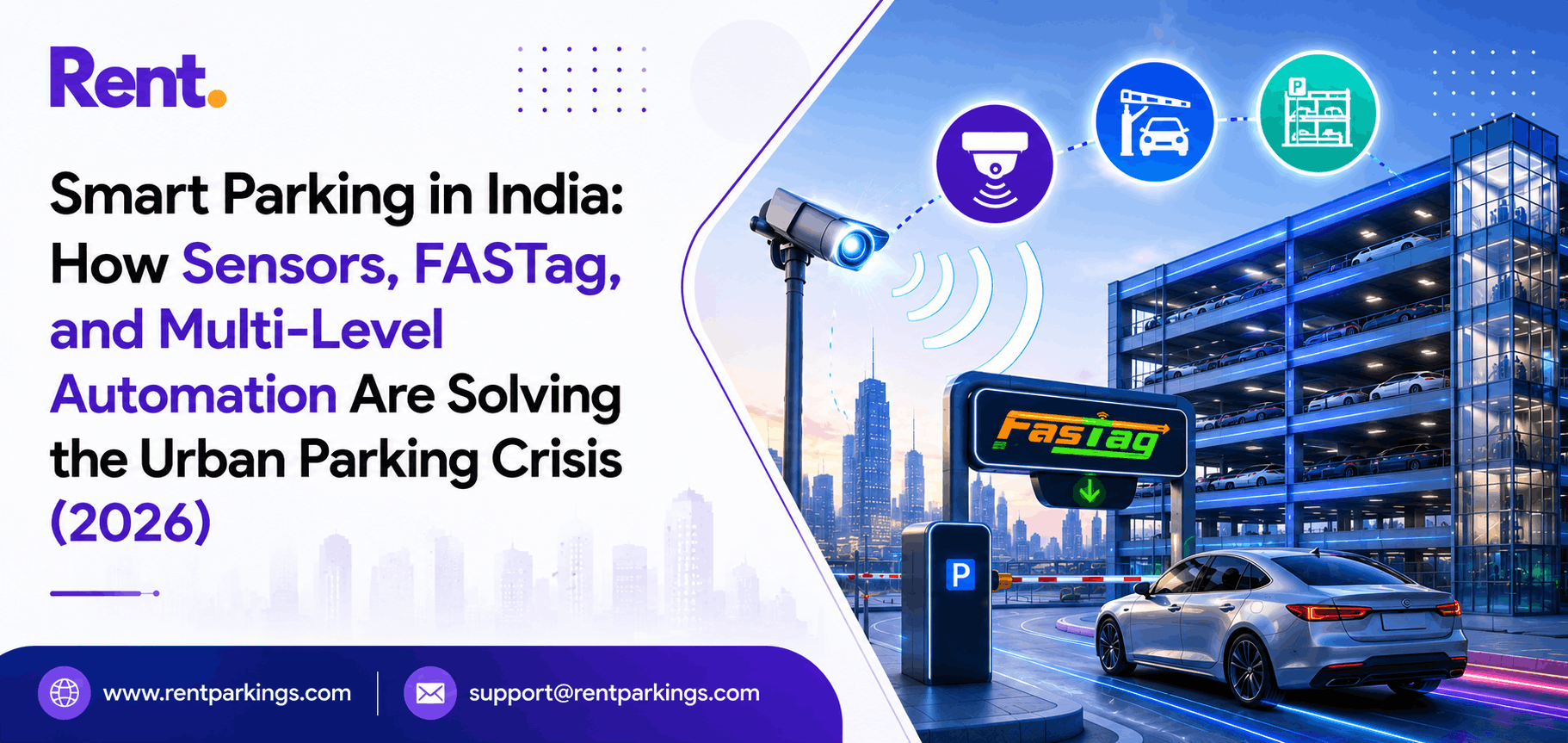
Smart Parking in India: How Sensors, FASTag, and Multi-Level Automation Are Solving the Urban Parking Crisis (2026)
Anyone who has circled the same block in Bengaluru's Indiranagar for fifteen minutes, engine idling, eyes scanning for a gap that never appears, already understands the problem better than any policy paper could explain it. The car is parked roughly 95% of its life. Yet finding somewhere to leave it for that 95% has quietly become one of the most stressful, time-wasting parts of urban Indian life.
India crossed 300 million registered vehicles a few years ago, and the country still adds roughly 25–30 million new vehicles every year. Meanwhile, the streets they need to rest on were largely laid out for a different century — many of our older city cores predate independence and were never designed to absorb this volume of metal. The result is the daily friction every Indian driver knows: double-parked lanes, footpaths swallowed by two-wheelers, society gates jammed with visitor cars, and the slow-burning arguments between neighbours over a strip of kerb.
For most of the last twenty years, the official answer was simply "build more parking." But something more interesting is now happening. Instead of only pouring concrete, Indian cities are starting to make the parking they already have visible, bookable, and intelligent. Sensors are counting empty bays in real time. Cameras read your number plate and lift the barrier without a ticket. FASTag — the same sticker on your windscreen that pays highway tolls — is starting to pay for parking too. And in dense commercial pockets where land is impossibly expensive, automated towers are stacking cars vertically like books on a shelf.
This is smart parking, and 2026 is the year it stopped being a pilot-project novelty and started becoming infrastructure. This guide explains what it actually is, the technology behind it, where it is already live across Indian cities, the policy shifts driving it, and — most importantly — what it means for you as a vehicle owner, a housing-society resident, or simply someone tired of circling the block.
India's Parking Math No Longer Adds Up
Before the solution, it helps to sit with the scale of the problem, because it explains why "just build more" was always going to fail.
Consider the vehicle load in a few major cities, drawn from registration data: Delhi has had close to 12 million registered motor vehicles, Bengaluru around 9.6 million, Chennai over 6 million, Ahmedabad and Mumbai several million each, with Hyderabad, Pune, Jaipur and Kochi all carrying their own swelling fleets. Now layer on a brutal land truth that the Centre for Science and Environment (CSE) has documented: in several Indian cities — including Pune, Surat, Nagpur, Patna and Kochi — more than 40% of the road network is already occupied by on-street parking. Across the country, roughly 14% of total road length is given over to parked vehicles.
In other words, a huge slice of the most valuable real estate in any Indian city — the road itself — is being used as free or near-free vehicle storage. CSE makes the uncomfortable point bluntly: cheap, unmanaged parking is effectively a hidden subsidy to car owners, paid for by everyone else in lost road space, congestion and clean air. A single structured multi-level car park can cost crores to build, and parking fees almost never recover that cost, so the subsidy compounds with every new concrete deck.
This is why smart parking matters beyond convenience. The goal is not just to help you find a slot faster. It is to make every existing slot work harder, to price kerb space so it stops being abused, and to give cities the data they have never had: how many spaces exist, where, how full they are, and what they are actually worth.
What "Smart Parking" Actually Means
Smart parking in India uses IoT sensors, ANPR cameras, mobile apps and digital payments like FASTag to show drivers real-time available spaces, automate entry and billing, and help cities manage kerb space efficiently. It is being deployed under the Smart Cities Mission across cities such as Chandigarh, Chennai, Bengaluru, Hyderabad and Pune.
That is the one-line version. In practice, "smart parking" is not a single product but a stack of technologies that can be mixed and matched. A small residential society might use just one layer; a large airport or mall might use all of them together. The four building blocks are worth understanding individually, because you will increasingly meet them in daily life.
Sensor-based detection
Small ground or overhead sensors detect whether a specific bay is occupied or free and push that status to a central system in real time. In a multi-level garage, this is what powers those red-and-green lights above each slot, and the digital boards at every floor entrance announcing "Level 3: 12 spaces free." On-street, magnetometer or camera-based sensors can do the same for kerbside bays, feeding a city dashboard and a public app.
ANPR camera entry and exit
Automatic Number Plate Recognition (ANPR) cameras read your registration plate as you approach. The barrier lifts without a paper ticket, your entry time is logged against the plate, and on exit the same camera calculates your fee automatically. This is what removes the maddening queue at the exit boom barrier where everyone fumbles for change.
App and guidance systems
Driver-facing apps and dynamic signage take all that sensor and camera data and turn it into directions: where the nearest free parking is, how many slots remain, what it costs, and — increasingly — the ability to reserve and pre-pay before you arrive. This is the layer that ends the circling.
Automated and multi-level structures
At the heavy end sit automated multi-level systems — puzzle parking, stack parking, and fully robotic parking towers — where the car is mechanically lifted, shuffled and stored, often with no human driver entering the structure at all. These pack two to several times more cars into the same footprint, which is the only way to add capacity in land-starved business districts.
The Technology Stack Reshaping Indian Parking
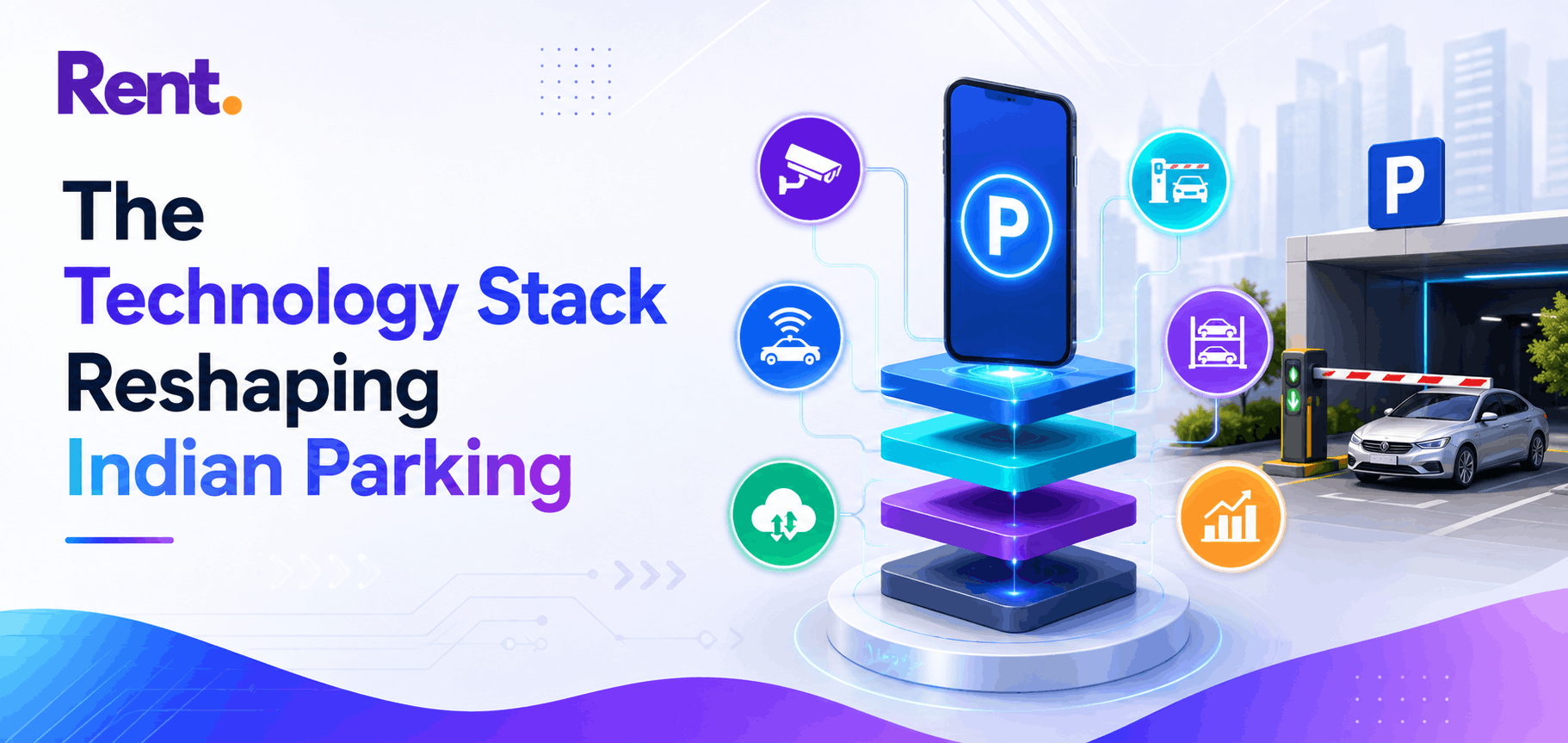
IoT sensors and real-time availability
The quiet workhorse of smart parking is the humble occupancy sensor. Each one does only one job — "is this bay empty or not?" — but networked across a garage or a street, thousands of them create a live map of a city's parking. That map is what makes everything downstream possible: the app that guides you, the analytics that tell a municipal corporation which streets are chronically over-demanded, and the dynamic pricing that can nudge demand toward quieter blocks. India's parking systems market, valued in the region of US$700 million in 2025, is expanding precisely because this sensor layer is finally affordable enough to deploy at scale.
ANPR and barrier-free entry
If you have driven into a newer mall or tech park in Bengaluru, Hyderabad or Gurugram recently, you may have noticed the boom barrier rising before you reached for a ticket. That is ANPR at work. Beyond convenience, plate-reading has a security dividend that matters in Indian commercial complexes: every vehicle's entry and exit is time-stamped against its number, creating an audit trail that paper tickets never could. Operators like the large pan-India parking managers now run ANPR and app-based access across hundreds of thousands of bays in dozens of cities.
FASTag: India's quiet parking payment revolution
This is the most distinctly Indian piece of the puzzle. FASTag began as a highway-toll sticker, but the National Payments Corporation of India (NPCI) has been extending it into an interoperable parking-payment rail. The vision is simple and powerful: the same tag that pays your toll on the expressway pays for parking at the mall, the airport, and eventually the municipal lot — contactless, cashless, no app download, no cash, no queue. It is already live for parking at select airports, malls and lots in cities including Delhi, Mumbai, Chennai and Chandigarh, with interoperability widening.
The reason FASTag could leapfrog standalone parking apps is adoption: tens of millions of Indian vehicles already carry a tag. There is no behaviour to teach and no new app to install. For a country where parking payment has historically meant a wad of ten-rupee notes and a handwritten chit, that is a genuinely transformational shortcut.
Multi-level and automated parking
Where land is the binding constraint — South Mumbai, Connaught Place in Delhi, T. Nagar in Chennai, central Pune — the answer is to go vertical or underground with automation. Puzzle and stacker systems use moving platforms to store cars in a grid with minimal aisle space. Fully automated tower parking takes a car at a ground-level cabin and a machine does the rest, often doubling to quadrupling capacity on the same plot. These systems are increasingly common in new commercial real estate and in retrofit projects by municipal corporations trying to claw back road space from on-street parking. They are capital-intensive, which is exactly why they need the pricing and policy reforms discussed below to be financially viable.
City by City: Where Smart Parking Is Already Live
The most convincing evidence that this is real and not a brochure fantasy is that specific Indian cities are already running it.
Chandigarh offers one of the cleanest 2026 examples. In January 2026 the Chandigarh Municipal Corporation launched MC One Pass, a single monthly digital parking pass valid across all civic-managed parking sites in the city — surface lots and multi-level structures alike — under one unified smart system. For a daily commuter, that replaces a patchwork of separate payments with one digital pass: a small change that signals a big shift in how a city thinks about its parking as a single network rather than scattered islands.
Chennai is rolling out a revamped smart-parking system in 2026 built around digital discovery, seamless payment and real-time monitoring, explicitly aimed at reducing the illegal and disorderly parking that chokes neighbourhoods like T. Nagar and helping the traffic police see kerb occupancy live.
Bengaluru, Hyderabad and Pune anchor much of the private smart-parking deployment — ANPR-gated tech parks, app-managed mall garages, and FASTag-enabled commercial lots — driven as much by IT-corridor real estate as by municipal policy. National parking operators report managing hundreds of thousands of bays spread across Mumbai, Delhi NCR, Bengaluru, Hyderabad, Chennai, Pune and Ahmedabad, most of it now digitised in some form.
Delhi NCR and Mumbai, with the country's heaviest vehicle loads, are where FASTag parking, automated multi-level structures and paid on-street zones are being pushed hardest, because the alternative — gridlock — is no longer politically survivable.
Tier-2 and Tier-3 cities are not bystanders. The Smart Cities Mission deliberately spread funding well beyond the metros, so cities like Indore, Bhopal, Coimbatore, Visakhapatnam, Surat and Kochi have piloted sensor-based and app-based parking as part of their integrated command-and-control centres. The trajectory is clear: smart parking is following the same path mobile payments did, starting in the metros and rippling outward faster than anyone expected.
The Policy Engine Behind the Technology
Technology alone never fixed Indian parking; policy has to change with it. Three policy shifts are doing the real heavy lifting.
The Smart Cities Mission
The Smart Cities Mission has been the single biggest catalyst, channelling large-scale investment — on the order of US$1.5 billion toward urban-mobility projects — into more than a hundred cities, with smart parking a recurring component of their Integrated Command and Control Centres. The Mission's genius was bundling parking sensors and dashboards into a broader civic-data platform, so a city that installed cameras for traffic could extend the same backbone to parking with marginal extra cost.
Maharashtra's Proof of Parking idea
Perhaps the most consequential recent move came in April 2025, when Maharashtra circulated a Proof of Parking policy — a discussion framework around requiring buyers to demonstrate they have a parking space before a vehicle can be registered. It echoes systems used in other dense Asian cities and, if adopted widely, would strike at the root cause of street chaos: vehicles bought with nowhere of their own to keep them. Whatever its final shape, it marks a philosophical turn — from treating parking as a free public entitlement to treating it as a private responsibility that must be arranged before purchase.
The end of "free" parking
Underpinning all of it is the pricing argument that CSE and the Union urban-development guidelines have pushed for years: on-street parking should be priced to reflect the value of the land it occupies, both to discourage needless car trips and to raise revenue cities can reinvest locally. Smart parking is what makes this finally enforceable. You cannot meaningfully charge variable, demand-based prices for thousands of kerbside bays with a man and a register; you can with sensors, ANPR and digital payment. In that sense the technology is not just a convenience — it is the enabling tool for a long-overdue economic correction.
How Indian Commuter Behaviour Is Changing
Infrastructure shifts only matter if people change how they move, and the early behavioural signals are real.
Drivers in well-served pockets are beginning to check before they drive, treating a parking app the way they treat a cab app — confirming availability and price before turning the key, rather than gambling on a spot. Pre-booking, once unheard of for daily parking, is becoming normal for airport runs and big-event days. Cashless habits built by UPI and FASTag have removed the friction that made paid parking feel like a hassle, so paying ₹40 by tag now feels easier than hunting for change.
There is also a subtler shift in the calculus of car use itself. When parking is invisible and free, every trip by car feels rational. When parking is visible, priced and sometimes scarce, people start making trade-offs — taking the metro for the office commute and keeping the car for the weekend, or choosing the mall with reliable smart parking over the one with a chaotic lot. Smart parking, in other words, is quietly becoming a nudge toward more deliberate mobility, which is exactly what congested Indian cities need.
Where EVs Fit Into the Smart-Parking Picture
The rise of smart parking is colliding, productively, with India's electric-vehicle push, and the two reinforce each other. An EV does not just need a parking bay; it needs a bay with power. That makes the parking slot the natural home for charging infrastructure, and smart-parking systems are increasingly being designed with charging baked in — sensors that show not just "free bay" but "free bay with a working charger," apps that let you reserve a charging slot, and billing systems that meter electricity alongside parking time on the same FASTag or app payment.
For residents of apartment complexes, this convergence is where the future gets practical: the same digitised society parking that allocates your bay can, in principle, manage a shared charging queue fairly, log usage, and split costs — turning what is today a source of neighbour friction into a managed amenity. As EV penetration deepens across Indian cities through the late 2020s, the parking layer and the charging layer will increasingly be one system, not two.
What Still Stands in the Way
It would be dishonest to present this as a solved problem. Several real obstacles remain.
The first is fragmentation. A city might have a brilliant municipal app, a mall running its own ANPR system, an airport on FASTag, and a housing society using a third platform — none of which talk to each other. The promise of smart parking is a single seamless experience; the reality, for now, is a patchwork. Interoperability efforts like NPCI's FASTag rail are the antidote, but they are still maturing.
The second is enforcement and behaviour. Sensors can tell a city that a no-parking zone is full of cars, but someone still has to act on it, and India's history of lax parking enforcement does not vanish because a dashboard lights up red. Technology surfaces the problem; political will has to close it.
The third is cost and equity. Automated multi-level structures are expensive, and if smart parking simply becomes a premium amenity for malls and gated tech parks while ordinary neighbourhoods stay chaotic, the divide widens. The policy answer — pricing on-street parking and reinvesting the revenue locally — is essential to making the benefits broad rather than exclusive.
The fourth is data and trust. Plate-reading cameras and movement logs raise legitimate questions about how that data is stored and used. Sensible data-governance norms will need to keep pace with deployment.
None of these is a reason to dismiss the shift. They are the ordinary growing pains of any infrastructure transition, and the direction of travel is unmistakable.
What This Means for You: Practical Takeaways
For the everyday vehicle owner, society resident or city dweller, here is how to actually use this shift rather than just read about it.
If you own a car or two-wheeler: keep your FASTag active and topped up — it is becoming your parking wallet, not just a toll tag. Get into the habit of checking a parking app for unfamiliar destinations the way you check for traffic; pre-booking a slot for an airport trip or a big event can save you the most stressful part of the journey. And when you buy your next vehicle, factor in where it will sleep as seriously as the EMI, because proof-of-parking thinking is coming.
If you live in an apartment complex: push your RWA or management committee to digitise parking allocation and visitor parking before EV charging forces the issue. A simple app-based system for resident bays, visitor logging and a fair charging queue prevents the disputes that otherwise consume society WhatsApp groups. Smart parking at the society scale is mostly a management decision, not a megaproject.
If you are a developer or commercial property owner: ANPR entry, app-based discovery and FASTag payment are quickly becoming table stakes, not differentiators. Building automation and charging-ready bays into new projects now is far cheaper than retrofitting later.
If you are simply a citizen: support paid, priced on-street parking in your area, counter-intuitive as that sounds. Free kerb parking is not actually free — you pay for it in congestion, lost footpaths and dirtier air. Priced, managed parking is what funds the local improvements everyone wants.
Conclusion
India's parking story is quietly turning a corner. For decades the only idea was to pour more concrete, and the only experience was circling, idling and arguing. Now sensors are making empty bays visible, cameras are erasing the ticket queue, FASTag is turning a toll sticker into a parking wallet, and automated towers are stacking cars where there was never room before — all stitched together by the Smart Cities Mission and a new willingness to treat parking as priced, managed infrastructure rather than a free-for-all.
It will not happen evenly, and it will not happen overnight. Fragmentation, enforcement, cost and data questions are all real. But the trajectory is set, and it mirrors how digital payments swept India faster than anyone predicted: starting in the metros, proving the value, and then spreading outward until the new way simply becomes the normal way. The smartest move for any Indian vehicle owner is not to wait for the future of parking to arrive, but to start adopting its tools — the active FASTag, the parking app, the digitised society system — today. The block you keep circling may not be circled for very much longer.
FAQs
What is smart parking in India?
Smart parking in India is a system that uses IoT sensors, ANPR cameras, mobile apps and digital payments such as FASTag to show drivers real-time available parking, automate entry and exit, and let cities manage and price kerb space efficiently. It is being rolled out under the Smart Cities Mission in cities including Chandigarh, Chennai, Bengaluru, Hyderabad and Pune.
Can I use FASTag to pay for parking?
Yes. The same FASTag on your windscreen that pays highway tolls can pay for parking at select airports, malls and lots in cities like Delhi, Mumbai, Chennai and Chandigarh. NPCI is widening interoperability so a single tag works across more parking locations contactlessly, without cash or a separate app.
Which Indian cities have smart parking systems?
Chandigarh (the MC One Pass launched in January 2026), Chennai (a 2026 smart-parking rollout), and Bengaluru, Hyderabad, Pune, Delhi NCR, Mumbai and Ahmedabad all have significant smart-parking deployments. Many Tier-2 cities such as Indore, Coimbatore and Kochi have piloted it through the Smart Cities Mission.
How do sensor-based parking systems work?
Small sensors in each bay detect whether it is occupied or free and send that status to a central system in real time. That data powers the green-and-red slot lights in garages, the "spaces free" boards at entrances, and the apps that guide drivers straight to an open bay instead of circling.
What is ANPR parking?
ANPR (Automatic Number Plate Recognition) parking uses cameras to read your vehicle's number plate at entry and exit. The barrier lifts without a paper ticket, your time is logged against your plate, and the fee is calculated automatically — removing queues and creating a secure record of every vehicle.
Is multi-level automated parking common in India?
It is growing fast, especially in land-scarce commercial districts of Mumbai, Delhi, Chennai and Pune. Puzzle, stacker and robotic tower systems store cars mechanically and can hold two to several times more vehicles on the same plot than a conventional lot, which is why municipal bodies and developers increasingly use them.
What is the Maharashtra Proof of Parking policy?
In April 2025 Maharashtra circulated a Proof of Parking policy framework that proposes requiring vehicle buyers to demonstrate they have a parking space before the vehicle can be registered. The aim is to stop new vehicles being bought with nowhere of their own to park, which is a major cause of street congestion.
Why is free on-street parking considered a problem in India?
Research by the Centre for Science and Environment shows that in cities like Pune, Nagpur and Kochi, over 40% of road length is taken up by parking, and free kerb parking acts as a hidden subsidy to car owners. Pricing and managing parking frees up road space, cuts congestion and raises revenue cities can reinvest.
How does smart parking connect with EV charging?
Smart-parking systems are increasingly designed with EV charging built in — apps that show bays with working chargers, the ability to reserve a charging slot, and billing that meters electricity alongside parking time. In apartment complexes, a digitised parking system can fairly manage a shared charging queue.
How can I benefit from smart parking as a regular vehicle owner?
Keep your FASTag active and funded since it is becoming a parking wallet, use parking apps to check and pre-book slots before you drive (especially for airports and events), and push your housing society to digitise resident and visitor parking. When buying a vehicle, plan where it will be parked, since proof-of-parking norms are emerging.
Share This post
Search
Recent Post
Parking Space vs. Renting Out a Room to...
05 Oct, 2026
Think Parking Rental Only Pays in Mumbai...
02 Oct, 2026
Your Mumbai Parking Space Is Worth More...
01 Oct, 2026
Hyderabad's Real Estate Boom Left One As...
30 Sep, 2026
What Your Parking Space in Chennai Could...
29 Sep, 2026
Your Plans Changed After Listing Your Pa...
28 Sep, 2026
Parking Space vs SIP: Which Idle Asset A...
25 Sep, 2026
What Your Parking Space in Pune Could Ac...
24 Sep, 2026