

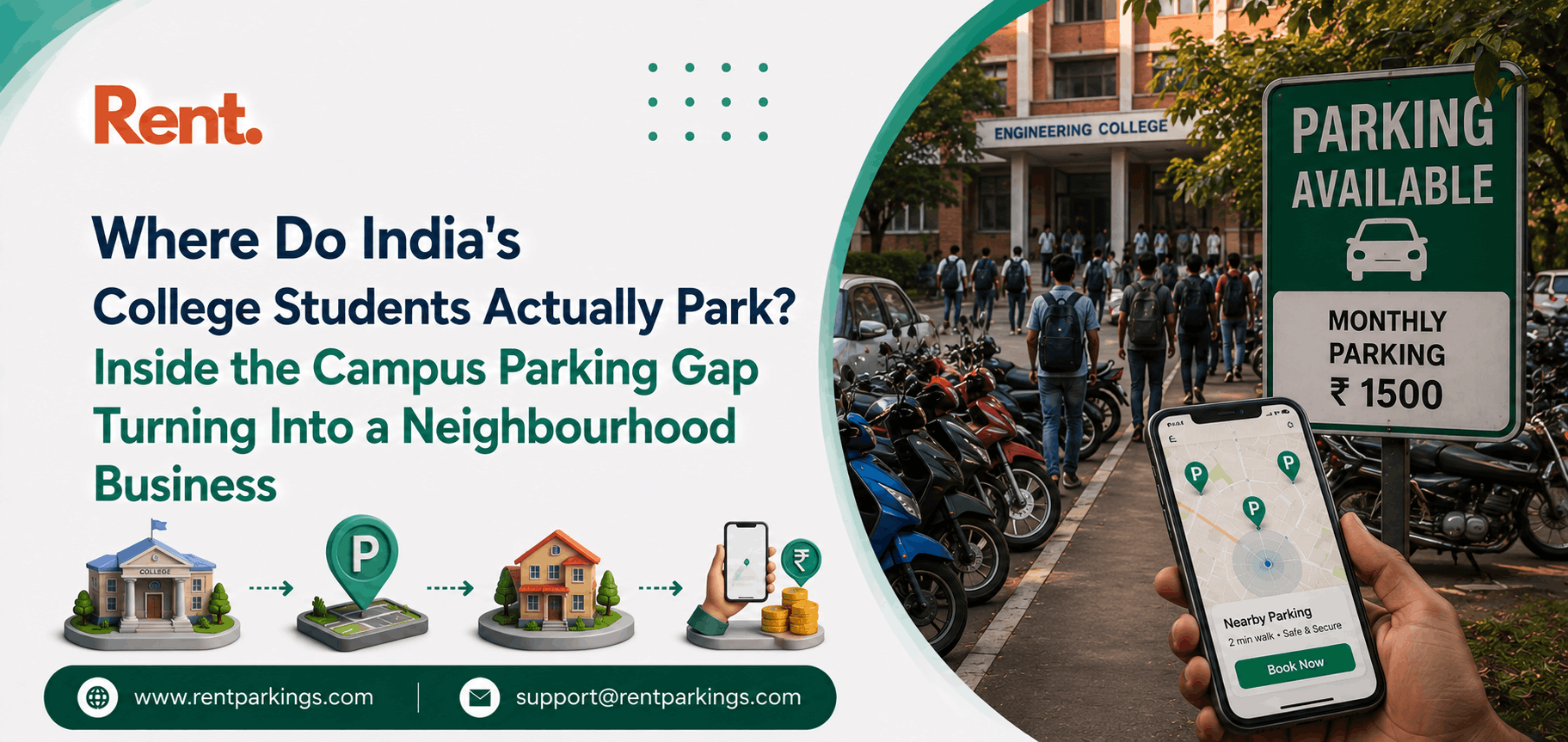
Where Do India's College Students Actually Park? Inside the Campus Parking Gap Turning Into a Neighbourhood Business
Walk down FC Road in Pune around 9:40 on a weekday morning, and you will see it before you hear it: a wall of scooters parked three deep against the compound fence of Fergusson College, spilling onto the footpath, then onto the road itself.
The same scene repeats outside Delhi University's North Campus, along the lanes near Anna University in Chennai, and around the engineering colleges lining Hyderabad's Kukatpally stretch. Lecture halls have grown. Hostel intake has grown. The parking lot, more often than not, has stayed exactly the size it was in 1998.
This isn't a story about traffic jams, though there are plenty of those. It's about what happens when a fixed piece of land, a college campus, tries to absorb a student population that keeps expanding every admission cycle. And it's about the quieter shift happening one street over, where homeowners and PG operators near these campuses have started renting out driveways and empty plots to solve a problem the institution itself never got around to fixing.
At RentParkings, we've watched this pattern surface again and again in listings near college towns and university belts. It's worth understanding properly, both for students hunting for a place to leave their scooter and for owners sitting on space they haven't thought to monetise.
Why Every Big Indian Campus Has the Same Problem
Most established Indian colleges were designed decades before two-wheeler ownership among students became the norm it is today. A campus built for a few hundred day scholars commuting by bus or cycle simply wasn't drawn up with covered parking for thousands of bikes and a growing number of cars.
Add to that the newer private colleges and university satellite campuses built on tight urban plots, where land cost pushed parking down the priority list in favour of classrooms and labs. Planning approvals in many cities still don't enforce parking ratios strictly for educational institutions the way they do for commercial buildings.
The result is predictable. Students park wherever there's a gap: on the main road, along residential lanes, inside the compounds of nearby shops that tolerate it until they don't. Traffic police in college-heavy zones of Bengaluru, Coimbatore, and Lucknow have all run periodic drives against this kind of encroachment, usually with limited long-term effect, because the underlying shortage never actually goes away.
Who Feels the Squeeze Most
Three groups absorb most of the pain.
- First-year students who don't yet know the informal rules of where it's "safe" to leave a scooter without a challan or a theft risk.
- Hostel residents whose institution allows vehicles but never expanded parking to match rising hostel capacity.
- Faculty and non-teaching staff, who often lose out to student volume despite technically having reserved slots.
Parents in cities like Madurai and Kochi, sending a child to college in a bigger metro for the first time, frequently mention parking safety as an underrated worry, right up there with hostel food and hygiene. A stolen or vandalised two-wheeler near campus is not a rare story; it's one every college WhatsApp group seems to have at least once a semester.
The Business Quietly Growing Around Campus Gates
Here's the part that doesn't get written about much. Within a few hundred metres of almost every major Indian college, there are homeowners and PG landlords who already have surplus driveway or open plot space, space that was never really "used" beyond parking a single family car.
Some of them have started renting that space out, sometimes to a handful of students on a monthly basis, sometimes through PG packages that quietly bundle in a guaranteed parking slot as a differentiator. It's not a formal industry yet. It's closer to word-of-mouth arrangements between a landlord and a batch of students who trust each other because they live in the same building.
What's changing is that this arrangement is starting to move online. Property owners near university belts are listing spare parking on platforms instead of relying on a notice board or a PG WhatsApp group, which widens the pool of students who can find them and removes a lot of the awkward, unverified back-and-forth that used to come with informal deals.
What Owners Near Campuses Can Realistically Earn
Rates vary a fair bit by city, by how close the spot sits to the campus gate, and by whether it's covered or open. Based on what owners in college towns have reported, here's a rough sense of monthly two-wheeler parking rates near major campuses.
- Pune (near FC Road, Kothrud colleges): roughly ₹400 to ₹800 per scooter per month
- Delhi NCR (North Campus, Noida colleges): roughly ₹500 to ₹1,000
- Bengaluru (colleges near Jayanagar, Whitefield tech institutes): roughly ₹600 to ₹1,200
- Chennai (Anna University belt, Adyar): roughly ₹400 to ₹900
- Lucknow and Coimbatore: roughly ₹300 to ₹600
Car parking, where a hostel student's family car needs a spot during visits or where a faculty member wants a monthly arrangement, tends to run two to three times higher. Owners with two or three spare slots often stack several students together, which adds up to a steady, low-effort monthly figure without needing any construction or renovation. For a broader sense of how these numbers stack up city to city outside the campus context, our city-by-city look at parking rental rates across India is a useful companion read.
Scooters Are the Majority. Parking Design Still Ignores That.
It's tempting to think of "parking" as a car problem first. On a college campus, that's backwards. The overwhelming majority of daily vehicle traffic around an Indian college is scooters and motorcycles, not cars, and most of the country's parking infrastructure, both institutional and informal, still leans toward car-shaped thinking.
India now has an enormous and growing two-wheeler population, and students are a huge slice of first-time riders and owners. We went deep into why the country keeps building for cars while ignoring this shift in our piece on how India's two-wheeler numbers have outgrown the parking built for them, and campuses are one of the clearest places you can see that mismatch play out daily.
Why Parking on the Street Outside Campus Isn't a Real Solution
A lot of students default to the road because it's free and it's right there. It rarely stays a good option for long. Municipal towing drives, encroachment fines, and simple theft risk all make roadside parking near a college gate a gamble rather than a plan.
There's also a legal dimension students often don't think about: the road outside a house or shop isn't anyone's private property to guarantee, which means there's no real recourse if a spot gets blocked, ticketed, or towed. We unpacked this exact confusion, and what actually is and isn't allowed, in our explainer on whether you can really reserve street parking outside a house in India. The short version: don't build a routine around a spot nobody actually controls.
Budget Matters More for Students Than for Almost Any Other Renter
Students are, by definition, working with tighter monthly budgets than most other parking renters. A ₹500 monthly slot sounds small until you multiply it across a hostel batch, and price sensitivity shapes almost every decision a student makes about where to park.
This is exactly why monthly, subscription-style parking arrangements tend to work better near campuses than daily or hourly rates. If you're weighing what a fair monthly rate looks like anywhere in the country, our guide to finding budget-friendly monthly parking breaks down what to expect and what to negotiate.
What Owners Should Know Before Renting to Students
Renting parking space to students isn't fundamentally different from renting to any other tenant, but a few things are worth doing properly from day one.
- Ask for a copy of the student's college ID and a local guardian or parent contact, especially for a first-year renter.
- Put the monthly rate, notice period, and vehicle details in writing, even if it's just a simple message thread, rather than a purely verbal deal.
- Decide upfront whether you're offering a covered or open spot, since covered slots near colleges consistently command a premium.
- Clarify what happens during college breaks and semester gaps, when demand and payment reliability can dip.
Owners who treat this as a proper, if small, rental relationship tend to have far fewer disputes than those who keep it entirely informal. If you want the fuller legal and safety picture before you start, our guide on renting out your parking space in India, covering the legal, tax, and safety basics, is worth fifteen minutes before you list your first spot.
Why This Gap Isn't Closing on Its Own
New college campuses keep opening. Existing ones keep adding seats faster than they add parking bays. Municipal parking policy for educational institutions hasn't caught up in most Indian cities, and it's unlikely to catch up quickly given how many competing infrastructure priorities local bodies are juggling.
That gap is precisely why the informal, owner-to-student rental model around campuses keeps growing rather than shrinking. It isn't a temporary workaround. For a lot of families near college towns, it has quietly become part of how they use a piece of property that would otherwise sit idle for most of the day.
Frequently Asked Questions
Why don't Indian colleges just build more parking?
Most established campuses are already built out, and adding parking means giving up land currently used for classrooms, labs, or green space. Newer private colleges on tighter urban plots face the same trade-off, and municipal norms in many cities don't strictly mandate parking ratios for educational institutions the way they do for offices or malls.
Is it legal for a homeowner to rent out a driveway to students for parking?
Yes, renting out unused parking space on your own property is generally allowed, provided your housing society or local rules don't specifically restrict it. It's sensible to check your society's bylaws if you live in an apartment complex, since some societies have specific clauses about third-party use of allotted parking.
How much can I earn renting parking near a college campus?
Reported monthly rates for a single two-wheeler spot near major campuses generally range from around ₹300 to ₹1,200 depending on the city and proximity to the gate, with car spots running higher. Owners with multiple spare slots can build this into a steady secondary income without any major upfront investment.
Should I ask for a security deposit from student renters?
A modest deposit, roughly equal to one month's rent, is a reasonable and common practice, and it gives both sides a bit of protection if a vehicle is left behind unpaid or a spot needs unexpected repair. It's worth agreeing on this in writing before the first payment.
Is covered parking worth the extra cost for a student?
For a two-wheeler that sits outdoors for eight or more hours a day near a busy road, covered parking meaningfully reduces sun and rain damage over an academic year. Many students find the small premium worth it, particularly during monsoon months.
What happens to a rented parking arrangement during semester breaks?
This should be agreed upon in advance. Some owners offer a reduced holding rate to keep the spot reserved, while others simply pause the arrangement and re-let it, so it's worth clarifying expectations before the break rather than after.
Are students more likely to face vehicle theft near colleges?
Campus-adjacent streets, with high vehicle turnover and less consistent lighting or watch than a residential society, do tend to see more opportunistic theft and vandalism than quieter residential lanes. A verified, owned parking spot with some degree of oversight is generally a safer bet than open street parking.
Can hostels legally restrict where students park their vehicles?
Hostels can set internal rules about vehicle registration and permitted parking zones on their own premises, since that's private institutional property. They generally can't control what a student does on a public road or on a private driveway rented from someone else nearby.
How is campus parking different from general residential parking demand?
Campus parking demand is heavily skewed toward two-wheelers, follows the academic calendar rather than a steady year-round pattern, and tends to involve younger, more price-sensitive renters. It also clusters intensely within walking distance of the gate rather than spreading evenly across a neighbourhood.
Where can students and nearby owners actually connect for this kind of arrangement?
Platforms like RentParkings let property owners near college and university belts list spare parking space directly, so students can search and compare nearby options instead of relying on notice boards or word of mouth. It also gives both sides a documented listing rather than a purely informal handshake deal.
The Bottom Line for Students and Property Owners Near Campus
India's colleges are not going to solve their parking shortage overnight, and honestly, there's no strong sign they're trying to. Enrolment keeps rising, two-wheeler ownership keeps rising with it, and campus footprints stay roughly the same size they've always been.
For property owners living near a college gate or university belt, that ongoing shortage is a genuine, low-effort opportunity sitting in their own driveway. For students, it means a safer, more predictable place to leave a scooter than gambling on the road outside the gate every morning. List your parking space on RentParkings and start earning from the space near your home that a hundred students on your street are already looking for.
Share This post
Search
Recent Post
Parking Space vs. Renting Out a Room to...
05 Oct, 2026

Think Parking Rental Only Pays in Mumbai...
02 Oct, 2026
Your Mumbai Parking Space Is Worth More...
01 Oct, 2026

Hyderabad's Real Estate Boom Left One As...
30 Sep, 2026

What Your Parking Space in Chennai Could...
29 Sep, 2026
Your Plans Changed After Listing Your Pa...
28 Sep, 2026
Parking Space vs SIP: Which Idle Asset A...
25 Sep, 2026
What Your Parking Space in Pune Could Ac...
24 Sep, 2026