

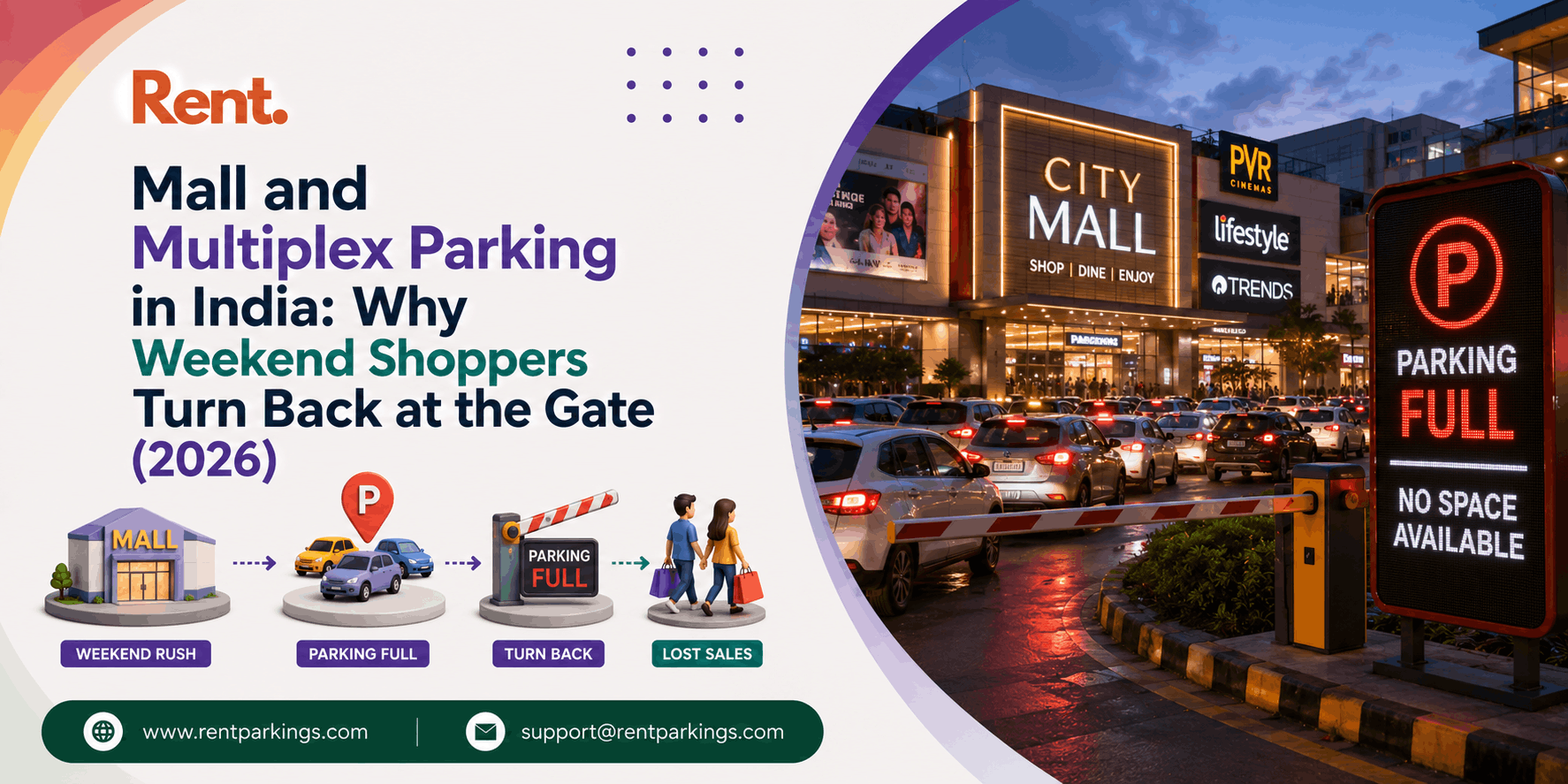
Mall and Multiplex Parking in India: Why Weekend Shoppers Turn Back at the Gate (2026)
Saturday, 7:40 PM. A family of four circles the basement of a Phoenix Mall for the third time, hazard lights blinking, the kids arguing in the back seat about missing the trailer before the movie starts. The security guard waves them toward level minus three. It's full too. By the time they find a spot on the street outside, walk back, and buy tickets, the film has already started.
Nobody plans a mall trip expecting this. But across Bengaluru, Mumbai, Delhi NCR, Hyderabad, and Pune, weekend mall parking has quietly become one of the most predictable failures in urban India. The stores are ready. The screens are ready. The parking never quite catches up. Platforms like RentParkings, India's parking marketplace, exist because this gap between what malls built and what shoppers actually need has become impossible to ignore.
Why Malls Keep Running Out of Space
Most malls in India were designed against a parking ratio set years before quick commerce, ride-hailing pickup zones, and multiplex chains with six or eight screens became the norm. A mall built for a certain footfall in 2012 is often serving triple that crowd on a festive weekend in 2026, with the same basement levels it started with.
Add to that the newer complications nobody accounted for. Cab drivers waiting for pickups occupy bays meant for shoppers. Delivery riders collecting online orders from mall-based dark stores park wherever they can. Valet queues back up onto the ramp itself during peak hours, slowing everyone behind them.
The result is a mismatch that shows up almost exclusively on weekends and holidays, which is exactly when malls need parking to work the most.
The Streets Around the Mall Absorb the Overflow
When the basement fills, shoppers don't turn around and go home. They park wherever they can find a gap: a side street two blocks away, an unmarked stretch outside a shuttered showroom, or a residential lane meant for the people who actually live there.
This creates friction on both sides. Residents near popular malls in cities like Gurugram, Noida, and Hyderabad frequently deal with strangers' cars blocking their own gates on weekends. Shoppers, meanwhile, end up walking ten or fifteen minutes in the heat or rain just to reach the entrance they were trying to drive up to.
It's a problem neither the mall management nor the local traffic police fully owns, which is part of why it never quite gets fixed at a policy level.
What This Means for Property Owners Nearby
Here's the part most people overlook. If you own a driveway, a covered bay, or an unused stretch of open ground within a five to ten minute walk of a busy mall or multiplex, you're sitting on something that becomes genuinely valuable for a few concentrated hours every weekend.
Unlike parking near a metro station or an office park, where demand spreads across the whole day, mall-adjacent parking has sharp peaks. Friday evenings, Saturday afternoons through night, and Sunday from noon onward are when shoppers are actively searching, and willing to pay more than they would on a quiet Tuesday morning.
Owners near India's busiest shopping corridors, the kind of high-footfall zones we mapped out in India's busiest parking hotspots, are often earning more from three or four peak hours a week than some full-time monthly renters bring in over a slower stretch of days elsewhere.
A few things tend to separate a listing that fills up on weekends from one that doesn't:
- Close enough to walk to the mall entrance, so nobody has to cut across a busy road to get there.
- Clear signage or an easy pin location, since first-time visitors won't want to hunt for an unmarked gate
- Enough space for an SUV, not just a hatchback, since weekend mall traffic skews toward family vehicles
- A surface that isn't muddy or waterlogged during the monsoon months, when demand for covered alternatives spikes
If you're unsure how much space a typical vehicle actually needs before you list a spot, our guide to standard car and bike parking dimensions spells out exact measurements, so you don't accidentally undersell a spot that could fit a bigger car, or oversell one that can't.
How This Differs From Everyday Commuter Parking
Commuter parking near IT parks or metro stations tends to be sold on reliability: the same person, the same spot, every working day. Mall parking works on a different rhythm entirely. It's occasional, often last-minute, and driven by whatever movie released that week or whichever weekend the family decided to finally go furniture shopping.
That means owners near malls generally do better with hourly or half-day pricing than with a fixed monthly arrangement, since very few renters need the spot on a Tuesday morning. Pricing a bay at a flat rate for a three or four hour window on Friday and Saturday evenings, and a slightly higher one during festive release weekends, tends to perform better than a blanket monthly rate that ignores when the actual demand happens.
Multiplexes Add Their Own Pressure Point
Standalone multiplexes and mall-based cinema chains compound the problem further because of how ticketing works. Shows are scheduled in tight fifteen to twenty minute intervals across multiple screens, which means the parking lot experiences several waves of arrivals and departures within a single evening rather than one steady flow.
A family running slightly late for a 7 PM show and finding the lot full doesn't have the option of waiting twenty minutes for a spot to open up. They need something within walking distance immediately, which is exactly the kind of urgent, high-willingness-to-pay demand that a verified nearby listing can capture.
Why Renters Are Turning to Marketplaces Instead of Guesswork
A decade ago, a shopper stuck without mall parking had few real options beyond circling the block and hoping. That's changed. Platforms built specifically around this kind of short-notice, location-specific demand now let drivers search for a verified nearby spot before they even leave home, check what other renters said about it, and book it in advance instead of gambling on arrival.
That shift matters most in tight commuter corridors too. The same search-and-book behaviour that's changing mall parking is what's making spots near India's IT parks so competitive on weekday mornings, and a mall-adjacent driveway sees the exact same dynamic on weekend evenings instead. A homeowner near a mall doesn't need to build anything new. They just need to make an existing, mostly idle driveway or covered spot visible to the shoppers who are already circling the block looking for exactly that.
Setting Up a Mall-Adjacent Spot for Weekend Demand
Getting a listing ready for this kind of traffic doesn't require major investment. A few practical steps make the biggest difference:
- Photograph the spot in daylight and again in the evening, since most bookings happen for evening slots
- Mention the exact walking time to the mall entrance rather than a vague "nearby"
- Note whether the surface is shaded or covered, since parked cars sitting in direct sun for three hours during a movie matter to renters
- List separate weekday and weekend rates instead of one flat price, since weekend demand can comfortably support a higher rate
- Respond quickly to booking requests on Friday and Saturday afternoons, when most last-minute searches happen
Owners who've read through the legal, tax, and safety guide to renting out a parking space in India, including who's responsible if something goes wrong on the property, tend to list with more confidence and fewer surprises later.
A Market That's Only Getting Tighter
New mall projects keep getting announced across tier two cities like Coimbatore, Lucknow, and Jaipur, but construction and parking capacity rarely arrive together. Even in metros where malls are already established, footfall keeps climbing faster than any basement level was built to handle.
That gap isn't closing on its own. Multi-level parking structures built to fix these exact problems often sit half-used because of poor lighting or inconvenient access. We dug into why so many purpose-built parking towers across India stay empty, and the same pattern shows up again here: informal, well-located spots keep beating expensive, poorly run formal ones. The mismatch between planned capacity and real demand is likely to keep widening as more malls open and more families decide a weekend trip is worth the drive, regardless of what the basement level looks like when they arrive.
Frequently Asked Questions
1. Why is parking near malls in India so unpredictable?
Most malls were built with parking capacity based on older footfall estimates, and demand has grown faster than basement levels or multi-level structures have expanded to match. Weekend and festive crowds push existing capacity well past what it was designed for.
2. Is it legal to rent out my driveway or private parking spot near a mall?
Generally yes, provided you actually hold the rights to that space, whether it's an independent house driveway or an allotted bay within an apartment complex. It's worth confirming ownership and any society rules before listing, especially in shared residential buildings.
3. How much can I charge for a parking spot near a busy mall?
Rates vary by city and distance, but spots within a short walk of high-footfall malls can often command a premium during peak weekend hours compared to weekday rates, since demand is concentrated into a few busy evenings rather than spread evenly across the week.
4. Should I price mall-adjacent parking hourly or monthly?
Hourly or half-day pricing usually works better near malls, since most renters need the spot for a single evening rather than every day. A flat monthly rate tends to undersell the value of peak weekend demand.
5. What makes shoppers choose one parking listing over another nearby?
Walking distance to the entrance, clear directions, and genuine reviews from other renters matter more than price alone. A slightly pricier spot that's easy to find and close by often gets booked before a cheaper one that's harder to locate.
6. Do I need CCTV or a boundary wall to list my space?
It isn't mandatory, but spots with basic security features tend to attract more consistent bookings, particularly for evening and night shows when renters are more cautious about where they leave a vehicle.
7. Can I list a spot that only fits a hatchback, or does it need to handle SUVs?
You can list any size spot, but being upfront about exact dimensions helps avoid cancelled bookings. Weekend mall traffic includes a good mix of larger family vehicles, so spots that comfortably fit an SUV tend to see more demand.
8. What happens if a renter's car is parked longer than the booked time?
This is worth agreeing on clearly in the listing terms upfront, including how overtime is handled or communicated. Most disputes come down to unclear expectations rather than bad intent, so spelling this out in advance helps both sides.
9. Are mall parking spots in demand year-round, or mainly during festivals?
Weekends see consistent demand throughout the year, but festive releases, holiday shopping seasons, and big film openings push demand noticeably higher for short bursts. Owners who adjust pricing around these known peaks tend to earn more without losing regular weekend bookings.
10. How is this different from renting parking near an office or IT park?
Office-adjacent parking is built around daily, predictable commuter demand on weekdays. Mall-adjacent parking is driven by short, high-intensity weekend and evening demand, which usually calls for a different pricing approach and a listing that highlights walking distance and evening availability rather than long-term reliability.
Conclusion
The mismatch between mall footfall and mall parking isn't going away soon. If anything, it's becoming one of the more reliable patterns in Indian urban life. For shoppers, that means planning ahead is no longer optional. For property owners sitting near a busy mall or multiplex, it means a driveway or empty bay that sits idle most weekdays could be earning steadily every single weekend.
If you've got a spot within walking distance of a mall, a multiplex, or a busy shopping street, there's a good chance shoppers are already searching for exactly what you have. List your parking space on RentParkings and start turning those weekend hours into income, on your own schedule, whether that's a few evenings a month or every single Saturday.
Share This post
Search
Recent Post
Parking Space vs. Renting Out a Room to...
05 Oct, 2026
Think Parking Rental Only Pays in Mumbai...
02 Oct, 2026
Your Mumbai Parking Space Is Worth More...
01 Oct, 2026
Hyderabad's Real Estate Boom Left One As...
30 Sep, 2026
What Your Parking Space in Chennai Could...
29 Sep, 2026
Your Plans Changed After Listing Your Pa...
28 Sep, 2026
Parking Space vs SIP: Which Idle Asset A...
25 Sep, 2026
What Your Parking Space in Pune Could Ac...
24 Sep, 2026