

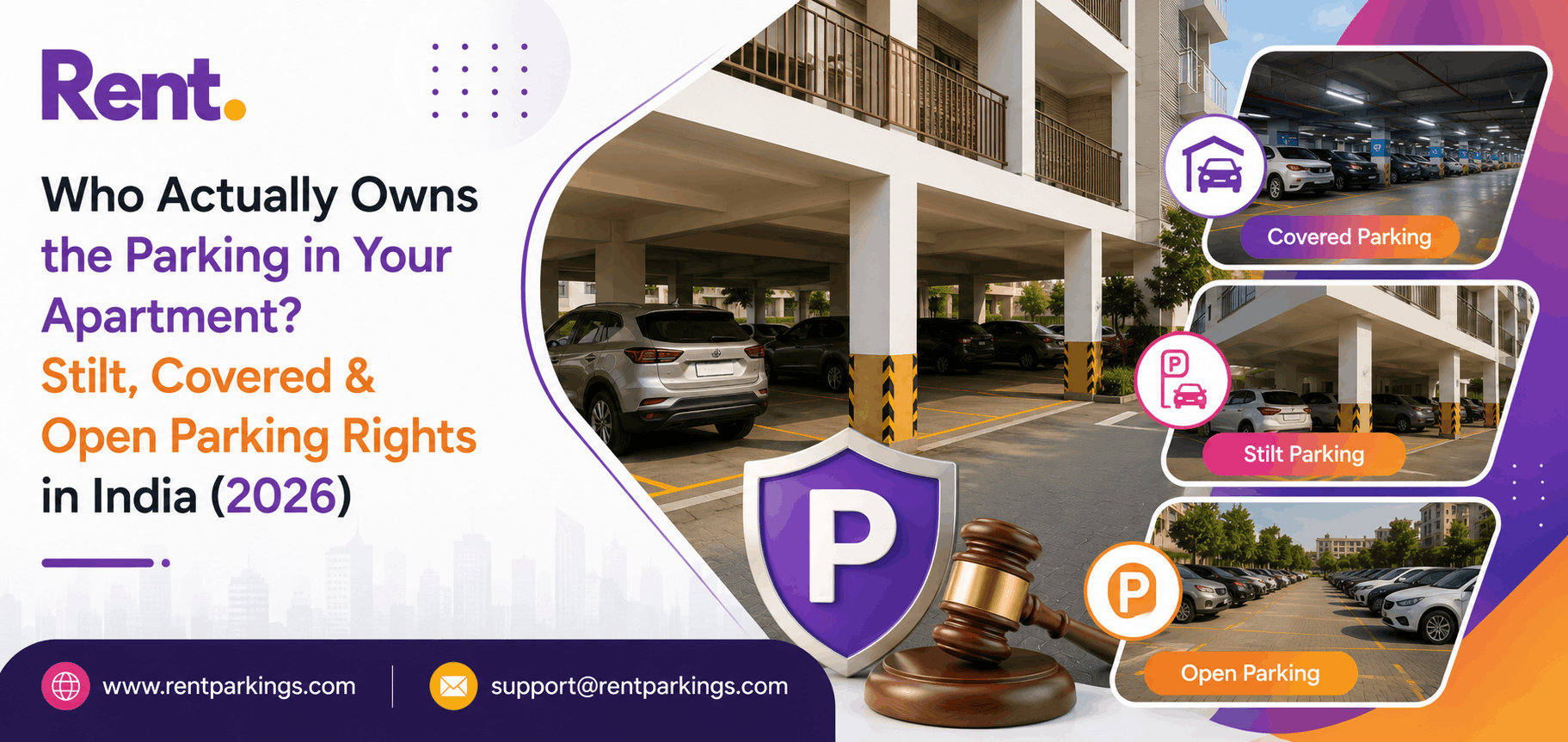
Who Actually Owns the Parking in Your Apartment? Stilt, Covered & Open Parking Rights in India (2026)
You signed the sale agreement, paid an extra two or three lakh for "covered car parking," and assumed the rectangle of cement near pillar B-12 was yours the way your living room is yours. Then one morning the watchman tells you the secretary has re-allotted "your" slot to the new owner in 704, because the original allotment was never legally yours to begin with.
If that scenario makes your stomach drop, you are not alone. Parking is quietly one of the most litigated, most misunderstood subjects in Indian apartment living. Families in Bengaluru fight over it in WhatsApp groups. Societies in Mumbai go to court over it. First-time buyers in Pune and Hyderabad pay lakhs for it without ever reading what the law actually says they are buying.
Here is the uncomfortable truth most builders will never volunteer: in a large number of cases across India, the parking space you "bought" was never the builder's to sell. Understanding why, and what you can actually claim, is the difference between confidently holding your ground and meekly moving your car.
This is a plain-English guide, from the team at RentParkings, to who really owns apartment parking in India, what the Supreme Court has ruled, how RERA changed the game, and what to do when a dispute lands at your bumper.
The Three Kinds of Parking, and Why the Difference Decides Everything
Before any argument about ownership, you have to know which type of parking you are standing in. Indian law treats three categories very differently, and people lose disputes simply because they use the wrong word.
Open parking
This is an uncovered space, typically painted lines on the ground in the open compound, with no roof and no walls. Visitor bays, the rows along the boundary wall, and most surface parking fall here. In legal terms, open parking is almost always a common area. It belongs collectively to all flat-owners, not to the builder and not to any single resident.
Stilt parking
The classic Indian apartment design: the ground floor is left open on pillars (the "stilt"), with flats starting from the first floor above. Cars park between the pillars. A stilt is partially covered (it has the building above as a roof) but it is not enclosed by walls. This is the category that has caused the most confusion, and the most litigation, because builders love to sell it, and for years they did.
Covered parking / garage
A "garage," in the strict legal sense, is an enclosed structure, roofed and walled on at least three sides, usually lockable, that can be independently identified on the building plan. A basement parking slot specifically demarcated and shown on the sanctioned plan can also fall here in some readings. This is the only category that a builder may, in defined circumstances, legally sell as a separate sellable unit.
Hold these three pictures in your head. Almost every parking dispute in India is really an argument about which box a particular slot falls into.
The Judgment That Rewrote the Rules: Nahalchand Laloochand v. Panchali (2010)
For decades, Indian builders treated parking as free inventory, bundle it, price it, sell it, profit from it. Then in 2010 the Supreme Court drew a line that still governs the country.
In Nahalchand Laloochand Pvt. Ltd. v. Panchali Co-operative Housing Society Ltd. (AIR 2010 SC 3607), a Mumbai developer argued it had every right to sell stilt parking spaces as separate flats to buyers who wanted them for parking. The Society pushed back, saying those spaces belonged to all members as common areas.
A bench of Justices A. K. Patnaik and R. M. Lodha sided firmly with the residents. The Court held that stilt parking spaces are not "flats" and cannot be sold as independent units. They are part of the "common areas and facilities" of the building, to be passed on to the co-operative society and shared among all flat-owners. The developer's only legitimate right, the Court said, was to recover the proportionate cost of common areas from each buyer based on the carpet area of their flat, not to auction the parking like a product.
The Court also clarified what counts as a true "garage": broadly, an area closed on three sides and above, used for parking. A bare stilt, open between pillars, does not meet that bar. That single distinction is why a developer can sometimes sell a lockable corner garage but cannot sell the open stilt slot next to it.
This judgment matters enormously because it means a very large number of "parking sales" executed across Mumbai, Pune, Bengaluru and other metros over the years were, in the eyes of the Supreme Court, not valid sales of independent property at all. What buyers actually received was, at best, a right of use over a common asset, not absolute ownership.
Then RERA Arrived: What the 2016 Act Actually Says
The Real Estate (Regulation and Development) Act, 2016, RERA, codified much of the spirit of that judgment and brought transparency to the murk.
RERA defines a "garage" as a place within a project having a roof and walls on three sides for parking a vehicle, but it specifically excludes unenclosed or uncovered parking such as open parking areas. In the same breath, the Act's definition of "common areas" explicitly includes open parking areas.
Put those two definitions together and the modern position becomes clear:
Open parking is a common area. A builder cannot sell it. Full stop.
Stilt parking, being open between pillars and not walled on three sides, is treated as a common area in line with the Supreme Court's reasoning. Builders cannot sell it as a separate flat or unit.
A genuine garage (roofed, three walls, independently identifiable, and crucially shown on the sanctioned plan) may be sold separately, but only if it is clearly disclosed in the sanctioned plan and spelled out in the sale agreement.
State RERA authorities have sharpened this further. MahaRERA, for instance, has taken the position that promoters cannot sell open parking spaces, and has been strict about builders treating parking as bundled, transparent, and properly disclosed rather than as a hidden upsell. This is why a Mumbai or Pune buyer's experience can differ in the fine print from a buyer in another state, the central Act sets the floor, and the state authority builds on top.
The practical upshot for a 2026 buyer: if a builder is charging you separately for "parking," your first question should be, is this a sanctioned-plan garage, or are you selling me a common area you don't own?
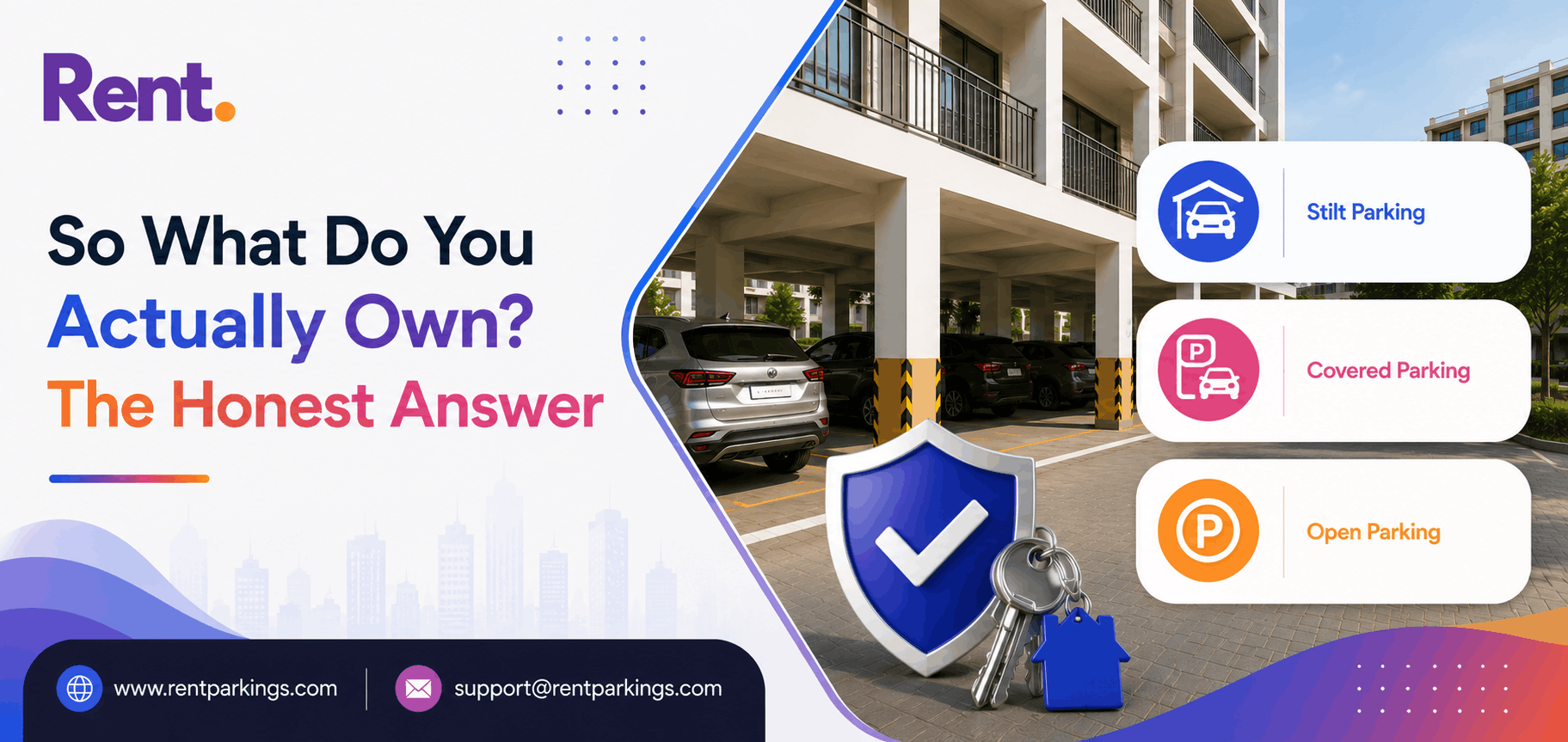
So What Do You Actually Own? The Honest Answer
This is where buyers get whiplash, so let's be precise.
When you buy a flat in a typical Indian apartment with stilt or open parking, you do not own a specific slab of parking the way you own your bedroom. What you own is an undivided share in the common areas of the building, parking included, in proportion to your flat. The right to use a particular slot comes not from a separate sale deed but from allotment, a decision made by the builder initially and then, after the society is formed, by the co-operative housing society or RWA under its bye-laws.
That distinction sounds academic until the day someone wants to move your car. It means:
A parking slot is generally not independently saleable to an outsider; it travels with the flat.
The society can frame rules for allotment, rotation, and fair distribution, especially where slots are fewer than flats.
A builder's promise of "slot B-12 forever" carries weight morally and contractually against the builder, but the eventual authority over allotment is the society's.
If you bought a true garage that appears on the sanctioned plan and in your agreement, you have a far stronger, more property-like claim. If you bought a painted rectangle in the open compound, you bought a use right over a shared asset, valuable, defensible, but not absolute private property.
The Allotment Headache: When Flats Outnumber Slots
India's real parking crisis is arithmetic. A tower of 120 flats with 80 parking slots is not unusual in older parts of Bengaluru, Kolkata, Chennai or the dense pockets of Delhi NCR, the same scarcity that has smart apartment owners profiting from India's parking crunch. When demand outstrips supply, the society's allotment policy becomes the single most important document in the building, and the value of a slot can rival what comparable spaces fetch in the city's wider parking rental rates.
Well-run societies typically use one of a few approaches:
One slot per flat first, with surplus slots allotted by lottery, seniority, or nominal additional charge before anyone gets a second.
Rotation systems for premium covered slots so the same families don't permanently monopolise the best spots.
Need-based priority, for example, residents with disabilities, senior citizens, or pregnant members getting the closest, most accessible bays.
A modest monthly parking maintenance charge that funds lighting, paint, security and, increasingly, EV infrastructure, distinct from "selling" the slot.
The legally and socially safest model is the one the Supreme Court's logic points to: treat parking as a shared community resource managed fairly, not as private fiefdoms carved out by whoever paid the builder first. Societies that have shifted from "builder-sold permanent slots" to "society-administered fair allotment" have generally seen fewer feuds, though the transition itself is often where the fireworks happen.
EV Charging Has Made the Ownership Question Even Hotter
The rise of electric vehicles in Indian cities has added a sharp new edge to an old argument. An EV owner in a Hyderabad or Pune high-rise doesn't just want a place to park, they want to draw power there, run a dedicated line, and sometimes install a wall box. That immediately raises questions only the ownership framework can answer: Can the society stop me from charging in a slot I was "allotted"? Whose electricity? Whose wall?
Because most slots are legally common areas under society control, the answer usually runs through the RWA, not around it. EV charging in apartments is increasingly governed by model EV-charging guidelines, electricity board provisions for separate metering, and society resolutions that permit charging subject to safety and fair-cost rules. The clearer a society is about who owns and controls the parking, the smoother these EV decisions become, as our playbook for getting an EV charger past the society gate explains in detail. The murkier the ownership, the uglier the standoff. Parking ownership, in other words, is no longer just about cars, it is fast becoming the gateway to a building's entire energy future.
Red Flags to Catch Before You Sign
If you are buying a flat in 2026, treat parking as a clause to negotiate, not a freebie to assume. Watch for these:
"Parking sold separately" with no sanctioned-plan reference. If the builder can't point to the slot on the approved plan, be very cautious, they may be selling you a common area.
A lump-sum "parking charge" buried in the cost sheet. Ask whether it is a sanctioned garage or merely a stilt/open allotment, and get the answer in writing.
Verbal promises of a specific slot. Get the slot identification into the agreement; a verbal "B-12 is yours" evaporates the day the society takes over.
No mention of how surplus or visitor parking will be handled. This predicts future conflict.
Resale assumptions. Don't assume you can later sell "your" parking to anyone other than along with the flat.
Reading the sanctioned plan, the sale agreement, and (for ready buildings) the society bye-laws before you pay is the cheapest legal protection you will ever buy.
When a Dispute Hits: Your Realistic Options
Say it has already gone wrong, a re-allotment, a double-sold slot, a builder who pocketed your parking money. You have more leverage than you think, but you have to use the right forum, just as you would for the on-street side of parking covered in our guide to no-parking fines, towing and your parking rights in India.
The housing society / RWA. Most allotment disputes are internal. Raise it formally in writing, ask for the matter to be tabled at a general body meeting, and insist on a transparent, bye-law-compliant allotment policy. Many disputes die here once rules are applied evenly.
RERA authority. If a builder sold you parking improperly, mis-disclosed it, or failed to deliver what the sanctioned plan promised, the state RERA authority is the natural venue for registered projects.
Consumer forum. Selling a common area as private property, or charging for something the builder didn't own, can amount to an unfair trade practice and deficiency in service, grounds Indian consumers have successfully used.
Civil court / co-operative court. For ownership-title questions and society-level disputes, depending on your state's co-operative law.
Across all of them, your strongest evidence is documentary: the sanctioned plan, the sale agreement, society bye-laws, allotment letters, and payment receipts. The resident who walks in with paper usually walks out with the slot.
The Bigger Picture: Parking as Shared Urban Infrastructure
Step back from your own pillar for a moment. The reason Indian law nudges parking toward "common area" rather than "private product" is not bureaucratic stubbornness, it reflects a genuine truth about how dense Indian cities work. Land is scarce, vehicle ownership is rising faster than any city can build slots, and treating parking as infinitely sliceable private property has, in practice, created hoarding, feuds, and inequity inside thousands of buildings.
The Smart Cities Mission's experiments with sensor-based and app-managed municipal parking, the slow shift toward paid and regulated on-street parking in Bengaluru and Pune, the way thousands of commuters now park near metro stations to cut their costs, and the rise of shared mobility all point the same direction: parking is increasingly understood as a managed, shared resource rather than a personal entitlement. Apartment law got there first, in 2010, when the Supreme Court refused to let builders treat the common compound as a warehouse of sellable rectangles.
Understanding that you own a share and a fair claim rather than a private fiefdom isn't a downgrade, it's the legal architecture that, applied well, keeps a 200-flat tower from descending into a daily parking war.
Actionable Takeaways
Identify your parking type first, open, stilt, or true garage. Your rights flow entirely from which one it is.
Remember the rule: builders cannot sell open or stilt parking as separate units; only sanctioned-plan garages can be sold, with full disclosure.
You own an undivided share of common-area parking in proportion to your flat, the society allots usage, the builder cannot grant permanent private title to stilt/open slots.
Get everything on paper, sanctioned plan reference, slot ID in the agreement, and a copy of society bye-laws.
Use the right forum for disputes: society first, then RERA or consumer forum against builders.
Push your society toward a fair, written allotment policy, it is the single best defence against future feuds, including EV-charging conflicts.
Conclusion
Parking in an Indian apartment feels like the smallest part of buying a home, a rectangle of cement that barely registers next to the flat itself. Yet it triggers more conflict per square foot than almost anything else in shared living, precisely because so few owners understand what they actually bought.
The law, once you cut through it, is reassuringly clear. Open and stilt parking are common areas that belong to everyone; builders cannot sell them as private property; only a genuine, sanctioned-plan garage can change hands separately. What you own is a fair share and a fair claim, administered by your society under rules that, when written and applied honestly, protect you far better than any builder's verbal promise ever could.
So the next time someone tells you to move your car "because it was never really yours," you'll know exactly which question to ask, which document to pull out, and which forum to walk into. In India's crowded, fast-motorising cities, knowing your parking rights isn't a niche legal hobby. It's part of knowing what your home is actually worth. And once you understand what you own, you can explore the rest of the parking picture, from city rates to everyday booking, over at RentParkings.
FAQs
Can a builder legally sell car parking separately in India?
Only in limited cases. A builder can sell a genuine "garage", a structure roofed and walled on three sides, shown on the sanctioned plan, as a separate unit with clear disclosure. Builders cannot sell open or stilt parking separately; the Supreme Court ruled these are common areas owned collectively by all flat-owners.
What did the Supreme Court rule about parking in flats?
In Nahalchand Laloochand v. Panchali Co-operative Housing Society (2010), the Supreme Court held that stilt and open parking spaces are not "flats" and cannot be sold as independent units. They are common areas and facilities belonging to all members of the housing society, not the builder's sellable inventory.
Is parking included in the price of my flat?
For open and stilt parking, yes in principle, its cost is meant to be recovered proportionately through the common-area charge based on your flat's carpet area, not sold as a separate product. A separately sold garage on the sanctioned plan is the exception and must be disclosed in your agreement.
What is the difference between stilt, covered, and open parking?
Open parking is uncovered ground-level space. Stilt parking sits under the building on pillars but has no surrounding walls. A covered parking or "garage" is enclosed, roofed and walled on three sides, often lockable. Only the genuine garage category can be sold separately under Indian law.
Does RERA allow builders to sell parking spaces?
RERA defines open parking as a common area and excludes it from "garage." So builders cannot sell open or stilt parking under RERA. A roofed, three-walled garage shown on the sanctioned plan can be sold, provided it is clearly disclosed in the sanctioned plan and the sale agreement.
Who decides parking allotment in a housing society?
Initially the builder allots slots, but once the co-operative housing society or RWA is formed, allotment is governed by its bye-laws. The society can frame fair rules for distribution, rotation, and surplus slots, especially when there are fewer parking spaces than flats.
Can my society take away or change my parking slot?
For stilt and open slots, which are common areas, the society generally has authority to administer and re-allot parking fairly under its bye-laws. A slot allotted by the builder is not absolute private ownership. A sanctioned-plan garage you legally purchased has a far stronger, more protected claim.
Can I sell my apartment parking space to someone else?
Generally no, a stilt or open parking right travels with your flat and cannot be independently sold to an outsider, because it is a common area. Even a purchased garage is typically transferred along with the flat rather than sold to a third party, subject to society rules.
What can I do if a builder sold me parking he didn't own?
You can raise it with the housing society, file a complaint with your state RERA authority for registered projects, or approach the consumer forum, since selling a common area as private property can be an unfair trade practice. Keep your sanctioned plan, sale agreement, and payment receipts as evidence.
Do I have a right to visitor parking in my society?
Visitor parking is a common area meant for the shared use of all residents and their guests, governed by society rules. No single owner or the builder can permanently appropriate visitor bays as private parking, and societies are expected to keep them available for their intended purpose.
Share This post
Search
Recent Post
Parking Space vs. Renting Out a Room to...
05 Oct, 2026
Think Parking Rental Only Pays in Mumbai...
02 Oct, 2026
Your Mumbai Parking Space Is Worth More...
01 Oct, 2026
Hyderabad's Real Estate Boom Left One As...
30 Sep, 2026
What Your Parking Space in Chennai Could...
29 Sep, 2026
Your Plans Changed After Listing Your Pa...
28 Sep, 2026
Parking Space vs SIP: Which Idle Asset A...
25 Sep, 2026
What Your Parking Space in Pune Could Ac...
24 Sep, 2026