

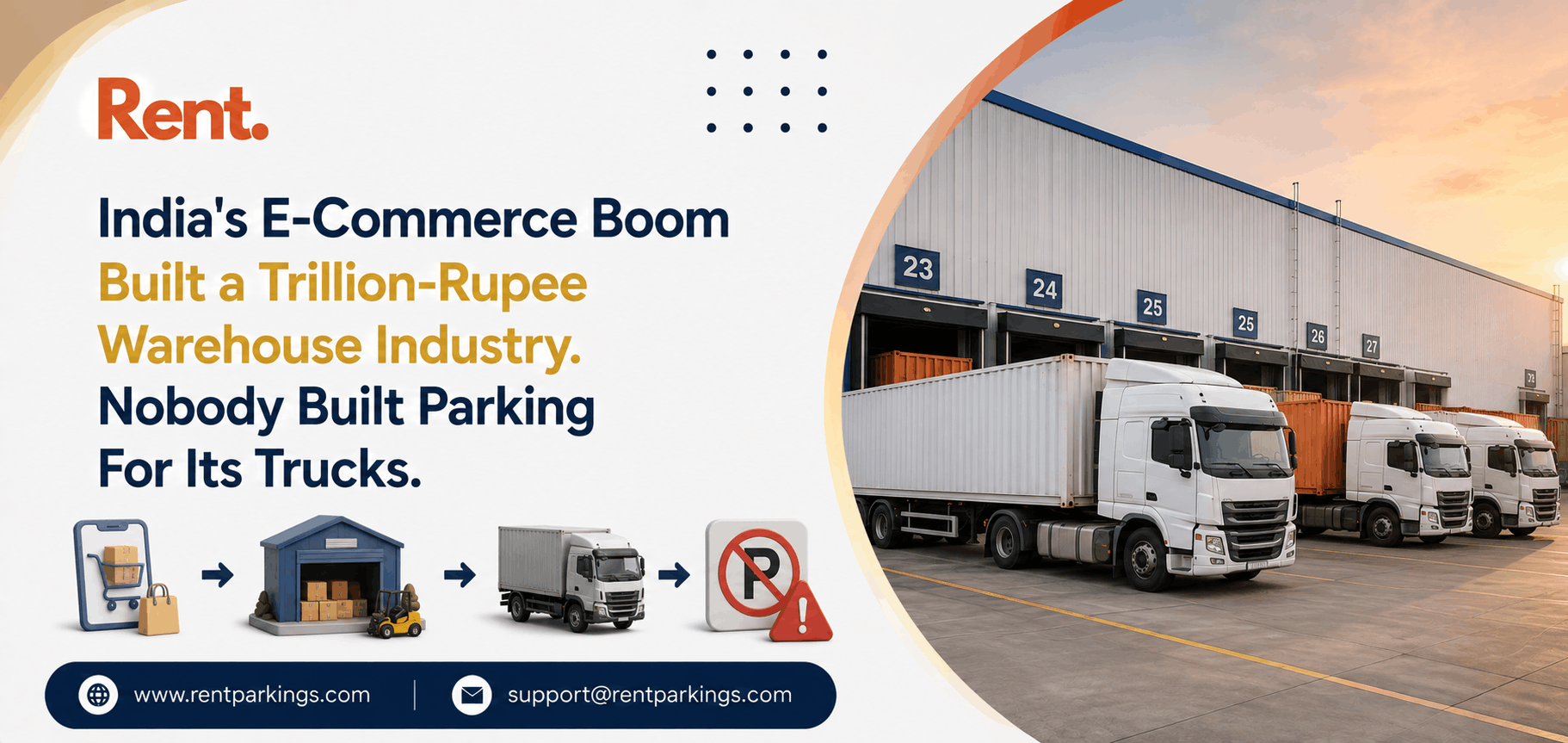
India's E-Commerce Boom Built a Trillion-Rupee Warehouse Industry. Nobody Built Parking For Its Trucks.
Everyone talks about India's warehousing boom in square feet. Almost nobody talks about parking, which is a strange blind spot for an industry whose entire job is moving things efficiently. The trucks and trailers keeping e-commerce fulfilment centres and manufacturing supply chains running often have nowhere sanctioned to sit still, so they end up parked on highway shoulders, wedged into dhaba compounds, or spilling onto access roads meant for someone else's warehouse gate.
Every quarter, another distribution centre opens near an industrial corridor. Every festival season, another fleet of delivery vans and trailers gets added to serve it. What almost nobody budgets for, until the traffic outside the gate becomes unmanageable, is where all those vehicles are supposed to sit when they're not moving. That gap between built-up warehouse capacity and available fleet parking is quietly becoming one of the more overlooked opportunities in India's parking economy, and platforms like RentParkings are increasingly the place where landowners near these corridors go to make sense of it.
Why India's Warehousing Boom Created a Parking Problem Nobody Planned For
The scale of the shift is easy to miss because it happened gradually. Grade-A warehousing stock across India's top industrial belts has multiplied over the past several years, driven by e-commerce fulfilment centres, third-party logistics operators, and manufacturers moving to a hub-and-spoke distribution model instead of scattered depots. Land near expressway interchanges got rezoned, warehouses got built, and tenants moved in fast.
What rarely got built alongside them was enough space for the vehicles that actually keep those warehouses running. A single mid-sized fulfilment centre can see dozens of trucks and trailers cycling through in a day, some unloading, some waiting their turn, some simply parked overnight because the next leg of the journey doesn't start until morning. Warehouse compounds are usually designed around racking, dock doors, and staff parking. Nobody sized the plot for forty trailers waiting outside.
This isn't the same problem covered by the everyday truck parking crunch inside Indian cities, where drivers get pushed off residential streets because municipal bylaws simply don't allow commercial vehicles to park there overnight, a struggle we broke down in our piece on where India's trucks actually go when cities won't let them park. The logistics-hub version of this problem is different in shape. It isn't about being unwelcome inside the city. It's about there simply not being enough organised yard space near the warehouses themselves.
Where the Trucks Actually End Up Waiting
Talk to fleet managers and warehouse operators near any major distribution belt and the same handful of workarounds come up again and again. None of them are particularly good.
- Highway shoulders and service roads: Trailers pull onto the hard shoulder near the warehouse turn-off, sometimes for hours, sometimes overnight, creating a bottleneck for every other vehicle trying to use that stretch.
- Dhaba compounds: Roadside eateries with spare land have quietly become informal truck stands, charging a flat overnight fee with none of the security, lighting, or written terms a fleet operator would actually want.
- Overflow onto warehouse access roads: When the compound fills up, trucks spill onto the shared access road that other tenants in the same industrial park also need, which is how one warehouse's parking shortage becomes an entire park's traffic problem.
- Vacant plots, used without permission: Drivers pull into an empty, unfenced plot because it's there, not because anyone gave them the right to. It works until the owner shows up, or the local police do.
Every one of these workarounds costs someone money, whether it's the fleet operator paying a driver to sit idle in traffic, the warehouse losing goodwill with its neighbours, or the landowner whose empty plot is being used for free.
The E-Commerce and Quick Commerce Multiplier Effect
Large trailer parking near industrial belts is only half the story. The other half is smaller, faster, and arguably growing quicker: the last-mile fleet that quick commerce and e-commerce delivery has created around every city's dark stores and micro-fulfilment hubs. The daily grind this creates for delivery riders is something we unpacked separately when we looked at the parking problem hiding behind ten-minute delivery, and the pattern at the warehouse end of the chain isn't so different, just scaled up.
A dark store needs somewhere for its delivery fleet to stage between runs. A regional fulfilment centre needs a holding area for the smaller vans that make the final hop from the big trailers to the local hub. None of this was part of anyone's original site plan because quick commerce, as a category, barely existed when a lot of these industrial parks were laid out.
The result is two overlapping fleets, big trailers and small delivery vehicles, both short on organised space, both willing to pay for something better than a highway shoulder.
Why This Is a Real Estate Opportunity, Not Just a Traffic
Problem
Here's the part that gets missed in most conversations about warehousing congestion: every one of those parking shortages is a demand signal for someone who owns land nearby. A vacant plot next to an industrial corridor, one that might otherwise sit idle for years waiting for the "right" commercial buyer, can start earning as a fleet holding yard almost immediately.
Fleet operators and third-party logistics companies typically need one of three things: an overnight halt for trailers between long-haul legs, a detachment yard where the trailer is dropped and the tractor unit moves on to its next job, or a driver rest stop with basic amenities like a toilet block, drinking water, and enough security that a driver is comfortable leaving the vehicle unattended.
Rates vary a fair bit depending on the corridor and how developed the site is, but owners we've spoken with in this space report monthly fleet parking arrangements running anywhere from roughly ₹3,000 to ₹8,000 per truck slot in tier-2 industrial belts, climbing higher near the busiest hubs around Delhi NCR and Mumbai's outer ring. For a plot that can hold twenty or thirty vehicles, that adds up to a meaningfully different return than leaving the land fallow. It's the same underlying logic covered in our breakdown of how much an empty parking space can genuinely earn, just applied at commercial vehicle scale instead of a single car space.
And fleet parking isn't the only category worth exploring on land like this. Owners weighing their options might also want to see how two-wheeler, EV, and event-day parking can add income streams beyond a single-use plot, especially on land near a mixed industrial and residential corridor where demand shifts by time of day.
What Makes a Good Fleet Parking Site
Not every plot near a warehouse belt is a good candidate. Fleet operators are fairly specific about what they'll actually pay for, and it usually comes down to a short list of practical requirements rather than anything glamorous.
- Direct or near-direct access to a highway or expressway interchange. A site that requires navigating narrow village roads loses most of its appeal, no matter how cheap it is.
- A flat, compacted, all-weather surface. Loose mud that turns into a swamp during the monsoon is a dealbreaker for anyone parking a loaded trailer overnight.
- Boundary walls or fencing, with a gate that can be manned or locked. Open plots invite exactly the kind of unauthorised, unpaid use described earlier.
- Enough turning radius for a 32-foot or 40-foot trailer. This sounds obvious until you've seen a plot that looks spacious on paper but can't actually accommodate a full turn.
- Proximity, not distance, to the warehouse cluster it's meant to serve. A yard fifteen minutes away defeats the purpose for a driver trying to grab a few hours of rest between shifts.
The Rush Zones Where This Demand Is Concentrated
Fleet parking pressure isn't evenly spread across the country. It clusters wherever warehousing density has grown fastest, which tends to be a fairly predictable list of corridors once you start looking for it, not unlike the pattern we mapped out in our look at India's busiest parking rush zones.
- NH48 around Bhiwandi and the Mumbai-Nashik belt, one of the densest warehousing clusters in the country
- The Delhi-Jaipur corridor near Manesar, Bilaspur, and Farrukhnagar, serving the wider Gurugram-Sohna industrial spread
- Sriperumbudur and Oragadam outside Chennai, where auto-component and consumer goods warehousing has expanded rapidly
- Chakan and Talegaon near Pune, another manufacturing-linked warehousing hub with limited organised yard space
- Dankuni and the NH19 stretch near Kolkata, a key eastern gateway that sees heavy long-haul trailer movement
Landowners sitting on plots along any of these stretches, even a few hundred metres off the main highway, are sitting on exactly the kind of asset that logistics companies are actively trying to find.
Legal and Practical Considerations for Landowners
Turning a plot into fleet parking isn't purely a matter of putting up a signboard. A few things are worth getting right before the first trailer rolls in.
Land use classification matters. A plot zoned industrial or commercial is far more straightforward to use this way than agricultural land, which may require a change of land use before it can legally host a paid parking operation. It's worth a conversation with a local property lawyer or the municipal planning office before signing anything long-term.
A written agreement, even a simple one, beats a verbal arrangement every time. It should spell out the monthly rate, the number of vehicles covered, who's responsible for damage, and how either side can exit the agreement. Fleet operators are used to formal contracts and will generally prefer dealing with an owner who offers one over an informal cash arrangement.
Basic security is non-negotiable at this scale. A boundary fence, a gate that's actually manned during handover hours, and ideally a camera covering the entry point go a long way toward making an owner's plot the preferred choice over an unsecured alternative down the road.
Where RentParkings Fits Into This
This is exactly the kind of demand that doesn't show up on a typical property listing site, because a fleet operator searching for overnight trailer parking isn't browsing real estate portals. They're looking for a marketplace built specifically around parking, one where an owner near an industrial corridor can list a plot, describe its access and surface condition, set a monthly rate, and get discovered by the operators who actually need it. That's the gap RentParkings is built to close, connecting landowners near India's fastest-growing logistics belts with the fleets that need somewhere reliable to park.
Frequently Asked Questions
1. What exactly counts as fleet or logistics parking?
It generally means a dedicated plot or yard where trucks, trailers, or delivery vans belonging to a logistics company or fleet operator can park overnight, wait for a loading slot, or be detached from their tractor unit for a few days. It's distinct from casual, single-vehicle parking because it usually involves a recurring monthly arrangement with one operator rather than daily walk-in customers.
2. How much can a landowner realistically earn from fleet parking?
It depends heavily on location and site quality, but owners near active industrial corridors report monthly per-slot rates roughly in the ₹3,000 to ₹8,000 range for a secured, all-weather plot. A yard that can hold twenty or more vehicles can add up to a substantial monthly income compared to leaving the same land vacant.
3. Do I need special permission to rent out land for truck or trailer parking?
It depends on how the land is currently classified. Industrial or commercial plots are usually straightforward, while agricultural land may need a formal change of land use before it can be used commercially. It's worth checking with the local municipal or panchayat office before entering into any long-term arrangement.
4. Is fleet parking only useful for big warehousing hubs like Bhiwandi or Manesar?
Those corridors see the heaviest demand, but any plot near an active industrial area, a national or state highway junction, or a growing quick commerce dark store cluster can attract interest. Smaller cities with expanding logistics parks are seeing similar demand, just at a smaller scale.
5. What's the difference between this and the truck parking crisis inside Indian cities?
City-centre truck parking problems usually come from municipal restrictions that keep commercial vehicles off residential streets altogether. Logistics-hub fleet parking is a different issue: there's often no restriction on the vehicles being there, there just isn't enough organised yard space built near the warehouses to hold them.
6. What amenities do fleet operators actually expect at a parking yard?
At a minimum, a flat and secure surface with enough turning space for large vehicles. Beyond that, drinking water, a basic toilet facility, decent lighting, and a manned or lockable gate meaningfully improve a site's appeal and can support a higher monthly rate.
7. Can a residential plot near a highway be converted into fleet parking?
It's possible in some cases, but residential zoning typically restricts commercial use, and neighbours may object to heavy vehicle movement at odd hours. Industrial or commercial land, or land with an approved change of land use, tends to be a far smoother path.
8. How is this different from renting out a driveway or a single car parking spot?
The scale and the tenant profile are both different. Fleet parking usually involves a formal agreement with a logistics company or transport contractor covering multiple vehicles over months, rather than an individual driver renting a single spot for their own car.
9. Are there tax implications for renting land as fleet parking?
Yes, income earned this way is generally treated as rental or business income and needs to be declared, and GST may apply once earnings cross the applicable threshold. It's worth speaking with a chartered accountant to structure the arrangement correctly from the start.
10. How do I find fleet operators who need parking near my land?
Word of mouth through transporters and warehouse managers works, but it's slow and inconsistent. Listing the plot on a dedicated parking marketplace makes it discoverable to operators actively searching for exactly this kind of space, rather than relying on chance introductions.
Conclusion
The gap between how fast India built its warehouses and how little thought went into parking for the vehicles serving them isn't closing on its own. If anything, every new fulfilment centre and every quick commerce dark store adds to the pressure. For a landowner sitting on the right plot near the right corridor, that pressure is simply demand waiting for a listing. List Your Parking Space on RentParkings and start turning an idle plot near India's busiest logistics corridors into steady, verified monthly income, on your own terms and your own schedule.
Share This post
Search
Recent Post
Parking Space vs. Renting Out a Room to...
05 Oct, 2026

Think Parking Rental Only Pays in Mumbai...
02 Oct, 2026
Your Mumbai Parking Space Is Worth More...
01 Oct, 2026
Hyderabad's Real Estate Boom Left One As...
30 Sep, 2026

What Your Parking Space in Chennai Could...
29 Sep, 2026
Your Plans Changed After Listing Your Pa...
28 Sep, 2026
Parking Space vs SIP: Which Idle Asset A...
25 Sep, 2026
What Your Parking Space in Pune Could Ac...
24 Sep, 2026