

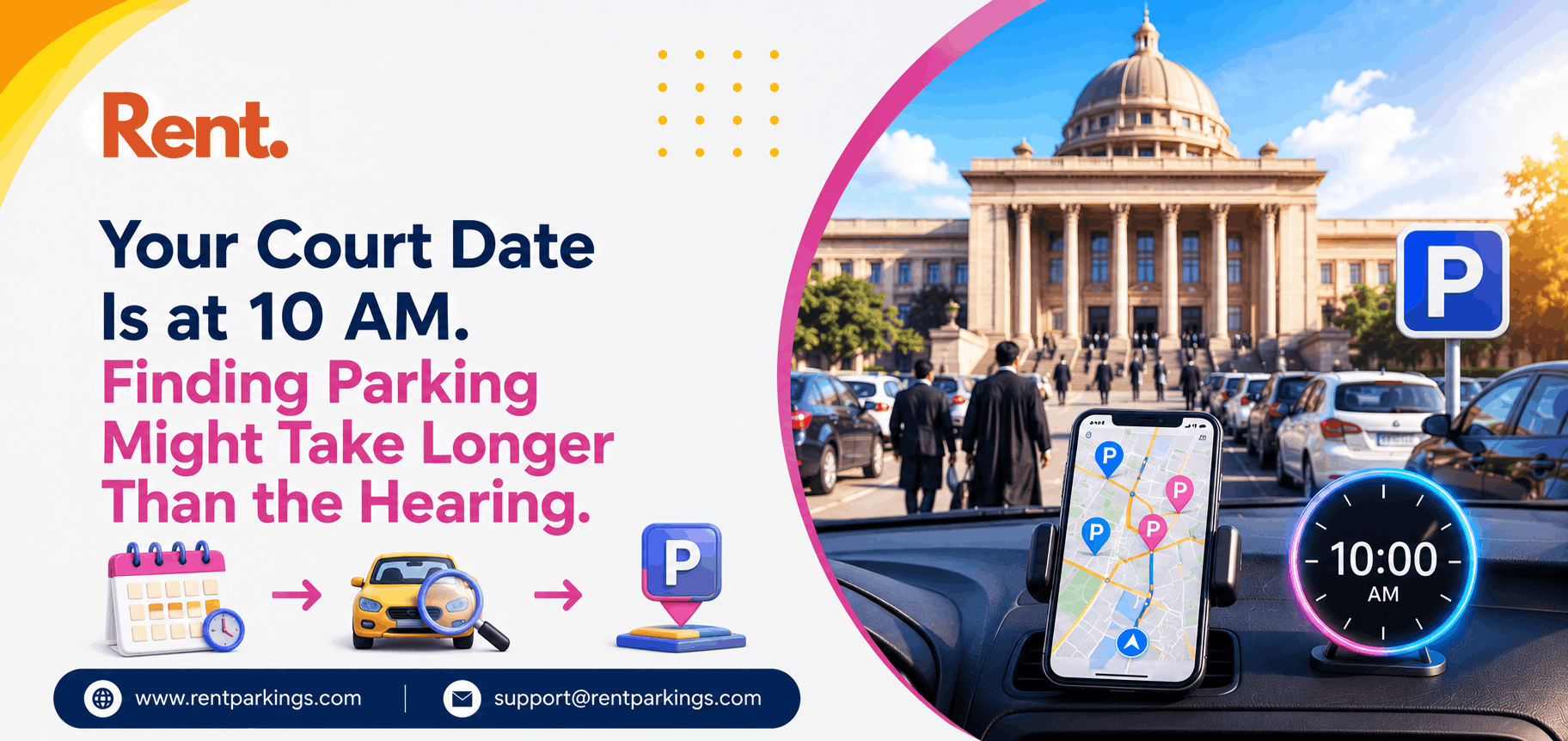
Your Court Date Is at 10 AM. Finding Parking Might Take Longer Than the Hearing.
Ramesh had a 10 AM hearing at the Saket court complex in Delhi. He left home at 7:45, budgeting more than two hours for a drive that Google Maps said should take forty minutes. He still walked into the courtroom eleven minutes late, sweating, after circling three lanes near the complex and eventually paying a stranger with a hand-painted board to squeeze his car between two others on what was technically someone's front gate.
Ask any lawyer, litigant, or court clerk in a Tier 1 or Tier 2 Indian city, and you'll hear a version of this story almost every week. Courts are among the busiest institutional destinations in urban India, yet parking planning for them has barely kept pace with the crowds they pull in.
This is a gap RentParkings, India's parking marketplace, sees again and again from property owners near court complexes who have no idea their empty driveway or vacant plot is sitting on genuine daily demand.
Why Court Complexes Are a Parking Problem Unlike Any Other
Most institutional parking crunches in India follow a predictable rhythm. Malls get busy on weekends. Stadiums fill up on match day. Schools jam up at pickup time. Courts don't work that way, and that's exactly what makes them harder to plan around.
A single district court complex can have dozens of courtrooms running simultaneously, each with its own cause list, its own hearing schedule, and its own crowd of people who need to be physically present at a specific hour. Add lawyers who visit five or six days a week, litigants who may show up only once or twice in their life and have no idea where to park, police escorts for high-profile matters, stamp paper vendors, typists, notaries, and the support staff who keep the whole ecosystem running, and you get a destination with round-the-clock footfall and almost no dedicated capacity to absorb it.
Complexes like Tis Hazari, Patiala House, Saket, and Rohini in Delhi, the City Civil Court in Bengaluru, the Bombay High Court and Sessions Court premises in Mumbai, the Chennai High Court campus, and district courts in Pune, Ahmedabad, Lucknow, and Jaipur were mostly built decades before the vehicle volumes they now handle. Expanding a court campus is a legal and administrative process that can take years. The traffic outside it, meanwhile, keeps growing every year.
The Hidden Cost of Not Finding a Spot
For a lawyer, a missed slot in the parking queue isn't a minor inconvenience. It can mean being late to a hearing, which in some benches means the matter gets pushed further down the list, adding weeks to a case that's already been dragging on. For a litigant, it can mean added stress on what is often already one of the more anxious days of their year.
There's also a quieter cost that rarely makes it into conversation: what happens to the vehicle itself once it's parked somewhere improvised. Court-adjacent streets are frequently targeted by towing drives, since municipal authorities treat "no parking" zones near government buildings with less tolerance than a typical residential lane. Anyone who has been on the receiving end of this knows how disruptive it is to walk out of a three-hour hearing only to discover the car is gone. We've written before about how towing rules and no-parking fines vary by city, and courts are one of the settings where that risk runs highest, precisely because enforcement tends to be stricter around government and judicial premises.
Who Actually Needs Parking Near a Court, and What They Each Want
Not every visitor to a court complex has the same problem. Treating them as one undifferentiated crowd is a mistake many informal parking operators near courts make, and it's part of why the experience feels so chaotic.
- Practicing lawyers and advocates want reliability above everything else. They're often at the same court multiple days a week, sometimes daily during a busy stretch, and they need a spot they can count on without negotiating each time.
- Litigants and their families are usually first-time or occasional visitors. They don't know the informal rules of the area, they're often nervous about the hearing itself, and they respond well to something that feels organised and safe rather than a random person waving them into a gap.
- Court staff and clerks tend to arrive early and stay through the working day, similar to any office commute, but with less flexibility around timing since court hours are fixed.
- Support professionals such as stamp vendors, typists, photocopy shop owners, and notaries often work near the same court every day and need something closer to a monthly arrangement than a one-off visit.
- Witnesses and out-of-town parties may be visiting a city for the first time specifically for a hearing, arriving stressed and unfamiliar with the neighbourhood.
That mix, someone who needs a monthly pass sitting next to someone who needs a single safe hour, is very similar to what we described in our piece on exam day parking chaos outside test centres, where a building draws a huge one-time surge of anxious, unfamiliar visitors on a fixed schedule. Courts have that same surge pattern, except it repeats almost every working day of the year across dozens of hearing dates.
The Income Opportunity for Property Owners Near Courts
If you own a residential plot, a commercial building, or even an underused driveway within walking distance of a court complex, you're sitting on something more valuable than you might realise. Property near a court is, by definition, close to a place people are legally required to visit, often on short notice and often more than once for the same case.
This isn't a seasonal spike like festival parking or a weekend rush like a mall. It's steady, working-day demand, five or six days a week, month after month, for as long as the court keeps functioning.
What Owners Near Courts Typically Charge
Rates vary by city and by how close the property sits to the main entrance, but a general pattern has emerged among owners who list their space:
- Metro cities such as Delhi, Mumbai, and Bengaluru: roughly ₹60 to ₹120 for a single hearing-day slot, and ₹2,500 to ₹4,500 for a monthly pass aimed at lawyers or staff.
- Tier 2 cities such as Lucknow, Jaipur, Coimbatore, and Kochi: roughly ₹40 to ₹80 per visit, and ₹1,500 to ₹3,000 for a monthly arrangement.
- Premium locations directly opposite a busy court gate can often command a modest premium over these ranges, particularly on days with high-profile or high-volume cause lists.
A single two-car driveway rented out through the working week, plus a couple of monthly lawyer subscribers, can realistically add several thousand rupees a month to a property owner's income without requiring any construction or renovation. It's the same underlying logic we explored in our guide on parking income near hospitals: proximity to an institution people are compelled to visit turns an ordinary patch of land into a dependable, recurring source of rent.
What Makes a Space Work Well for Court-Adjacent Parking
Not every plot near a court is equally suited to this. A few practical factors decide how well a space performs:
- Walking distance matters more than road distance. Court security often restricts vehicle movement close to the main gates, so a spot that's a five-minute walk away can outperform one that's technically closer but harder to reach by car.
- Shade and surface quality count. Lawyers and clients waiting for their case to be called don't want to return to a car that's been baking in the sun for four hours, or step through mud after a monsoon downpour.
- Predictable access hours help. Court sessions typically run from around 10 AM to 5 PM on working days, so owners who can guarantee availability across that window, rather than sporadically, attract more repeat bookings.
- Basic security reassurance goes a long way. A visible boundary, a chain, or simply a person on site during peak hours reduces the anxiety litigants already feel about leaving their vehicle in an unfamiliar area.
The Liability Question Owners Should Not Ignore
Anyone renting out space for parking, court-adjacent or otherwise, should think through what happens if a parked vehicle is scratched, dented, or broken into while on their property. This is a genuine concern for owners and for the drivers trusting them with their vehicle. We covered the legal reality of this in detail in our article on liability when a car is damaged in a parking lot, and the short version is that clear terms, a basic written understanding with regular users, and reasonable precautions go a long way toward protecting both sides.
How Owners Are Getting Started
Most property owners near court complexes don't need to build anything new. The typical starting point looks like this:
- Measure what's actually available, even if it's just enough room for two or three vehicles.
- Decide on a mix of hourly, daily, and monthly pricing, since lawyers and clerks will usually prefer a monthly pass while litigants are more likely to need a single day.
- List the space with clear photos, exact walking distance to the court gate, and honest information about access hours.
- Start with a soft launch, perhaps through word of mouth among local advocates, before scaling up as demand becomes clear.
For owners who are new to this altogether, our broader breakdown of common parking situations that trip up Indian drivers is a useful companion read, since it explains many of the frustrations that make organised, predictable parking near a court such a welcome alternative to the current free-for-all.
A Quiet Category With Real Staying Power
Court complexes aren't going anywhere, and the number of pending cases in Indian courts has only grown over the years, which means the daily footfall around these buildings isn't likely to shrink either. For property owners nearby, that's an unusually stable kind of demand in a market where most rental income depends on economic cycles or seasonal swings.
It won't make headlines the way a stadium or an airport does. But for the lawyer who no longer has to leave home an extra hour early, and for the property owner earning steady monthly income from a driveway that used to sit empty, that quiet reliability is exactly the point.
Frequently Asked Questions
1. Why is parking near Indian courts so much harder than near other public buildings?
Courts combine several kinds of visitors, from daily-visiting lawyers to one-time litigants who don't know the area, all converging around fixed hearing schedules. Most court campuses were also built long before current vehicle volumes, so official parking capacity rarely matches actual demand.
2. Is it legal to rent out private property for parking near a court complex?
Yes, renting out privately owned land, a driveway, or a commercial plot for parking is legal in India as long as the property itself isn't restricted by any specific zoning or security order. Owners should check local municipal rules if the property sits extremely close to a court's security perimeter.
3. How much can I earn renting parking space near a court in my city?
It depends heavily on location and city tier, but many owners near metro-city courts report earning anywhere from a few thousand to over ten thousand rupees a month by combining daily visitors with a handful of monthly subscribers such as advocates or clerks.
4. Do lawyers usually prefer daily parking or a monthly pass?
Most practicing lawyers who visit a particular court regularly prefer a monthly pass, since it removes the hassle of negotiating a spot every single day and guarantees availability during a busy hearing schedule.
5. What if my property is a few minutes' walk from the court rather than right next to it?
That's often fine and sometimes even preferable, since vehicle movement is frequently restricted immediately around court gates for security reasons. A short, safe walk is usually more valuable to visitors than a spot that's technically closer but hard to access by car.
6. Are court-adjacent parking spaces at risk of towing or fines?
The risk applies mainly to informal, unauthorised roadside parking rather than to a legitimately owned private property being rented out. Enforcement around "no parking" zones near government and judicial premises tends to be stricter than average, which is exactly why a properly listed private spot is more attractive to visitors than gambling on the street.
7. What happens if a parked car gets damaged on my property?
Owners should set clear expectations upfront, ideally through a simple written note or listing terms, about what is and isn't covered. Reasonable precautions such as basic boundary markers and visible oversight during peak hours reduce risk for both the owner and the vehicle's driver.
8. Does court parking demand change during vacations or holidays?
Yes, demand typically drops during court vacation periods when fewer hearings are scheduled, similar to how office-adjacent parking softens during long holiday stretches. Many owners adjust by offering short-term flexible rates during these quieter weeks rather than a fixed year-round rate.
9. Can I list a space that only has room for one or two vehicles?
Absolutely. Court-adjacent demand is granular enough that even a single reliable spot, especially one close to a busy complex, can attract a regular lawyer or clerk client on a monthly basis.
10. How do I get started listing my property for court-area parking?
Start by measuring the available space accurately, deciding on hourly, daily, and monthly pricing, and listing it with clear photos and honest details about walking distance and access hours, then adjust pricing once you see how local demand actually behaves.
The Bottom Line for Property Owners Near India's Courts
India's court system isn't slowing down, and neither is the daily crowd of lawyers, litigants, and staff who need somewhere safe and predictable to leave their vehicle. If you own even a small patch of usable space within walking distance of a court complex, that steady, recurring footfall is income you're currently leaving on the table. List your parking space on RentParkings and start turning that daily court-day traffic into dependable monthly income, on your own terms, whether you'd rather rent by the hour, the day, or the month.
Share This post
Search
Recent Post
Parking Space vs. Renting Out a Room to...
05 Oct, 2026
Think Parking Rental Only Pays in Mumbai...
02 Oct, 2026
Your Mumbai Parking Space Is Worth More...
01 Oct, 2026
Hyderabad's Real Estate Boom Left One As...
30 Sep, 2026
What Your Parking Space in Chennai Could...
29 Sep, 2026
Your Plans Changed After Listing Your Pa...
28 Sep, 2026
Parking Space vs SIP: Which Idle Asset A...
25 Sep, 2026
What Your Parking Space in Pune Could Ac...
24 Sep, 2026