

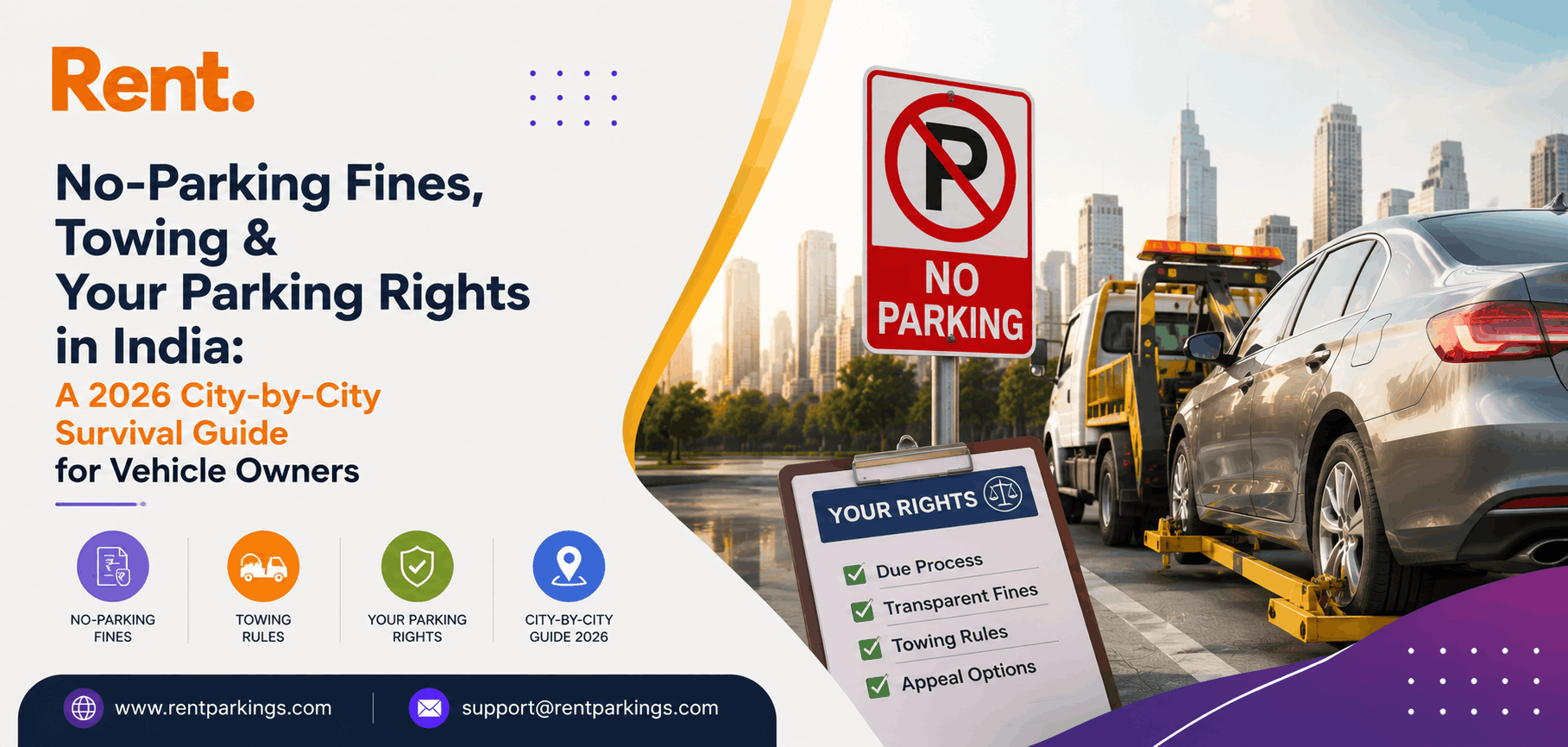
No-Parking Fines, Towing & Your Parking Rights in India: A 2026 City-by-City Survival Guide for Vehicle Owners
You step out of a shop in Indiranagar, glance toward the kerb where you left your hatchback ten minutes ago, and the space is empty. Not stolen, towed. Somewhere across Bengaluru, a crane-mounted truck is hauling your car to a yard, the meter on your wallet already running. If you have ever felt that specific drop in your stomach, you already understand why this guide exists.
India crossed 400 million registered vehicles in 2025, up from 326 million in 2020, and the national average now sits at roughly 280 vehicles for every 1,000 people. Yet the tarmac has not grown to match. On a normal working day, an estimated 40 per cent of road space in an average Indian city is consumed by parked vehicles rather than moving ones. The result is a daily collision between too many cars and too little legal space to keep them, and into that gap steps the traffic constable with an e-challan machine.
Most Indian vehicle owners can quote the price of petrol to the paisa but have no idea what a no-parking violation actually costs, how towing works, or what rights they hold over the very parking spot they think they bought. This RentParkings guide fixes that. It is not about earning from parking. It is about not bleeding money because of it.
What "No Parking" Actually Means in Indian Law
The phrase gets thrown around loosely, so it helps to be precise. Parking offences in India are prosecuted mainly under two sections of the Motor Vehicles Act, 1988 (as amended in 2019). Section 122 deals with leaving a vehicle in a position that causes danger, obstruction or inconvenience. Section 177, the general penalty clause, is what most no-parking challans are issued under, and it prescribes ₹500 for a first offence and ₹1,500 for any subsequent offence.
That central figure is only the floor. The Motor Vehicles Act lets states and city traffic authorities notify their own schedules, so the amount you actually pay depends far more on where you parked than on the Act itself. A "no parking" board, a yellow kerb line, a tow-away-zone sign, a footpath, a bus stop, within 15 metres of an intersection, in front of a fire hydrant or a hospital gate, all of these convert an ordinary stop into a finable, and frequently towable, offence.
There is also a crucial distinction that trips up thousands of motorists: the towing charge and the challan are two separate bills. Paying the crane operator to release your car does not wipe out the traffic violation. You settle the towing fee to recover the vehicle and the challan to clear your record, and in most cities, you have a limited window (often around 60 days) before the unpaid challan escalates.
City-by-City: What Bad Parking Costs in 2026
Penalty schedules change with municipal notifications, festival drives and court directions, so treat the figures below as current-2026 reference bands rather than eternal truths. Always confirm the live amount on your city traffic police portal or the Parivahan e-challan website before paying.
Delhi NCR
The capital region runs one of the most aggressive enforcement regimes in the country, simply because it has the most vehicles, well over 1.5 crore. No-parking penalties typically start around ₹500 and climb for obstruction. Towing charges are tiered by vehicle class, roughly ₹100 for two-wheelers, ₹200 for cars, and up to ₹400 for larger vehicles, with separate storage charges if you do not collect promptly. Gurugram and Noida apply their own variants, and tow-away zones around metro stations and markets are heavily patrolled.
Mumbai
Mumbai is in a league of its own. The Brihanmumbai Municipal Corporation, backed by a stringent no-parking policy around its scarce road space, levies car fines that commonly range from ₹1,000 to ₹2,000, with two-wheelers at ₹500–₹1,000 and towing charges of roughly ₹450–₹800. The real sting is for repeat offenders: BMC has powers to charge between ₹5,000 and ₹15,000 for those who habitually ignore no-parking rules near their residence or workplace. In a city where a designated spot can cost more than a small-town flat, the enforcement reflects the scarcity.
Bengaluru
Bengaluru's narrow arterial roads and chronic congestion mean the traffic police lean hard on no-parking enforcement, with fines that start from around ₹1,000 for parking in a no-parking area. The city made national headlines in 2026 when commuters were fined ₹500 for parking near a metro station that lacked adequate official parking, a flashpoint that captures the city's deeper problem: enforcement is racing ahead of infrastructure. (For the smarter way commuters are handling this, see our guide on parking near metro stations to save money.) BBMP and the traffic police also run regular towing drives in CBD zones like MG Road, Koramangala and Indiranagar.
Hyderabad
Hyderabad runs one of the more technology-forward systems, issuing no-parking penalties largely through an advanced e-challan platform rather than only on-the-spot. Towing fines are clearly tiered: ₹600 for heavy motor vehicles, ₹300 for light motor vehicles, ₹200 for a car, jeep, auto or rickshaw, and ₹150 for a two-wheeler, with the traffic challan stacked on top. The Cyberabad and Hyderabad commissionerates both publish spot-fine schedules online, which makes contesting an erroneous challan more transparent than in many other cities.
Chennai
Chennai tends to sit at the gentler end of the spectrum, with no-parking fines generally in the ₹500–₹1,500 band for four-wheelers and ₹300–₹500 for two-wheelers, though enforcement intensifies sharply around T. Nagar, Marina and railway terminals, especially during festival shopping seasons. Greater Chennai Traffic Police increasingly use camera-based and app-based challans.
Pune, Ahmedabad, Kolkata and Kochi
Pune mirrors Mumbai's framework at slightly lower amounts and has expanded paid on-street parking zones where parking outside a marked bay invites a fine. Ahmedabad, under its Smart City programme, has rolled out designated paid-parking corridors where non-compliance is penalised. Kolkata blends municipal parking fees with traffic-police action, and unauthorised parking on its famously crowded central streets draws quick towing. Kochi, smaller but rapidly motorising, enforces no-parking zones around the metro corridor and MG Road. Across all of these, the pattern is identical: a base challan of a few hundred to a couple of thousand rupees, plus a separate towing or clamping fee.
Tier-2 and Tier-3 Cities
In cities like Coimbatore, Indore, Jaipur, Lucknow, Nagpur, Visakhapatnam and Surat, fine amounts are usually lower, but two things are rising fast: the spread of e-challan and CCTV-based enforcement (so the "the constable didn't see me" era is ending), and the introduction of paid parking zones as these cities chase Smart Cities Mission funding. The smaller-city motorist who assumes lax enforcement is increasingly the one caught off guard by a digital challan arriving on their phone days later.
How Towing, Clamping and E-Challan Actually Work
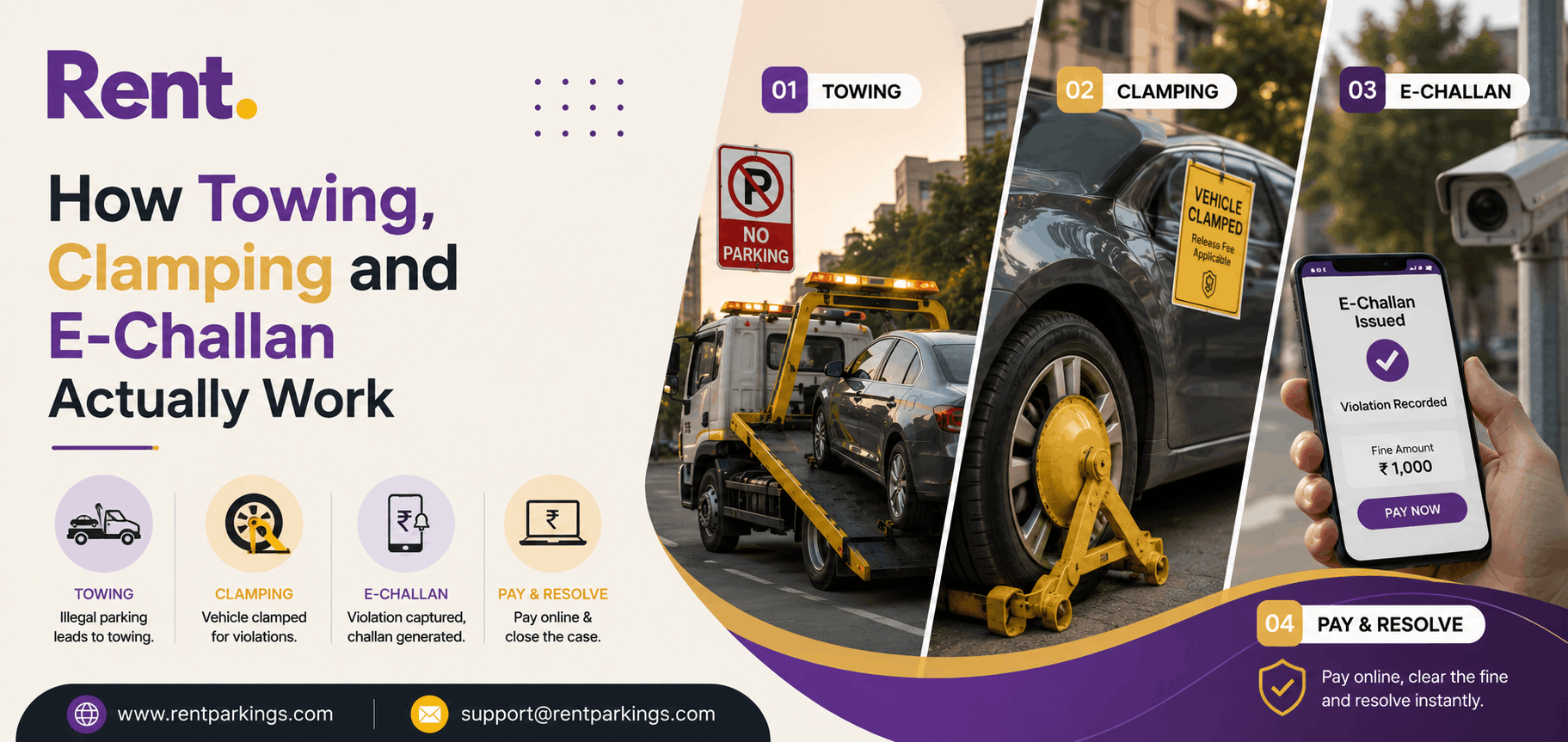
Understanding the mechanics saves both money and panic.
Towing. When your vehicle is lifted, it is taken to a designated towing yard or the nearest traffic police station. To recover it you generally need to carry the registration certificate, your driving licence, and proof of identity, then pay the towing fee plus any daily storage charge and clear (or formally acknowledge) the challan. In several cities you have roughly 60 days before complications mount, but storage charges accrue daily, so speed matters.
Clamping (wheel locks). Increasingly common in commercial districts, a clamp immobilises the vehicle in place rather than removing it. You typically call the number on the notice stuck to your windscreen, pay the penalty, and wait for an official to unclamp it. Attempting to drive off with a clamp attached damages the car and invites a heavier penalty.
E-challan. Camera networks, traffic-police apps and digital ticketing mean a fair share of parking penalties now arrive after the fact, an SMS or an entry on the Parivahan portal linked to your registration number. You can verify and pay these online. Critically, unpaid e-challans can block services such as insurance renewal smoothness, fitness certification, and resale transfer, and can be flagged at the next checkpoint. Ignoring them is the expensive option.
Contesting a wrong challan. If a board was missing, faded, or you were demonstrably parked legally, most city portals and the virtual traffic-court mechanisms (Lok Adalat traffic challan drives are held periodically) let you dispute it. Photograph the scene, the signage (or absence of it), and the kerb markings the moment you suspect an error, that evidence is your strongest defence.
The Parking Rights Most Indians Never Knew They Had
Here is where this becomes more than a fine schedule. Many disputes that look like "traffic" problems are really ownership problems, and the law is clearer than most flat owners realise.
Can a builder sell you a parking spot?
In the landmark 2010 case Nahalchand Laloochand Pvt Ltd vs Panchali Co-operative Housing Society, the Supreme Court of India held that open and stilt parking spaces are part of the "common areas and facilities" of a housing project and cannot be sold by a builder as independent, separate units. The reasoning is simple and powerful: the cost of the land and construction is already bundled into the price of your flat, so charging extra for a slice of that same land as a standalone "parking unit" is an unfair practice.
The bench drew a sharp line between a stilt or open space (common area, to be allotted by the society, not sold) and a true closed garage, an enclosed structure with a roof and walls on three sides, providing an independent, lockable space. Only a genuine garage can be legitimately sold. For the purposes of laws like the Maharashtra Ownership Flats Act, a stilt portion may be usable for parking but cannot be treated as a saleable garage.
For the everyday Indian homebuyer, the practical takeaways are concrete. A builder demanding a separate, large "parking purchase" price for open or stilt parking is on shaky legal ground. Allotment of common parking is properly the job of the housing society or RWA, which can frame fair, transparent rules for distribution among members. And if you are buying a new flat, the parking arrangement and its legality deserve as much scrutiny as the carpet area.
Parking inside your society
Once you live there, parking rights flow from the society's bye-laws and resolutions, not from a one-time builder promise. A society can allot spaces, regulate visitor parking, and penalise members who block fire lanes or encroach on common passages. It generally cannot arbitrarily strip a member of a long-allotted space without due process, nor allow permanent private sale of common area. When neighbours clash over a spot, the correct forum is the managing committee and, if needed, the Registrar of Cooperative Societies or the relevant state RERA authority, not a shouting match in the basement. The deeper backdrop here is India's growing parking crisis in apartment complexes, which is exactly why clear society rules matter more every year.
Accessible and reserved parking
Public buildings, malls and many commercial complexes are required to provide reserved, accessible parking for persons with disabilities under accessibility norms. Misusing these reserved bays is both a civic and, increasingly, an enforced violation. As Indian cities digitise parking, expect tighter monitoring of reserved and emergency bays.
Why This Keeps Getting Worse, and Where It's Heading
The friction is structural. Two-wheelers alone number around 260 million, cars around 50 million and climbing, and projections suggest the total vehicle fleet could nearly double from 2023 levels to almost 494 million by 2050. The annual additional parking demand in a single city can equal hundreds of football fields of space. No enforcement drive can out-fine a supply problem of that magnitude.
But three shifts are changing the picture. First, the Smart Cities Mission has pushed dozens of cities toward sensor-based, app-managed paid parking that replaces the free-for-all kerb with priced, monitored bays, orderly, but unforgiving of the motorist who ignores the rules. Second, EV adoption (electric vehicles hit roughly 8 per cent of new registrations in 2025) is reshaping parking around charging access, layering new society and public-charging rules onto old parking ones, a tangle the RentParkings playbook for getting an EV charger past your society gate walks through in detail. Third, metro expansion across Bengaluru, Hyderabad, Chennai, Pune, Kochi and the NCR is concentrating demand at station precincts, creating exactly the kind of enforcement flashpoint Bengaluru saw in 2026.
The direction of travel is clear: parking in India is moving from unregulated and free to digitised, priced and strictly enforced. The motorist who learns the rules now will spend the next decade paying far less in penalties than the one who waits to learn them the hard way.
FASTag, Smart Bays and the Cashless Parking Shift
The same FASTag sticker on your windscreen that pays your highway toll is quietly becoming a parking instrument. Several airports, malls and municipal lots, across Hyderabad, Bengaluru, the Delhi NCR and a growing list of Smart City pilots, now run FASTag-based, boom-barrier parking where entry and exit are logged automatically and the fee is debited from your linked account. The convenience is real, but so is the new failure mode: a low FASTag balance or a deactivated tag can leave you stuck at the exit barrier, and some operators levy a penalty for tag mismatches. The lesson for 2026 is simple, keep your FASTag funded and KYC-valid the same way you keep fuel in the tank.
Alongside this, sensor-equipped smart parking bays are spreading through commercial districts. Ground sensors and overhead cameras detect occupancy, feed availability to a mobile app, and, crucially, flag overstays and non-payment automatically. In a manually enforced world you could gamble that no constable would pass by; in a sensor-managed bay, the system itself is the enforcer, and the penalty is generated without a human in the loop. This is precisely why "I only stopped for five minutes" is fast becoming an obsolete excuse.
A Real-World Cost Scenario
Consider a typical Bengaluru weekday. You park on a no-parking stretch off a busy commercial road to dash into a bank. The base challan is around ₹1,000. While you are inside, the towing crew lifts the car: add a towing charge, plus the auto-rickshaw you now hail to reach the towing yard, plus a half-day of your time, plus a storage charge if you cannot get there before the cut-off. A ten-minute "free" parking decision has quietly become a ₹1,500-plus afternoon and a ruined schedule. Set against that, the ₹40 you would have paid at the official multi-level car park two streets away is not an expense, it is insurance. If you commute the same route daily, locking in a budget-friendly monthly parking spot makes that insurance cheaper still. Framing parking spend this way is the single most useful mental shift an Indian motorist can make.
Actionable Takeaways: Stay Fine-Free in 2026
- Read the kerb, not just the road. Yellow lines, "no parking" boards, tow-away signs, footpaths, bus stops and the 15-metre zone near intersections are all finable. When in doubt, assume it is a no-parking zone.
- Photograph before you walk away if signage is unclear. That photo is your evidence if a wrong challan lands.
- Check your e-challan status periodically on the Parivahan portal using your registration number, penalties now arrive silently and compound if ignored.
- Keep RC, licence and ID accessible, not buried in the glovebox, so you can recover a towed vehicle fast and minimise storage charges.
- Remember the two-bill rule: towing fee recovers the car, the challan clears the offence. Settle both.
- For homebuyers: never pay a builder a separate "sale price" for open or stilt parking without legal advice, the Supreme Court has held these are common areas, not saleable units.
- For society residents: resolve parking disputes through the managing committee and bye-laws, and insist on transparent, documented allotment.
- Use official paid parking near metros, malls and markets. A ₹30–₹60 parking ticket is always cheaper than a ₹1,000 challan plus towing, and if you want to know the going rate in your city, check the RentParkings city-by-city parking rate guide.
Conclusion
Parking in India has quietly become one of the most expensive small mistakes a vehicle owner can make, not because any single fine is large, but because the rules are invisible until you break them and the bills arrive in pairs. The same congestion that makes a legal spot hard to find is exactly what makes the illegal one so costly. Yet almost everything in this guide is knowable in advance: the city-wise penalty bands, the separation of towing and challan, the digital trail of e-challans, and above all the rights you already hold over the parking your flat purchase included.
As the country digitises its kerbs and prices its bays, the gap between informed and uninformed motorists will only widen. Knowing what a no-parking violation costs in your city, knowing how to recover a towed car without overpaying, and knowing that a builder cannot quietly sell you land you already own, that knowledge is, in the most literal sense, money in your pocket. Park smart, keep your paperwork ready, and let the fines fall on someone who didn't read this. RentParkings will keep decoding India's fast-changing parking landscape, one practical guide at a time.
FAQs
What is the no-parking fine in India in 2026?
Under Section 177 of the Motor Vehicles Act, the base no-parking penalty is ₹500 for a first offence and ₹1,500 for repeat offences. Individual cities set higher amounts, typically ₹500 to ₹2,000 for cars, and add separate towing charges on top.
Do I have to pay both the towing charge and the challan?
Yes. The towing fee is what you pay to physically recover your vehicle, while the challan is the penalty for the parking violation itself. Clearing the towing charge does not cancel the challan; both have to be settled.
How much are towing charges in Indian cities?
Towing charges vary by city and vehicle type, broadly from about ₹150 for a two-wheeler to ₹800 for a car or larger vehicle. For example, Hyderabad charges roughly ₹150 for two-wheelers, ₹200 for cars and ₹600 for heavy vehicles, while Mumbai's range is around ₹450–₹800.
Which Indian city has the highest no-parking fines?
Mumbai is generally the most expensive, with car fines of ₹1,000–₹2,000 and repeat-offender penalties that the BMC can set between ₹5,000 and ₹15,000. Bengaluru and Delhi NCR also enforce heavily, especially in commercial zones and near metro stations.
How do I recover a car that has been towed in India?
Go to the designated towing yard or the nearest traffic police station, carry your registration certificate, driving licence and ID proof, then pay the towing fee, any daily storage charge, and clear the challan. Collect the vehicle quickly, since storage charges usually accrue each day.
Can I check and pay a parking e-challan online?
Yes. Parking e-challans are linked to your vehicle registration number and can be viewed and paid on the Parivahan e-challan portal or your city traffic police website. Unpaid e-challans can complicate insurance renewal, fitness certification and vehicle resale, so it is best to clear them promptly.
Can a builder charge me extra to sell a parking space in my apartment?
No, not for open or stilt parking. In the 2010 Nahalchand Laloochand judgment, the Supreme Court held that open and stilt parking are common areas of the housing project and cannot be sold as separate units. Only a genuine enclosed garage with a roof and three walls can be legitimately sold.
Who allots parking inside a housing society in India?
Parking allotment in a registered housing society is the responsibility of the society or RWA through its bye-laws and resolutions, not the builder. The society can frame fair rules for distributing common parking among members and regulate visitor parking.
What should I do if I receive a wrong parking challan?
Gather evidence immediately, photograph the spot, any missing or faded signage, and the kerb markings. You can then contest the challan through your city traffic police portal or at a traffic Lok Adalat, where disputed challans are reviewed.
How can I avoid parking fines in Indian cities?
Park only in marked or paid parking bays, avoid yellow lines, footpaths, bus stops, no-parking boards and the area within 15 metres of intersections, and use official parking near metros and markets. A small paid-parking ticket is always cheaper than a challan plus towing.
Share This post
Search
Recent Post
Parking Space vs. Renting Out a Room to...
05 Oct, 2026
Think Parking Rental Only Pays in Mumbai...
02 Oct, 2026
Your Mumbai Parking Space Is Worth More...
01 Oct, 2026
Hyderabad's Real Estate Boom Left One As...
30 Sep, 2026
What Your Parking Space in Chennai Could...
29 Sep, 2026
Your Plans Changed After Listing Your Pa...
28 Sep, 2026
Parking Space vs SIP: Which Idle Asset A...
25 Sep, 2026
What Your Parking Space in Pune Could Ac...
24 Sep, 2026