

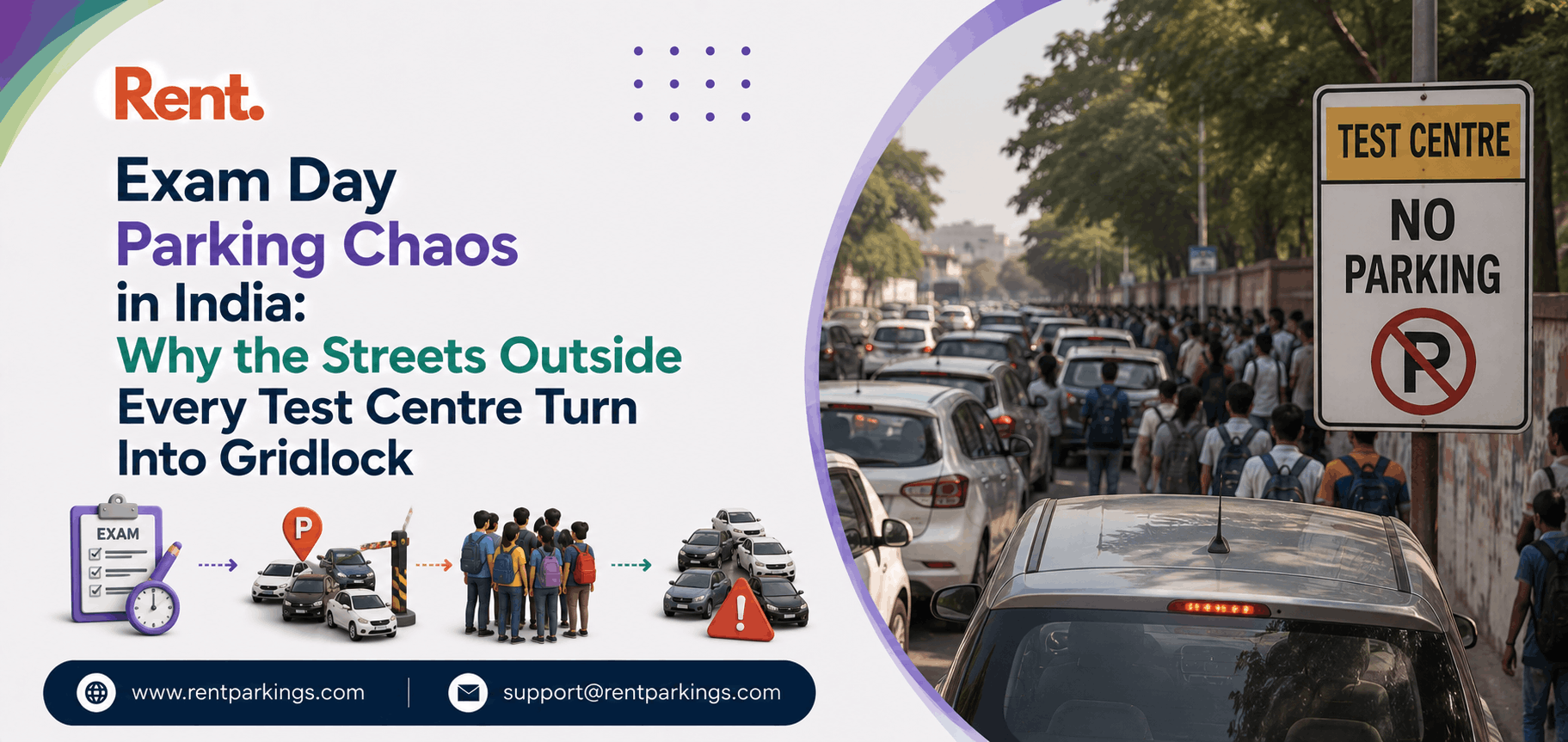
Exam Day Parking Chaos in India: Why the Streets Outside Every Test Centre Turn Into Gridlock
Ask any parent who has driven a child to a NEET or JEE exam centre in Kota, Hyderabad, or Delhi NCR what the morning felt like, and you'll get the same answer: they were still hunting for a place to park twenty minutes after they arrived, with the exam clock already running in their head.
It's a strange kind of traffic problem. It doesn't happen every day. It happens on specific Sundays, a handful of mornings a year, when lakhs of students sit for the same test at the same hour across hundreds of centres. And because it's occasional, almost nobody plans for it properly, not the schools that host the centres, not the traffic police, and certainly not the families who show up assuming they'll find a spot within walking distance.
They rarely do. What follows instead is a familiar scene: double-parked cars along narrow lanes, autos and cabs idling wherever they can squeeze in, constables waving vehicles further and further from the gate, and parents pacing the footpath because they can't leave the car unattended in a no-parking zone. RentParkings, India's parking marketplace, sees a version of this pattern play out around almost every kind of high-footfall event, and exam season is one of the sharpest examples of it.
What Exam Day Actually Looks Like Outside a Test
Centre
Most exam centres in India are ordinary schools or colleges. They were built to handle staff cars and a few buses, not a sudden surge of private vehicles arriving within the same thirty-minute window.
On a normal school day, the parking lane outside stays half empty. On exam day, that same stretch of road absorbs cars belonging to hundreds of candidates, plus the drivers who came just to drop someone off, plus anxious parents who insist on waiting nearby until the exam ends.
Multiply that by the number of centres in a single city and you get a temporary but very real parking emergency, one that repeats itself every time a major national or state exam is scheduled.
Why the Same Streets Break Down Every Single Time
The pattern is predictable once you look at what's actually causing it.
- Centres are chosen for exam-hall capacity, not parking capacity. Exam boards allot venues based on how many desks a building can hold, not how many cars its lane can absorb.
- Everyone arrives in the same short window. Reporting time is usually fixed within a 60 to 90 minute band, so the surge is concentrated rather than spread across the day.
- Families travel together, not alone. It's common in India for a parent, sometimes two, to accompany a candidate, which roughly doubles the number of adults hovering near the gate with nowhere to sit and nothing to do but wait in the car.
- Traffic police impose last-minute no-parking cordons. To keep the main gate clear for security checks, constables often push private vehicles two or three lanes away, sometimes with barely any signage warning drivers in advance.
- Local businesses and residents get squeezed too. Shopkeepers and homeowners near the centre lose their own parking for the morning, which is exactly the kind of friction that turns into arguments on the street.
None of this is unique to one city. Coaching-heavy towns like Kota deal with a milder version of it almost weekly, since test series and mock exams run on a near-continuous calendar there. Bigger metros like Bengaluru, Mumbai, and Chennai feel it in sharper bursts, concentrated around board exam season and the big national entrance tests.
The Numbers Nobody Officially Tracks
There's no single national dataset on exam-day parking demand, and any article claiming exact figures for it should be read with suspicion. Talk to property owners and shop staff near exam centres, and a fairly consistent pattern emerges. At a mid-sized centre handling a few hundred candidates, the surrounding streets can see 150 to 300 private vehicles pass through in just a two-hour window. Most of these drivers aren't dropping someone off and moving on: they're circling for a place to park and settling in for the wait.
That's a lot of vehicles competing for a stretch of road that, on any other day, might comfortably fit twenty cars.
The Real Cost: Fines, Towing, and Missed Reporting Time
The stakes here aren't just inconvenience. Exam halls in India are famously strict about late entry, and several boards close the gate the moment reporting time ends, no exceptions, no matter how good the excuse.
Drivers who park illegally near a cordoned exam zone also run a real risk of a challan or towing, particularly once traffic police start actively clearing the area an hour or so before the exam begins. Our city-by-city breakdown of no-parking fines and towing rules is worth bookmarking, since the penalties and the process for getting a towed vehicle back vary more than most drivers expect.
So you end up with two bad outcomes competing with each other: park illegally and risk a fine or a tow, or keep circling for a legal spot and risk missing the reporting window entirely. That's not where any parent wants to find themselves fifteen minutes before their child's biggest exam of the year.
Which Exams Create the Biggest Crunch
Not every test causes the same level of chaos. The ones that do tend to share two things: a huge candidate pool and centres concentrated in specific pockets of a city.
- NEET (UG): among the largest single-day exams in the country, with dense centre clusters in cities known for medical coaching.
- JEE Main and JEE Advanced: multiple sessions a year, each triggering the same scramble in engineering-coaching hubs.
- UPSC Civil Services Prelims: fewer candidates per centre, but centres are often in older, congested parts of a city with almost no spare road width.
- SSC CGL and other SSC exams: spread across smaller towns too, where parking infrastructure is even thinner than in metros.
- Bank PO and Clerk exams (IBPS, SBI): multiple shifts in a single day at the same centre, meaning the surge repeats itself two or three times before evening.
- CAT and other management entrance tests: centres often sit inside business districts that are already parking-starved on a normal working day.
- State board Class 10 and Class 12 finals: spread over weeks, but each date brings its own mini version of the same rush, this time with younger students and more anxious parents.
The Quiet Income Opportunity Hiding in This Chaos
Here's the part most people never think about: every one of these exam days is also a short, predictable burst of demand for exactly the kind of asset a lot of Indian property owners already have and rarely use, a driveway, a vacant plot, or a covered space near their gate.
If you live within walking distance of a school or college that regularly hosts exams, you're sitting on something genuinely valuable for a few hours at a time, several times a year. We broke down what it actually takes to rent out a driveway in India, and the same logic applies here almost exactly, except the demand is even more concentrated and easier to predict, since exam dates are published months in advance.
Owners near coaching hubs like Kota, or near exam-heavy neighbourhoods in Jaipur, Lucknow, Pune, and Coimbatore, are often better positioned for this than owners in the busiest parts of Delhi or Mumbai, simply because the competition for space is less intense and word travels fast in smaller, tighter-knit localities. It helps to know the going rates in your area first. Our city-wise guide to parking space rental income lays out realistic earning ranges before you set your own price.
How Much Space You're Actually Working With
Before listing a spot for exam-day parking, it helps to know exactly what fits. A standard hatchback needs roughly 4.5 to 5 metres in length and 2.4 metres in width to park and open its doors comfortably, and most Indian driveways can fit one car plus a two-wheeler alongside it without much trouble. Our detailed breakdown of standard car parking dimensions in India is worth a quick look before you decide how many vehicles your space can realistically take, especially if you're planning to list more than one slot on exam day.
A Practical Playbook for Owners Near Exam Centres
If you're within ten to fifteen minutes' walk of a regular exam venue, here's a simple way to think about turning that into income rather than letting the chaos pass you by.
- Check the exam calendar early. NEET, JEE, board exams, and major recruitment tests all publish dates months ahead, so you can plan without guesswork.
- Price it as a flat exam-day rate, not an hourly one. Parents want certainty on a stressful morning, not a meter running in the background.
- List the space a week or two in advance. Families searching for parking rarely start looking the night before, they start as soon as their admit card arrives.
- Be clear about walking distance and safety. A verified, well-lit spot close to the centre will always beat a cheaper one further away, especially for parents accompanying daughters.
- Keep it simple on the day. A visible marker, a bit of shade if possible, and someone reachable by phone go a long way toward a five-star review.
This pattern shows up again and again across India's busiest parking hotspots, a narrow window of extreme demand followed by hours of nothing, and owners who understand that rhythm are the ones who benefit most from listing ahead of time rather than reacting on the morning itself.
What Parents and Students Can Do Differently
On the demand side, the fix is almost embarrassingly simple: stop assuming you'll find something near the gate. Search and book a verified spot within walking distance before the exam date, not on the drive there. It removes one entire source of stress from a morning that already has enough of it, and it means arriving with fifteen spare minutes instead of spending them stuck behind a police barricade three streets away.
Frequently Asked Questions
1. Why is parking near exam centres so much worse than on a normal day?
Because reporting time is fixed within a narrow window, hundreds of vehicles arrive at almost the same moment instead of spreading out across the day. Add family members accompanying candidates and last-minute police cordons, and a lane that's normally quiet turns into a bottleneck within minutes.
2. Can traffic police tow my car if I park near an exam centre?
Yes, if you're parked inside a cordoned no-parking zone set up for the exam, towing and challans are both possible, and enforcement tends to get stricter as reporting time approaches. It's safer to book a spot outside the restricted zone in advance rather than risk it.
3. How early should I look for parking on exam day?
Ideally a week or more before, once the admit card confirms the exact centre. Waiting until the morning of the exam means competing with everyone else for the same handful of legal spots.
4. Is it legal to rent out my driveway for exam-day parking?
Yes, renting out a private driveway or vacant plot for short-term parking is legal in India, provided it doesn't obstruct public roads or violate local municipal rules. Most owners simply list the space and let drivers book it directly.
5. How much can a property owner near an exam centre realistically earn on a single exam day?
It varies by city and how close the space is to the venue, but owners typically charge a flat rate for the exam window rather than an hourly fee, since demand is concentrated into just a few hours. Spaces within a short walk of the gate tend to command the highest rates.
6. Which exams cause the worst parking congestion in India?
NEET, JEE Main and Advanced, UPSC Civil Services Prelims, SSC exams, bank recruitment tests, CAT, and state board finals are the biggest culprits, mainly because of how many candidates sit at once and how tightly centres cluster in certain neighbourhoods.
7. Do coaching hubs like Kota face this problem more often than other cities?
In a sense, yes. Because Kota runs frequent mock tests and test series alongside the major national exams, the parking pressure around its coaching centres and test venues repeats far more often than in cities where it's tied to just one or two exam dates a year.
8. Is it safe for parents to wait inside a parked car near an exam centre?
It can be, as long as the vehicle isn't in a restricted zone and the area is reasonably well monitored. Choosing a verified parking spot with some visibility, rather than an isolated stretch of road, is generally the safer option.
9. What's the difference between exam-day parking demand and regular event parking?
Event parking, like weddings or festivals, is usually planned around a known venue with some existing infrastructure. Exam-day demand is trickier because it hits ordinary schools and colleges that were never designed for parking surges, and it repeats on a recurring, exam-board-driven calendar rather than a one-off date.
10. How can property owners find out which exams are scheduled near them?
Exam boards like NTA, UPSC, SSC, and state education departments publish official calendars and centre lists months in advance. Owners near known exam venues can simply check these public schedules and list their space ahead of the relevant dates.
The Takeaway
Exam day parking chaos isn't going away on its own. Centres will keep being chosen for classroom capacity rather than road capacity, and families will keep travelling together out of habit and concern rather than convenience. What can change is how prepared both sides are for it, parents booking a verified spot ahead of time instead of gambling on finding one, and owners near these centres recognising that a few hours of otherwise idle space is worth something real, several times a year.
If you own a driveway, garage, or open plot anywhere near a school, college, or coaching centre that regularly hosts exams, this is exactly the kind of recurring demand worth capturing. List your parking space on RentParkings and start earning from the mornings your street turns into the busiest stretch of road in the neighbourhood, on your own terms, whether that's an hourly, daily, or exam-day rate.
Share This post
Search
Recent Post
Parking Space vs. Renting Out a Room to...
05 Oct, 2026
Think Parking Rental Only Pays in Mumbai...
02 Oct, 2026
Your Mumbai Parking Space Is Worth More...
01 Oct, 2026
Hyderabad's Real Estate Boom Left One As...
30 Sep, 2026
What Your Parking Space in Chennai Could...
29 Sep, 2026
Your Plans Changed After Listing Your Pa...
28 Sep, 2026
Parking Space vs SIP: Which Idle Asset A...
25 Sep, 2026
What Your Parking Space in Pune Could Ac...
24 Sep, 2026