

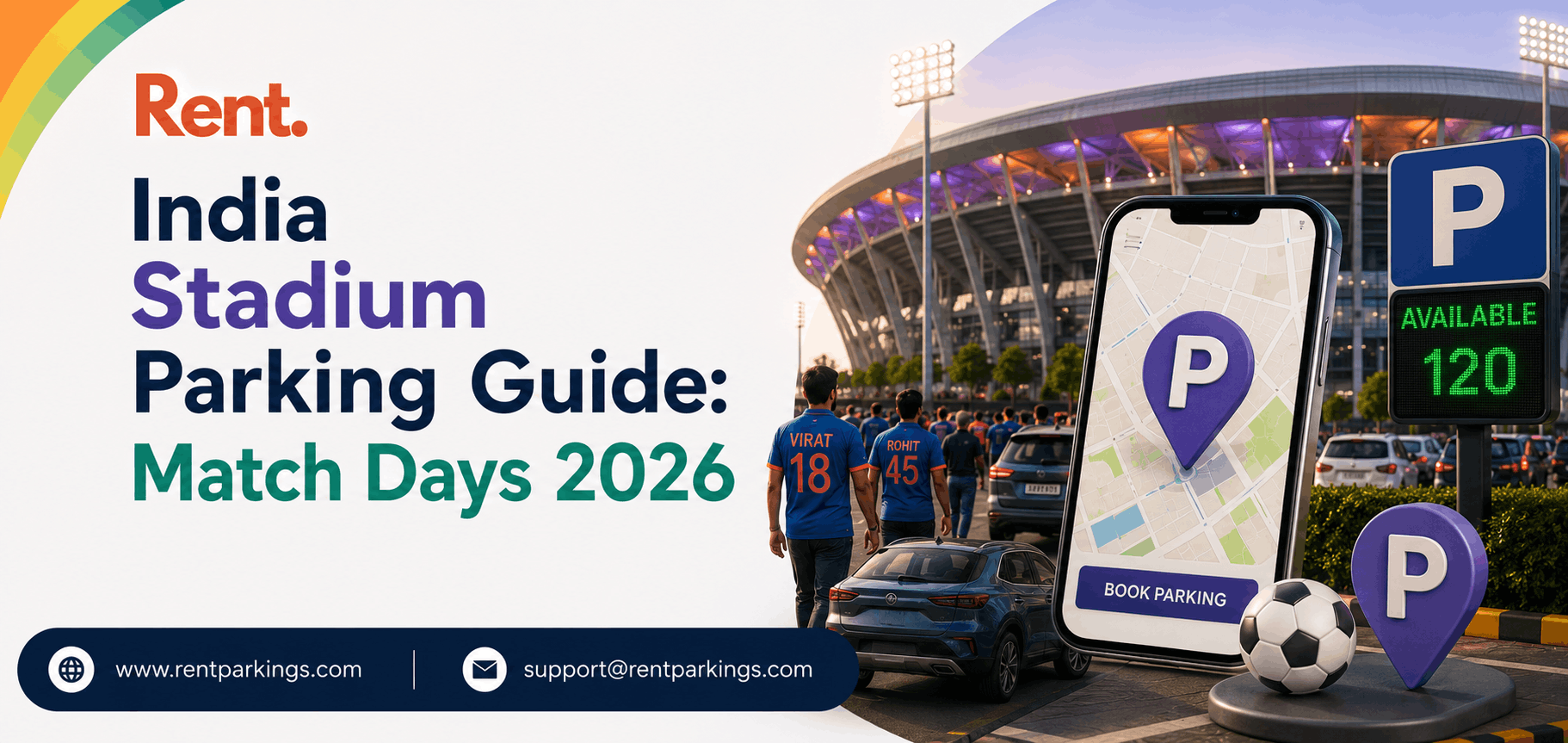
India Stadium Parking Guide: Match Days 2026
Ekana Stadium in Lucknow holds close to fifty thousand people. On a normal Tuesday, the road leading up to it is quiet enough that a stray dog can nap in the middle lane. On an IPL night, that same stretch turns into something closer to a slow-moving river of headlights, two hours before the toss and long after the last over.
This is the part of Indian cricket, football and event culture that nobody puts on a highlight reel: the parking. Not the stadium itself, not the floodlights or the anthem before kickoff, but the fifteen minutes of pure chaos that happens on every street within a kilometre of the gate.
It's a genuine urban planning gap, and increasingly, it's also a business opportunity for property owners who happen to live near the action. RentParkings, India's growing parking marketplace, has watched this pattern repeat across cities every match season, and it's worth understanding both sides of it.
How Big Is the Gap, Really?
Take a stadium like Narendra Modi Stadium in Ahmedabad, the largest cricket ground in the world by seating capacity. It can hold well over a lakh spectators. Even with a generous multi-level parking structure on site, a large share of that crowd arrives by car, auto, or bike, and the venue's own lots simply cannot absorb everyone.
The same math plays out, in smaller proportions, at Chepauk in Chennai, Chinnaswamy in Bengaluru, Eden Gardens in Kolkata, Wankhede in Mumbai, and the Arun Jaitley Stadium in Delhi. These are older grounds, built in an era when far fewer fans arrived by private vehicle. Retrofitting them with enough parking would mean tearing down surrounding neighbourhoods, which nobody is proposing.
So the overflow goes somewhere. It goes into residential lanes, into shop fronts that are closed for the evening, into government office compounds, and into any gate that isn't chained shut. Some of that overflow is unauthorised and messy. Some of it, increasingly, is organised and paid for.
For a sense of scale, our roundup of India's busiest parking hotspots and where demand runs out fastest shows that stadium zones behave a lot like railway stations or big office corridors on any given weekday. Supply simply can't keep pace with a sudden concentration of people arriving at the same time.
The gap is worst in the two or three hours before a match starts, when everyone tries to arrive at once, and again right after the final whistle, when everyone tries to leave at once.
Why Stadiums Can't Fix This on Their Own
Most Indian stadiums sit inside dense, already-built city fabric. Chepauk is boxed in by residential streets that have existed for generations. Wankhede sits close to Marine Drive and a cluster of commercial buildings with no spare land in any direction.
Building new parking towers on these sites usually isn't realistic. Land acquisition near a functioning stadium is expensive and politically messy, and match days happen only a handful of times a year, which makes a dedicated structure hard to justify financially for the venue itself.
That leaves the surrounding neighbourhood to absorb the demand, whether it wants to or not. The interesting shift over the last couple of years is that some of those neighbourhoods have started treating it as income rather than inconvenience.
Who's Quietly Filling the Gap
Owners of homes, shops, and empty plots within walking distance of major venues have realised something simple: a driveway that sits empty three hundred and sixty days a year can earn real money on the five or six nights it matters most.
This isn't unique to stadiums. Similar demand spikes show up around temples during major festivals, where nearby landowners see months of quiet followed by a few days of intense footfall. Our piece on temple parking economics around festivals like Navratri covers the same pattern from a different angle, and the underlying math is nearly identical: short bursts of extreme demand are worth more, per hour, than steady low demand ever will be.
What's different with stadiums is the predictability. Match calendars are published months in advance. An owner near a venue can literally mark the dates on a wall calendar and plan around them, rather than guessing when the next spike might hit.
What Match-Day Parking Actually Pays
Pricing near stadiums moves in a completely different band from regular monthly parking. A spot that might rent for a few thousand rupees a month under a long-term arrangement can pull in a few hundred rupees for a single evening, sometimes more, depending on distance from the gate and how tight supply is that night.
For context on baseline numbers across Indian cities, our detailed breakdown of what property owners typically earn from renting out parking space is a useful starting point before layering event pricing on top. Owners near stadiums tend to treat match nights as a premium add-on to that base income rather than their entire business model, since there are only so many high-profile matches in a season.
Rough figures reported by owners we've spoken with near major venues suggest two-wheeler spots going for somewhere in the range of fifty to a hundred and fifty rupees for a match night, and four-wheeler spots landing anywhere from two hundred to six hundred rupees depending on the city and the stakes of the game. A high-profile final or a derby match between rival franchises tends to push these numbers higher still.
Why the Nearer Spots Command a Premium
Distance from the gate matters enormously. A spot five minutes' walk from the entrance can charge two or three times what a spot fifteen minutes away commands, simply because fans arriving close to game time are willing to pay to avoid the long trudge in a crowd.
The Metro Alternative Some Fans Are Choosing Instead
Not every fan wants to deal with post-match traffic at all, and metro-connected cities are seeing more supporters skip the driveway hunt entirely. Bengaluru, Delhi NCR, and increasingly Kochi and Hyderabad have stations within a short walk of their major venues, which changes the calculation for a lot of commuters.
We've written before about how living near a metro station turns into an income opportunity of its own, and stadium nights are one of the clearest examples of that in action. A fan who parks near a metro stop on the outskirts and rides in avoids the worst of the post-match gridlock altogether, and the property owner near that station earns from the arrangement too.
This park-and-ride pattern is still a minority behaviour compared to driving straight to the venue, but it's growing, particularly among younger fans who'd rather spend an extra twenty minutes on a train than an extra ninety minutes stuck in a car park queue after the final wicket falls.
The Risk Side Nobody Mentions: Towing and Fines
Here's the part that catches a lot of first-time match-goers off guard. Traffic police in most stadium cities run visible enforcement drives on match nights specifically because informal roadside parking spills over so badly. A car left on what looks like an empty stretch of road can get clamped, challaned, or towed within the hour.
We covered the mechanics of this in detail in our guide to what happens when your vehicle gets towed in India and how to get it back, and stadium zones are exactly the kind of high-enforcement area where that guide becomes relevant fast. The safest move on a match night is always a verified, paid spot rather than a gamble on an empty-looking curb.
This is precisely where organised platforms add value over informal roadside arrangements. A driver who books a confirmed spot in advance knows exactly where they're going, avoids the enforcement risk entirely, and isn't circling the block at kickoff time hoping something opens up.
Doing This Safely as a Property Owner
For owners near a venue who want to try this, a few basics go a long way. Keep the arrangement documented, even if it's informal, so there's no confusion about timing or payment. Match end times can run long, especially if there's a super over or extra time, so build a buffer into whatever window is agreed.
Lighting matters more on match nights than any other night of the year, given the volume of strangers moving through the area in a short window. A well-lit driveway with a visible boundary reduces the odds of disputes and makes the space more attractive to drivers choosing between options nearby.
UPI has made the payment side almost frictionless. Most owners now collect match-night fees the same way they'd collect any other digital payment, with a QR code taped near the entrance doing most of the work.
- Confirm the exact match timing and likely finish time before quoting a price
- Keep a visible, well-lit boundary so drivers know exactly where they're allowed to park
- Use UPI or a similar digital method to avoid cash-handling hassles in a crowd
- Have a simple backup plan if a match runs into extra overs or a rain delay
- List recurring event dates in advance so regular commuters or fans can book ahead
Where This Is Headed in 2026
A few Indian cities have started experimenting with dynamic, app-based pricing for stadium-adjacent parking, similar to how ride-hailing apps adjust fares during surge periods. It's early days, and nowhere in India has this fully matured into a citywide system yet, but the direction is clear enough.
Municipal corporations in a handful of cities have also floated public-private partnership models for match-day traffic and parking management, treating it as a logistics problem worth solving properly rather than leaving it to informal arrangements. Whether these plans move from proposal to practice remains to be seen, but the demand signal is loud enough that something will likely change over the next few seasons.
What's unlikely to change soon is the core dynamic: stadiums will keep selling more tickets than they have parking for, and the streets around them will keep absorbing the difference. The only real question is whether that absorption stays chaotic and unpaid, or becomes organised and worth something to the people living nearby.
Frequently Asked Questions
1. How much can I charge for parking near a stadium on a match day in India?
Rates vary heavily by city and distance from the venue, but owners commonly report figures between fifty and one hundred fifty rupees for two-wheelers and two hundred to six hundred rupees for cars on a single match night. High-stakes games like finals typically push prices toward the upper end of that range.
2. Is it legal to rent out my driveway for stadium parking?
Yes, renting out private property you own or have the right to use, such as a driveway or empty plot, is legal in India. The concern is only ever with parking on public roads or someone else's land without permission, which is a different issue entirely.
3. Why do so many cars get towed on match nights specifically?
Traffic police increase enforcement drives around stadiums precisely because demand overwhelms official parking, pushing many drivers toward informal roadside spots that are technically illegal. Booking a verified private spot in advance avoids this risk completely.
4. Which Indian stadiums have the worst parking shortages?
Older, centrally located grounds tend to struggle most, including Chepauk in Chennai, Wankhede in Mumbai, and Eden Gardens in Kolkata, simply because they were built into dense city neighbourhoods long before private vehicle ownership reached today's levels.
5. How far in advance should I book parking near a stadium?
For high-demand matches like IPL playoffs or international fixtures, booking a day or two ahead is safer than assuming you'll find something on arrival. Popular spots near major gates fill up quickly once the match calendar is public.
6. Do stadium parking arrangements need a written contract?
A full legal contract isn't mandatory for a single evening's arrangement, but a simple written or messaged confirmation of price, timing, and vehicle details protects both sides if any dispute comes up later.
7. Is match-day parking income taxable in India?
Yes, income earned from renting out parking space, including occasional event-based earnings, counts as taxable income and should be declared under the relevant head when filing returns, the same as any other rental income.
8. Can two-wheelers and four-wheelers use the same private parking spot on match nights?
Many owners split their available space to accommodate both, since two-wheeler demand near stadiums is often just as high as four-wheeler demand, particularly from younger fans and local residents attending the match.
9. What happens if a match gets delayed and I need my parking spot back?
This is why building a buffer window into any agreement matters. Most owners quote pricing that already accounts for extra innings, rain delays, or extra time, rather than a fixed exit deadline that could cause friction with a driver still watching the match.
10. Is stadium parking demand only relevant during IPL season?
No. International cricket fixtures, domestic league matches, football tournaments, and concerts at the same venues all create similar spikes, just on a less predictable calendar than the IPL's published schedule.
Conclusion
Stadium parking in India isn't going to fix itself through new construction anytime soon, and that's actually good news for property owners who live near the action. The demand is real, it's predictable months in advance, and it pays considerably more per hour than an ordinary monthly parking arrangement ever could.
If you own a driveway, an empty plot, or a covered spot within reach of a major venue, match nights are sitting right there as income you're currently leaving on the table. List Your Parking Space on RentParkings and start turning those five or six big nights a year, plus every ordinary day in between, into steady money from verified drivers who are actively looking for exactly what you have.
Share This post
Search
Recent Post
Parking Space vs. Renting Out a Room to...
05 Oct, 2026
Think Parking Rental Only Pays in Mumbai...
02 Oct, 2026
Your Mumbai Parking Space Is Worth More...
01 Oct, 2026
Hyderabad's Real Estate Boom Left One As...
30 Sep, 2026
What Your Parking Space in Chennai Could...
29 Sep, 2026
Your Plans Changed After Listing Your Pa...
28 Sep, 2026
Parking Space vs SIP: Which Idle Asset A...
25 Sep, 2026
What Your Parking Space in Pune Could Ac...
24 Sep, 2026