

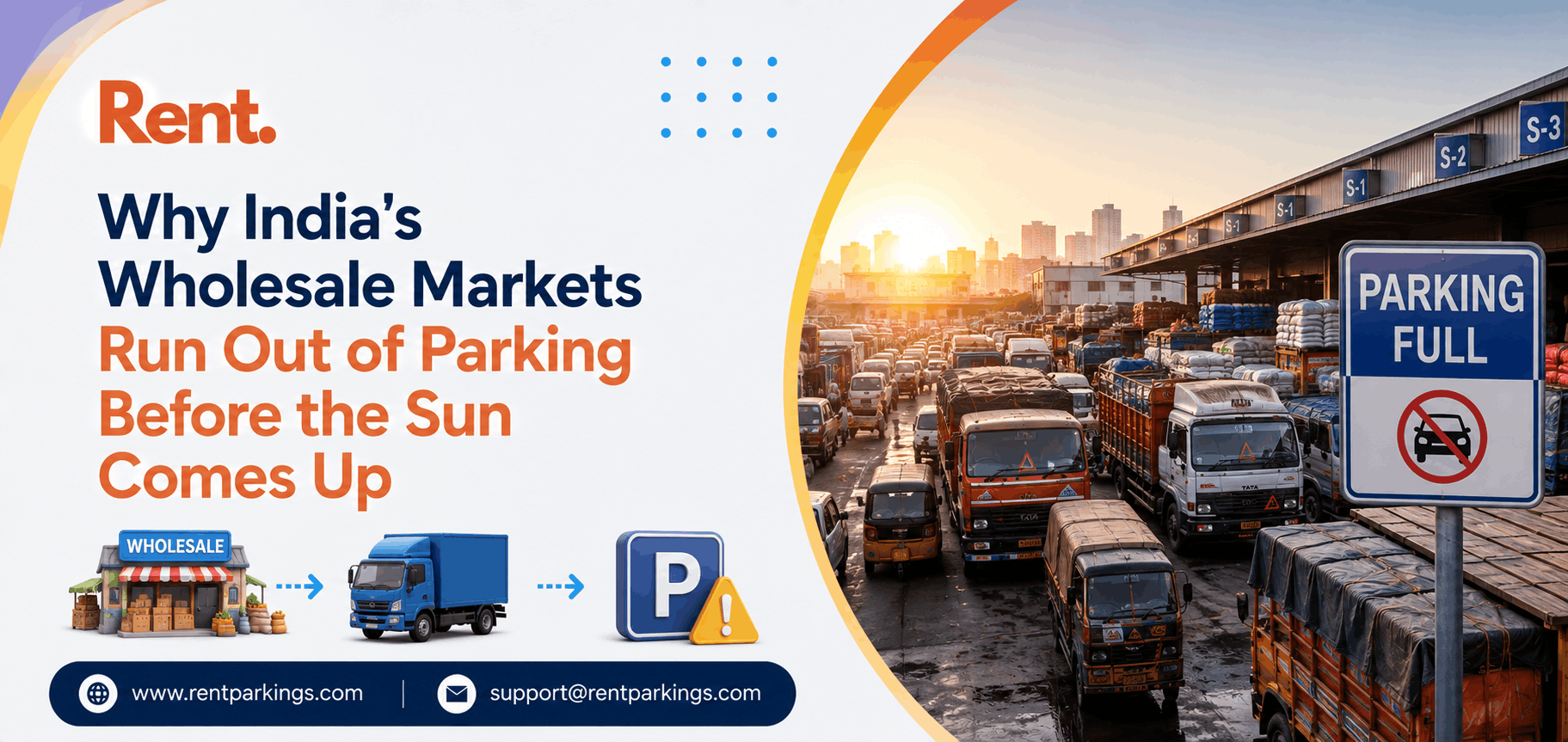
Why India's Wholesale Markets Run Out of Parking Before the Sun Comes Up
By 4:30 AM, the lane outside a wholesale vegetable market in any major Indian city already looks like a puzzle nobody solved on purpose. Mini-trucks are parked at angles that block three others. A handcart owner is arguing with a Bolero driver over six inches of road. Somewhere behind them, a buyer who drove in from a city fifteen kilometres away is circling for the fourth time, looking for anywhere to leave a hatchback for two hours.
This scene repeats every single morning at APMC yards, mandis, and wholesale trading hubs from Azadpur in Delhi to Koyambedu in Chennai. It has for decades. And somehow, in a country that debates parking shortages near malls, stadiums and metro stations constantly, almost nobody talks about the one type of parking crunch that happens daily, before dawn, at full intensity, every single day of the year.
That gap is exactly where an opportunity sits for property owners near these markets, and it is what this piece is about. Along the way we will look at who actually needs parking near a mandi, what makes this demand different from anything else in India's parking landscape, and how RentParkings, India's trusted parking marketplace, fits into solving it.
A Parking Problem Nobody Planned For
Most of India's wholesale markets were built decades before the vehicle count around them exploded. Azadpur Mandi in Delhi handles produce for a large part of North India and was never designed with modern trader fleets in mind. Koyambedu in Chennai, Vashi's APMC complex in Navi Mumbai, KR Market in Bengaluru, Gultekdi Market Yard in Pune, and Muthiganj Mandi near Kanpur all share the same story: infrastructure from an earlier era trying to absorb today's traffic.
Add to that the informal layout of most mandi zones. Loading and unloading happen on the same roads used for parking. Handcart movement competes with vehicle access. Municipal parking, where it exists at all, is usually built for cars, not for the mix of tempos, three-wheelers, mini-trucks and two-wheelers that actually show up.
The result is a rush hour that starts hours before the rest of the city wakes up, then largely disappears by mid-morning, only to build again in the evening for markets that run a second shift.
Who Actually Needs Parking Near a Mandi
It helps to separate the different groups competing for the same limited space, because their needs are not identical:
- Wholesale traders and commission agents, who need a fixed, reliable spot for their vehicle for hours at a stretch, often the same spot daily.
- Retail buyers and small shop owners, who drive in for thirty minutes to two hours to stock up, and need something quick and close to the entrance.
- Loaders and transport operators, whose mini-trucks and tempos need space not just to park but to load and unload without blocking the lane.
- Market staff and support workers, including weighing agents, accountants and helpers, many of whom ride two-wheelers and need affordable daily parking.
- Occasional visitors, such as restaurant owners or caterers buying in bulk for an event, who show up unpredictably and rarely know where to park.
Each of these groups has a different tolerance for price, distance and duration. A commission agent might happily pay for a monthly reserved slot. A one-time bulk buyer just wants somewhere within walking distance that will not get their car towed.
Why This Demand Doesn't Look Like Other Parking Crunches
Most articles about Indian parking shortages focus on malls, stadiums, or festival season. Those are spikes: intense but occasional. Mandi parking is the opposite. It is a permanent low simmer that hits a rolling boil every single working day, often before the local traffic police shift even starts.
This is a genuinely different pattern from the organised fleet yards discussed in our guide to no-parking fines and towing rules, where the concern is mostly about avoiding a challan on a city street. Around a mandi, the bigger daily headache is not fines, it is simply not finding a legal spot within a reasonable walking distance before the produce spoils or the shop opens late.
Vehicle mix adds another layer of complexity that most residential or commercial parking discussions skip entirely. A hatchback, a loaded mini-truck, and a handcart do not need the same footprint, and municipal layouts rarely plan for all three. Anyone trying to design a private parking arrangement near a market needs to think in terms of vehicle dimensions rather than a single generic "car space," a point covered in more depth in our piece on standard parking dimensions for cars, bikes and SUVs in India.
The Income Opportunity Hiding in Plain Sight
Here is the part that rarely gets discussed: every wholesale market in India is surrounded by residential plots, small commercial buildings, and semi-vacant land within a five to ten minute walk. Many of those owners have no idea their empty courtyard or unused ground-floor space is worth anything to a trader who just wants somewhere safe to leave a tempo for six hours.
Unlike parking near a mall or a cinema, which sees demand mostly on weekends and evenings, parking near a functioning mandi has near-daily, predictable demand almost every working day of the year, minus a handful of market holidays. That predictability is rare in the Indian parking rental space and makes it genuinely attractive as a passive income stream.
Owners considering this should think about a few practical questions before listing a space:
- What time does demand actually peak? Most mandis are busiest between 3 AM and 9 AM, and again in the late afternoon for markets with a second trading window.
- Can the space handle a mini-truck or tempo, or only two-wheelers and cars? Be specific about maximum vehicle length and height.
- Is there a safe, lit approach road, especially given how early trading starts?
- Will renters need daily access, or would a monthly arrangement work better for regular traders?
Indicative Monthly Rates Near Wholesale Markets
Rates vary a great deal depending on the city, the exact distance from the market gate, and vehicle type. Based on patterns owners and market-area residents have described to us, here is a rough sense of what monthly parking near a busy Indian mandi tends to fetch:
| Vehicle Type | Typical Monthly Range (₹) | Notes |
|---|---|---|
| Two-wheeler | ₹500 – ₹1,200 | Popular with market staff and helpers |
| Hatchback / sedan | ₹1,500 – ₹3,000 | Retail buyers and shop owners with daily visits |
| Mini-truck / tempo | ₹2,500 – ₹5,500 | Depends heavily on available loading space |
| Three-wheeler / loader | ₹1,200 – ₹2,500 | Often paired with short-term loading access |
These figures are broad estimates rather than fixed benchmarks, and actual pricing should be checked against comparable spaces in the specific market area before listing.
Setting Up a Space Without Getting It Wrong
A few things separate a smoothly run mandi-adjacent parking arrangement from a frustrating one. First, clarity on timing matters more here than almost anywhere else, because trading hours are early and rigid. A renter who needs to be parked by 4 AM cannot work with an owner who is unreachable before 8 AM.
Second, security deserves real thought. Vehicles left unattended for hours, sometimes overnight before a pre-dawn shift, are a natural target for concern. Property owners who have hesitated to rent out space specifically because of security worries are not being unreasonable, and it is worth reading how affordable smart parking security options are helping hesitant owners list their space with more confidence.
Third, payment collection should be simple. UPI and monthly auto-debit arrangements work far better here than cash handovers at odd hours, given how early some renters need to leave.
Finally, owners further from the market gate but closer to a metro or suburban rail line have a secondary advantage worth remembering. Some buyers and staff prefer to park once, further out, and walk or take an auto the last stretch rather than fight for a spot right at the market entrance, a pattern similar to what we described in our look at commuters saving money by parking near metro stations instead of driving all the way in.
How This Differs From Warehouse and Logistics Parking
It is worth being precise here, because the two can sound similar. Organised logistics parking, the kind found near industrial belts and freight corridors, deals with large trailers and long-haul trucks parked for extended periods, often overnight, in purpose-built yards.
Mandi parking is smaller in scale per vehicle but far busier in turnover. A single parking spot near a market gate might see three or four different vehicles use it across a single day: a mini-truck at 4 AM, a retail buyer's car at 7 AM, and a two-wheeler in the afternoon. That churn is part of what makes it valuable, and part of what makes it harder to manage without a clear system.
Getting Started as a First-Time Owner
If this is the first time renting out a parking space, the mandi-adjacent version of this business is actually a reasonably forgiving place to start, since demand is dependable and mostly local. New owners often have basic questions about listing, pricing and screening renters, and our first-timer walkthrough for listing an empty parking space covers the practical steps in more detail.
The traders, buyers and staff who circle these market lanes every morning are not looking for anything fancy. They want a spot they can count on, a fair price, and an owner who understands that their business day starts before most of the city has had its first cup of tea.
Frequently Asked Questions
1. What makes wholesale market or mandi parking different from other commercial parking demand in India?
Mandi parking is driven by a daily, early-morning trading cycle rather than occasional spikes like weekends or festivals. It combines several very different vehicle types, from handcarts to mini-trucks, competing for the same limited lanes almost every working day of the year.
2. Which Indian wholesale markets face the worst parking crunch?
Major produce and trading hubs such as Azadpur Mandi in Delhi, Koyambedu in Chennai, the APMC complex in Vashi, KR Market in Bengaluru, and Gultekdi Market Yard in Pune are among the busiest. Most large cities have at least one wholesale hub with similar daily congestion.
3. What kinds of vehicles actually need parking near a mandi?
Expect a mix of two-wheelers, hatchbacks and sedans, mini-trucks, tempos and three-wheeler loaders. Each has different space and access requirements, so owners should be clear about which vehicle types their space can realistically accommodate.
4. When does parking demand peak near a wholesale market?
Most mandis see their heaviest rush between roughly 3 AM and 9 AM. Markets running a second trading window may see a smaller secondary peak in the late afternoon.
5. Can property owners near a mandi legally rent out unused land or courtyard space for parking?
In most Indian cities, owners can rent out private land or covered space for parking as long as it does not obstruct public roads or violate local municipal or society rules. It is worth checking specific local regulations and, where applicable, housing society bylaws before listing.
6. How much can an owner realistically earn renting parking space near a busy market?
Monthly rates typically range from around ₹500 for a two-wheeler slot to ₹5,000 or more for a mini-truck spot with loading access, depending on the city and exact distance from the market gate. Actual earnings depend heavily on location and vehicle mix.
7. What safety precautions should owners near a mandi consider?
Good lighting, a secure boundary, and basic surveillance go a long way given how early some renters arrive. Simple written agreements covering timing, access and liability also help avoid disputes later.
8. How is mandi parking different from warehouse or logistics fleet parking?
Warehouse and logistics parking usually involves fewer vehicles parked for longer, uninterrupted stretches in purpose-built yards. Mandi parking sees much higher turnover, with the same spot sometimes used by three or four different vehicles across a single day.
9. Should owners near a market charge hourly, daily, or monthly rates?
Regular traders and market staff generally prefer monthly arrangements for predictability, while occasional retail buyers often want hourly or daily access. Offering both options tends to capture the widest range of renters.
10. How does RentParkings help owners near wholesale markets find renters?
RentParkings lets owners list their space for free, set their own pricing, and choose between hourly, daily or monthly rental options, connecting them directly with verified drivers and traders searching for parking in that specific area.
Conclusion
Wholesale markets are never going to stop needing parking, and the municipal infrastructure around most of them is not catching up anytime soon. That gap between demand and supply is exactly the kind of steady, dependable opportunity that property owners near a mandi should not be leaving on the table.
If you own land, a courtyard, or unused space within walking distance of a wholesale market anywhere in India, there is very likely a trader, buyer or delivery driver nearby who would pay reliably for it every single week. List your parking space on RentParkings and start turning that early-morning chaos into a steady, predictable income stream.
Share This post
Search
Recent Post
Parking Space vs. Renting Out a Room to...
05 Oct, 2026

Think Parking Rental Only Pays in Mumbai...
02 Oct, 2026
Your Mumbai Parking Space Is Worth More...
01 Oct, 2026
Hyderabad's Real Estate Boom Left One As...
30 Sep, 2026

What Your Parking Space in Chennai Could...
29 Sep, 2026
Your Plans Changed After Listing Your Pa...
28 Sep, 2026
Parking Space vs SIP: Which Idle Asset A...
25 Sep, 2026
What Your Parking Space in Pune Could Ac...
24 Sep, 2026