

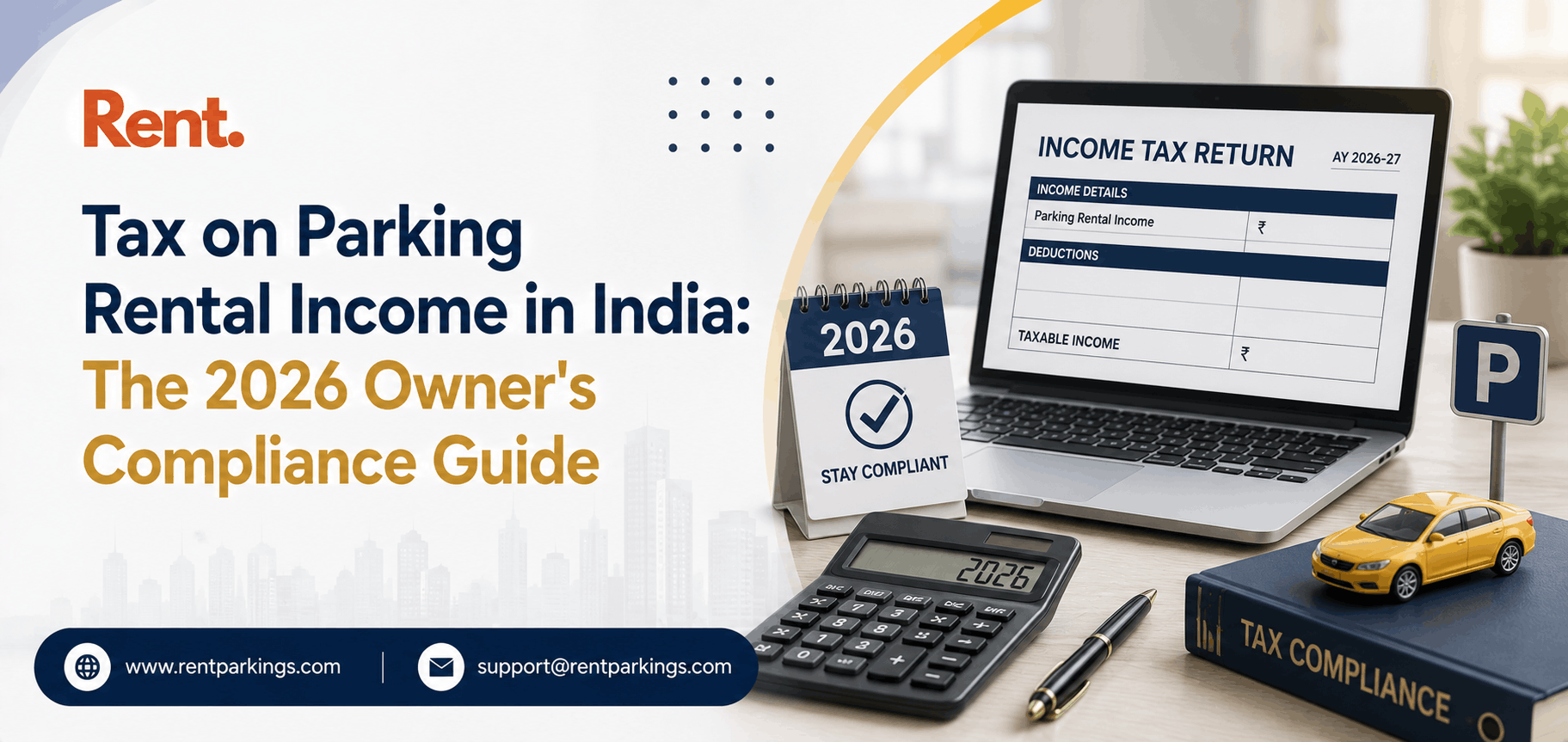
Tax on Parking Rental Income in India: The 2026 Owner's Compliance Guide
Most people who rent out an empty parking spot in their building never once ask whether that money needs to show up on a tax return. That's not because the law stays quiet about it. It's because nobody selling the idea of "easy passive income from your unused parking space" ever mentions the paperwork that follows once the rent actually lands in your bank account.
The truth is simpler than most owners expect, and also stricter than most owners hope.
Rental income from a parking space is taxable in India, the same way rent from a flat or a shop is taxable. What changes is how much you owe, whether GST enters the picture, and whether your tenant is supposed to deduct anything before paying you. If you're using a platform like RentParkings to find tenants for a spare spot, this guide walks through exactly what the 2026 rules mean for your pocket.
Why This Question Suddenly Matters More in 2026
Parking has quietly turned into a real income category across Indian cities. Owners near metro stations, IT parks, hospitals, and railway stations are earning anywhere from a couple of thousand rupees a month to five figures, depending on location and demand. As that income becomes steadier and larger, it stops looking like pocket change and starts looking like something the Income Tax Department expects to see reported.
There's also more scrutiny on digital payments now. UPI transfers, monthly standing instructions, and platform-based bookings all leave a trail. A landlord who once collected cash quietly from a neighbour parking their scooter is now far more likely to receive that same rent through a bank transfer that shows up in an annual information statement.
Is Parking Rental Income Taxable in India?
Yes. There is no exemption carved out for parking spaces specifically. If you own a stilt parking slot, a covered garage, an open plot, or even a driveway, and someone pays you to use it, that payment is income in the eyes of the tax department.
Which Head of Income Does It Fall Under?
This is where owners get confused, and honestly, tax professionals sometimes disagree too. There are two possible heads:
- Income from House Property applies when the parking space is legally treated as part of a residential or commercial property and rented along with, or as an extension of, that property.
- Income from Other Sources applies when the parking space is rented independently, without being tied to a larger residential letting arrangement, which is the more common situation for owners using a marketplace to rent out a standalone spot.
Most independent parking rental arrangements, the kind where you're simply listing a spare covered or open slot for a monthly fee, get taxed under Income from Other Sources. If in doubt, a chartered accountant can look at your specific ownership documents and rental structure and tell you which head fits.
How Much Tax Will You Actually Pay in 2026?
Under the new tax regime, which is now the default option for most taxpayers, income up to ₹4 lakh is not taxed at all. Beyond that, the slabs for FY 2025-26 (AY 2026-27) look like this:
- ₹4 lakh to ₹8 lakh: 5%
- ₹8 lakh to ₹12 lakh: 10%
- ₹12 lakh to ₹16 lakh: 15%
- ₹16 lakh to ₹20 lakh: 20%
- ₹20 lakh to ₹24 lakh: 25%
- Above ₹24 lakh: 30%
There's also a rebate under Section 87A that can bring your total tax liability to zero if your total taxable income stays at or below ₹12 lakh. So a retired homeowner earning ₹6,000 a month from a parking spot, with no other significant income, may end up owing nothing at all once this rebate is applied. Someone already earning a full salary and adding parking rent on top, however, will simply see that rent taxed at whatever slab their total income falls into.
Before you assume your numbers, it helps to see what parking actually fetches in different Indian cities. There's a city-by-city breakdown of how much owners are earning from parking space rentals that gives a realistic sense of what to expect before you even get to the tax calculation.
Does GST Apply to Renting Out a Parking Space?
Renting a parking space is treated as a supply of service under GST law, which means it can attract GST in principle. In practice, almost no individual owner ever crosses the threshold that would require registration.
The ₹20 Lakh Threshold, Explained Simply
For service providers in normal category states, GST registration becomes compulsory only once aggregate turnover crosses ₹20 lakh in a financial year. An individual renting out one or two parking spaces at typical residential rates is nowhere near that figure. This threshold matters more for property owners or businesses that lease out multiple commercial parking bays, large open lots, or entire parking facilities as a structured business, where combined turnover can genuinely reach that level.
If you're only renting a single spot near your apartment or office, GST is unlikely to be a practical concern. If you're scaling up into managing several bays commercially, it's worth checking your turnover against this threshold every year rather than assuming it will never apply to you.
TDS on Parking Rent: When Does It Actually Kick In?
Tax Deducted at Source only becomes relevant when the person paying you rent is required by law to deduct it before making the payment. Under Section 194-I, the threshold was raised in Budget 2025 to ₹50,000 per month, roughly ₹6 lakh a year. Below that, most payers have no obligation to deduct anything.
In practice, this means an individual paying you ₹3,000 or ₹8,000 a month for a parking spot won't need to deduct TDS. Where it becomes relevant is corporate or institutional arrangements, such as a company leasing several bays for its staff at a combined monthly rent above the threshold, or a business renting a large lot near an IT park or warehouse. There, the tenant is legally required to deduct 10% before paying you, and you would need to account for that credit when filing your return.
It's a comparison worth sitting with if you're deciding between putting spare cash into a fixed deposit or into renting out an idle asset you already own. One useful way to think about it is laid out in a piece comparing parking space rental income against a fixed deposit, since the after-tax math often looks more favourable than people initially assume.
Records Every Parking Space Owner Should Keep
Good documentation protects you if your return is ever questioned, and it also makes filing far less stressful each year. At minimum, keep the following:
- A signed rental agreement or booking confirmation, even if it's a simple one-page document, stating the monthly rate and duration.
- Bank statements or UPI records showing each rent payment received, matched against the agreement.
- The tenant's basic details, especially if the arrangement involves a business or an amount large enough to attract TDS.
- Any maintenance, painting, or security expenses connected to the parking space, since some of these may be relevant depending on how your accountant structures the income.
- Form 26AS and the Annual Information Statement, checked at least once before filing, to confirm nothing is missing or mismatched.
Owners who rent through a listing platform rather than word of mouth generally find this part easier, simply because the booking history and payment trail already exist in one place instead of being scattered across cash receipts and WhatsApp messages. It's also worth treating this as more than pocket change from the start. A separate piece on why renting out a parking space often beats other side hustles makes the case for tracking it properly from month one rather than treating it as an afterthought.
Filing Your ITR: A Quick Walkthrough
For most individuals with parking rental income taxed under Other Sources, ITR-1 works fine if your total income stays within the limits for that form and you have no complex capital gains or business income to report. If your total income situation is more layered, such as owning multiple properties, running a business, or having capital gains from other investments, ITR-2 or ITR-3 may be the correct form instead.
Report the gross rent received for the year, then claim any TDS already deducted by your tenant as a credit against your final tax liability. If no TDS was deducted, you simply declare the income and pay tax according to your slab when you file. Missing this step doesn't usually go unnoticed for long, since UPI transfers and bank credits above certain thresholds are already visible to the tax department through the AIS.
What Happens If You Sell the Parking Space Later?
Selling is a different tax event altogether from renting. If you sell a standalone parking space, or a flat that includes a parking allotment, any gain over your purchase cost may attract capital gains tax, calculated separately from your rental income. Short-term or long-term treatment depends on how long you've held the asset before selling.
This becomes especially relevant in cities where parking has genuinely appreciated as a scarce resource. There's a detailed look at whether a parking space actually adds resale value to your flat, which is useful reading before you decide whether to rent the spot for years or eventually sell it outright.
Common Mistakes Owners Make With Parking Income Tax
The most frequent mistake is simply not reporting the income at all, usually because the amount feels too small to matter. Even ₹2,000 a month adds up to ₹24,000 a year, and it should be declared regardless of size. Another common error is mixing personal and rental transactions in the same bank account without any way to separate them later, which makes reconstruction painful if a query ever comes from the tax department.
A third mistake is assuming GST applies the moment any tax question comes up, when in reality most individual owners will never cross the registration threshold. And a fourth, less obvious mistake is forgetting that parking rental income from a spare spot is part of a much larger shift already happening across Indian cities, where property owners are treating idle space as a genuine asset rather than a forgotten corner. That broader shift is explored in a piece on why India's parking shortage is turning ordinary owners into small-scale earners, and it's worth understanding the bigger picture even while you're focused on the tax details.
Frequently Asked Questions
1. Is money earned from renting out a parking space taxable in India?
Yes. Rental income from a parking space is taxable regardless of the amount, and it should be declared in your income tax return under either House Property or Other Sources, depending on how the arrangement is structured.
2. Which ITR form should I use to report parking rental income?
Most individual owners with straightforward rental income can use ITR-1, provided their total income fits within its limits, and they have no other complex income sources. Owners with multiple properties, business income, or significant capital gains typically need ITR-2 or ITR-3 instead.
3. Do I need to register for GST if I rent out my parking space?
Not usually. GST registration for services only becomes mandatory once your aggregate annual turnover crosses ₹20 lakh in most states, and a single or even a couple of residential parking spaces rarely reach that figure.
4. Will my tenant deduct TDS on the rent they pay me?
Only if the monthly rent exceeds ₹50,000, which works out to roughly ₹6 lakh a year. Most individual tenants renting a single parking spot pay well below this, so TDS typically only applies in larger corporate or institutional leasing arrangements.
5. Can I claim any deductions against parking rental income?
Some genuine expenses connected to maintaining the space, such as repairs or security costs, may be deductible depending on how your income is classified. It's best to confirm the exact treatment with a chartered accountant based on your specific situation.
6. What happens if I don't report parking rental income in my ITR?
Undeclared income can attract penalties and interest if it's later flagged through bank records, UPI transactions, or the Annual Information Statement, even if the original amount was small. It's safer to declare it every year than to risk a mismatch surfacing later.
7. Is parking rental income treated differently for a housing society than for an individual owner?
Yes, in many cases. When a Resident Welfare Association collects and pools parking fees on behalf of members, the tax treatment can differ from an individual owner renting out their personal allotted slot directly, since the RWA itself may have separate compliance obligations.
8. Do I have to pay tax if I rent my parking space to a family member?
Technically yes, if actual rent changes hands, though many families choose not to formalise such arrangements with a market rent at all. If you do receive a genuine rental payment, it should still be reported like any other rental income.
9. What if my parking rental income is on top of my regular salary?
It simply gets added to your total income for the year and taxed according to whichever slab your combined income falls into. There's no separate lower rate just because the source is a parking space rather than a salary or a flat.
10. Do I need a written rental agreement for tax purposes?
It isn't legally mandatory for very small, informal arrangements, but having one makes life much easier if your return is ever questioned. A simple agreement stating the monthly amount, duration, and parties involved is enough for most individual owners.
Where This Leaves You as an Owner
Renting out a parking space is still one of the simplest ways for Indian property owners to turn an idle asset into steady monthly income, and the tax rules around it are far less intimidating than they first appear. Most individual owners will owe modest tax at most, rarely deal with GST, and only occasionally encounter TDS. What actually protects you is keeping clean records and reporting the income honestly every year, rather than hoping it goes unnoticed.
If you haven't listed your spare parking spot yet, there's no reason to let it sit empty while the paperwork question holds you back. List your parking space on RentParkings and start earning steady monthly income from verified drivers, with the flexibility to choose hourly, daily, or monthly rentals and set your own price from day one.
Share This post
Search
Recent Post
Parking Space vs. Renting Out a Room to...
05 Oct, 2026

Think Parking Rental Only Pays in Mumbai...
02 Oct, 2026
Your Mumbai Parking Space Is Worth More...
01 Oct, 2026

Hyderabad's Real Estate Boom Left One As...
30 Sep, 2026

What Your Parking Space in Chennai Could...
29 Sep, 2026
Your Plans Changed After Listing Your Pa...
28 Sep, 2026
Parking Space vs SIP: Which Idle Asset A...
25 Sep, 2026

What Your Parking Space in Pune Could Ac...
24 Sep, 2026