

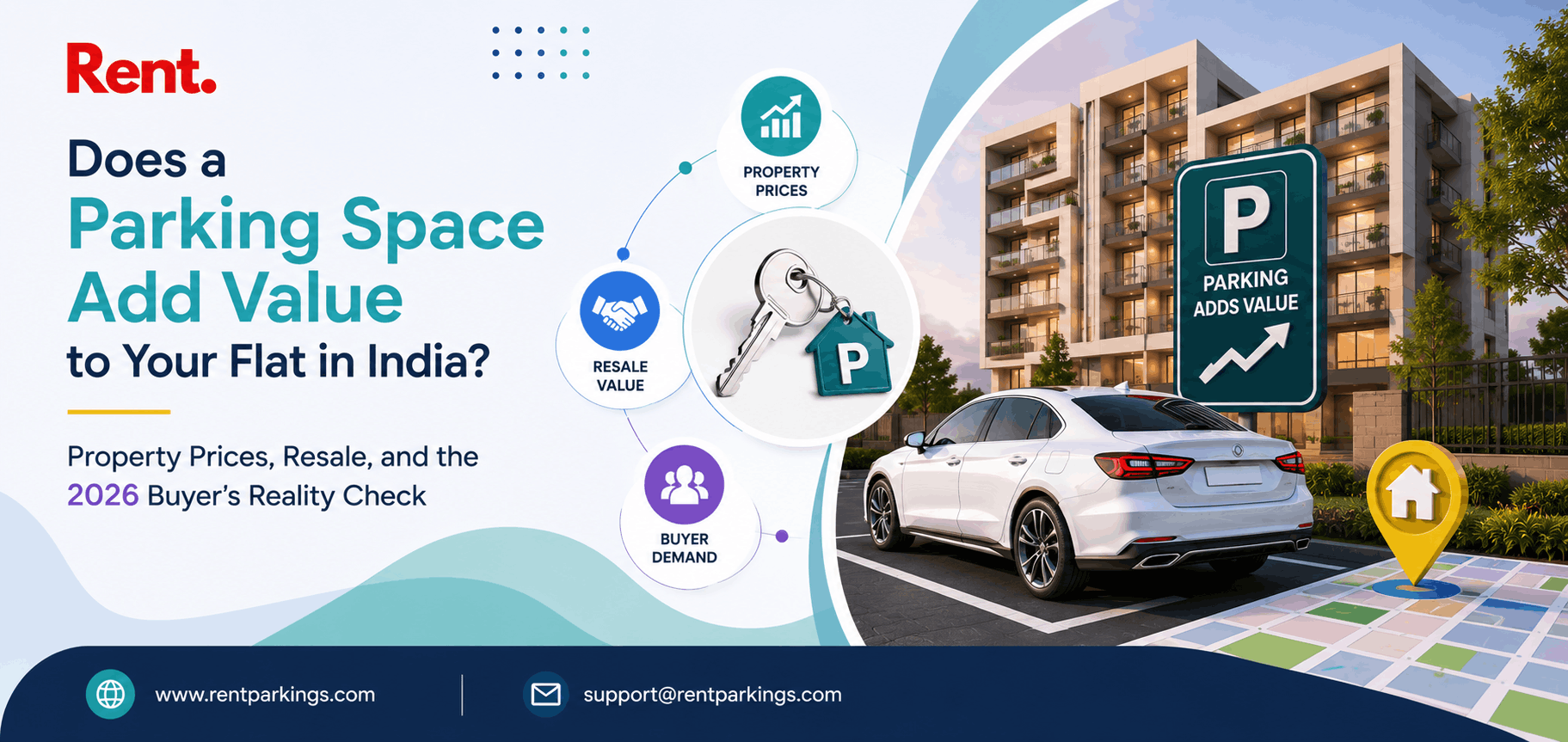
Does a Parking Space Add Value to Your Flat in India? Property Prices, Resale, and the 2026 Buyer's Reality Check
The flat checks out. The layout suits you, the ventilation is decent, the EMI won't wreck the household budget. Then, almost as an afterthought, the sales manager writes down a second figure: "Covered parking, ma'am, that's another eight lakh." In one sentence, a purchase you assumed was about rooms and views turns into a debate about a strip of floor you'll glance at for all of ten seconds each morning.
Nearly every buyer in urban India runs into this exact moment, and hardly anyone walks in prepared for it. We interrogate the per-square-foot rate down to the last rupee, then wing the parking call entirely, occasionally shelling out lakhs for a slot the builder had no legal right to sell in the first place, occasionally shrugging it off, only to be ambushed years later when a buyer backs out because there's simply nowhere to keep the car.
Consider this the honest breakdown. Not the usual "list your spot and earn" pitch, that is a separate subject, and one RentParkings has written about at length elsewhere. This is strictly about the home you're buying: whether that parking slot truly lifts what the property is worth, what the law genuinely permits a builder to charge, and how to work out, before you put pen to paper, whether the premium is a smart spend or cash going up in smoke.
The quick answer, and why quick doesn't mean simple
In most Indian cities, a documented parking slot does lift a flat's price and its resale value. In the crowded metros it can decide the sale outright. Yet three wrinkles muddy that tidy verdict, and every one of them is peculiar to India.
To begin with, the size of the uplift swings dramatically, practically negligible in a small town, more than the cost of a hatchback in the priciest corners of south Mumbai. Next, the legality of the amount you're being asked for is often shaky, because the country's top court has already declared that certain categories of parking can't be sold at all. And finally, the value only sticks if the slot is on paper, a nod-and-a-handshake arrangement with the builder or the society barely registers the day a buyer's lawyer starts asking questions.
Let's unpack each in turn.
Why parking is scarcer, and dearer, than the brochure lets on
By world standards, India isn't a car-saturated nation: roughly 44 cars for every 1,000 residents in 2025, a sliver of what you'd find across Western economies. But that tidy statistic conceals the squeeze. The country sailed past 400 million registered vehicles in 2025, climbing from around 326 million in 2020, and overall ownership now sits near 280 vehicles per 1,000 people. Two-wheelers make up the bulk of that tally, yet car ownership is accelerating precisely where room is scarcest, the metros and the towns orbiting them.
And the spread across the map is savage. Chandigarh clocks in near 800 vehicles per 1,000 residents; Bihar hovers around 150. So "what is parking worth" has no single national figure, it has a Chennai figure, a Gurugram figure, a Kochi figure.
The common thread is a plain arithmetic problem. Buildings sanctioned ten or twenty years ago were drawn up for households with one vehicle, or none at all. The same three-bedroom flat now shelters a car, a couple of scooters, and a college-goer lobbying for a third. Supply is frozen; demand keeps stacking up, which is exactly why municipal bodies are betting on sensors, FASTag, and multi-level automation to wring more capacity out of the footprint they already have. Whatever is scarce commands a premium, and inside a gated society, a guaranteed slot ranks among the scarcest things going.
What a parking slot actually costs, city by city
This is the point where the theory turns into rupees.
Take Mumbai. Depending on the micro-market, developers have billed anywhere from ₹1 lakh to ₹15 lakh for a single parking space. Out in the distant suburbs like Borivali, ₹7–8 lakh is routine; around the Bandra Kurla Complex belt the number has hit ₹15 lakh. The headline extreme still gets quoted at property desks: a slot in Cuffe Parade reportedly changed hands for close to ₹25 lakh, spanning about 146 sq ft, dearer than the on-road cost of the car it was meant to shelter. In the city's most rarefied pockets, the concrete outbids the vehicle.
Over in Bengaluru, the figures are gentler but no less genuine. Covered parking inside apartment projects trades and rents well above open parking within the very same society, and in supply-choked central neighbourhoods, a documented slot becomes a live bargaining chip in every resale conversation.
Right across Delhi NCR, particularly the tower corridors of Gurugram and Noida, premium projects bundle one or even two covered slots into the headline price, then bill again for a third, treating spare parking as a luxury upgrade. In Pune, Hyderabad, and Ahmedabad, the premium is thinner but still perceptible, especially in the newer vertical builds where podium parking runs out fast. Down in Kolkata and Kochi, older buildings with barely any formal parking make any flat that does arrive with a slot pop on the listing portals.
The shape of it stays constant even where the numbers don't: the denser and costlier the city, the bigger the slice of your home's worth quietly parked in that slot.
The law nobody reads until the cheque has cleared
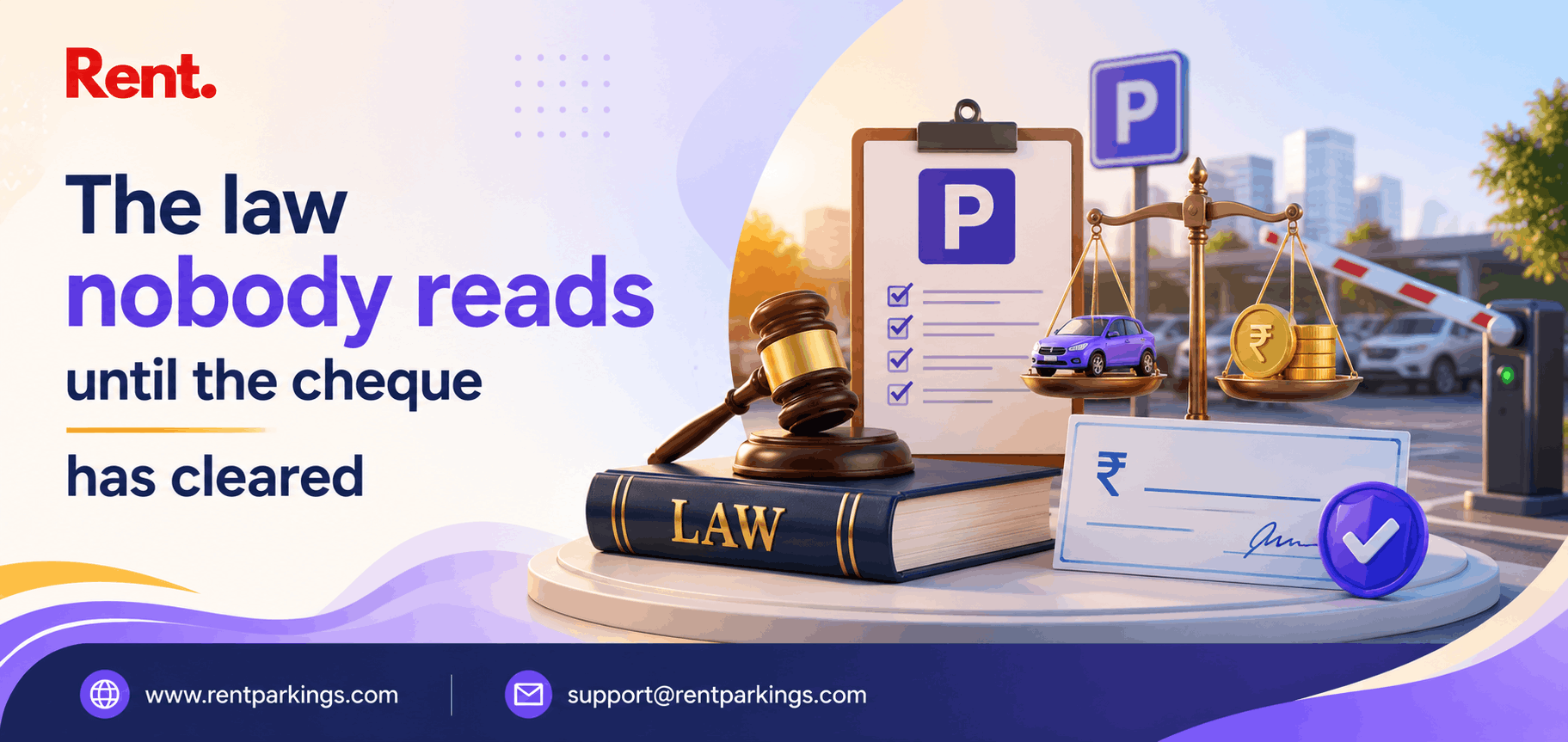
Here's the part that blindsides lakhs of buyers. Is a builder even entitled to bill you separately for parking?
Frequently, the answer is no. In the defining case Nahalchand Laloochand Pvt. Ltd. vs. Panchali Cooperative Housing Society Ltd., the Supreme Court ruled that open and stilt parking are not standalone, saleable units, they qualify as common areas owned collectively by the flat purchasers. A builder can't peel them off and market them like apartments. Their cost is supposed to be folded into the price of the flats, and once the society comes into being, handing out those spaces is the society's remit, not the developer's. (For the full walk-through of stilt, covered, and open parking rights, RentParkings has a dedicated explainer on who actually owns the parking in your apartment.)
RERA hardens this further: under Section 2(n), the definition of "common areas" expressly folds in open parking. Maharashtra RERA, in particular, has drawn a hard line, promoters cannot hawk open or stilt parking as separate stock.
There is a real exception, and that's where the subtlety hides. A fully enclosed garage, walls on all sides and a shutter, distinctly drawn and cleared in the sanctioned plan, can be sold on its own, because it counts as a defined, enclosed structure rather than a wedge of common area. So "covered parking" in the everyday Indian sense (a bay under a podium or stilt, tagged with a pillar or a painted number but no walls) usually cannot be sold separately, whereas a genuine lock-up garage sometimes can.
Why should any of this shape value? Because if you hand over ₹8 lakh "for parking" the builder never had the authority to sell, you may have merely bought the flat at an inflated price with a wobbly paper trail bolted on. Come resale, a careful buyer's advocate will want to see how that slot is recorded, and "the builder handed it to me on a letter" is a feeble reply.
Documented versus "understood": the line that sets resale value
A parking slot builds lasting value only when it can move with the flat on paper. On the ground, Indian parking arrangements sit along a spectrum:
Marked in the sanctioned plan and cited in your sale or allotment papers, the sturdiest position. The slot is pinpointable, its status is clean, and the next buyer inherits it without a fight.
Allotted to you by the housing society through a formal resolution, dependable. Once registration is done, the society is the rightful authority for handing out common-area parking, and a minuted, consistent allotment carries genuine heft.
A builder side-letter with no society acknowledgment, flimsy. When the developer walks away and the society takes charge, informal assurances routinely fall apart, and squabbles over "my" slot rank among the most frequent conflicts in Indian residential societies.
Nothing written down, just the corner you've always used, effectively no transferable worth, and a standing hazard. First-come, first-served open parking belongs to the whole society; you can't sell what the committee might reassign next month.
This is the one idea worth burning into memory: at resale, buyers and their lawyers pay for certainty, not for a bay you happen to occupy. Two identical flats, one with a documented slot, one with a mere "understanding", will not fetch the same figure. That gap is the value of parking, and it materialises only on paper.
So how much value does it really add? A framework
Ditch the guesswork and reason through it in three layers.
Layer one, the replacement cost. What would a buyer have to spend, or give up, to sort out parking some other way? If nearby monthly parking goes for ₹2,000–4,000, that's ₹24,000–48,000 a year of dodged expense, plus the daily aggravation of circling for a spot. Capitalise that and you land on a floor for what the slot is worth to a level-headed buyer. It's worth checking the builder's premium against real local monthly parking rates before you accept the number.
Layer two, the scarcity multiplier. In a society where vehicles outnumber slots, a guaranteed bay stops being a convenience and turns into a precondition. Here value shoots well past replacement cost, because without it the buyer can't realistically live there. In loosely parked Tier-2 and Tier-3 layouts with open compounds, the multiplier barely rises above one.
Layer three, the resale filter. In plenty of metro projects, "no dedicated parking" silently strikes a flat off a big chunk of buyers' shortlists before anyone even schedules a visit. Value here isn't only the premium you tack on; it's the deals you don't forfeit. A flat everyone will at least look at is worth more than an identical flat a third of buyers reject on a filter.
Stack the three together: in a dense metro with tight ratios, a documented covered slot can add value in the ballpark of what the builder charged, and occasionally more at resale. In a Tier-3 town with open, casual parking, that same slot adds little, because scarcity, the engine of the premium, just isn't running.
Covered, stilt, or open: which one keeps its value
Parking isn't one uniform thing, and the pecking order surfaces in the pricing.
Enclosed garages sit at the summit, legally the tidiest to own and pass on, and physically the best shield for the vehicle. They earn the sharpest premium and hang onto it through resale.
Covered/stilt slots (tucked under a podium or the building's stilt floor) are the practical Indian standard in high-rises. Buyers prize the shade and the monsoon protection, and in the metros these pull a healthy premium over open parking, subject to the documentation caveat flagged above.
Open parking in the compound contributes the least. It bakes in the sun, takes the rain, catches falling debris, is typically first in line whenever a society reshuffles, and legally sits squarely inside the common area. It still beats no parking, but it's the weakest of the three as a value driver.
For a buyer sizing up the premium, the rule of thumb writes itself: pay up for enclosed and covered, be wary of paying much for open, and in every scenario chase the paperwork before the discount.
Two-wheelers, visitor bays, and the small print that quietly shifts price
The car slot hogs the spotlight, but in India it's the whole parking picture a sharp buyer weighs. Two-wheeler parking is a real value lever in cities like Pune, Chennai, and Ahmedabad, where a household might juggle two or three scooters alongside the car; a project that has planned for bike parking simply feels livable in a way a car-only layout never quite does. Visitor bays count too, societies with next to no guest space breed non-stop friction, and buyers with large families clock it on the very first walkthrough. Even the placement of your slot earns a modest premium: a bay near the lift lobby, easy to back into, clear of the podium edge's drip line, is far nicer to use day after day than a pinched corner wedged behind a pillar, and that ease shows up subtly in what people will pay.
None of this appears as a line item on the builder's quote. Yet together it explains why two flats in the same tower, both advertised "with parking," can still fetch different prices. The buyer isn't paying for a rectangle of cement; they're paying for the daily luxury of never having to wonder where the vehicles go. In a country where that very worry drains real mental energy every single day, deleting it is worth money.
The Tier-2 and Tier-3 twist
It's tempting to assume the metro logic simply shrinks to fit, but it flips in a couple of telling ways. Across many Tier-2 and Tier-3 towns, say Coimbatore, Indore, Nagpur, Vijayawada, independent houses and low-rise plots still rule, land runs comparatively cheap, and open compound parking is the default. A "dedicated slot" here is often just the apron in front of your own gate, and the resale premium for formal parking stays slim because the scarcity that fuels the metro premium hasn't arrived yet.
But these are precisely the towns where car ownership is now climbing fastest, and the fresh gated apartment projects mushrooming on their fringes are starting to import metro-grade parking scarcity. A buyer in a booming Tier-2 city should think a move ahead: parking that looks plentiful today can tighten in a hurry as a layout fills up and second cars roll in. Nailing down a documented slot early, while developers are still generous with them, is a quietly shrewd play.
The buyer's pre-purchase checklist
Before you sign off on any parking premium, run this loop:
Establish whether the slot is open, stilt/covered, or a fully enclosed garage, that alone shapes both the value and what can lawfully be charged. Ask to see the sanctioned plan and check if and how parking is marked. Insist the slot is named in your allotment letter, agreement, or sale deed, never left to a spoken promise. For a resale flat, request the society's allotment record and confirm the slot is registered to the current owner and is transferable. Weigh the society's car-to-slot ratio and its visitor-parking setup, tight ratios spell high value but also daily friction. Benchmark the builder's quoted premium against local monthly parking rates to test whether the figure is sane. And if a builder is billing separately for open or stilt parking, remember the Supreme Court's ruling hands you room to push back.
What this means if you already own
If the flat is already yours, flip the lesson around: your parking is an asset at resale only when it's documented. The cheapest upgrade you can make to your own home often isn't a modular kitchen, it's getting the slot properly minuted in the society's books and reflected in your papers, so that when you sell, the value stands up rather than being argued over. In tight metro societies, that single sheet of paper can be worth several lakh at the negotiating table.
And with EV adoption on the rise, the calibre of your slot counts for more every year. A documented, covered bay where a charging point can be fitted is fast overtaking a bare open space in worth, because the next wave of buyers is thinking about where the car recharges overnight, not merely where it rests.
Actionable takeaways
A documented parking slot does add measurable value to an Indian flat, especially in dense metros, but the premium tracks scarcity, so it's large in Mumbai and Gurugram and small in Tier-3 towns.
Under the Nahalchand Laloochand judgment and RERA, open and stilt parking are common areas a builder generally cannot sell separately; only an enclosed, sanctioned garage can be. Challenge separate charges for open/stilt slots.
Value survives resale only if the slot is on paper, in the sanctioned plan, the sale deed, or the society's allotment record. An "understanding" is worth almost nothing at sale.
Covered and enclosed parking hold value; open parking adds the least. Pay the premium accordingly.
The cheapest upgrade an existing owner can make is documenting the slot properly, it turns a daily convenience into a transferable asset.
Conclusion
That extra line on the sales desk, "eight lakh for the covered park", is neither a nuisance to brush aside nor a luxury to splurge on. It's a real slice of what your home is worth, and in India it comes bundled with a specific legal backdrop most buyers never bother to verify. In the packed core of a metro, a documented slot can separate a flat that sells in a fortnight from one that lingers a year. In a sleepy Tier-3 layout, it may hardly nudge the price. The craft lies in reading which situation you're actually in, insisting the slot exists on paper, and refusing to pay separately for something the law says was never the builder's to sell in the first place. Get those three right and the parking premium stops being a punt and becomes exactly what it ought to be, value you can see, defend, and one day hand on to the next owner. And once that slot is yours, RentParkings is where you can put it to work, or track one down near you when you need it.
FAQs
Does a parking space really increase a flat's value in India?
Yes in most cities, though the scale of the bump depends on how scarce space is. In packed metros such as Mumbai, Bengaluru, and Gurugram, a documented slot can add a meaningful premium and is frequently make-or-break for reselling at all. In Tier-2 and Tier-3 towns with open, informal parking, the uplift is modest because space isn't in short supply.
Can a builder charge me separately for a parking space?
For open or stilt parking, usually not. The Supreme Court's Nahalchand Laloochand ruling classes these as common areas that can't be sold as separate units, so their cost is meant to sit inside the flat price. Only a fully enclosed garage drawn into the sanctioned plan may be sold on its own.
How much does a parking space cost in Indian cities?
The range is wide. In Mumbai, developers have charged roughly ₹1 lakh to ₹15 lakh, and one Cuffe Parade slot reportedly sold for close to ₹25 lakh. Bengaluru, Pune, Hyderabad, and Delhi NCR carry smaller but real premiums, with covered slots always priced above open ones.
Is covered parking worth more than open parking?
It is. Covered and stilt parking shield the vehicle from sun and monsoon and pull a clear premium over open parking. Fully enclosed garages top the list, since they're the cleanest to own and transfer in law.
Will a flat without parking be hard to resell?
In the metros, often yes. Plenty of buyers filter out flats with no dedicated parking before they even visit, so lacking a documented slot can shrink your buyer pool and dent your bargaining position at resale.
What documents prove I own my parking slot?
The strongest evidence is the slot appearing in the sanctioned plan and being cited in your sale deed or allotment agreement. After the society forms, a minuted society allotment in your name also holds. A builder's informal letter with no society backing is weak.
Can a housing society reallocate my parking space?
For common-area (open) parking, yes, the society governs allotment and can reassign first-come, first-served bays. A slot formally allotted to you by resolution, or documented in your purchase papers, is considerably more secure.
Does buying extra parking make financial sense?
Line up the builder's price against local monthly parking rates and the society's car-to-slot ratio. In tight metro societies, a documented slot usually retains most of its value at resale. In loosely parked areas, paying a hefty premium for a second slot seldom pays off.
How does EV adoption affect parking value in India?
It's pushing up the worth of documented, covered slots where a charging point can be installed. As more buyers plan to charge at home overnight, a slot that supports an EV charger is growing more appealing than a plain open space.
What should I check about parking before buying a flat?
Confirm whether the slot is open, stilt, or an enclosed garage; inspect the sanctioned plan; insist the slot is named in your agreement or the society's records; verify the car-to-slot ratio; and question any separate charge levied for open or stilt parking.
Share This post
Search
Recent Post
Parking Space vs. Renting Out a Room to...
05 Oct, 2026
Think Parking Rental Only Pays in Mumbai...
02 Oct, 2026
Your Mumbai Parking Space Is Worth More...
01 Oct, 2026
Hyderabad's Real Estate Boom Left One As...
30 Sep, 2026
What Your Parking Space in Chennai Could...
29 Sep, 2026
Your Plans Changed After Listing Your Pa...
28 Sep, 2026
Parking Space vs SIP: Which Idle Asset A...
25 Sep, 2026
What Your Parking Space in Pune Could Ac...
24 Sep, 2026