

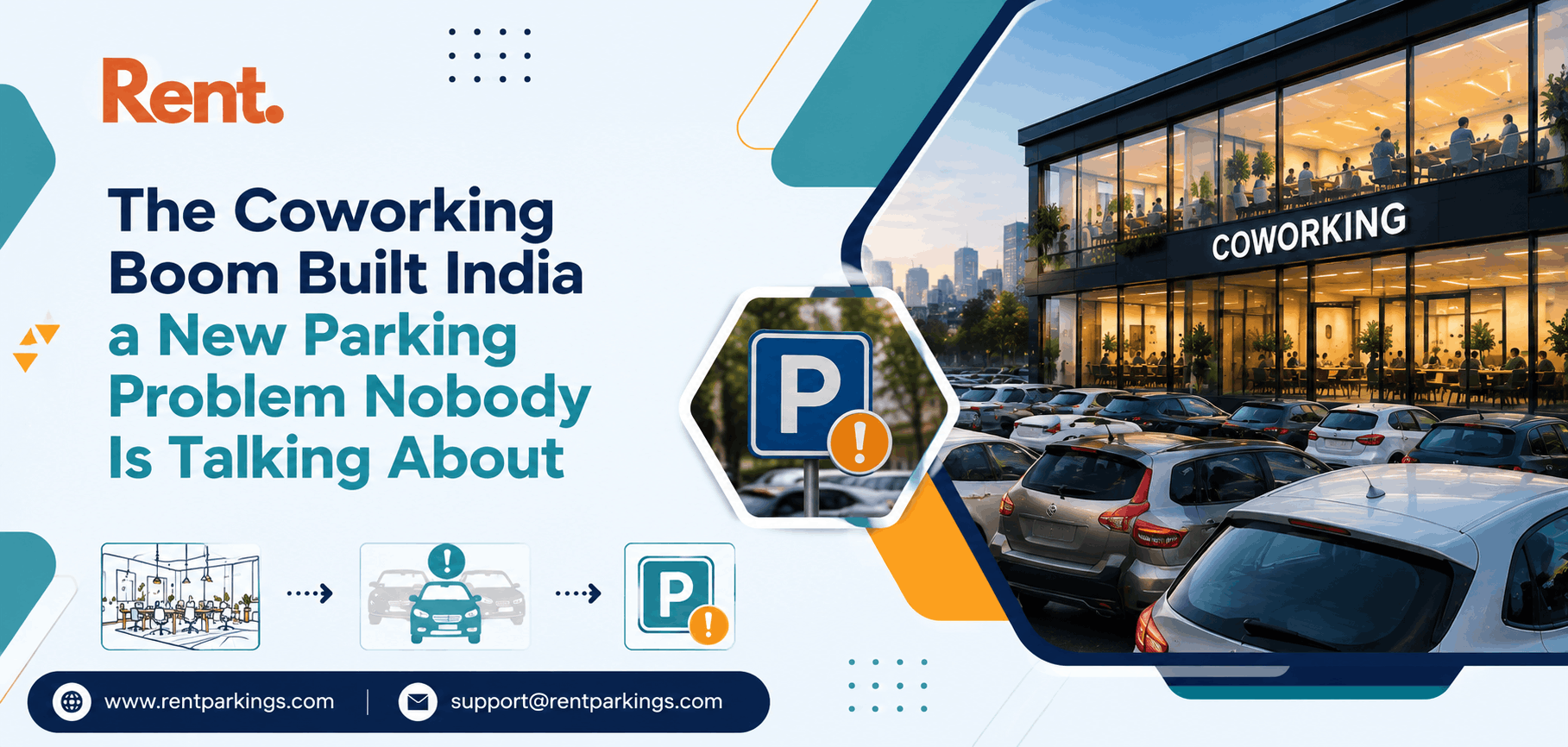
The Coworking Boom Built India a New Parking Problem Nobody Is Talking About
Walk into any coworking floor in Koramangala on a Tuesday morning and you'll find forty desks booked, a queue for the good chairs near the window, and a WhatsApp group buzzing with one recurring question: where did everyone park. Not "is there parking." Where did everyone park, because clearly someone found a spot and the rest are stuck circling the block for the third time this month.
That's the part of India's coworking story that rarely makes it into the glossy startup profiles. Everyone talks about flexible desks, community events, and the death of the nine-to-five commute. Almost nobody talks about the fact that a five-storey building with two hundred members and eleven parking slots is, mathematically, a problem waiting to happen every single working day.
This piece looks at why coworking parking behaves so differently from the corporate campus parking everyone already understands, which Indian cities feel it worst, and why property owners sitting on an unused spot near a coworking hub might be looking at one of the more dependable income streams in their neighbourhood. As India's parking marketplace, RentParkings has watched this specific demand pattern grow quietly for a couple of years now, and it's worth putting some structure around it.
Why Coworking Parking Doesn't Behave Like Office Parking
A large IT campus solves parking the way a factory solves logistics: fixed headcount, predictable shift timings, a basement or multi-level structure sized (more or less) for the workforce. Messy at times, but it's a known problem with a known shape.
Coworking spaces break that model completely. A single WeWork, Smartworks, Awfis, 91springboard or Innov8 floor might host a fifteen-person startup, three solo freelancers, a sales team that's only in twice a week, and a corporate satellite office all under one roof. Nobody knows exactly how many people will show up on a given Wednesday, because membership isn't the same as attendance. Occupancy swings hard around Monday mornings, investor pitch days, and the last week of every quarter, then drops off on Fridays.
Add to that the fact that most coworking operators lease floors inside buildings that were never designed with this density of daily visitors in mind. A building built for a single mid-sized tenant with forty employees suddenly houses four floors of coworking members, each floor turning over its own crowd. The parking ratio the builder planned for stopped making sense years ago.
Where the Squeeze Is Worst Right Now
The pressure isn't evenly spread. It concentrates in a handful of predictable pockets across India's major coworking cities:
- Bengaluru: Koramangala, Indiranagar and HSR Layout, where coworking density is highest but most buildings are older residential-turned-commercial structures with barely any dedicated parking.
- Gurugram: Cyber Hub, Golf Course Road and Sector 44, where glass towers look parking-ready from outside but basements fill up before 10 am.
- Mumbai: BKC, Andheri East and Lower Parel, where land is simply too expensive for generous parking allotments in the first place.
- Pune: Baner, Kalyani Nagar and Koregaon Park, popular with startups precisely because rents are lower than Bengaluru, which means more members per building.
- Hyderabad: the fringe of HITEC City and Jubilee Hills, where coworking spaces have sprung up faster than the surrounding roads and lots can absorb.
- Noida and Gurugram's Sohna Road corridor: newer coworking clusters riding the National Capital Region's startup growth, often in buildings converted mid-lease.
Ask a member in any of these pockets how they park, and the honest answer usually involves one of three things: a paid monthly arrangement with a nearby building, a two-wheeler because four-wheeler parking simply isn't realistic, or a daily gamble on street parking that occasionally ends in a fine.
The Quiet Income Opportunity for Property Owners Nearby
Here's where the story turns interesting for anyone who owns a flat, a small commercial plot, or a driveway within walking distance of a coworking hub. Coworking members are, in a specific sense, ideal tenants for a parking space. They need it on working days, roughly the same hours every time, and they're generally willing to pay a predictable monthly rate rather than negotiate hourly.
Owners near these clusters have told us they typically see monthly rates somewhere in this range, depending on the city and how close the spot sits to the coworking entrance:
- Bengaluru and Gurugram hotspots: roughly ₹3,000 to ₹6,000 a month for a car spot, ₹800 to ₹1,500 for two-wheelers
- Mumbai's high-density pockets: often ₹4,000 to ₹7,000 a month given how scarce space is
- Pune and Hyderabad's newer clusters: usually ₹2,000 to ₹4,500 a month, still rising as more coworking operators move in
- Tier 2 coworking pockets in Chandigarh, Jaipur, Kochi and Coimbatore: generally ₹1,500 to ₹3,000 a month, lower demand but also far less competition
These are broadly similar to what owners near India's established IT park corridors have already discovered works well for corporate commuters, and coworking follows a similar logic with a twist: the tenants change more often, so a flexible monthly or even weekly listing suits this crowd better than a rigid year-long lease.
What Coworking Members Actually Want From Parking
Talk to enough freelancers and startup employees and a pattern emerges. They're not asking for luxury. They want three things, in roughly this order of priority.
First, reliability. A coworking member who books a desk for the day cannot afford to spend twenty minutes hunting for parking before a client call. A guaranteed spot, even a modest one, beats a cheaper but uncertain option almost every time.
Second, proximity that actually saves time. Five minutes of walking is fine. Fifteen minutes defeats the purpose of choosing a nearby coworking space in the first place.
Third, and increasingly common among younger professionals, EV charging access. A growing share of coworking members now ride electric two-wheelers or drive EVs, and a parking spot with even a basic charging point becomes noticeably more attractive than one without. Property owners who've added a charging point near their listing, a trend explored in how a wall socket next to a parking spot turns into rentable real estate, tend to fill their spot faster and can usually justify a slightly higher rate.
The Metro Factor
Coworking operators increasingly choose locations near metro stations on purpose, betting that "five minutes from the metro" sells memberships. That's good news for the coworking business and terrible news for parking, because it stacks two different kinds of demand on the same few streets: commuters parking to catch the metro, and coworking members parking to walk to their desk.
For an owner with a spot near a station that also happens to sit close to a coworking cluster, this overlap is actually an advantage rather than a headache, since it widens the pool of people who might want the space on any given day. The dynamics here echo what we've seen play out around metro-adjacent parking generally, something we unpacked in why living near a metro station puts you on some of the most wanted parking real estate in the city.
When the Building Itself Becomes the Battleground
A less obvious wrinkle: many coworking spaces occupy floors inside residential-turned-commercial buildings or mixed-use complexes managed by a resident welfare association. When a coworking operator moves into the ground floor of what used to be a purely residential block, visitor and commercial parking suddenly compete with residents' own vehicles for the same limited slots.
This friction isn't unique to coworking, but coworking makes it worse simply because of daily footfall. It mirrors a pattern we broke down when looking at why housing societies are struggling to manage visitor parking fairly, except here the "visitors" are paying coworking members rather than occasional guests, which usually makes the case for a formal, paid arrangement even stronger.
How to List Your Parking Space for This Demand
If you own a spot near a coworking hub, positioning it correctly matters more than the listing itself. A few things tend to make the difference between a spot that fills within days and one that sits empty for weeks.
- Mention the exact coworking building or cluster by name in your listing, not just the general neighbourhood.
- Offer both monthly and weekly pricing, since coworking membership patterns vary more than a typical office job.
- Be upfront about covered versus open parking, since summer heat and monsoon rain both matter more to someone parking daily than someone parking occasionally.
- If security is a concern in the area, say so honestly and mention any gate, guard, or CCTV coverage you have. Coworking members read reviews the same way they read desk-booking apps.
- Keep your listing updated when it's taken, rather than leaving it live and fielding messages you can't act on.
For owners who are new to this altogether, the general mechanics of getting a spot listed and earning from it are covered well in our complete walkthrough on renting out parking space in India, and if you're unsure which category your spot falls under on the platform, our breakdown of how parking categories work on RentParkings is a quick way to figure out where you fit.
Where This Is Headed
Coworking isn't slowing down in India. If anything, hybrid work policies at larger companies are pushing more employees toward coworking spaces near their homes instead of a single central office, which spreads the parking pressure into more neighbourhoods rather than concentrating it in one business district. Tier 2 cities are following the same trajectory a couple of years behind the metros, which means owners in Jaipur, Lucknow, Coimbatore and Madurai are likely to see this demand pattern show up on their street sooner than they'd expect.
None of this requires a large plot or a commercial license to participate in. A single unused car or two-wheeler spot within a short walk of a coworking building is, for many owners, already sitting on more earning potential than they've given it credit for.
Frequently Asked Questions
1. Why is parking near coworking spaces harder to find than parking near a regular office?
Coworking spaces pack more independent members, freelancers and small teams into one floor than a typical single-tenant office, and attendance varies day to day rather than following one fixed shift. Buildings were rarely designed with that density of daily visitors in mind, so the available parking ratio falls short even when the building itself looks modern and well planned.
2. How much can I earn renting out a parking spot near a coworking hub?
It depends heavily on the city and how close your spot sits to the building's entrance. Owners near busy coworking clusters in Bengaluru or Gurugram often see somewhere between ₹3,000 and ₹6,000 a month for a car spot, while two-wheeler spots typically earn less but fill up faster due to lower supply of dedicated two-wheeler slots.
3. Do coworking members prefer monthly or daily parking arrangements?
Most prefer monthly arrangements because it matches how they think about their coworking membership itself, but a meaningful share also want the flexibility of a weekly option since not every member visits five days a week. Offering both tends to attract more inquiries than rigid month-only pricing.
4. Is it safe to rent out my residential parking spot to coworking members I don't personally know?
Most owners manage this comfortably by verifying the renter's identity and vehicle details upfront, setting clear entry and exit timings, and using a platform that keeps a record of who's renting the space. It's no riskier in principle than renting out a room or a garage, provided the basic verification steps aren't skipped.
5. Which Indian cities have the strongest demand for coworking-related parking right now?
Bengaluru, Gurugram and Mumbai currently see the sharpest demand because of how densely coworking operators have expanded there, but Pune and Hyderabad are close behind. Tier 2 cities like Jaipur, Kochi and Coimbatore are earlier in this curve, which can actually work in an owner's favour since there's less competition among listings.
6. Should I add EV charging to my parking spot to attract coworking members?
It's worth considering if you're in a city with a fast-growing EV or electric two-wheeler base among young professionals, since a charging point tends to make a listing stand out and can support a slightly higher rate. It's not mandatory, though, and a well-located spot without charging still rents out reliably in most cities.
7. Can a resident welfare association object to a member renting out their allotted parking space to a coworking professional?
This varies by housing society and depends on the specific bylaws in place, along with how the parking allotment is documented in the sale deed or society rules. It's worth checking your society's parking policy and, where needed, having a conversation with the managing committee before listing your spot, so there's no confusion later.
8. How is coworking parking demand different from IT park or corporate campus parking?
Corporate campuses usually have a fixed workforce and predictable shift timings, so the parking problem, while real, is at least consistent day to day. Coworking demand fluctuates more because membership doesn't equal daily attendance, and the mix of freelancers, startups and satellite teams changes the crowd from one day to the next.
9. What documents or details should I mention when listing a spot near a coworking building?
Naming the specific coworking building or cluster nearby, stating whether the spot is covered or open, mentioning security features like a gate or CCTV, and being clear about entry and exit hours all help. Listings with this level of detail tend to get faster, more serious inquiries than vague ones.
10. Will coworking parking demand grow in smaller Indian cities too?
It's a reasonable expectation given how coworking operators have been expanding into tier 2 cities over the past couple of years, often a few years behind the pattern set in metros. Owners in cities like Lucknow, Madurai and Coimbatore may start seeing this kind of demand appear locally sooner than they'd assume.
Conclusion
Coworking spaces solved a real problem for India's freelancers and startups: flexible desks without a long lease. What they didn't solve, and mostly haven't tried to, is what happens to everyone's vehicle once they arrive. That gap is exactly where property owners near these hubs have room to step in, turning a spot that would otherwise sit empty into a dependable monthly income stream. List your parking space on RentParkings and put your unused spot to work for the coworking crowd already looking for it nearby.
Share This post
Search
Recent Post
Parking Space vs. Renting Out a Room to...
05 Oct, 2026
Think Parking Rental Only Pays in Mumbai...
02 Oct, 2026
Your Mumbai Parking Space Is Worth More...
01 Oct, 2026
Hyderabad's Real Estate Boom Left One As...
30 Sep, 2026
What Your Parking Space in Chennai Could...
29 Sep, 2026
Your Plans Changed After Listing Your Pa...
28 Sep, 2026
Parking Space vs SIP: Which Idle Asset A...
25 Sep, 2026
What Your Parking Space in Pune Could Ac...
24 Sep, 2026