

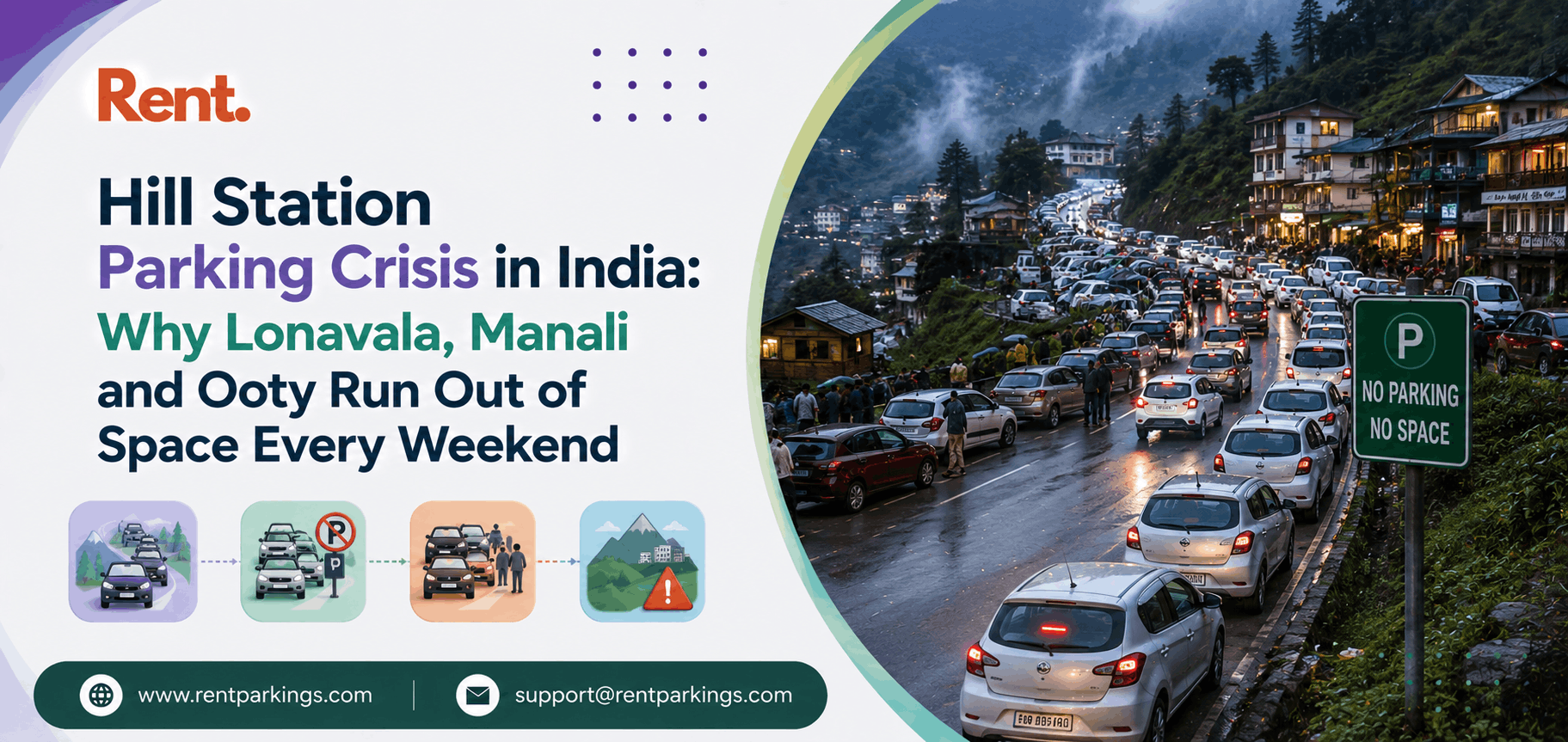
Hill Station Parking Crisis in India: Why Lonavala, Manali and Ooty Run Out of Space Every Weekend
Picture a Friday evening in July. A family from Pune has been driving for two hours, the kids are asleep in the back seat, and the GPS says Lonavala is four minutes away. Then the queue starts.
Cars inch forward bumper to bumper along the main road, hazard lights blinking, drivers leaning out of windows asking anyone nearby if they know a place to park. Forty minutes later, the family is still searching, and the hotel check-in they booked for 7 PM keeps slipping further away.
This scene repeats almost every weekend across dozens of Indian hill towns. It has become such a familiar part of the hill station experience that people now plan for it the way they plan for expressway traffic. Somewhere between "when should we leave" and "will there be parking," a whole unofficial economy of parking touts, roadside attendants and last-minute deals has grown up around India's favourite weekend getaways.
What gets talked about less is who actually benefits from that chaos right now, and who could be benefiting instead. RentParkings, India's parking marketplace, has spent time studying how weekend tourist traffic reshapes small hill towns, and the pattern points to a real, underused opportunity for the people who live there.
The Weekend Exodus: Why India's Hill Towns Run Out of Parking Every Friday
Most Indian hill stations were never built for this much traffic. Towns like Mahabaleshwar, Coonoor, Kasauli and Munnar grew around narrow colonial-era roads meant for bullock carts and the occasional jeep, not a weekend influx of thousands of private cars.
Add a tourism boom that has only accelerated as private vehicle ownership became more affordable, and you get a mismatch that shows up every single Friday afternoon. Local municipal parking, where it exists at all, was sized for a much smaller town and a much smaller era.
A few things make the problem worse:
- Weekend and holiday traffic can run several times higher than weekday traffic in most tourist hill towns, based on patterns local traders and taxi unions consistently describe.
- Long weekends, monsoon getaways and the October-to-February peak season push demand even further past what official parking can absorb.
- Many of these towns have almost no land left to build new parking lots, since the terrain is hilly and the area near the main market is already built up.
- Local administrations often lack the budget or the mandate to build permanent parking structures for problems that, in truth, only bite hard on a few peak days a week.
It plays out the same way each time. Cars line both sides of the narrow roads, drivers spend twenty or thirty minutes circling for a gap, and traffic constables try to manage the mess with very little to work with.
Who Actually Loses Money When Hill Station Parking Runs Out
Tourists are the most visible victims of this chaos, but they're far from the only ones losing out.
Local shopkeepers lose footfall because visitors who can't find parking near the market often turn back or cut their trip short. Restaurant owners see empty tables during peak hours because a group circling for parking simply picks a different eatery closer to wherever they finally found a spot. Even hotels feel it: guests who spend forty-five minutes hunting for parking on arrival tend to leave lower reviews, no matter how good the room turns out to be.
The same imbalance RentParkings has documented in India's busiest parking hotspots shows up here too, only in a sharper, more compressed form. Demand spikes hard for two or three days, then disappears almost completely until the following weekend.
That's the detail that makes hill station parking genuinely different from, say, a railway station or a hospital. It isn't a daily problem. It's a weekend problem, and a weekend problem needs a weekend solution, not a permanent municipal structure sitting empty on a Tuesday afternoon.
The Opportunity Hiding in Plain Sight for Local Landowners
Here's where the picture flips from a problem into a proposition.
If you own a home, an empty plot, a driveway or unused frontage anywhere within walking distance of a hill station's main market, viewpoint or bus stand, you're sitting on an asset that gets more valuable exactly when tourists arrive and municipal parking runs dry.
Across towns like these, the pattern tends to repeat with small local variations:
- Lonavala and Khandala: weekend traffic from Mumbai and Pune floods the main market and the Tiger Point stretch, with visitors often willing to pay for guaranteed parking rather than risk missing sunset views.
- Mahabaleshwar and Panchgani: strawberry season and the stretch near Venna Lake draw heavy footfall, especially on weekends and during winter and monsoon breaks.
- Manali and Kasol: Himachal's road network narrows sharply near the main market, and backpacker season pushes demand well past what the town can physically handle.
- Ooty and Coonoor: the ghat roads leading into these Nilgiri towns simply weren't built for the volume of cars arriving during the April-May and December holiday rush.
- Munnar and Coorg: plantation-road towns where the walk from a parked car to a viewpoint or homestay can stretch to twenty minutes if visitors can't get close.
- Nainital and Mussoorie: Mall Road congestion during summer holidays and Diwali week regularly spills over onto nearby residential lanes.
Property owners in these locations don't need to build a commercial parking structure to take part. A cleared plot, a widened driveway or even a paved patch of land near the market can be listed, priced by the day, and rented out specifically for the weekends and holiday weeks when demand actually spikes.
RentParkings has already broken down what a well-located parking space earns across Indian cities, and the same underlying logic, location plus scarcity, applies here too, just compressed into a few high-value days instead of spread evenly across the month.
How Much a Weekend Parking Spot in a Hill Town Can Realistically Earn
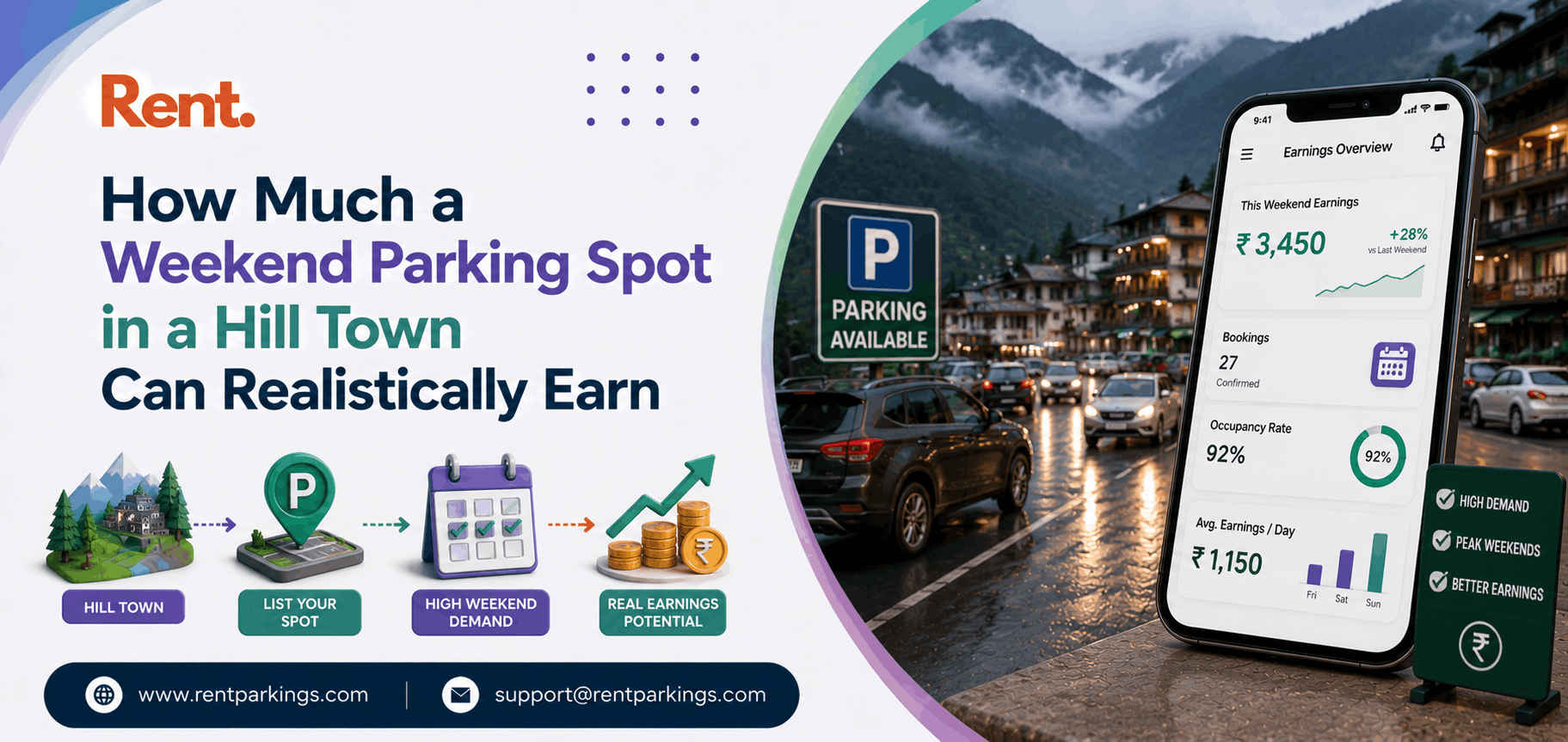
Because this market is mostly unregulated and hyperlocal, exact numbers vary widely between towns, seasons, and even which side of the road a plot sits on. Still, some rough patterns show up consistently in what property owners and local operators describe.
- A single car parking spot within a five-minute walk of a hill station's main market can often fetch somewhere between roughly ₹100 and ₹300 for a few peak weekend hours, more during long weekends or festival periods.
- Owners with room for eight to fifteen vehicles have reported earning a meaningful side income purely from Friday evening through Sunday night, without touching their land the rest of the week.
- Peak season, roughly October through February in most hill stations, plus the summer school holiday stretch, tends to bring in the bulk of a year's parking income.
- Off-season weekdays, especially during heavy monsoon months in certain regions, can see demand drop close to zero, which is exactly why treating this as flexible, hourly or daily rental usually works better than a long-term lease.
If you're wondering how many vehicles a given plot can realistically hold, RentParkings' breakdown of standard car parking dimensions in India is worth checking before you mark out bays with paint or rope.
What It Actually Takes to Turn a Plot Into Weekend Parking
Getting started doesn't require construction. It requires clarity.
Steps that most successful hill-station parking owners tend to follow:
- Clear and level the plot enough that cars can enter, turn and exit without a three-point turn on a narrow lane.
- Mark out bays, even with simple chalk, paint or rope, so vehicles park in an orderly line instead of blocking each other in.
- Decide on hourly, half-day or full-day pricing rather than one flat rate, since weekend tourist parking behaves very differently from daily commuter parking.
- Post prices clearly in rupees, so visitors don't feel like they're being charged an arbitrary "tourist rate" after they've already parked.
- Accept UPI and digital payments alongside cash, since most tourists now expect a QR code as much as they expect a parking attendant.
- List the spot online, so travellers can find, and sometimes even pre-book, it before they arrive, instead of discovering it purely by luck while circling the market.
That last point is where a lot of hill-town parking income gets left on the table. A plot that relies only on foot traffic and word of mouth earns far less than one that shows up in a search when someone is planning next weekend's trip.
For owners whose main asset is a driveway rather than open land, RentParkings' guide on renting out a driveway for paid parking covers the practical side: gate access, timing, and how to avoid accidentally blocking your own vehicle in the process.
Rules, Safety and Trust: What Hill-Town Parking Owners Should Get Right
Before listing a plot for weekend parking, a few practical points are worth sorting out early.
- Check local municipal or panchayat rules on using private land for paid parking, since requirements can differ from town to town and sometimes even street to street.
- Keep a clear boundary between your parking area and any residential or agricultural use of the same land, both for safety and to avoid disputes later.
- Consider basic lighting and a simple barrier or attendant during peak hours, since tourists are far more likely to return, and to pay a premium, for a spot that feels supervised.
- Be upfront about what happens if a vehicle is damaged while parked, and consider whether a simple written receipt or basic cover makes sense for higher-value bookings.
- Factor in monsoon drainage if your region gets heavy rain, because a plot that turns to mud in July earns nothing in July.
The same seasonal spike logic shows up around India's festival calendar, where RentParkings has looked at how short bursts of high demand around specific dates translate into outsized earnings for owners who plan ahead instead of reacting on the day itself.
Why This Matters Beyond Just One Weekend
Hill station tourism in India isn't slowing down. More families are choosing to drive instead of fly, more first-time car owners are picking weekend road trips over long-haul vacations, and more small hill towns keep showing up in Instagram feeds and getting discovered by a fresh wave of visitors every season.
That means the parking crunch these towns face every Friday isn't a temporary glitch. It's a structural gap between how these towns were built and how they're actually being used today. For local landowners, that gap is exactly where the opportunity sits: an asset that costs nothing extra to maintain most of the week and earns real money during the exact hours when demand peaks.
Frequently Asked Questions
1. Why do hill stations like Lonavala, Manali and Ooty run out of parking almost every weekend?
Most of these towns were built long before private car ownership became common in India, so their roads and municipal parking were never designed for today's traffic volumes. Weekend and holiday visitor numbers can run several times higher than an average weekday, and there's often very little flat land left to expand parking capacity. The result is a predictable squeeze every Friday and Saturday.
2. Can I legally rent out my private land or driveway for tourist parking in a hill town?
In most cases, yes, though rules vary by municipality, panchayat and sometimes even by street. It's worth checking local regulations before charging for parking, especially if your plot sits close to a protected viewpoint, forest boundary or heritage zone. A quick check with the local municipal office or panchayat usually clears this up.
3. How much can I realistically earn from a small parking plot in a place like Mahabaleshwar or Munnar?
Earnings depend heavily on location, season and how close your plot is to the main market or a popular viewpoint. Owners near high-footfall areas during peak weekends and holiday weeks tend to earn noticeably more than those a longer walk away, while off-season weekday earnings are usually minimal. Flexible, date-based pricing tends to work better here than a fixed monthly rate.
4. Do I need to build a proper structure to rent out land for parking?
No. Most hill-town parking spaces are simply cleared, levelled plots with marked bays, sometimes with basic lighting or a barrier for peak hours. Formal construction isn't necessary to get started, though a well-marked, well-lit plot generally earns more trust, and more bookings, than an unmarked patch of land.
5. What's the best way for tourists to find parking spots ahead of a weekend trip?
Increasingly, travellers search online or check listing platforms before they even leave home rather than relying on luck once they arrive. Owners who list their space in advance, with clear pricing and directions, tend to capture this demand instead of losing it to whichever attendant happens to be standing on the road that day.
6. Is weekend hill station parking only profitable during peak season?
Peak months, generally the winter and summer holiday stretches plus long weekends, bring in the bulk of the income, but many towns also see steady weekend demand year-round. Monsoon months can be considerably quieter in regions with heavy rainfall, which is another reason flexible, short-term pricing tends to work better than a fixed annual lease.
7. How do I price my parking space fairly without overcharging tourists?
A good starting point is to check what nearby municipal or private lots already charge, then price competitively while factoring in your location advantage. Charging noticeably more than the going local rate risks bad reviews and fewer repeat visitors, while pricing too low leaves money on the table during genuinely high-demand weekends.
8. What payment methods should I accept for parking in a hill station?
UPI is now the default expectation for most Indian travellers, so a simple QR code alongside cash covers the vast majority of visitors. Accepting only cash can slow down turnover and frustrate tourists who are already tired after a long drive.
9. Are there safety concerns I should think about before offering my land as a parking spot?
Basic precautions go a long way: decent lighting for evening arrivals, a clear boundary so vehicles don't block each other in, and a simple way to track which vehicle belongs to which visitor. For higher-value bookings, some owners also look into basic liability cover in case a parked vehicle is damaged.
10. How is renting out hill station parking different from renting a parking spot in a city like Bengaluru or Mumbai?
City parking tends to have steady, daily demand from commuters, so pricing is usually monthly or daily and fairly predictable. Hill station parking is far more seasonal and weekend-driven, with sharp spikes around holidays and long weekends, which means pricing flexibility and good timing matter more than they do in a typical urban listing.
Turning Friday Traffic Into Sunday Income
If you own land, a driveway or even an unused stretch of frontage near a hill station's market, viewpoint or main road, the traffic jam outside your gate every Friday evening isn't just an inconvenience. It's a queue of paying customers who currently have nowhere to go.
Turning that into income doesn't require construction, a loan or a long-term commitment. It just requires listing the space somewhere travellers can find before they start circling the block. Start Earning from Your Parking Space on RentParkings and put your weekends to work instead of watching the traffic crawl past for free.
Share This post
Search
Recent Post

Parking Space vs. Renting Out a Room to...
05 Oct, 2026

Think Parking Rental Only Pays in Mumbai...
02 Oct, 2026
Your Mumbai Parking Space Is Worth More...
01 Oct, 2026

Hyderabad's Real Estate Boom Left One As...
30 Sep, 2026

What Your Parking Space in Chennai Could...
29 Sep, 2026

Your Plans Changed After Listing Your Pa...
28 Sep, 2026

Parking Space vs SIP: Which Idle Asset A...
25 Sep, 2026

What Your Parking Space in Pune Could Ac...
24 Sep, 2026