

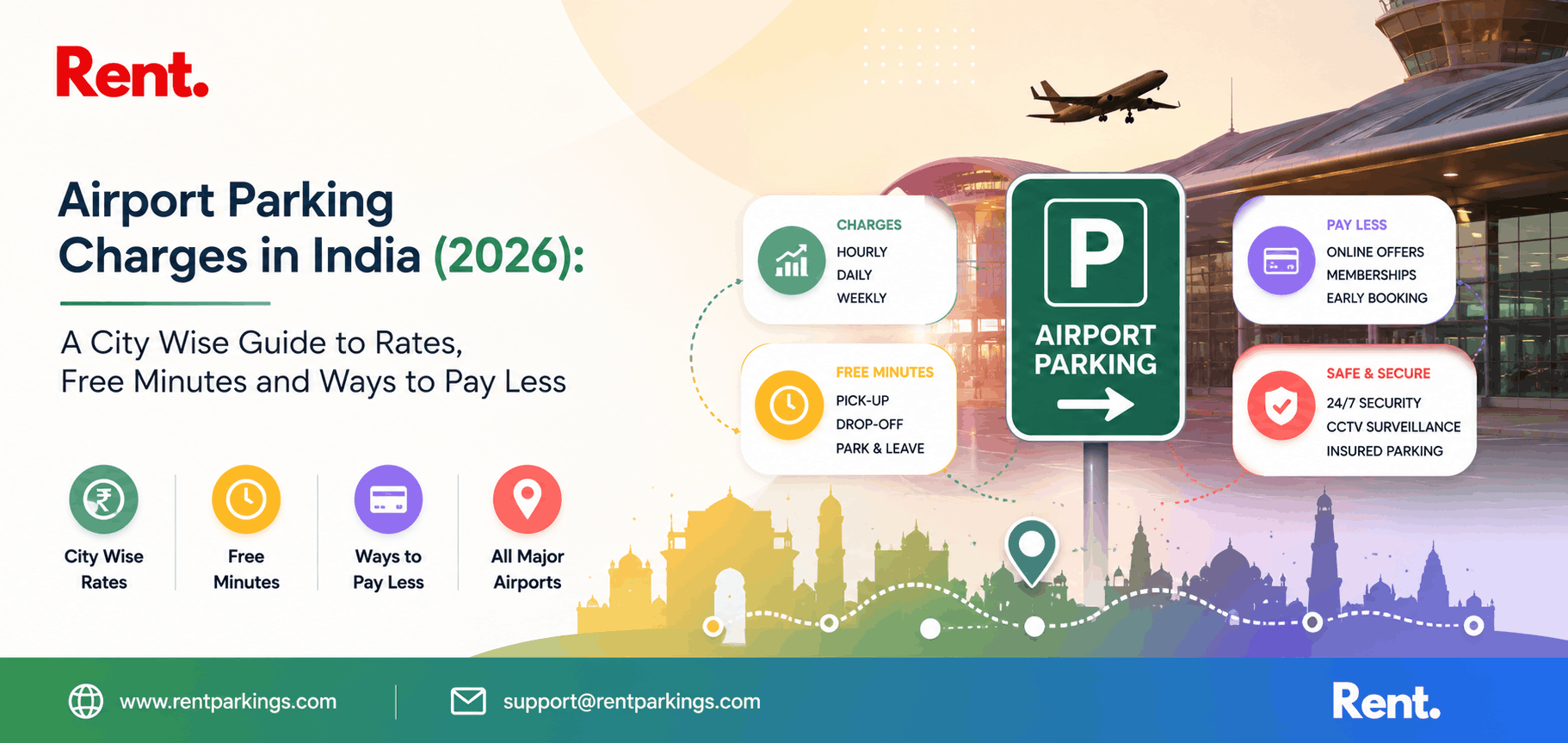
Airport Parking Charges in India (2026): A City Wise Guide to Rates, Free Minutes and Ways to Pay Less
Picture the scene that repeats itself thousands of times a day at every big Indian airport. A driver eases up to the arrivals kerb to collect a cousin whose flight has just touched down, the flight is running late, the free minutes quietly run out while everyone waits, and a parking charge starts ticking for the crime of simply standing still. Stretch that same story across a week long family holiday, where the car is left behind while everyone flies, and airport parking quietly graduates from a rounding error into a real line in the travel budget. The good news is that this is one of the most avoidable costs in Indian travel, and the same clarity that helps you book parking online in India can be applied to the airport with a little planning.
Here is the reassuring truth. Airport parking in India is far more predictable than people assume. Every major airport publishes its tariff, nearly all of them now run on FASTag so entry and exit are seamless, and each one hands you a short free window at the kerb that costs nothing at all when you use it properly. The problem is almost never the airport. It is that hardly anyone reads the rules until they are already frowning at the payment machine with a boarding pass in hand.
This guide sets out what parking genuinely costs in 2026 at India's five busiest airports, which are Delhi, Mumbai, Bengaluru, Hyderabad and Chennai. It explains the free minutes you keep leaving on the table, and it shows how to bend the bill downward when you are flying out for days rather than hours. Treat every figure here as an indicative 2026 tariff, because airports revise rates from time to time, so confirm on the official airport website or app before you drive out.
Start by understanding the three layers of airport parking
Before the city numbers, get the structure straight, because the single most common mistake is using the wrong parking layer for your situation. Airports offer three, and each one is priced for a different need.
The first is the free kerbside window, the strip right outside the terminal meant for dropping off or picking up. It is genuinely free, but only for a handful of minutes, usually six to eight. It exists for a quick stop, unload and go, not for waiting out a delayed arrival. Cross that window and you are billed as though you had rolled into the paid lot.
The second is short stay parking, which at most large airports is the multi level car park closest to the terminal. It is priced per hour or in slabs, and it is where you belong the moment you know you will be inside for more than a few minutes, whether you are seeing someone off or waiting for a landing. Understanding these slabs matters as much as knowing the parking rates across Indian cities, because a few unread lines on a tariff board are what turn a small wait into a surprising charge.
The third is long stay, often branded Park and Fly, built for travellers leaving their own car while they fly. It is priced per 24 hours, frequently at a gentler daily rate, and it is the layer that saves real money on a multi day trip, provided you actually book the long stay product rather than letting an hourly meter run for a week.
One more thing ties all three together. Almost every big Indian airport now uses FASTag for entry and exit, reading your tag on the way in, logging the time, and auto deducting the correct fare as you leave. It is the same tag you use on the highway, and it is closely related to the wider shift toward smart parking and FASTag systems in India. The practical takeaway is small but real: top up your FASTag the night before an early departure so the barrier never becomes a bottleneck.
Delhi, Indira Gandhi International Airport (IGI, DEL)
Delhi's IGI is the busiest airport in the country, and its Terminal 3 multi level car park runs a unified, slab based tariff for cars. In 2026, parking up to 30 minutes costs roughly ₹80, the 30 minute to 2 hour band sits near ₹180, and every additional hour beyond two hours adds about ₹90 up to the eight hour mark. There is a daily ceiling too, a flat cap of around ₹1,180 for 24 hours, so a full day will not spiral beyond that figure. The clock starts the instant your car crosses the entry barrier, and your FASTag settles the bill on exit.
If you are leaving a car at Delhi for several days, the airport's long stay Park and Fly facility beats the hourly car park, because a dedicated long stay lot is priced for exactly that purpose. The simple rule at IGI holds everywhere: for a quick pick up, respect the free kerb window, for anything longer step into the multi level car park, and for an actual trip, book long stay.
Mumbai, Chhatrapati Shivaji Maharaj International Airport (CSMIA, BOM)
Mumbai's CSMIA offers parking at both the domestic and international terminals, with short and long term choices to match how long you will be gone. Private vehicles get a complimentary pick up window of roughly zero to eight minutes at the kerb, one of the more generous free windows among the metros, after which the paid rates begin.
CSMIA also lets you pre book parking online, which is well worth doing during peak travel dates when the terminal car parks fill and circling for a slot wastes both fuel and patience. The money saving discipline in Mumbai is the same one that applies at a crowded railway forecourt or a mall gate: do not idle at the kerb hoping a late flight lands on time. Either loop back once your passenger has actually collected their bags, or park properly in short stay instead of gambling on the free minutes.
Bengaluru, Kempegowda International Airport (KIA, BLR)
Bengaluru's KIA has one of the clearest published structures. In 2026, car parking opens at about ₹100 for the first two hours and roughly ₹600 for a full day, with an added charge near ₹350 for each further day of a multi day stay. Prefer to hand the keys over? Valet parking runs about ₹475 for the first hour plus roughly ₹200 for every hour after that, capped near ₹1,200 a day.
Two Bengaluru specific savings are worth banking. First, the airport offers up to a 20 percent discount when you pre book parking online through the official website or app, a genuine reason to reserve before you leave home rather than paying full tariff at the barrier. Second, the free windows are strict but usable, with the drop off zone free for about six minutes, the pick up zone free for about six minutes, and short stay free for the first fifteen. If you are collecting someone, wait in the short stay or a nearby holding area until they are actually out, then swing in. This is the kind of small planning habit that pairs neatly with knowing your park and ride options near metro stations for the days you would rather not drive all the way in.
Hyderabad, Rajiv Gandhi International Airport (RGIA, HYD)
Hyderabad's RGIA uses a per slab structure that is kind to short stays. For a private car in 2026, the first half hour is about ₹50, up to one hour is around ₹150, one to two hours is roughly ₹200, each subsequent hour adds about ₹50, and 24 hours lands near ₹500. For multi day parking, subsequent days sit around ₹300 per 24 hours. That comparatively low daily rate makes RGIA one of the more economical big airports for leaving a car over a short trip, but only if you are in the correct long stay category rather than piling up hourly charges.
Chennai, Chennai International Airport (MAA)
Chennai International runs a multi level car park for travellers who need structured parking close to the terminal, alongside the usual kerbside pick up and drop. As at the other airports, commercial and app based taxis pay a separate entry fee for the pick up area. For private travellers the pattern mirrors the rest of the metros, a short free window at the kerb, per hour charges inside the multi level car park for longer waits, and a daily rate for extended stays. Because Chennai revises its tariff periodically, confirm the current per hour and 24 hour rates on the official Chennai airport website rather than trusting an old screenshot.
The free minutes almost everyone wastes
If one habit separates travellers who never overpay from those who grumble at the exit machine, it is respecting the free kerbside window. Across Indian airports it runs about six to eight minutes and is meant strictly for loading or unloading, not for waiting. The classic slip is arriving early to collect someone and parking at the kerb for just a few minutes, which then stretches to twenty because the flight is late and the belt is slow.
The fix is refreshingly simple. When you are picking someone up, do not enter the kerb or the paid lot until they tell you they have their bags and are walking out. Until then, wait in the marked holding or short stay area, which several airports keep free or cheap for exactly this reason. When you are dropping someone off, keep it to a real stop: pull in, help with the bags, and leave within the free window. Those two behaviours alone wipe out the most common airport parking charge Indians pay, the one for doing nothing but waiting.
How to pay less when you leave your car for days

Short waits are cheap. Multi day trips are where the bill balloons, and where a few small decisions make a large difference.
Use the long stay product, not the hourly meter. The single biggest overpayment is leaving a car in short stay for a week. Airports price dedicated long stay or Park and Fly lots per 24 hours at a lower effective daily rate, so always ask for the long stay category for a trip.
Pre book online where discounts exist. Bengaluru's up to 20 percent online saving is the clearest example, and reserving at busy airports also guarantees a slot so you are not hunting a full car park with a flight to catch. Check the official airport app before you leave.
Keep your FASTag funded. Since entry and exit are FASTag based at most major airports, a low balance can stall you at the barrier. Top it up the night before an early flight.
Run the maths against a round trip cab for longer trips. For a week away, compare total long stay parking plus fuel against simply taking a cab both ways. Short trips and odd hour flights usually favour driving and parking, while long holidays sometimes favour the cab. The point is to decide with numbers, not habit.
Note your bay and terminal. It sounds trivial, but hunting for a forgotten car after a red eye wastes time and, at hourly airports, money. Photograph the bay number and level on the way in.
Two wheeler and bike parking at Indian airports
Cars get all the attention, but plenty of Indian flyers reach the airport on a two wheeler, especially solo travellers and those living close by who would rather ride than pay a cab both ways. Most major airports run separate two wheeler parking at a much softer tariff than cars, usually a modest per hour or slab charge with a low daily rate, and dedicated bike bays kept clear of the car lanes.
For a frequent flyer within riding distance, leaving a two wheeler in long stay bike parking can be one of the cheapest strategies going, often a fraction of the car rate and far less than repeated app cab fares. The cautions are practical rather than financial. A two wheeler is more exposed to weather and to a forgotten helmet or loose bag, so use the covered zone where available, carry your documents and helmet or lock them properly, and photograph the bay so you can find the bike after a long trip. Confirm the two wheeler long stay rate on the official app, since bike tariffs are revised alongside car rates.
Beyond the metros, parking at Tier 2 airports
India's airport story in 2026 is increasingly a Tier 2 and Tier 3 story, and the parking economics there look a little different from the big five. Airports serving Pune, Kochi, Ahmedabad, Kolkata, Coimbatore and Lucknow generally run simpler, lower tariffs and are less prone to the full car park scramble of Delhi or Mumbai at peak hours, which means pre booking is less essential though still handy during festival surges.
The trade offs run the other way too. Smaller airports may offer fewer structured long stay options, so a multi day traveller sometimes has only the standard lot to lean on, and the free kerb window is enforced just as strictly. The city specific rule of thumb is that a Tier 2 airport is usually gentler on the wallet but narrower in choice, so plan a multi day stay by checking in advance whether a dedicated long stay rate exists rather than assuming one does. Wherever you fly from, the official airport website is the only reliable source for that airport's current numbers.
Leaving your car for days, safety and practical checks
Money is only half of the multi day decision. The other half is leaving a valuable car unattended in a public facility for a week. A few sensible habits separate a relaxed return from an unpleasant one. Park in a covered or well lit section where you can, especially during the monsoon, when open lots expose the car to standing water and falling debris, a risk worth reading up on the same way you would about protecting your parked car in the monsoon. Clear all valuables and documents from the cabin and leave nothing visible on the seats.
Note and photograph your level, zone and bay along with the terminal, because a large multi level car park after a red eye is a genuinely disorienting place. If you use valet, keep the receipt and note the car's condition at handover. Make sure your FASTag holds enough balance for the full stay so the exit is smooth. And remember that a car standing untouched for two weeks can develop a flat battery or soft tyres, so for a very long holiday some travellers still find that a round trip cab or a lift from family beats both the parking bill and the risk of a car that will not start. Knowing the no parking fines and towing rules in India is worth having in your back pocket too, for those times you end up parking off airport in a hurry.
Conclusion
Airport parking in India is not really expensive so much as it is misunderstood. The traveller who reads the tariff, respects the free six to eight minute kerb window, uses short stay for anything longer, and books the long stay product for a genuine trip will almost never overpay. The one who treats the kerb as a waiting room and lets an hourly meter run for a week certainly will, and will usually blame the airport rather than the habit.
The rates shift from city to city, roughly ₹80 to ₹200 for the first couple of hours and about ₹500 to ₹1,180 for a full day depending on the airport, but the principles never move. Pick the right layer for your situation, keep your FASTag topped up, and check the official app before you drive out. A little planning at the barrier is the cheapest part of any journey and it is entirely in your hands, which is exactly the mindset that makes it easy to find and book secure parking wherever the road takes you next.
FAQs
How much does airport parking cost in India in 2026?
It depends on the city, but expect roughly ₹80 to ₹200 for the first two hours and about ₹500 to ₹1,180 for 24 hours. Delhi's daily cap is near ₹1,180, Bengaluru is around ₹600 a day, and Hyderabad is roughly ₹500 for 24 hours. Most airports also give a free kerbside window of 6 to 8 minutes.
What are the parking charges at Delhi airport (IGI T3)?
At IGI Terminal 3's multi level car park in 2026, up to 30 minutes is about ₹80, 30 minutes to 2 hours is around ₹180, and each additional hour is roughly ₹90, with a 24 hour cap near ₹1,180. The fare is auto deducted through FASTag at exit.
How much is parking at Bengaluru airport (KIA)?
Bengaluru airport parking opens at about ₹100 for the first two hours and around ₹600 for a full day, with roughly ₹350 for each additional day. Valet parking is about ₹475 for the first hour plus ₹200 per subsequent hour. Pre booking online can save up to 20 percent.
What is the free parking time at Indian airports?
Most major Indian airports offer a free drop off and pick up window of about 6 to 8 minutes at the kerb, meant only for loading or unloading passengers. Bengaluru also gives roughly 15 minutes free in short stay. Overstaying the free window triggers the standard parking charges.
Can I pre book airport parking in India?
Yes. Airports including Bengaluru and Mumbai let you pre book parking online, which can secure a slot at busy times and, in Bengaluru's case, save up to 20 percent over the on the spot tariff. Always book through the official airport website or app.
Is airport parking in India paid through FASTag?
Yes, most major Indian airports now use FASTag for entry and exit. The barrier reads your tag on entry, records the time, and automatically deducts the correct fare from your FASTag wallet when you leave, so keep the tag funded before you travel.
What is the cheapest way to park a car at the airport for several days?
Use the airport's dedicated long stay or Park and Fly lot rather than leaving the car in short stay, since long stay is priced per 24 hours at a lower effective daily rate. Pre booking online and comparing against a round trip cab also help for longer trips.
How much is parking at Hyderabad airport (RGIA)?
At Hyderabad's RGIA in 2026, the first half hour is about ₹50, up to one hour is around ₹150, one to two hours is roughly ₹200, each subsequent hour is about ₹50, and 24 hours is near ₹500, with multi day stays around ₹300 per additional 24 hours.
What happens if I overstay the free pick up time at the airport?
Once you cross the free kerbside window, usually 6 to 8 minutes, you are charged the applicable parking tariff from your time of entry. To avoid it, wait in the marked short stay or holding area until your passenger has collected their bags, then drive in.
Is it better to drive and park or take a cab to the airport?
For short trips or odd hour flights, driving and parking is often cheaper and more convenient. For multi day trips, compare total long stay parking plus fuel against a round trip cab, because for a week away the cab can sometimes work out cheaper. Decide with the numbers, not by habit.
Share This post
Search
Recent Post
Parking Space vs. Renting Out a Room to...
05 Oct, 2026
Think Parking Rental Only Pays in Mumbai...
02 Oct, 2026
Your Mumbai Parking Space Is Worth More...
01 Oct, 2026
Hyderabad's Real Estate Boom Left One As...
30 Sep, 2026
What Your Parking Space in Chennai Could...
29 Sep, 2026
Your Plans Changed After Listing Your Pa...
28 Sep, 2026
Parking Space vs SIP: Which Idle Asset A...
25 Sep, 2026
What Your Parking Space in Pune Could Ac...
24 Sep, 2026