

Standard Car Parking Size in India: Exact Dimensions for Cars, Bikes and SUVs, and How to Know If a Spot Will Really Fit (2026)
Almost every parking argument in India starts with the same silent question. Is this space actually big enough. The flat buyer wonders if the promised parking will hold the family car. The SUV owner eyes a tight basement bay and holds their breath. The neighbour who wants to list a spare corner of the driveway has no idea if it even counts as a real parking space. Everyone is guessing, and guessing is why bumpers get scratched and tempers rise.
This guide replaces the guesswork with numbers. You will get the exact standard sizes used across Indian cities, from a compact hatchback bay to a full SUV slot to a two wheeler space, and a simple method to check whether any real spot will fit your vehicle before you commit. Whether you park in Chennai, Bengaluru, Hyderabad, Mumbai, Pune, or a fast growing Tier 2 town, the measurements are the same, and knowing them changes how confidently you park. If you would rather book a spot that is already confirmed to fit, you can always browse verified spaces on RentParkings instead of circling and hoping.
What is the standard car parking size in India?
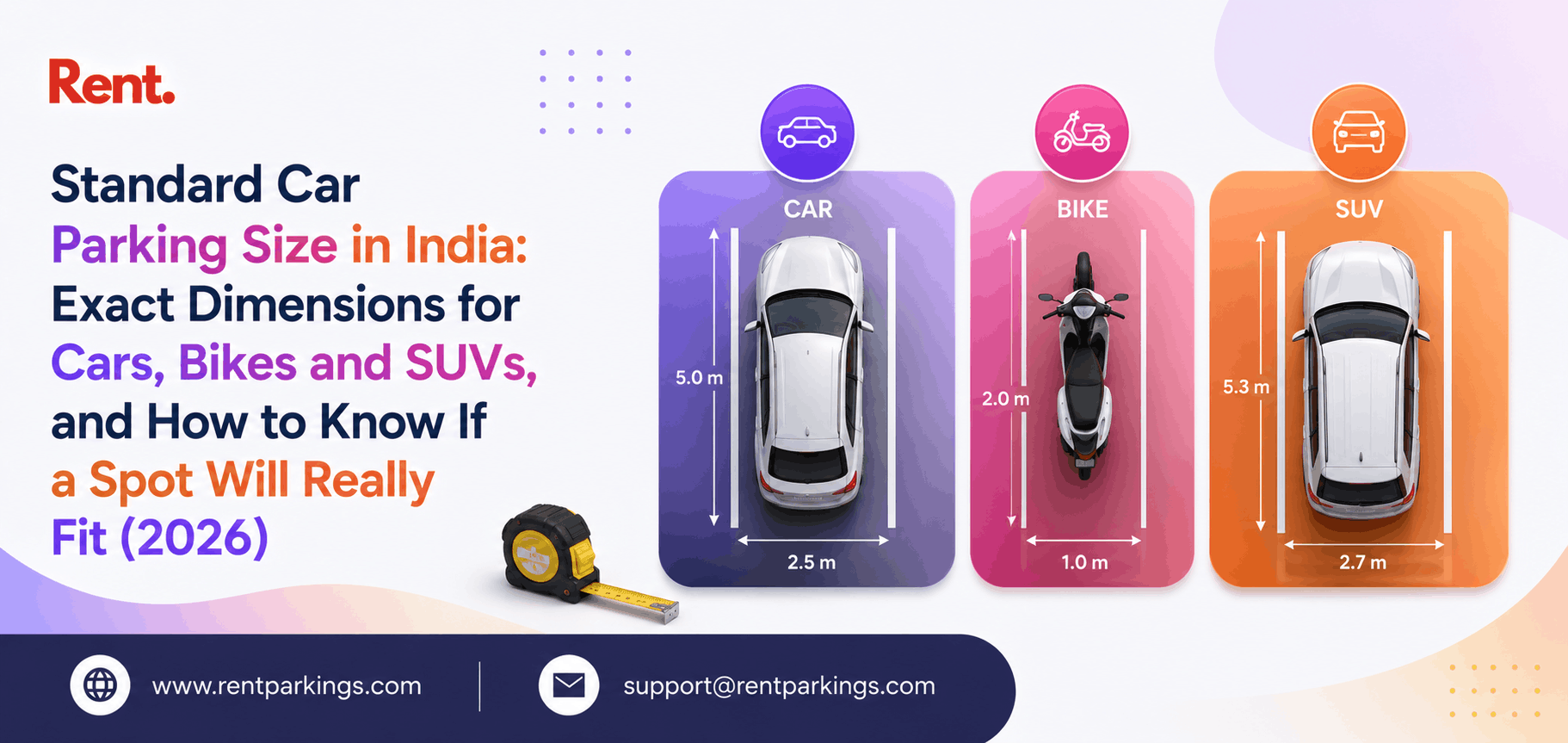
The common standard car parking space in India is 2.5 metres wide and 5.0 metres long, which is roughly 8 feet by 16 feet. This is the size most housing societies, malls, and commercial buildings use for a regular four wheeler bay. It works comfortably for hatchbacks and sedans such as a Swift, an i20, a City, or a Verna, and it is the figure you will see quoted in most building plans.
There is a second, more generous number worth knowing. The National Building Code recommends a minimum individual car parking size of 3.0 metres by 6.0 metres, about 10 feet by 20 feet, for a private or independent bay. In simple terms, 2.5 by 5.0 metres is the shared standard you find in stack parking and society basements, while 3.0 by 6.0 metres is the roomier size you want if you own the space or drive a larger vehicle. In area terms a single car space usually works out to between 12.5 and 13.75 square metres, before you add the driving lane in front of it.
How much space does an SUV need to park?
An SUV needs the larger bay of about 3.0 metres by 6.0 metres, not the compact 2.5 by 5.0 metre size. India has shifted hard toward big vehicles, and a Creta, a Scorpio N, a Fortuner, or an XUV700 simply does not sit comfortably in a bay built for a hatchback. Length is usually manageable, but width is where SUVs get pinched, because once a wide vehicle is centred in a 2.5 metre bay there is barely room to open the doors on both sides.
If you drive an SUV, treat 2.6 metres of width and 5.4 metres of length as your practical comfort minimum, and prefer the full 3.0 by 6.0 metre slot wherever you can get it. This matters even more in older buildings, where basements were designed years ago for smaller cars and never resized for today's fleet. The mismatch between yesterday's parking and today's vehicles is a big reason spaces feel tighter than the plan suggests, a theme RentParkings has explored while mapping India's busiest parking hotspots.
What is the standard two wheeler parking size in India?
A two wheeler needs about 1.0 metre by 2.0 metres, which is roughly 3.3 feet by 6.6 feet. In area that is a little over 1.25 square metres per bike or scooter, and it is why you can fit four to five two wheelers in the footprint of a single car. Some tightly planned societies squeeze this further, but going below one metre of width makes it hard to get on and off the vehicle and to swing it out without knocking the neighbour's mirror.
Two wheelers are the silent giant of Indian parking. There are hundreds of millions of them, and buildings that plan generously for cars often leave scooter owners fighting over scraps of leftover floor. If you have ever wondered why bike parking feels so cramped even in a new complex, RentParkings has written a sharp piece on exactly that imbalance in India builds its parking around cars, then wonders where to put the scooters. The short version is that the standard bike size is small, but the sheer number of bikes makes even small spaces valuable.
Standard parking sizes in India at a glance
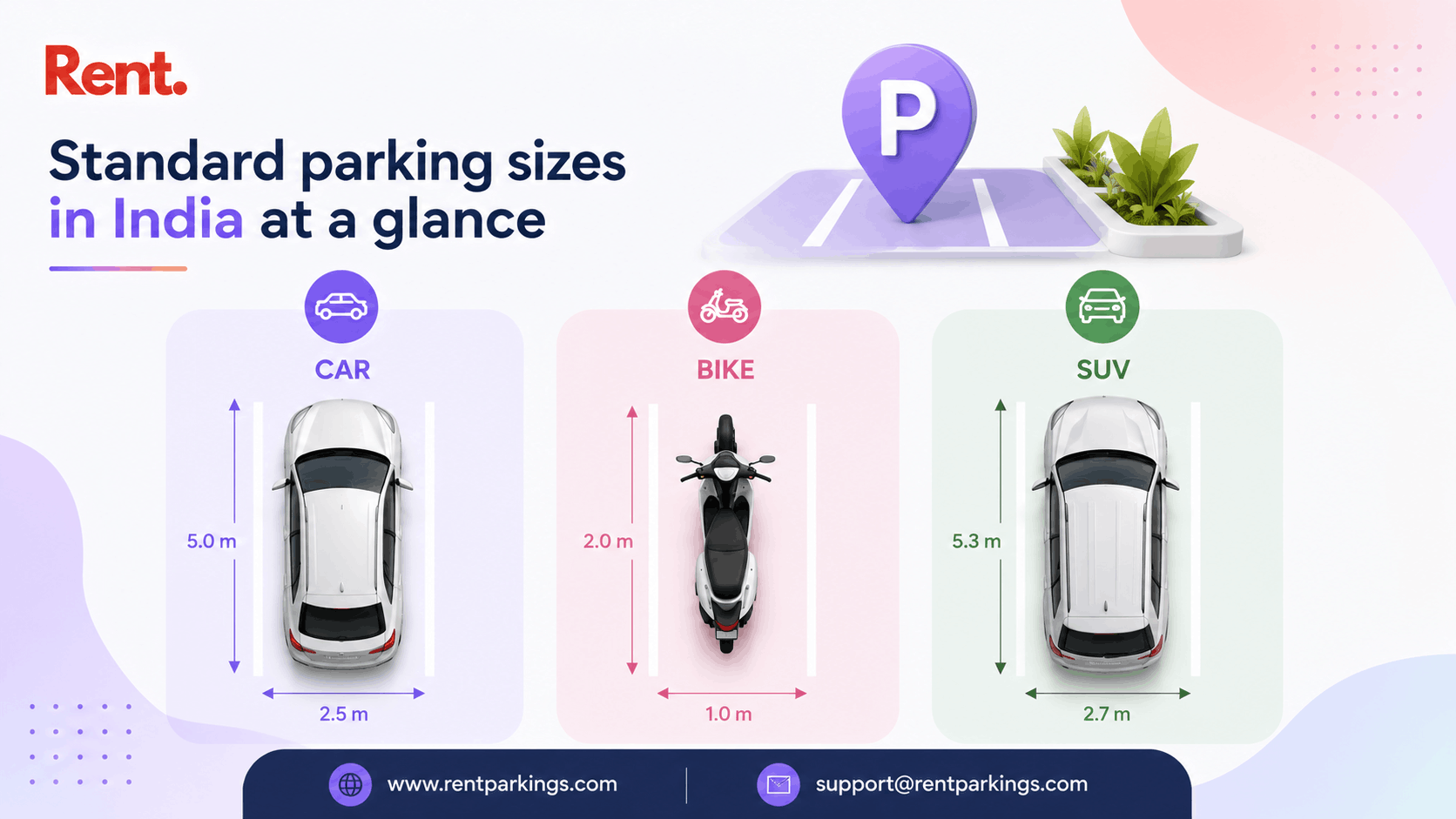
Here is the quick reference to keep in your head.
A compact or common car bay is 2.5 metres by 5.0 metres, about 8 feet by 16 feet, and suits hatchbacks and sedans. A spacious or individual car bay is 3.0 metres by 6.0 metres, about 10 feet by 20 feet, and is the right choice for SUVs and comfortable door opening. A two wheeler space is 1.0 metre by 2.0 metres, about 3.3 feet by 6.6 feet. On top of the bay itself, you also need a driving lane, and the aisle in front of perpendicular parking should be about 5.5 to 6.0 metres wide so a car can turn into the slot in one clean move.
That last number is the one people forget. A bay can be perfectly sized and still be unusable if the lane in front is too narrow to swing into it. When you judge a space, judge the approach too, not just the box painted on the floor.
How do I know if a parking spot will actually fit my car?
Measure three things: the width, the length, and the turning lane in front. A spot fits your car when it is wider than your car plus enough room to open a door, longer than your car plus a little buffer, and approached by a lane wide enough to turn in without a ten point struggle. You do not need an architect. A measuring tape and two minutes will tell you the truth.
Check width first
Width is where most parking goes wrong. Note your car's width including the mirrors, then compare it to the bay width. For easy daily use you want at least 40 to 50 centimetres of total spare width so you and your passengers can actually step out. A car that is 1.8 metres wide is technically fine in a 2.5 metre bay, but if the neighbouring vehicle parks close, the real usable gap vanishes.
Check length and the lane
Length is more forgiving because most cars are shorter than 5 metres, but do confirm the space clears your bumper front and back, especially in stack systems and pillar heavy basements. Then stand in the lane in front and picture the turn. If the aisle is under 5 metres for perpendicular bays, expect a multi move manoeuvre every single day. For tight approaches, the calm reversing and angle techniques in RentParkings' walkthrough of the parking situations that trip up Indian drivers will save your nerves and your alloys.
Watch the height in covered parking
In basements, stack parking, and mechanical systems there is a fourth dimension: clearance height. Standard covered parking usually allows about 2.1 to 2.4 metres of headroom, which is fine for most cars but can be a problem for tall SUVs with roof carriers. Always check the height barrier at the entry ramp before you drive a tall vehicle in.
Why do parking spaces feel smaller than the standard?
Because the painted bay and the real usable space are two different things. On paper a bay is 2.5 metres wide, but in practice pillars intrude, neighbours park off centre, the lane is narrower than ideal, and vehicles have grown larger than the design assumed. The standard has not shrunk. The vehicles got bigger and the buildings stayed the same.
There is also the pressure of numbers. Indian building rules often require a certain amount of parking per flat, commonly expressed as Equivalent Car Spaces, with many state bye laws asking for around 2 ECS for every 100 square metres of floor area. When more vehicles arrive than the plan allowed for, developers and societies pack bays tighter and press leftover corners into service. The result is spaces that meet the letter of the standard but feel cramped in daily life. Automation and better layout are starting to help, and RentParkings has covered how technology is easing this in its look at smart parking with sensors, FASTag, and multiple level systems.
Does a bigger or covered parking space add value?
Yes. Size and cover both raise what a parking space is worth, whether you are buying a flat or renting a spot. A full 3.0 by 6.0 metre covered bay that easily takes an SUV is far more desirable than a tight open corner, and buyers increasingly treat a proper parking space as part of a home's value rather than a throw in. RentParkings has looked closely at this in its analysis of whether a parking space adds value to your flat, and the honest answer is that a good one clearly does.
This is also where the numbers turn into opportunity. If you have a space that meets or beats the standard, it is a real asset that can earn for you, and listing your parking space on RentParkings is completely free. You measure it once, confirm it fits a car or a bike, put it up at no cost, and let a driver who has been circling the block finally park somewhere that fits. A correctly sized, clearly described spot rents faster and holds its tenant longer, precisely because the driver knows their vehicle will actually go in.
How to describe your parking space so it fits the right vehicle
If you plan to share or list a space, lead with the three numbers that matter. State the width, the length, and whether it is open or covered, then add the clearance height if it is a basement or stack. A listing that says "2.6 metres wide, 5.4 metres long, covered, suits sedan or compact SUV" earns trust instantly, because the driver can match it to their own car without a site visit. Vagueness costs you bookings. Precision wins them.
Photos help, but numbers close the deal. Add one shot straight on and one from the approach lane so the renter can see the turn in. When your listing answers the fit question before it is asked, you skip the wasted visits and the awkward cancellations, and your space works for you with almost no effort.
Do these sizes change in Tier 2 and Tier 3 towns?
The core dimensions stay the same, but the pressure is different. A car is the same size in Coimbatore, Nashik, Kochi, or Indore as it is in Mumbai, so the 2.5 by 5.0 metre and 3.0 by 6.0 metre standards still apply. What changes is availability. Many smaller towns have more open ground and wider plots, so home parking often runs larger and more comfortable than a metro basement bay. As vehicle ownership rises quickly in these towns, that early advantage is worth protecting, and a generously sized spot there is a genuine asset in growing demand. The measuring method in this guide works exactly the same, whether your lane is a busy metro basement or a quiet Tier 3 street.
Conclusion
Parking in India stops being stressful the moment you stop guessing. The common car bay is 2.5 metres by 5.0 metres, the roomier individual bay is 3.0 metres by 6.0 metres and is the one SUVs really want, and a two wheeler needs about 1.0 metre by 2.0 metres. Add a turning lane of roughly 5.5 to 6.0 metres and a clearance height of around 2.1 to 2.4 metres in covered areas, and you have every number you need to judge any spot with confidence.
Carry these figures the next time you buy, book, or list a space. Measure the width, the length, and the approach, and you will never again wedge a car into a bay that was never going to hold it. And if your space measures up, remember it is an asset. List it for free on RentParkings, describe it with the exact dimensions, and turn a well sized spot into a space someone will happily pay to use.
FAQs
What is the standard car parking size in India?
The common standard car parking space is 2.5 metres wide and 5.0 metres long, about 8 feet by 16 feet. A more spacious individual bay recommended by the National Building Code is 3.0 metres by 6.0 metres, about 10 feet by 20 feet.
How much space is needed to park a car in India?
A single car needs roughly 12.5 to 13.75 square metres for the bay itself, plus a driving lane in front. For everyday comfort you want a bay wider than your car by at least 40 to 50 centimetres so doors open freely.
What is the standard SUV parking size?
An SUV is best parked in a bay of about 3.0 metres by 6.0 metres. The compact 2.5 by 5.0 metre size is usually too tight for width and door opening on larger vehicles like a Creta, Scorpio N, or Fortuner.
What is the standard two wheeler parking size in India?
A two wheeler needs about 1.0 metre by 2.0 metres, roughly 3.3 feet by 6.6 feet, which is a little over 1.25 square metres. Around four to five two wheelers fit in the footprint of one car.
What is the minimum parking space size as per the National Building Code?
The National Building Code recommends a minimum individual car parking size of 3.0 metres by 6.0 metres, while the common shared bay used in most buildings is 2.5 metres by 5.0 metres.
How wide should the driving lane in front of parking be?
For perpendicular parking the aisle in front should be about 5.5 to 6.0 metres wide, so a car can turn into the bay in a single clean movement rather than a multi move struggle.
What is the minimum height for covered parking?
Covered parking usually provides about 2.1 to 2.4 metres of clearance height. Check the entry ramp barrier before driving in a tall SUV or a vehicle with a roof carrier.
Why does my parking space feel smaller than the standard size?
Painted bays and real usable space differ. Pillars intrude, neighbours park off centre, lanes are often narrower than ideal, and vehicles have grown larger than the original design assumed, so the space feels tighter than the plan.
Does a bigger parking space add value to a flat?
Yes. A larger, covered bay that comfortably fits an SUV is more desirable and adds to a home's resale value, whereas a tight open corner is worth less and is harder to sell or rent.
How do I describe my parking space when listing it?
State the width, the length, whether it is open or covered, and the clearance height for basements. Precise numbers let a driver confirm their vehicle fits before visiting, which helps the space rent faster and stay rented.
Share This post
Search
Recent Post
What Happens When You Need Your Parking...
01 Sep, 2026
How Listing Your Parking Space in India...
31 Aug, 2026
Parking Space vs Gold: The Idle Asset Th...
28 Aug, 2026
Your Garage Hasn't Parked a Car in Month...
26 Aug, 2026
Someone Dents a Car in Your Rented Parki...
25 Aug, 2026
Your Vacant Plot Is Not Free to Own: How...
24 Aug, 2026
Coaching Centre Parking in India: Why Ko...
21 Aug, 2026
India's PG and Co-Living Boom Has a Park...
20 Aug, 2026