

India's Busiest Parking Hotspots: The Main Areas & Rush Zones Where Parking Runs Out First, and How to List Your Space Free on RentParkings (2026)
There is a particular kind of Indian frustration that has nothing to do with the destination and everything to do with the last 500 metres. You have reached the market, the office, the mall, the clinic, and now you are circling. Around the block once, twice, a third time, engine idling, eyes scanning every kerb, hoping a reversing tail-light means someone is about to free up a spot. In India's busiest main areas and rush zones, the hardest part of any trip isn't getting there. It's finding somewhere to leave the car once you have.
This post maps those high-demand parking areas in India, the specific commercial hubs, IT corridors and market districts where parking runs out first, explains why the crunch is worst there, and shows the two people this matters most to. If you're a driver, you'll learn where to expect the squeeze and how to plan around it. And if you own an empty spot anywhere near one of these zones, you'll learn how to turn that idle space into steady demand by putting up a free parking space listing on RentParkings, where the drivers circling those blocks are already searching.
Why Parking "Runs Out" in the Same Places Every Day
India isn't short of vehicles. The country now has well over 300 million registered vehicles, roughly 260 million two-wheelers and around 50 million cars, and the fleet is projected to nearly double to about 494 million by 2050, with private cars alone growing about 2.7 times. What India is short of is places to put them, and that shortage is not spread evenly. It concentrates, brutally, in the same handful of areas in every city.
Three forces stack up to create a parking hotspot:
- Concentration of activity. Offices, showrooms, hospitals, restaurants and markets cluster into a few square kilometres, pulling tens of thousands of vehicles into a small footprint.
- Old road grids. Most of these hubs, such as T. Nagar, Karol Bagh, Dadar and Chickpet, were laid out long before two-car households existed. The on-street parking demand simply overwhelms roads that were never designed for it.
- Predictable rush. Demand spikes at the same hours: the weekday morning and evening peak hour parking rush around offices, and the weekend and festive season parking crunch around shopping districts. When capacity is exceeded, the overflow spills onto every available kerb.
The result is a daily, repeatable pattern: some areas have chronic commercial hub parking shortages while quiet residential lanes just streets away sit with unused driveways and empty stilts. That mismatch is the entire opportunity, and the reason a well-placed off-street parking space near a hotspot is so valuable. We cover the pricing side of this separately in Parking Rental Rates Across India: A City-by-City Guide.
The Hotspot Map: Where Parking Peaks, City by City
Here are the main areas across India where parking demand consistently outruns supply. If your home, shop or building sits in or near one of these, you're sitting on a high-demand location. Many commuters in these zones also cut costs by parking near metro stations and taking the train in.
Chennai
Chennai's shopping and commercial cores are textbook hotspots. T. Nagar, one of the highest-footfall retail districts in the country, sees parking demand rise sharply as visitors struggle to find safe, accessible spots, with narrow internal roads and limited multi-level infrastructure pushing vehicles onto every kerb, especially on weekends and during festivals. Anna Nagar, Mylapore (temple-driven rush), and the OMR IT corridor round out the list. T. Nagar parking is arguably the single most searched area-parking query in the city.
Bengaluru
Few cities generate parking pressure like Bengaluru. Koramangala and Indiranagar, dense with cafés, startups and showrooms, are perennial squeeze zones, and Koramangala parking on a Friday evening is close to a lost cause. Add the IT engines of Whitefield and Electronic City, plus MG Road and Brigade Road for retail, and you have a city where IT park parking and commercial demand collide daily.
Hyderabad
HITEC City and Gachibowli are notorious for rush-hour gridlock as IT professionals pour in and out at peak hours, and parking near the tech parks disappears well before 10 a.m. HITEC City parking demand is a daily certainty. Ameerpet (coaching and commerce) and the Banjara Hills and Jubilee Hills retail and dining belt are the other reliable hotspots.
Mumbai
Space is Mumbai's oldest problem, so almost every hub is a hotspot. Bandra-Kurla Complex (BKC) anchors the office rush; Andheri, Dadar, Lower Parel and the Fort/Nariman Point business district all run chronically short. In a city this dense, a secure parking space near any station or office cluster is gold.
Delhi NCR
Connaught Place, Karol Bagh, Lajpat Nagar and Nehru Place headline the retail-and-commerce crunch, while Cyber City (Gurugram) and Noida's IT and mall belts carry the office rush. The scale of the gap here is staggering: analyses have described Delhi's annual additional car-parking need as equivalent to hundreds of football fields.
Pune, Ahmedabad, Kolkata & Kochi
Pune's Hinjewadi IT park is a defining rush zone, alongside FC Road and Koregaon Park. Ahmedabad concentrates demand on CG Road and the SG Highway belt. Kolkata squeezes hardest around Park Street, New Market and the Salt Lake Sector V IT hub. Kochi's MG Road and Infopark complete the picture. Every one of these is a place where "parking near me" returns very little that's actually available.
The Tier-2 & Tier-3 wave
The crunch is no longer a metro-only story. Coimbatore, Indore, Nagpur, Kanpur, Visakhapatnam, Surat and Lucknow are now living the exact hotspot pattern: a booming main market or IT node, an old road grid, and nowhere to park. For space owners in these cities, being early to list means capturing demand before supply organises.
For Drivers: How to Beat the Hotspot Crunch
If you regularly head into one of these zones, a little planning saves the circling:
- Don't hunt at the destination; book near it. The smart move is to reserve an off-street parking spot a short walk from the hotspot rather than gambling on a kerb inside it. You can book parking online in advance instead of arriving on hope.
- Respect the rush windows. Aim to arrive before the weekday peak hour parking surge (before ~9:30 a.m., after ~7:30 p.m.) and avoid shopping districts on festival weekends when the festive season parking crunch is at its worst.
- Go monthly if you commute daily. If you work in an IT hub or commercial core, a monthly parking in commercial areas arrangement near your office is far cheaper and calmer than daily improvising.
- Prioritise a secure spot. A gated, off-road secure parking space protects your vehicle far better than a random kerb in a congested lane.
RentParkings exists precisely for this: it lets drivers find and book parking online in the exact high-demand parking areas where kerbside space has already run out. You can also read how smart parking, sensors and FASTag are easing India's urban parking crunch.
For Space Owners: Your Location Is the Product, List It Free
Here's the part most people near these hotspots never realise: you may already own the most valuable thing in the equation. An empty stilt, a spare covered bay, a driveway you don't use during the day, a shop's after-hours forecourt: if any of these sits within walking distance of a hotspot above, drivers are actively searching for it right now.
And listing it costs you nothing. RentParkings offers free listings, so you can put up a free parking space listing without any upfront fee, describe the location, size and availability, add photos, and go live. There's no reason to leave a parking near main areas advantage sitting idle; see just how much an empty parking space can really earn.
Is Your Location a Hotspot? A 30-Second Self-Check
Not sure if your spot qualifies? Run through this quick test. If you answer "yes" to even two of these, drivers are almost certainly searching your area:
- Is there an IT park, office cluster, mall, market, hospital, college or railway/metro station within a 10-minute walk?
- Do you regularly see cars circling or double-parked on your street during mornings, evenings or weekends?
- Is on-street parking demand so high near you that visitors complain about finding space?
- Does your area get a visible festive season parking or event-day surge?
Every "yes" is a signal that your idle space sits inside a real demand pocket, and that a free listing will find takers quickly. You don't need to be in the busiest lane; being a short, walkable distance from it is often the sweet spot, because drivers would rather park securely nearby than crawl through the congestion at the very centre.
Why free listings near hotspots work so well
- Demand is already there. You're not creating a market; you're plugging into one. In a rush hour parking India hotspot, the searching drivers exist before your listing does.
- Location does the selling. A generic spot in a quiet suburb competes on price. A spot near HITEC City parking, Koramangala parking or T. Nagar parking competes on scarcity, which is a far stronger position.
- Flexible use. List it for hourly visitors, daily commuters, or lock in a monthly parking in commercial areas tenant for steady, predictable interest.
- Zero listing cost. Because you can list your parking space free, there's no risk in testing demand; put it up and see who's searching your area.
What makes a hotspot listing stand out
To convert the demand into bookings, a listing near a busy zone should be clear and honest:
- Name the landmark. "5-min walk from Phoenix Marketcity" or "opposite HITEC City metro" tells searchers exactly why your spot solves their problem.
- Be specific on access hours (day-only, 24x7, or weekends) so commuters and shoppers self-select.
- Highlight security (gated, covered, CCTV, guarded) because a secure parking space commands trust and repeat use.
- Add clear photos of the entrance and the bay. In a hotspot, a driver deciding between two listings will pick the one they can actually visualise.
How to List Your Space Free on RentParkings: A Simple Walkthrough
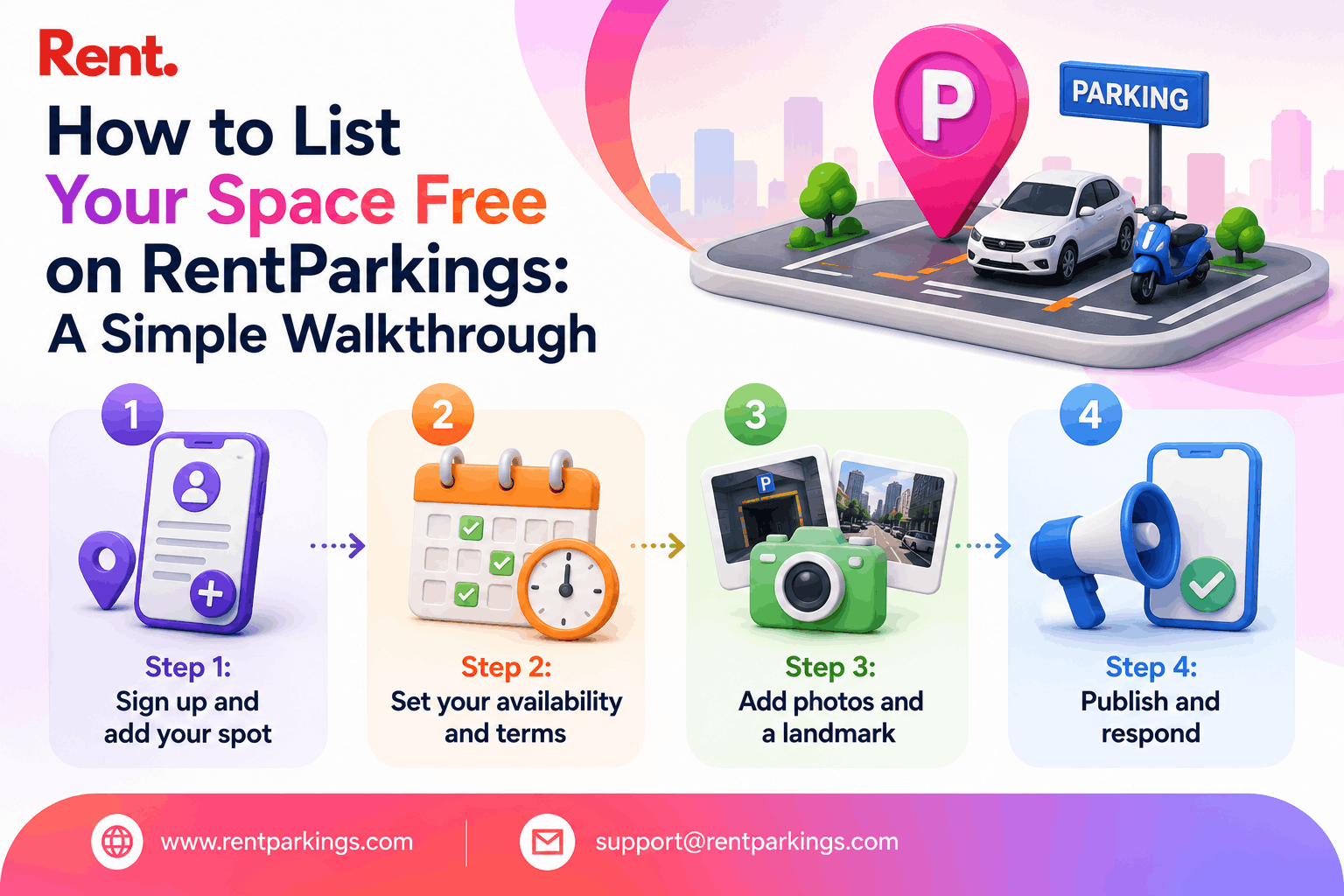
If you've decided your location is worth testing, the process is deliberately quick, because the whole point of a free parking space listing is that there's no barrier to getting started. Here's what it looks like end to end.
Step 1: Sign up and add your spot. Create an account and start a new listing. You'll enter the basics: where the space is, what type it is (open, covered or stilt), and what vehicle it fits (car, bike or larger). Pinning the exact location matters most, because searchers in a hotspot filter by proximity first.
Step 2: Set your availability and terms. Decide whether the spot is available hourly, daily, weekly or as monthly parking in commercial areas, and mark the hours it's usable (day-only, nights, weekends or 24x7). A commuter looking for peak hour parking near an office and a shopper needing a Saturday slot are two different customers; clear availability lets each self-select.
Step 3: Add photos and a landmark. Upload clear pictures of the entrance and the bay, and name the nearby hotspot in your description. "Two-minute walk from Cyber City metro" or "behind T. Nagar main road" instantly tells a searcher your spot solves their exact problem. This single detail is what turns a parking near main areas listing into a booked one.
Step 4: Publish and respond. Once live, your secure parking space is visible to everyone searching that area. Because listing is free, you can put it up, watch the interest, and adjust your hours or terms based on who's actually reaching out, with no cost for experimenting.
That's the entire loop. No setup fee, no construction, no complexity, just an idle spot made visible to the people already hunting for it.
The Four Types of Demand a Hotspot Listing Can Capture
Not all parking demand looks the same, and the beauty of a hotspot location is that it can serve several kinds at once. Understanding them helps you position your listing:
- Daily commuter demand (the office rush). Near IT corridors like Whitefield, HITEC City parking zones, Hinjewadi or BKC, thousands of professionals need a predictable spot five days a week. This is where monthly parking in commercial areas shines, offering steady, low-churn, reliable interest.
- Shopper and visitor demand (the retail rush). Around markets and malls such as T. Nagar parking, Karol Bagh, Park Street and CG Road, demand is spiky, peaking on weekends and during the festive season parking crunch. Hourly and daily listings capture this best.
- Event and seasonal demand. Stadiums, convention centres, wedding halls and temple zones generate sudden surges. A spot that's flexible on timing can command strong interest on event days when nearby off-street parking is fully booked.
- Overflow demand (the everyday circling driver). Beyond the scheduled rushes, there's constant baseline demand from drivers who simply can't find parking near me on a choked street. A listing near any busy node quietly captures this all day long.
A single well-placed spot near a hotspot can flex between these (weekday commuter parking, weekend shopper parking, occasional event parking), which is exactly why being close to a commercial hub parking zone makes an ordinary space genuinely valuable.
The Bigger Picture: Matching Idle Space to Peak Demand
Zoom out and the whole situation is really a distribution problem, not a scarcity problem. India's hotspots don't lack space so much as organised space. Right beside every choked commercial hub parking zone are hundreds of unused driveways, empty society bays and vacant plots, supply that never meets the demand a hundred metres away because nobody has connected the two.
That's exactly the bridge a free parking space listing builds. Every owner who lists an idle spot near a hotspot takes one more circling car off the road, eases a fraction of the on-street parking demand, and earns from an asset that was doing nothing. As Indian cities keep adding vehicles far faster than they add formal parking, this peer-to-peer matching of empty space to peak demand is the most practical relief valve available, and it scales one free listing at a time. For a step-by-step start, read How to List Your Empty Parking Space for Rent.
Conclusion
Parking in India doesn't run out everywhere. It runs out in the same predictable main areas and rush zones, such as T. Nagar and Koramangala, HITEC City and BKC, Connaught Place and Hinjewadi, at the same predictable hours, day after day. For drivers, the fix is to stop circling and start booking a secure parking space near the hotspot before you arrive. For anyone who owns an unused spot near one of these zones, the fix is even simpler: your location is already the product the market wants.
You don't need to build anything, and you don't need to pay to find out if it works. Put up a free parking space listing on RentParkings, name the hotspot you're near, and let the demand that's already circling your block come to you. In India's busiest high-demand parking areas, an empty spot isn't empty; it's an opportunity waiting to be listed.
FAQs
What are the highest-demand parking areas in India?
The busiest parking hotspots are India's main commercial and IT hubs: T. Nagar in Chennai, Koramangala, Indiranagar and Whitefield in Bengaluru, HITEC City and Gachibowli in Hyderabad, Bandra-Kurla Complex and Dadar in Mumbai, Connaught Place, Nehru Place and Cyber City in Delhi NCR, and Hinjewadi in Pune, where parking runs out fastest during rush hours.
Why does parking run out so fast in these main areas?
These zones concentrate offices, shops and services into small, old road grids that were never built for today's vehicle numbers. Demand spikes predictably during weekday peak hours and weekend or festive shopping, so the kerbside capacity is exceeded and vehicles overflow onto every available spot.
How can I find parking near a busy commercial area?
Instead of circling the hotspot, reserve an off-street spot nearby in advance. On RentParkings you can book parking online near main areas and IT hubs, choosing hourly, daily or monthly options based on how often you visit.
Is it really free to list my parking space on RentParkings?
Yes. RentParkings offers free listings, so you can list your parking space free with no upfront listing fee. You add the location, size, availability and photos, publish, and your spot becomes visible to drivers searching your area.
Does my spot need to be inside a hotspot to be worth listing?
No. A spot within a short walk of a high-demand area is ideal, because drivers happily park nearby and walk in. Being close to a rush zone (a mall, IT park, hospital, market or station) is what makes a listing valuable.
What kind of spaces can I list?
Almost any usable space: a spare covered or stilt bay, an unused driveway, a shop forecourt available after hours, or a vacant plot. If it's safe and accessible, it can be listed for hourly, daily or monthly parking.
How do I make my parking listing stand out near a busy zone?
Name the nearby landmark, state your access hours clearly, highlight security features like gating or CCTV, and add clear photos of the entrance and bay. A specific, well-photographed listing wins bookings in a hotspot.
Can I offer monthly parking to office commuters?
Yes. If your spot is near an IT park or commercial hub, offering monthly parking in commercial areas is popular with daily commuters who want a guaranteed, secure spot rather than improvising each day, and it gives you steady, predictable interest.
When is parking demand highest in these areas?
Weekday morning and evening rush hours drive office-area demand, while weekends and the festive season drive shopping-district demand. Listing with clear availability windows helps you capture whichever rush matches your location.
How does listing my empty spot help beyond earning?
Every idle space that gets listed near a hotspot takes a circling car off the road, easing on-street parking demand and congestion in that area. You earn from an unused asset while making the neighbourhood's parking crunch a little lighter.
Share This post
Search
Recent Post
What Happens When You Need Your Parking...
01 Sep, 2026
How Listing Your Parking Space in India...
31 Aug, 2026
Parking Space vs Gold: The Idle Asset Th...
28 Aug, 2026
Your Garage Hasn't Parked a Car in Month...
26 Aug, 2026
Someone Dents a Car in Your Rented Parki...
25 Aug, 2026
Your Vacant Plot Is Not Free to Own: How...
24 Aug, 2026
Coaching Centre Parking in India: Why Ko...
21 Aug, 2026
India's PG and Co-Living Boom Has a Park...
20 Aug, 2026