

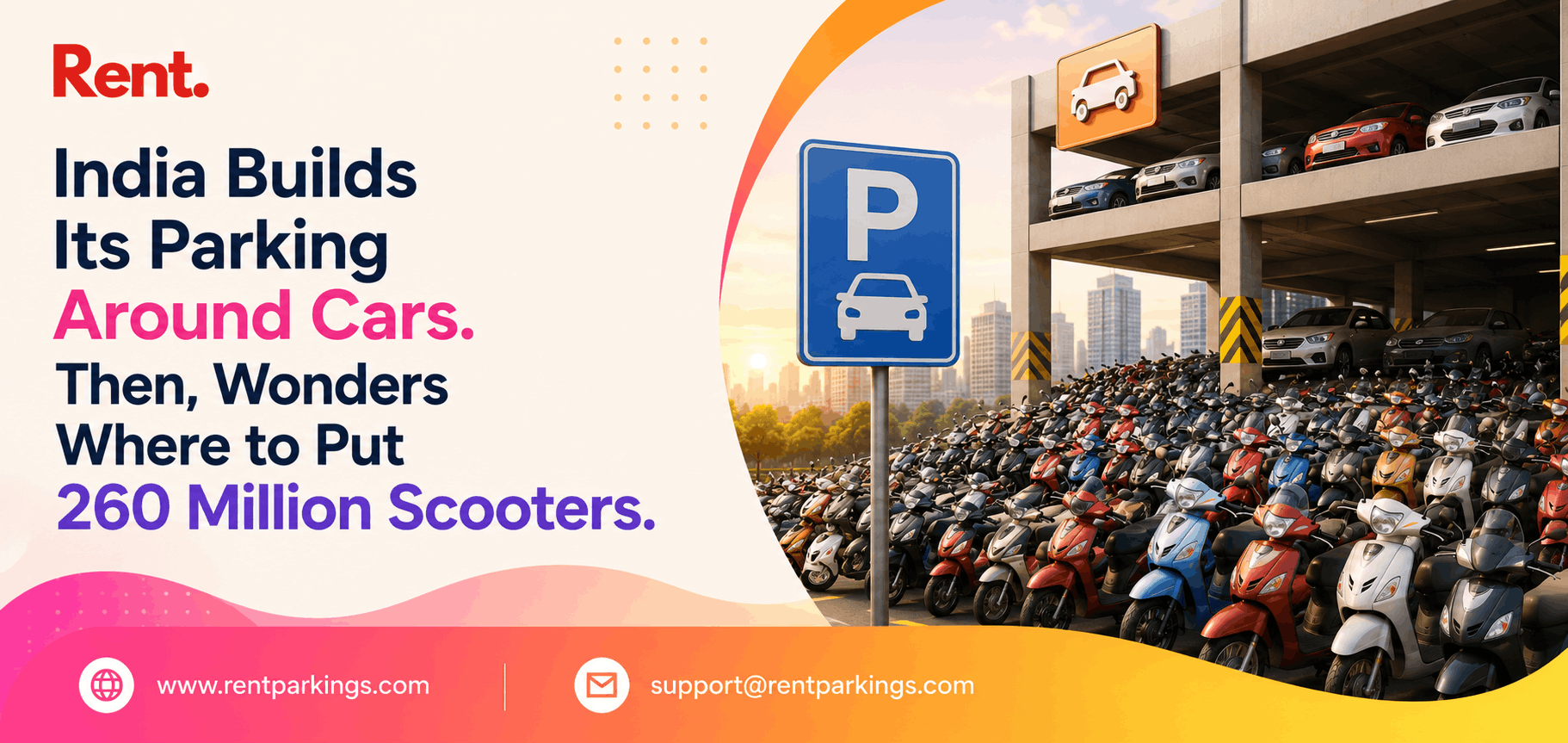
India Builds Its Parking Around Cars. Then, Wonders Where to Put 260 Million Scooters.
Every apartment basement in the country tells the same quiet story. Up front, near the ramp, sit the cars, each in a crisp painted rectangle with room to open a door. Somewhere behind the last pillar, in the space nobody bothered to draw lines on, live the two-wheelers, jammed shoulder to shoulder, mirrors kissing, one nudged scooter ready to topple the next four like a row of dominoes. That neglected corner is a perfect little map of how the country thinks about parking. We build for the car and hope the scooter squeezes in, even though the scooter is what most of us actually ride to work. If you have ever felt that Indian parking is permanently, maddeningly broken, that corner is where the answer starts, and the wider picture is worth exploring on RentParkings.
Call it the two-wheeler blind spot. It is the loudest problem in Indian mobility that almost nobody names.
The Numbers That No Parking Plan Respects
By 2025 India had rolled past 400 million registered vehicles, climbing steeply from roughly 326 million just five years earlier. Strip that fleet down and the picture is lopsided: the clear majority are two-wheelers, a pool now sitting somewhere around 260 million and still growing every month. In plain terms, get any three vehicles off an Indian road at random and two, often nearly three, will be scooters, motorcycles, or mopeds. In a typical Indian traffic stream, riders make up the bulk of everything in motion.
Ownership tilts the same way. For every thousand people, the country counts far more two-wheelers than cars, a gap of roughly five to one. We are, without much argument, a nation on two wheels. So it is strange, almost comic, that nearly every parking norm, builder brochure, mall signboard, pricing card, and policy debate is written as though the four-wheeler were the default.
There is the whole problem in one sentence. We keep engineering solutions for the vehicle a minority owns, and we keep improvising for the one that most of us park every single day.
Why the Scooter Always Ends Up in the Corner
A few honest habits explain the neglect.
Start with visibility. A car is bulky, pricey, and impossible to ignore when parking gets discussed. A scooter is small, cheap, and easy to wave off with a shrug of "it will fit somewhere." So planners assume two-wheelers will trickle into whatever gaps remain, and never bother designing an actual home for them.
Then there is status. In a lot of Indian planning, the car is the dream and the scooter is the daily grind. The dream gets the marked bays. The grind gets the leftovers.
And finally there is the ruler we use. Parking demand is routinely counted in car-equivalent spaces, a unit that makes the car the measuring stick and shrinks the two-wheeler into a fraction of one. When your yardstick is a car, scooters stop showing up clearly on the plan at all.
The joke is that the vehicle we keep sidelining is exactly the one that would dig us out, because a two-wheeler sips space where a car gulps it.
The Space Maths That Should Settle the Argument
Here is the figure that ought to rewrite parking plans across the country. Going by the National Building Code, a car swallows somewhere near 13.75 square metres once you account for its bay, while a single two-wheeler asks for only about 1.25 square metres. A normal bike bay measures roughly a metre across and two metres deep.
Run that comparison and it feels almost unfair to the car. Into the footprint of one sedan you can slot close to ten scooters. Field studies say the same thing in a different way: parked motorcycles work out to under two square metres each, whereas a car, aisles included, can eat nearly twenty.
So the vehicle carrying most of India's commuters is also the one begging for the least ground. A city that chose to plan for two-wheelers first would push far more people through the very same square footage. Instead we reserve the bright, ground-level, easy-access bays for cars and funnel ten times as many riders into the scraps.
This is not a war on cars. It is a plea to finally size parking to the vehicles Indians genuinely ride, which is the same demand-first logic threaded through the city-by-city parking rate guide on RentParkings.
The Four Places Where It All Falls Apart
The blind spot surfaces in four everyday scenes.
1. The Society Corner
Most housing complexes were drawn with a set number of car slots per flat and only a hand-wave for two-wheelers. Reality quickly outgrows the plan: a family with one car and two scooters, or three bikes and no car at all, never fits the original allotment. With two-wheeler rules left thin and fuzzy, parking slides into a daily land grab, bikes on the ramp, across the podium, boxed in against each other. That grind over slots is exactly why clear allotment matters so much, a subject the apartment parking ownership guide on RentParkings unpacks for residents trying to settle who owns what.
2. The Footpath
When no proper bay exists, the scooter drifts to the nearest flat surface, and on an Indian high street that surface is the pavement. Whole footpaths in market lanes across Chennai, Delhi, and Kolkata vanish under parked two-wheelers, shoving walkers into live traffic. Blaming riders misses the point. This is what demand does when it is handed no legitimate place to go.
3. The Commercial Basement
In malls and offices, two-wheeler bays usually get exiled to the cramped, poorly lit, badly ventilated bottom of the stack, with pillars in awkward spots and ramps too steep for a loaded scooter. Riders simply park wherever is easier, and the neat plan unravels within a week of the doors opening.
4. The Pricing Desk
Because tariffs are drawn up around cars, two-wheeler rates arrive as a clumsy afterthought, either so cheap they invite clutter or oddly steep for the sliver of space a bike uses. Thoughtful, space-based pricing for two-wheelers barely exists, even though the two-wheeler is the volume vehicle by a mile.
What Two-Wheeler-First Parking Would Actually Look Like
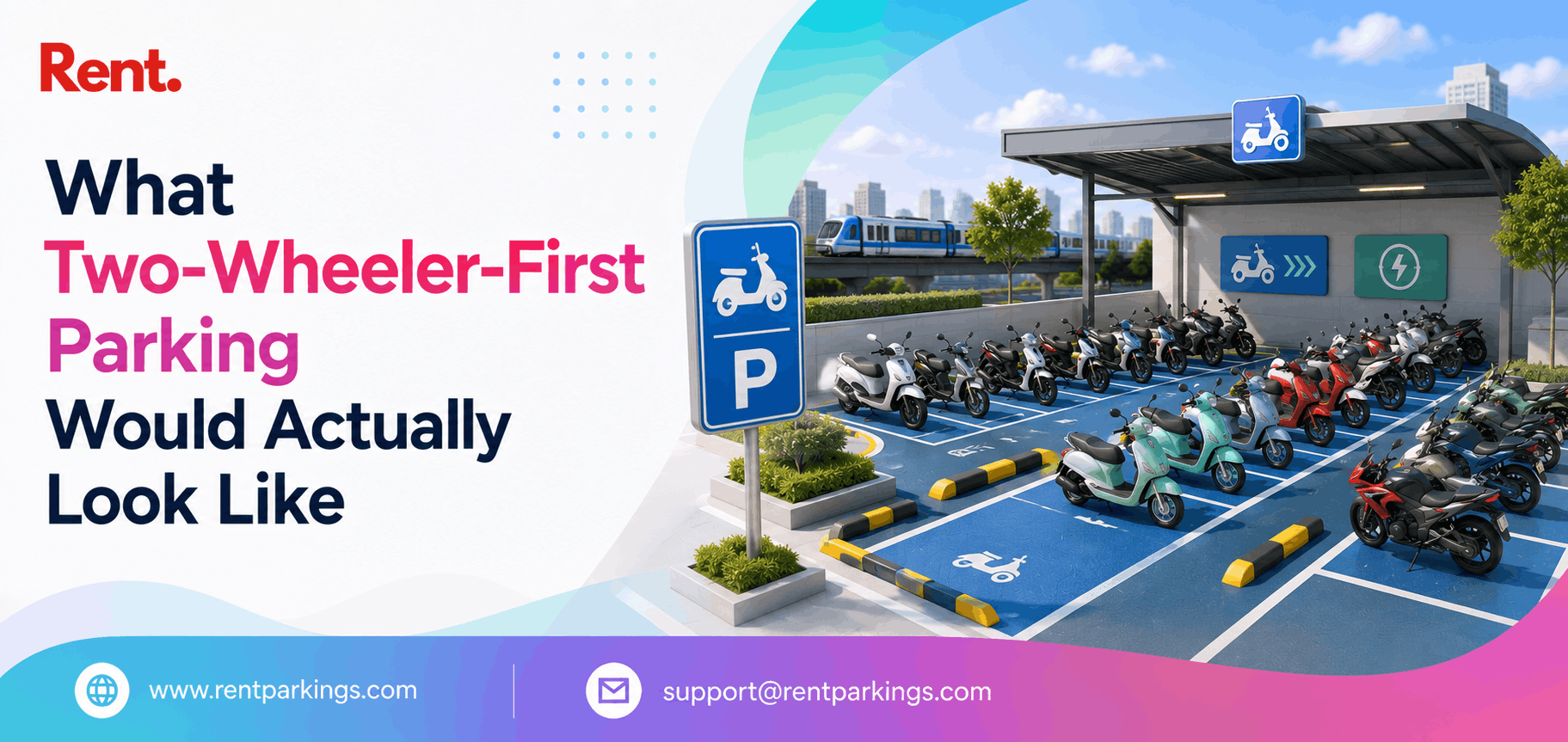
The cheering news is that fixing this is faster and cheaper than almost anything else in urban mobility, precisely because scooters need so little room. A handful of shifts would change everything.
Draw the bikes in first, not last. Give two-wheelers marked, properly measured bays on levels people can actually reach, rather than the residue behind a pillar. The footprint is tiny, so this costs a fraction of adding car capacity while serving many more people per square metre.
Build real bike infrastructure. Angled bays, wheel channels, and simple guide markings kill the domino-fall effect and let a rider pull out without hoisting a neighbour's scooter. Stacked and mechanised two-wheeler racks, already routine in crowded East Asian cities, multiply capacity upward on the same slab.
Point the tech at the scooter too. Sensor-guided bays, app-booked slots, and digital payment suit a bike at least as well as a car, and often better, given how fast two-wheeler turnover runs. That is simply the direction sketched out in the smart parking guide on RentParkings, aimed at the vehicle that stands to gain most.
Plan for the electric scooter today. Battery-powered two-wheelers are the quickest-growing slice of India's EV market, adding hundreds of thousands of registrations a year. Their charging cannot be an afterthought clipped onto a car-first basement. Bike bays need their own safe charging points, the same knot the EV charger guide on RentParkings works through at the society level.
Wire the scooter into transit. A two-wheeler is the ideal first-and-last-mile partner for a metro. Secure, well-planned bike parking at stations turns a rider into a train passenger, which is the entire idea behind the park-and-ride approach RentParkings covers here. Nail the parking at the station and you quietly cut car trips into the core.
Give riders a roof. A bike is far more exposed than a car, so shaded, covered bays are not pampering in a country that swings from savage summers to a punishing monsoon, for the very reasons the monsoon protection guide on RentParkings lays out.
The Prize Is City-Sized
Stack all of that together and the reward is huge. Two-wheelers already move most of India's commuters. Size parking to that truth and the same land carries far more people, pavements return to pedestrians, basements stop spilling over, and the daily war over slots cools off. The scooter is not what broke Indian parking. It is the most wasted piece of the fix.
And none of it needs moonshot technology or sprawling new land. It needs one change of default: from "car first, scooter somewhere" to "plan for the vehicle most people ride." That single mental flip is the cheapest large win on the table in Indian mobility.
Conclusion
India keeps solving a parking puzzle for a vehicle that is in the minority. The car gets the lines, the levels, the tariff, and the plan, while the two-wheeler, the machine most Indian households actually ride, gets the corner behind the pillar. The maths could not be blunter: a scooter needs roughly a tenth of a car's space, so planning for bikes first is the fastest, cheapest way to move more people through the same ground, hand the footpaths back to walkers, and calm the daily scramble. Next time you spot a wall of scooters overflowing onto a pavement, do not see disorder. See demand that was never given a place to stand. Give it that place and the whole system finally breathes. To see how the rest of India's parking puzzle clicks together, from societies to stations to smart systems, dig deeper on RentParkings.
FAQs
What share of India's vehicles are two-wheelers?
Close to three in four. Scooters, motorcycles, and mopeds add up to roughly 260 million out of a fleet that pushed past 400 million registered vehicles in 2025, so they are the overwhelming majority on Indian roads.
How much room does a two-wheeler bay need in India?
Going by the National Building Code, one bike works out to around 1.25 square metres, with a typical bay about a metre wide and two metres deep. A car needs close to 13.75 square metres, which is why nearly ten scooters can slot into a single car's footprint.
Why does two-wheeler parking feel so chaotic in Indian cities?
Because parking gets planned, priced, and measured around cars. Bikes are treated as something that will simply fit in the gaps, so they rarely get dedicated bays, and the overflow ends up on ramps, fire lanes, and footpaths.
What usually governs two-wheeler parking inside a housing society?
It differs from society to society, but most allot slots per flat and expect residents to stick to marked bays and keep ramps and walkways clear. Since firm two-wheeler norms are often missing, a clear allotment from the managing committee is the most dependable fix.
Can you park a two-wheeler on the footpath?
Pavements exist for people on foot, and parking that blocks them creates real safety risk. The deeper cause is usually the absence of any nearby legitimate bay, which is what cities need to correct instead of only fining riders.
How can Indian cities improve two-wheeler parking?
Draw bike bays first on reachable levels, add angled parking with wheel guides, stack capacity using mechanised racks in dense pockets, bring in sensor and app-based systems, and offer covered, lit spaces with charging for electric scooters.
Do electric two-wheelers need different parking?
They do. Electric bikes are the fastest-expanding EV segment in India and need their own safe charging points at the bay, not stray cables strung across a basement built for cars.
Why do builders leave too few two-wheeler slots?
Because demand is often tallied in car-equivalent spaces, a method that treats the car as the standard and undercounts bikes. Families owning several scooters, or a car plus two two-wheelers, outgrow that allotment fast.
Are two-wheelers really that much more space-efficient than cars?
By a wide margin. Studies put parked motorcycles at under two square metres each, against nearly twenty for a car once aisles are counted, so bike-first planning simply carries more people per square metre.
How is two-wheeler parking linked to public transport?
Bikes are the natural first-and-last-mile ride. Safe, well-designed two-wheeler parking at metro and transit hubs nudges riders onto trains, which trims the number of cars pouring into congested city centres.
Share This post
Search
Recent Post
What Happens When You Need Your Parking...
01 Sep, 2026
How Listing Your Parking Space in India...
31 Aug, 2026
Parking Space vs Gold: The Idle Asset Th...
28 Aug, 2026
Your Garage Hasn't Parked a Car in Month...
26 Aug, 2026
Someone Dents a Car in Your Rented Parki...
25 Aug, 2026
Your Vacant Plot Is Not Free to Own: How...
24 Aug, 2026
Coaching Centre Parking in India: Why Ko...
21 Aug, 2026
India's PG and Co-Living Boom Has a Park...
20 Aug, 2026