

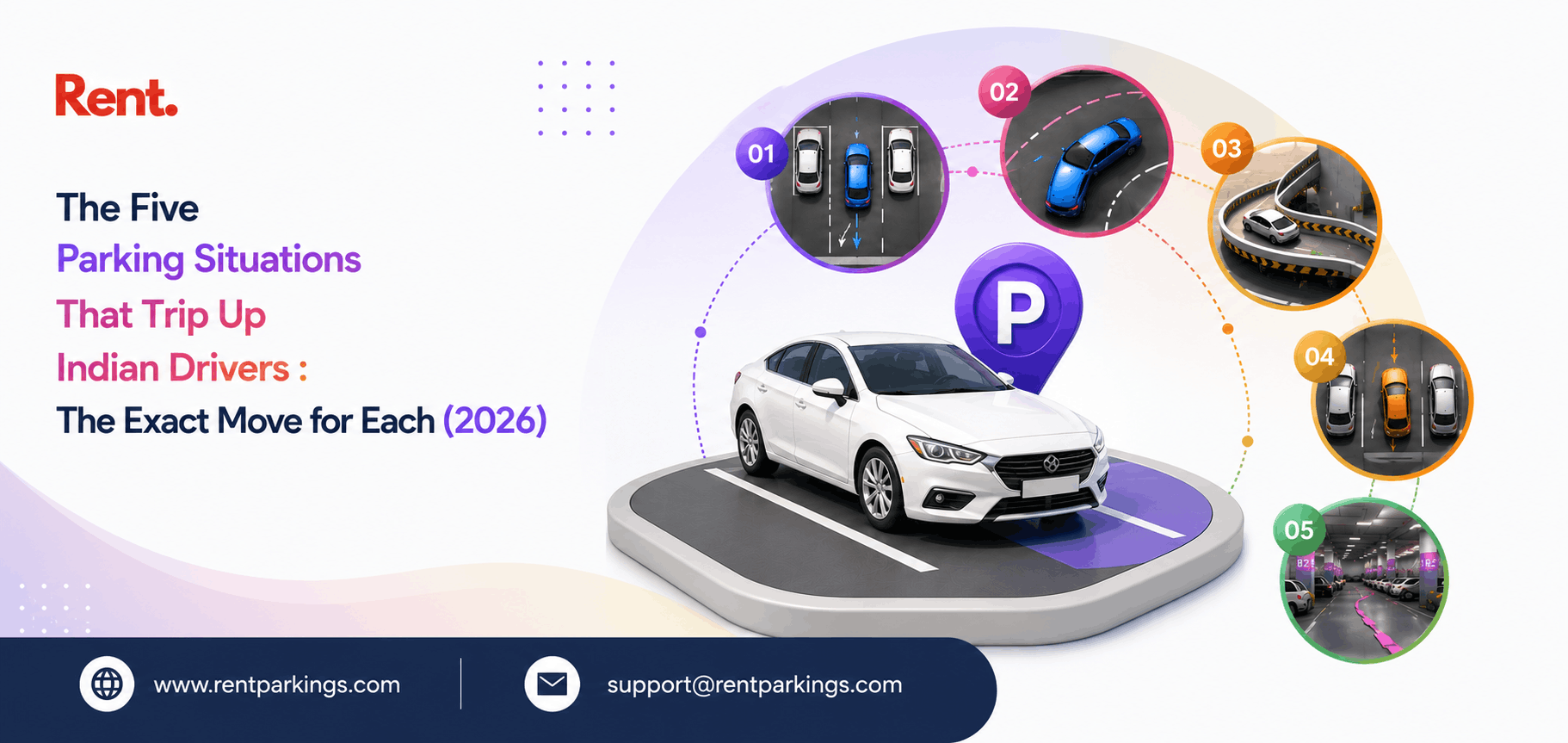
The Five Parking Situations That Trip Up Indian Drivers: The Exact Move for Each (2026)
Ask any Indian driver where their confidence quietly collapses, and it is almost never on the open highway. It is the moment a gap appears on a crowded lane and everything speeds up around them while they need to slow down. Parking is where good drivers suddenly feel like learners again, and the strange part is that it has very little to do with talent. It has to do with situations, a handful of specific, repeating scenarios that Indian roads throw at you, each with its own trap and its own fix. At RentParkings, we spend our days on the realities of parking in India, so this guide skips the theory and gets straight to what works.
Instead of one generic set of steps, it walks through the five parking situations that actually cause the sweating, the honking, and the occasional scraped bumper in Indian cities, and gives you the single clearest move for each. Learn these five, and there is almost nowhere in the country you will not be able to park calmly.
First, the Idea That Unlocks All Five: Stop Feeling, Start Marking
Before the situations, one mental shift changes everything. Nervous drivers try to feel where their car ends, where the rear bumper is, how close the left wheel sits to the kerb, whether the boot will clear the wall. But you cannot see any of those points from the driver's seat, so feeling turns into guessing, and guessing is what puts a dent in your door.
Skilled parkers do the opposite. They use markers: fixed, repeatable things they can see that reliably tell them where the hidden parts of the car are. "When the wall lines up with the middle of my rear window, my boot is about a foot away." "When the parked car fills my left mirror, it is time to turn." Once you find these markers for your own car and mirror setup, parking stops being a feeling and becomes a checklist you run the same way every time. Every situation below leans on this one habit, so spend a quiet Sunday in an empty ground finding your markers first. It is the highest-value hour of practice you will ever put in.
Situation One: The Narrow Market Gully (Parallel Parking Between Two Cars)
This is the classic nightmare. A slot has opened along the edge of a busy lane in a market area of Pune or Kolkata, there is a car in front of it and a car behind it, and a queue is forming behind you. It is the manoeuvre the RTO tests and the one most people avoid for years.
Here is the move, and it is more forgiving than it looks. Roll forward until you are sitting alongside the car parked ahead of the empty slot, your two vehicles side by side, roughly half a metre apart, rear bumpers about level. That side-by-side start is the whole foundation, so get it right and the rest almost happens on its own. Now reverse slowly, and the instant the front car's rear bumper appears in the lower corner of your left window, stop. Turn the wheel all the way towards the kerb and keep creeping back; your tail will swing neatly into the gap. When your car sits at a diagonal and you can see the headlamp of the car behind in your left mirror, straighten the wheels, then wind the steering the other way to bring yourself parallel. Finally, nudge forward to sit centred so both neighbours can leave.
Do the whole thing at crawling pace, foot hovering over the brake, and the impatient honking behind you becomes irrelevant, because you finish before they finish being annoyed.
Situation Two: The Tight Mall Basement (Reversing Into a 90-Degree Bay)
Underground and stilt parking in malls and apartment complexes across Hyderabad and Mumbai is a different beast: narrow aisles, concrete pillars waiting to catch a wide turn, and low beams overhead. The mistake most people make here is driving in nose-first because it feels easier in the moment.
Do the opposite and reverse in. It feels harder for ten seconds and pays you back every single time you leave, because you drive out facing forward, able to see the child, the trolley, or the scooter crossing the aisle. The move: drive just past the empty bay so it sits beside and slightly behind you, then when your rear door is level with the near edge of the slot, turn fully towards the bay and back in slowly, watching both mirrors and your camera if you have one. Keep the gaps in your two side mirrors roughly equal and you will land centred between the lines. In these basements, also fold your mirrors in the tightest aisles and keep half an eye on the beam height, because pillars and low ducts, not other cars, cause most basement scrapes.
One underrated trick for multi-level parks in cities like Bengaluru: skip the jammed ground floor and go one or two levels up. The upper decks are usually near-empty, the bays are the same size, and you will manoeuvre in total calm for the price of a short walk.
Situation Three: Packed Office and Society Stack Parking (The Squeeze-and-
Shuffle)
Office towers and older housing societies in Delhi NCR and Chennai run on stacked, double-row parking where cars are packed nose-to-tail and sometimes two-deep. Here the challenge is not one clean manoeuvre but fitting into a slot with almost no working room, often with a wall or pillar on one side.
The winning approach is patience and geometry. Give yourself the widest possible arc on the way in by swinging slightly wider before you turn, so your car curves into the slot instead of jack-knifing at a sharp angle. If it will not go in one motion, do not force it, because a clean three-point adjustment beats a scrape every time. Where cars are double-parked in the second row, follow the shared etiquette that keeps Indian parking functional: leave your car in neutral with the handbrake off and, ideally, your phone number on the dashboard, so a blocked neighbour can roll it aside without hunting for you. It is a small courtesy that prevents most of the ugly society parking disputes, and if you want to understand who actually controls these bays, read Who Actually Owns the Parking in Your Apartment? Stilt, Covered & Open Parking Rights in India (2026). And in these blind, crowded rows, reverse in wherever you can, so your exit into the moving lane is done facing forward.
Situation Four: The RTO Test Track (H-Track and Reverse-S)
If you are still learning, the parking section of the driving licence test is where nerves undo people. Modern automated RTO tracks in Indian cities test tight-space control on an "H" layout or the newer reverse-S curve, with lanes only around three to three-and-a-half metres wide, barely wider than the car itself.
The examiners are unforgiving about exactly two things: touching or crossing a boundary line, and knocking a sensor marker. Both are instant fails. Notice what that means, because the test does not reward speed, flair, or a confident swing. It rewards a car moving so slowly and so controlled that you can stop the moment a line creeps near. So keep it in half-clutch at a crawl, use your mirrors continuously rather than staring over your shoulder, hit your turn-in markers, and rehearse the specific shape your RTO uses beforehand, because the H and the reverse-S each have their own rhythm and knowing where to begin the turn is most of the battle. The candidates who fail almost always rushed; the ones who pass almost always looked slow and boring doing it.
Situation Five: The Hill Slope and Steep Ramp (Parking Without Rolling)
Anyone who drives in a hill town like Ooty or Shimla, or simply parks on a steep society ramp or a sloped basement entry, faces a scenario the plains never teach: a car that can roll away on its own. This is less about steering finesse and more about a habit that prevents an accident.
Set your wheels as a backup brake. Facing downhill, turn the front wheels towards the kerb, so if the car creeps it rolls into the kerb and stops. Facing uphill, turn them away from the kerb for the same reason. Then apply the handbrake firmly and leave the car in gear, using first gear facing uphill and reverse facing downhill, so the engine holds it even if the handbrake slips. On a ramp with no kerb, this wheels-plus-gear-plus-handbrake trio is what stands between your parked car and a runaway. It costs three seconds and it has saved countless bumpers and gates.
The SUV Factor Running Through All Five
One thread cuts across every situation above: Indians are buying bigger cars than the roads were built for. Compact and full-size SUVs now fill showrooms, but the gullies, stilt bays, and stack rows were sized for a small hatchback. A larger car is not harder to park in principle, but it is less forgiving, so adjust rather than panic. Its longer wheelbase means it swings wider, so begin your turns a touch later and give yourself more room on entry. Lean harder on mirrors and cameras because the blind zones are bigger. Fold the mirrors in the tightest spots to reclaim those last few centimetres. And always know your car's height in old basements where a low beam is the real threat. Treat sensors and the 360-degree camera as a helpful second opinion, never as the judge, because they routinely misread kerbs, low bollards, and poles. If you are curious how this tech is maturing on Indian lots, see Smart Parking in India: How Sensors, FASTag, and Multi-Level Automation Are Solving the Urban Parking Crisis (2026).
The Bonus Situations: Rain, Night, and the Festival Crush
Beyond the core five, three conditions quietly make every one of them harder, and they deserve their own quick playbook because Indian roads serve them up constantly.
Rain steals your markers. During the monsoon, fogged and streaming mirrors, glare off wet tar, and a windscreen the wipers cannot fully clear all blur the exact cues you rely on. The fix is not cleverness, it is caution: wipe your mirrors before you start, drop your pace even lower than usual, and when a slot is genuinely blind, do the unglamorous thing and step out for a two-second look. That glance costs nothing and routinely saves a bumper you would otherwise meet by feel. Puddles hide their own traps too, since a flooded gully can conceal an open drain, a broken kerb, or a deep pothole right where your wheel is about to go. For the full wet-weather routine, read When the Sky Breaks: How to Save Your Parked Car From the Indian Monsoon (2026).
Night hides the low stuff. After dark, the obstacles that vanish are the short ones your headlights arc over, such as a low bollard, a chained divider, a sleeping street dog, or a kerb without reflectors. Reverse lights and a camera help, but they do not reach everywhere, so slow right down in unlit society lanes and unfamiliar market corners, and let your ears do some of the work when your eyes cannot.
Festivals and weekends turn every rule up to maximum. Around a Diwali market in Delhi, a temple on a festival morning in Chennai, or a wedding venue anywhere, parking becomes a free-for-all where cars are wedged at odd angles and someone is always trying to leave as you arrive. Here the smartest move is often made before you park at all: accept a spot slightly farther out that you can enter cleanly and leave freely, rather than fighting for the closest gap that will trap you for an hour when the crowd swells. A calm ten-minute walk beats a tense forty-minute exit.
The Two-Wheeler's Version of the Same Problem
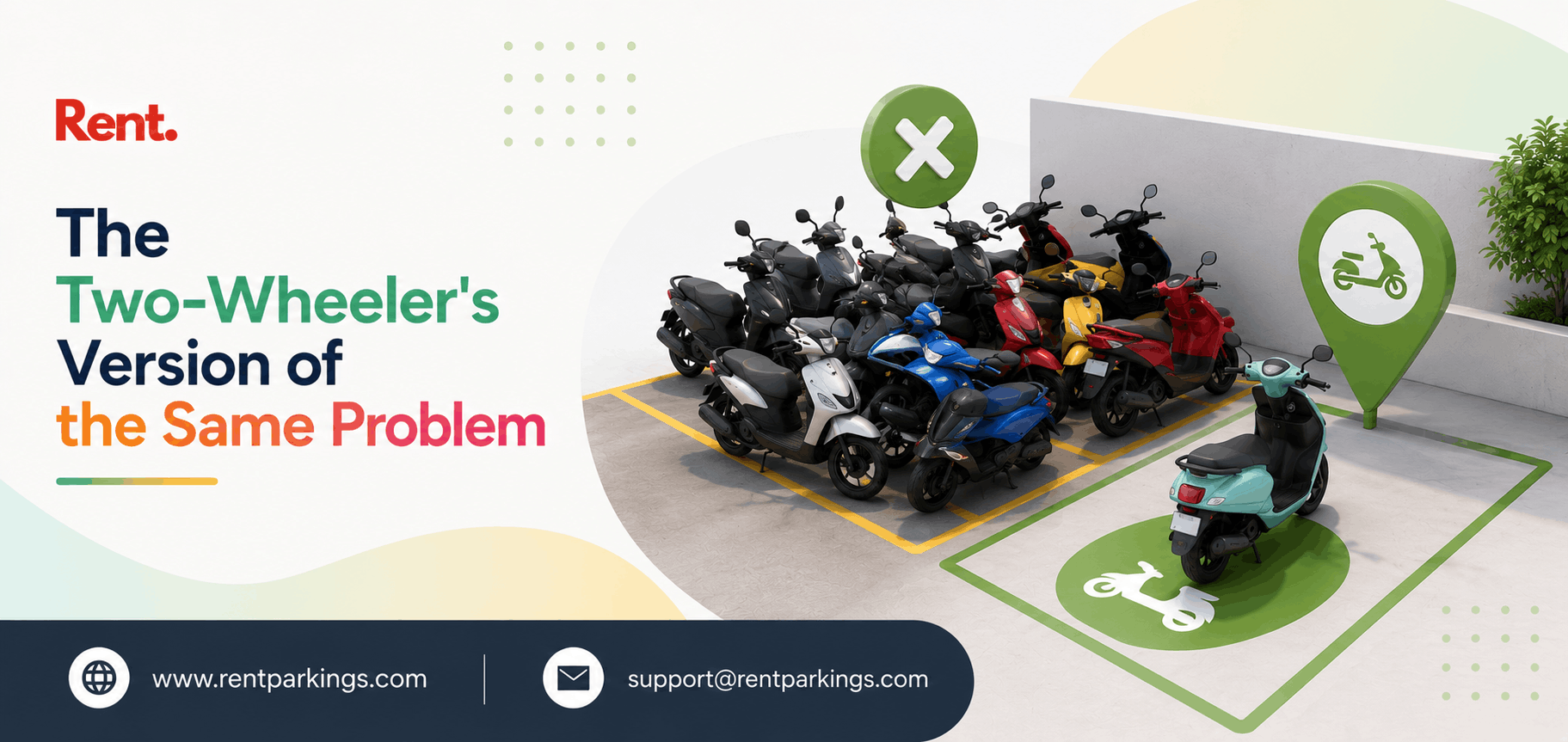
Parking pressure is not a four-wheeler-only story. With hundreds of millions of scooters and motorcycles on Indian roads, riders fight for space in packed rows outside stations, markets, and offices. The skills that keep a two-wheeler row moving are simple but rarely taught: back the machine into a tight line by walking it in with a light touch on the rear brake, prefer the centre stand where space is cramped so the vehicle occupies less width, and always leave the front wheel pointing out so you can roll straight off without a shuffle. A rider who parks tidily and predictably does the whole row a favour. For the bigger picture on why two-wheelers get squeezed everywhere, read India Builds Its Parking Around Cars. Then, Wonders Where to Put 260 Million Scooters.
The 30-Second Check That Prevents Most Bad Parks
Here is a habit the confident drivers share and the anxious ones skip: they decide whether a space is worth it before they commit, not halfway through the manoeuvre. As you roll up to any gap, run three fast questions. Is it truly big enough, a good car-and-a-half for a parallel slot, clearly wider than your car for a bay? What sits right around it, such as a pillar, a wall on your door side, a drain cover, or a two-wheeler that might roll away and leave you exposed? And crucially, how will you get out later, since a wall, a blind exit onto a fast road, or a car that will box you in can make leaving far harder than entering?
The power of this check is that it gives you permission to say no. A slot you can technically squeeze into but cannot open your door beside, or one that forces a blind reverse into a Bengaluru arterial an hour later, is not a win; it is a problem you have scheduled for your future self. Watch experienced Indian drivers and you will notice they quietly pass marginal gaps and take a slightly farther, cleaner one without a second thought. Rejecting the wrong space is not a failure of skill; it is the most advanced parking skill there is, and it costs you nothing but a few metres of walking.
What Actually Builds Parking Confidence
Notice what none of these five fixes required: talent, a "good sense of the car," or years behind the wheel. They required a calm pace, a set of markers, and having seen the situation before. That last part is the secret the naturally-good parkers will not admit, because they simply met each scenario enough times that the guesswork drained out of it.
You can compress that on purpose. Take an empty ground or a quiet early-morning street, set up two boxes or borrow two parked cars, and run the same manoeuvre ten or fifteen times slowly until your markers fire automatically. Then change it, using tighter gaps, reversing to both sides, and a mock slope. Two or three focused sessions turn the manoeuvre that once spiked your heart rate into something your hands do while your mind stays relaxed. Confidence here is not a gift; it is reps with a plan.
Conclusion
Parking in India will always come with narrow gullies, unmarked slots, low basement beams, honking queues, and a helpful stranger waving instructions you never asked for. But almost all of that difficulty collapses into just five repeating situations, the gully, the basement, the stack, the RTO track, and the slope, and each has one clear, unhurried move. Swap feeling for markers, keep the car crawling, reverse into blind bays so you leave facing forward, and let your wheels back up your handbrake on every ramp. Meet these five enough times on purpose, and the next open gap stops being a test you might fail and becomes something you simply do, cleanly, calmly, and first time. For more practical guides on parking smarter across India, explore RentParkings.
FAQs
What is the easiest way to reverse park between two cars in India?
Pull up beside the car ahead of the empty slot, about half a metre apart with rear bumpers level. Reverse slowly until that car's rear bumper appears in the lower corner of your left window, turn fully towards the kerb, straighten when you are diagonal, then counter-steer to sit parallel. Crawl the whole time and use both mirrors.
Should I reverse into a mall basement bay or drive in front-first?
Reverse in. It feels harder for a few seconds but lets you drive out facing forward later, with full view of pedestrians, trolleys, and scooters crossing the aisle, which is far safer in a busy Indian basement.
How do I park in tight stack or double-row parking?
Swing slightly wider before turning so the car curves in rather than jack-knifing, and use a clean three-point adjustment instead of forcing it. If you double-park a second row, leave the car in neutral with the handbrake off and your number on the dashboard so neighbours can roll it aside.
How do I pass the reverse parking test at the RTO?
Go slow and stay in total control. Automated H-track and reverse-S tracks fail you instantly for crossing a line or touching a sensor, so crawl in half-clutch, watch your mirrors, hit your turn-in markers, and practise your RTO's specific track shape in advance.
How should I park on a hill slope or steep ramp?
Facing downhill, turn the front wheels towards the kerb; facing uphill, turn them away. Then apply the handbrake firmly and leave the car in gear, so it cannot roll even if the brake slips.
What are markers or reference points in parking?
They are fixed, visible cues, like a wall lining up with your rear window, or a parked car filling your side mirror, that tell you where your car's hidden corners are. Calibrating them to your own car turns parking into a repeatable checklist instead of guesswork.
Why is parking harder with an SUV in India?
A longer wheelbase swings wider and blind zones are bigger, while old Indian lanes and basements were sized for small hatchbacks. Begin turns slightly later, give yourself more room, lean on mirrors and cameras, fold mirrors in tight spots, and mind low basement beams.
Can I trust my reversing camera and parking sensors fully?
Use them as a helpful second opinion, not the final judge. Cameras and sensors misjudge kerbs, low bollards, and poles, and their angle can miss a short obstacle or a child. Your mirrors and a slow crawl remain the real safety net.
How can beginners build parking confidence quickly?
Practise in an empty ground with two boxes or parked cars, repeating one manoeuvre slowly ten to fifteen times until your markers become automatic, then vary the gap and side. Two or three focused sessions replace years of nervous guessing.
How do I stay calm when people honk while I am parking?
Keep your pace slow and deliberate anyway, since rushing causes most bumper taps. The few extra seconds to park cleanly are far cheaper than the damage, delay, and argument a hurried mistake creates.
Share This post
Search
Recent Post
What Happens When You Need Your Parking...
01 Sep, 2026
How Listing Your Parking Space in India...
31 Aug, 2026

Parking Space vs Gold: The Idle Asset Th...
28 Aug, 2026
Your Garage Hasn't Parked a Car in Month...
26 Aug, 2026
Someone Dents a Car in Your Rented Parki...
25 Aug, 2026
Your Vacant Plot Is Not Free to Own: How...
24 Aug, 2026
Coaching Centre Parking in India: Why Ko...
21 Aug, 2026
India's PG and Co-Living Boom Has a Park...
20 Aug, 2026