

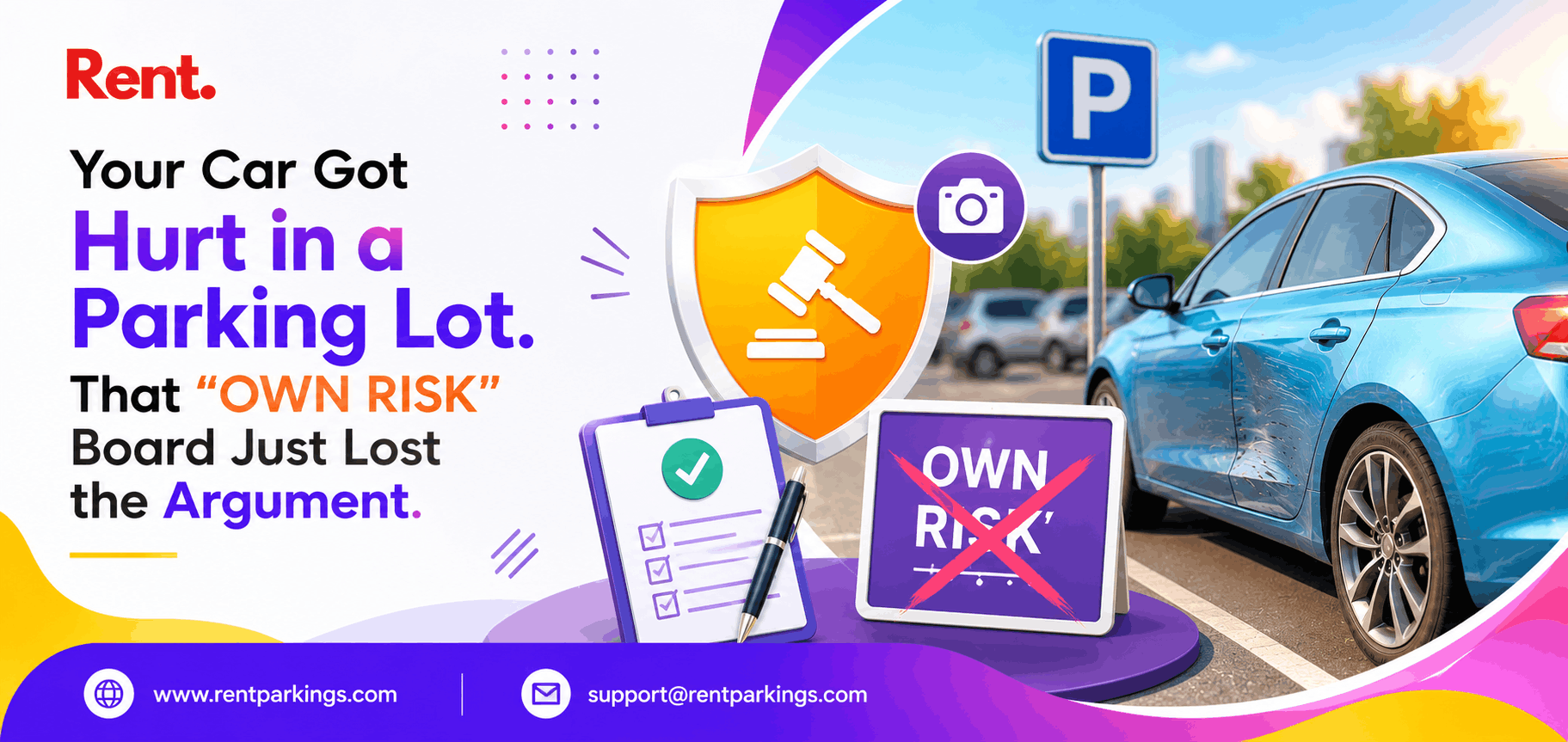
Your Car Got Hurt in a Parking Lot. That "Own Risk" Board Just Lost the Argument.
Picture a Saturday evening at a busy mall in Velachery, Chennai. You collect your parking token, watch the boom barrier lift, and leave your car in bay P2-118. Three hours later, the bumper hangs loose, paint is gouged across two panels, and the guard on duty gives you the answer every Indian driver has heard at least once — "Sir, board paaru. Park at your own risk."
Here is what that guard will never tell you: in Indian law, that board is closer to a suggestion than a shield. From the RentParkings editorial desk, this guide breaks down — scenario by scenario — who really pays when a parked vehicle is stolen or damaged in India, what the Supreme Court has already ruled, how your motor insurance behaves, and the exact moves that decide whether you recover your money or absorb the loss.
The problem is not rare. Delhi records a vehicle theft roughly every 12–14 minutes, two-wheelers vanish even faster than cars, and cramped basement parking in Bengaluru, Mumbai and Hyderabad produces dings and dents on an industrial scale. Yet most owners still believe the signage. Time to fix that.
One Old Word Decides Everything: Bailment
Nearly every parking fight in India comes down to a concept from the Indian Contract Act, 1872 called bailment. Section 148 says a bailment is born when you hand goods to someone for a purpose, expecting them back. Give your keys to a hotel valet in Mumbai, or take a paid token at a barrier-controlled lot outside Hyderabad's Hitec City — Indian courts have treated both as handing over custody of your vehicle.
Once custody exists, two more sections take over:
Section 151 forces the parking operator to care for your vehicle the way a sensible person guards their own property.
Section 152 flips the burden of proof — the operator must prove it took reasonable care. You do not have to reconstruct how the thief slipped past security. They have to explain how a car exited their gate without your token being surrendered.
That reversal is the single most powerful fact an Indian vehicle owner can know, and almost nobody at the boom barrier will volunteer it.
Custody vs. Permission: The Line That Decides Your Case
Not every parking spot creates bailment, so honesty matters here:
- Custody (bailment): keys handed over, or paid token with controlled entry-exit. The operator holds your car. Liability attaches.
- Permission (licence): a free, open, unattended ground — no token, no barrier, keys in your pocket. The landowner never took custody, and generally owes you nothing.
A free mud plot behind a market in Madurai is permission. A ₹60 token at a Gurugram mall basement with CCTV and exit checks is custody. Organised, verified facilities — the kind you can compare and book through RentParkings — sit firmly on the custody side, which is precisely why they are the safer choice for your vehicle and your legal position.
The Judgment That Changed Indian Parking: Taj Mahal Hotel (2019)
On 14 November 2019, the Supreme Court of India decided Taj Mahal Hotel v. United India Insurance Co. Ltd. — a case every car owner should be able to quote at a valet stand. A guest's car, handed to the hotel valet in Delhi, was driven away by a third person who got hold of the keys. The hotel's defence was the same script used across India: the valet service was complimentary, and the parking tag said owner's risk.
The Supreme Court dismantled both arguments:
- Key handover = bailment. The instant possession moves, responsibility moves with it.
- "Complimentary" is a pricing trick, not a legal escape. Free valet is baked into room tariffs and restaurant bills; a business cannot pocket the commercial benefit and disown the legal duty.
- Owner's-risk print cannot rescue a careless bailee. The operator must first prove reasonable care under Sections 151–152; only then does any disclaimer even enter the conversation.
The Court also set a "prima facie negligence" standard — show that your car went in and did not come back (or came back damaged), and negligence is presumed until the operator rebuts it. Consumer forums, including the NCDRC, had been applying bailment to pay-and-park facilities for years; the Taj ruling stamped Supreme Court authority on that entire line of reasoning.
Where You Parked Decides Who Pays
Mall and Multiplex Paid Parking
Your strongest ground. You paid, a token or FASTag-linked record exists, and the exit is physically controlled. Consumer commissions from Bengaluru to Pune have held malls and their parking contractors liable for thefts from paid lots — treating the own-risk board as an illegal attempt to contract out of a statutory duty. The paid receipt simultaneously makes you a "consumer" under the Consumer Protection Act, 2019, unlocking a deficiency-in-service complaint. Photograph your token the moment it's issued; a lost token is the fastest way to weaken a strong case.
Hotel Valet
Settled law after Taj. Keys handed over means the hotel answers for theft and damage — a kerbed alloy, a dented tailgate while shuffling cars at a Jaipur wedding reception, all of it. No tag, coupon or smiling disclaimer changes that unless the hotel first proves it was careful.
Hospitals and Airports
Hospital parking in Chennai or Hyderabad is usually outsourced to a contractor who charges and issues tokens — mall logic applies, and forums have entertained complaints against hospital and contractor together. Airport lots at Delhi, Mumbai and Bengaluru are paid, barrier-controlled and camera-covered, making the custody argument strong; just read the long-stay terms before a two-week trip.
Offices, IT Parks and Housing Societies
Free access-card parking from your employer often looks like permission, not custody — recovery is harder. But where a facility company charges a monthly parking fee in a Noida or Pune tech park, a service relationship exists and claims become viable; keep the allotment letter and payment receipts. Inside your own society, your allotted slot is generally your responsibility — the society is not your car's bailee — though a paid security arrangement that visibly failed (a guard waving out a stranger driving your car at 2 a.m.) can create liability. Residents in societies with chronic slot shortages increasingly locate reliable nearby monthly options through RentParkings rather than gambling on open street corners.
Municipal Pay-and-Park and Free Street Parking
BMC lots in Mumbai and MCD lots in Delhi issue receipts against a fee — and their contractors have been held answerable for thefts. Free street parking is the opposite end: no custodian, no bailment, only the police and your insurer. This is where India's parked-car hit-and-run problem lives — a sideswiped car on a Kochi side street at night will almost never yield a culprit, making your own-damage cover the only realistic remedy. If you park daily in such a zone, moving to a verified, gated spot listed on RentParkings is cheaper than one bumper respray.
The Insurance Lane: What Your Policy Actually Does
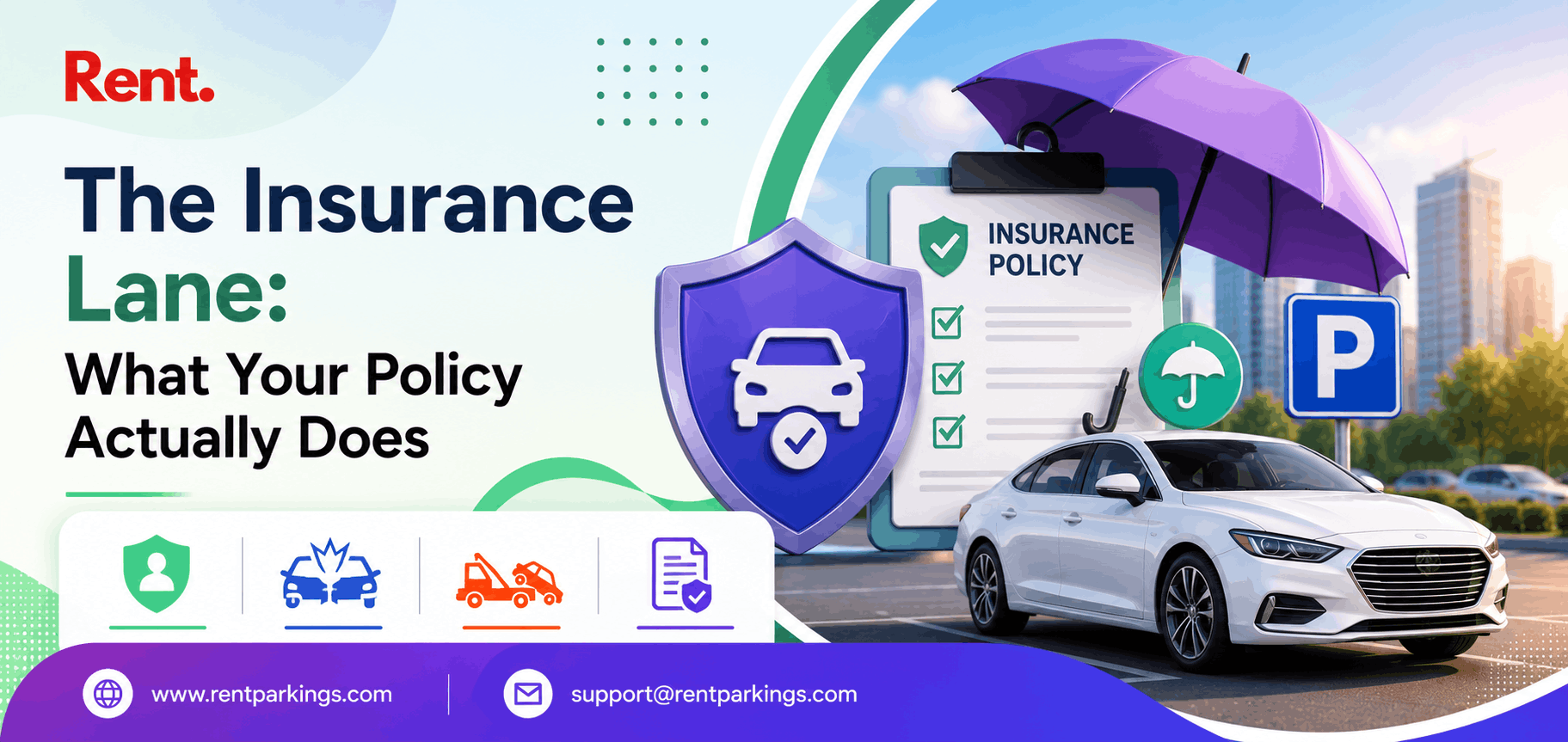
Liability and insurance run on parallel tracks — use both.
A third-party-only policy pays you nothing for theft or parked-car damage; you need a comprehensive policy. Within it, theft pays up to the Insured Declared Value (IDV); parking damage (vandalism, another car hitting yours, a falling branch) is covered under own damage minus depreciation and deductible — unless a zero-depreciation add-on absorbs the cuts, which is exactly why zero-dep has become the default choice for city cars under five years old. In theft-heavy zones like Delhi NCR, a return-to-invoice add-on covers the gap between IDV and your original invoice price.
The Theft Claim, Step by Step
- FIR the same day at the police station covering the parking location — delay is the number-one claim killer.
- Intimate the insurer within 24–48 hours, even before documents are ready.
- Inform your RTO of the theft.
- Surrender both original keys. A missing spare key reads as negligence to every insurer in India.
- Wait for the police non-traceable report (typically 90+ days) — the claim settles after it.
- Transfer the RC and sign subrogation papers; the insurer pays the IDV.
Common rejection traps: keys left in the ignition, FIR delay, lapsed policy, undeclared CNG kit, or the car standing in a no-parking zone when hit — a detail that interacts badly with your challan history. A booked, receipted slot from a platform like RentParkings removes that last trap entirely, because your parking location and timing are on record.
Chase Both at Once
You can claim from your insurer and pursue the parking operator. Insurers themselves do this — in the Taj case, the insurer paid the owner and then hunted the hotel through subrogation. Your practical version: take the insurance payout for speed, then file a consumer complaint against the operator for what insurance never covers — your deductible, depreciation cuts, lost No Claim Bonus, cab expenses, and compensation for harassment.
Dragging the Operator to Consumer Court in 2026
The Consumer Protection Act, 2019 made this route genuinely usable:
- File from home via e-Daakhil (edaakhil.nic.in) — no advocate needed at district level; complaints up to ₹5 lakh carry no fee.
- District Commissions hear claims up to ₹50 lakh — covering virtually every private vehicle in India — and you can file where you live, not where the mall stands.
- Winning evidence: the parking token, entry-exit CCTV footage (send a written preservation request within days — most systems overwrite in 15–30 days), the FIR, damage photographs, a photo of the signage itself, and the operator's written response or telling silence.
Set expectations honestly: district-level matters often run 12–24 months. For an ₹8,000 scratch, a firm written demand citing the Taj judgment and Sections 151–152 usually settles faster than litigation. For a stolen car, the consumer route rewards patience.
The First 48 Hours: Your Move-by-Move Checklist
Damaged in a lot: photograph everything before moving the car (damage, bay number, token, signage, nearest camera) → report to staff and demand a written acknowledgement with names → email a CCTV preservation request → note the offending vehicle's number if visible, else treat it as a parked-car hit-and-run → intimate your insurer before any repair and let the surveyor see it first.
Stolen from a lot: first confirm it wasn't towed (check the local traffic police yard — a surprisingly common false alarm in Delhi and Mumbai) → FIR the same day → insurer intimation within 24 hours → RTO notice → written notice to the parking operator holding them responsible and demanding footage preservation → track the case till the non-traceable report arrives.
Why This Knowledge Compounds Every Year
India adds crores of new vehicle registrations annually while organised parking supply crawls. The good news: Smart Cities Mission projects, FASTag-enabled lots and metro multimodal hubs are making custody provable — a time-stamped FASTag entry is superb bailment evidence. As organised paid parking spreads through Tier-2 cities like Coimbatore, Lucknow and Bhubaneswar, more parking relationships become legally recognisable bailments. Accountability is growing — but only for owners who choose structured facilities over anonymous open ground. Choosing a verified, secure spot through RentParkings is not just convenience; it is the difference between having a legal counterparty and having nobody to hold responsible.
Conclusion
The law is on your side far more often than the signage admits. A paid token or surrendered key creates custody under the Indian Contract Act; the Supreme Court's Taj Mahal Hotel ruling stripped "owner's risk" boards of their power to excuse negligence; comprehensive insurance is your fast lane and the consumer commission your accountability lane — and you may drive in both simultaneously. The protective habits cost nothing: keep the token, photograph the bay, put every complaint in writing, file the FIR the same day, and never leave a spare key in the glovebox. And the smartest habit of all is preventive — park where custody, cameras and accountability exist by design. Find that kind of secure, verified parking near you at RentParkings, and let the own-risk board argue with someone else.
FAQs
Is a "park at your own risk" board legally valid in India?
Not against negligence. Once a bailment exists — paid token or key handover — Sections 151 and 152 of the Indian Contract Act, 1872 make the operator prove it took reasonable care. The Supreme Court's Taj Mahal Hotel judgment (2019) held that an owner's-risk clause cannot protect a negligent parking operator or hotel.
Who pays if my car is stolen from a mall's paid parking in India?
The mall and its parking contractor can both be held liable, because a paid token-controlled lot creates a bailment and makes you a consumer. You can file an FIR, claim under your comprehensive insurance, and file a deficiency-in-service complaint against the mall.
Is a hotel responsible if my car is damaged or stolen during valet parking?
Yes, presumptively. Handing your keys to the valet transfers possession, creating a bailment. The hotel must prove it took reasonable care — and liability applies even if the valet service was free.
Does car insurance cover theft from a parking lot in India?
A comprehensive policy covers theft up to the Insured Declared Value (IDV). A third-party-only policy pays nothing for theft or damage to your own vehicle.
What documents are needed for a car theft insurance claim in India?
FIR copy, policy document, RC, both original keys, the claim form, RTO theft intimation, and the police non-traceable report accepted by the court. Most insurers settle only after the non-traceable report, which usually takes 90 days or more.
Can I claim insurance for a scratch on my parked car when the culprit is unknown?
Yes, under the own-damage section of a comprehensive policy, minus deductible and depreciation — or fully with a zero-depreciation add-on. Compare the repair estimate against your deductible plus No Claim Bonus loss before claiming.
How do I file a consumer complaint against a mall or parking contractor in India?
File online through the e-Daakhil portal (edaakhil.nic.in) before your District Consumer Commission. You can file where you live, claims up to ₹50 lakh qualify, and complaints up to ₹5 lakh carry no fee. Attach the parking token, FIR, photographs, and written correspondence.
Is my housing society liable if my car is stolen from my allotted slot?
Generally no — the society is not a bailee of your vehicle. Liability arises only where a specific paid security arrangement demonstrably failed, such as a guard letting a stranger drive your car out. Your insurer remains the primary recourse.
What should I do in the first 24 hours after my car disappears from a parking lot?
Confirm it wasn't towed, file an FIR the same day, intimate your insurer immediately, notify the RTO, and send the parking operator a written notice demanding CCTV footage preservation.
Why do insurers demand both car keys after a theft claim in India?
A missing spare key suggests the key was accessible to the thief, which insurers treat as owner negligence. If you lost a key earlier, a police diary entry or a documented lock replacement from that time protects your claim.
Share This post
Search
Recent Post
What Happens When You Need Your Parking...
01 Sep, 2026
How Listing Your Parking Space in India...
31 Aug, 2026

Parking Space vs Gold: The Idle Asset Th...
28 Aug, 2026
Your Garage Hasn't Parked a Car in Month...
26 Aug, 2026
Someone Dents a Car in Your Rented Parki...
25 Aug, 2026
Your Vacant Plot Is Not Free to Own: How...
24 Aug, 2026
Coaching Centre Parking in India: Why Ko...
21 Aug, 2026
India's PG and Co-Living Boom Has a Park...
20 Aug, 2026