

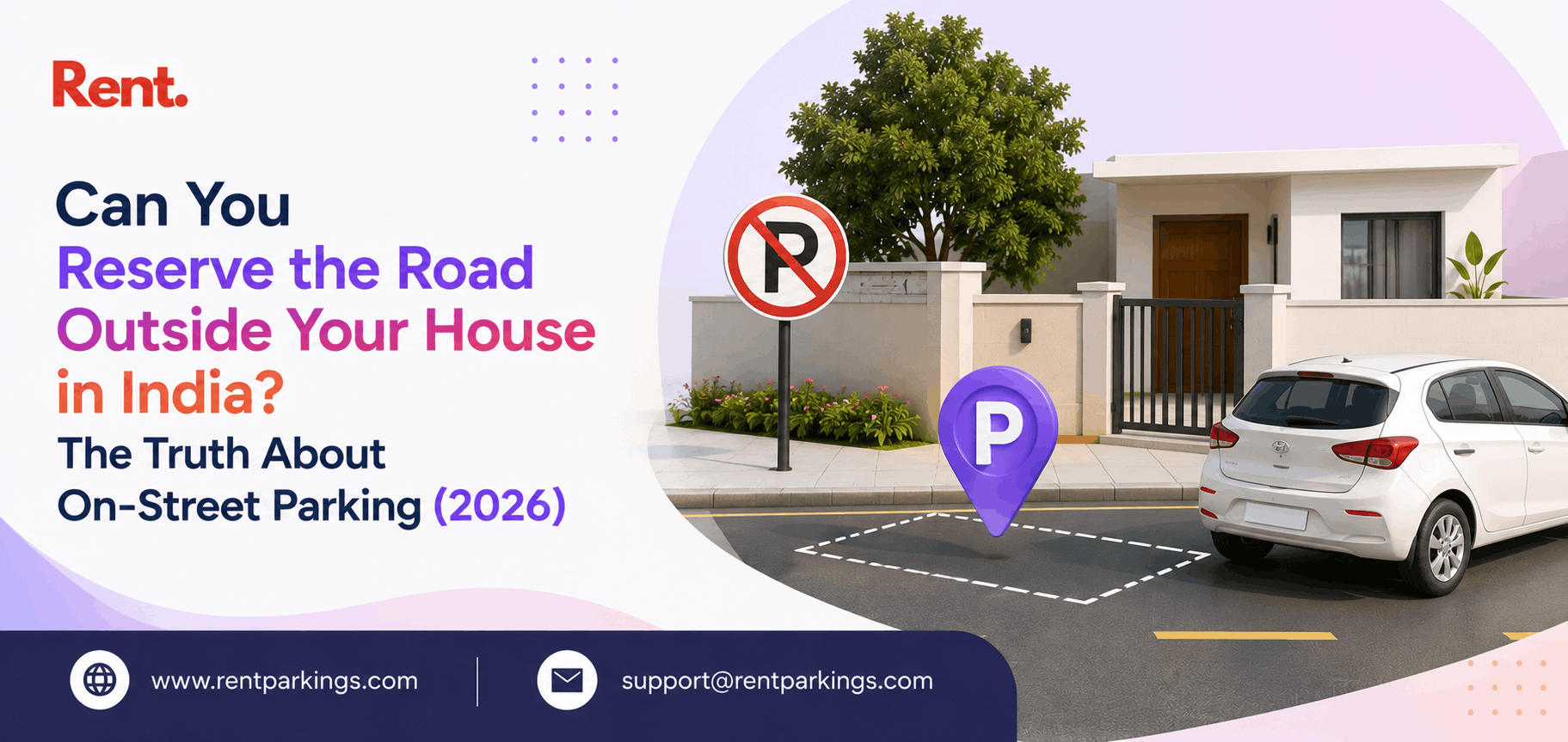
Can You Reserve the Road Outside Your House in India? The Truth About On-Street Parking (2026)
Walk down almost any residential lane in Chennai, Pune or Delhi, and you will see them: the plastic cones, the rusted iron chains looped between two bricks, the wobbly wooden stool, sometimes a hand-painted board that reads "RESERVED FOR DR. SHARMA." They all say the same thing without saying it: this stretch of road is mine.
It is one of the most Indian of urban rituals, and also one of the most misunderstood. Because here is the uncomfortable truth that no cone or chain can change: the road outside your house does not belong to you. Not the tar, not the kerb, not the shaded patch under the neem tree that your family has "always" parked under.
This article is about what the law actually says, why the confusion runs so deep, how different cities are quietly rewriting the rules, and, most usefully, what you can genuinely do when the space outside your gate becomes a battlefield. If you own a car or two-wheeler in urban India, this is the parking reality you live inside every single day, even if you have never seen it spelled out. At RentParkings, we break down the everyday parking questions Indian vehicle owners actually face, and few are as widely misread as this one.
The one-line answer everyone gets wrong
Let us settle the headline first, because most Indians believe the opposite.
A public road is public property. It belongs to everyone and can be used by everyone, subject to reasonable restrictions under the law. It follows, directly, that no resident can claim exclusive or preferential right to park on the portion of road in front of their own house. Indian courts have said this in plain language: a property owner cannot claim exclusive dominion over the road outside their gate, because that road is common property meant to be enjoyed by all.
Read that twice, because it overturns the unwritten rulebook of the average Indian street. Your name on the flat does not extend to the tar outside it. The years your family has parked there create no ownership. The fact that you keep the stretch swept and watered creates no right. In the eyes of the law, a stranger from three streets away has exactly as much right to park in front of your gate as you do, provided they are not sitting in a marked no-parking zone and are not blocking anyone's access.
This single principle is the foundation of everything else in this guide.
Why the confusion is so deep in India
If the law is that clear, why does half the country believe the opposite? Because in India, three things blur the line between public and private in a way they rarely do elsewhere.
The house-to-road spillover
Indian vehicle ownership has grown far faster than Indian streets. India crossed well over 300 million registered vehicles, and cities keep adding cars to road networks that were laid out for bullock carts and bicycles. When a household owns two cars and a scooter but its building sanctioned only one stilt bay, the overflow has nowhere to go but the street. Over years, that overflow hardens into a felt entitlement: "we have always kept our second car here."
The "sweat equity" belief
Many residents genuinely maintain the patch outside their home: they sweep it, they plant a tulsi, they repaint the kerb. This creates a powerful psychological sense of ownership. But maintaining a public space, however diligently, does not privatise it. This is the same reason you cannot fence off a corner of a public park because you water the grass there.
Weak, inconsistent enforcement
On paper, placing cones, chains, tyres or stools to reserve public road space without municipal authorisation is an encroachment and is illegal. In practice, municipal bodies rarely remove them unless a complaint is filed or a VIP route needs clearing. That gap between the rule and its enforcement is where the entire "reserved spot" culture breeds. People assume that because nobody stops them, the practice must be legal. It is not; it is simply un-policed.
The framework, in plain language
You do not need a law degree to understand the framework. Three layers govern the space outside your gate.
Layer one: the Motor Vehicles Act and traffic rules. These prohibit parking that causes obstruction, danger or inconvenience: parking on a footpath, at a corner blocking sightlines, in front of a fire hydrant or a gate, on a designated no-parking stretch, or in a way that narrows the carriageway for moving traffic. A vehicle violating these can be fined and towed regardless of who parked it.
Layer two: municipal and corporation bye-laws. Each city's municipal body (the GHMC in Hyderabad, BBMP in Bengaluru, MCGM in Mumbai, the various municipal corporations in Delhi, and so on) controls the road surface. They decide which streets allow parking, which are paid, which are no-parking, and who may authorise a reserved bay (for instance, a disabled resident, an embassy, or a hospital ambulance point). If the municipality has not authorised your private "reservation," it has no standing.
Layer three: private easements and access. This is the narrow zone where you do have protection. You have a right of access to your own property. If someone parks in a way that physically blocks you from entering or exiting your gate with your vehicle, that is an actionable obstruction. You can call the police, and if it persists, you can approach a civil court for a stay or injunction. Crucially, this is a right of access, not a right of parking. The system protects your ability to get in and out, not your claim to keep the space empty for your own car.
Hold on to that distinction. "Nobody can block my gate" is true and enforceable. "Nobody can park in front of my house" is false.
What this means on a real Indian street
Let us translate the framework into the situations you actually meet.
Your neighbour's guest parks in front of your gate but leaves room for you to drive in and out. You have no case. It is a public road, they are not obstructing your access, and they are not in a no-parking zone. Annoying, yes. Actionable, no.
A delivery van parks squarely across your gate so you cannot take your car out. Now you have a genuine obstruction. This is the one scenario where the system is on your side. Photograph it, note the time, and call the traffic police helpline; persistent offenders can be towed, and repeated blocking can be taken further.
You place cones to hold "your" spot while you are at work. You are the one breaking the rule here. Reserving public road space with objects, without municipal permission, is an encroachment. In several cities, corporation squads periodically confiscate such cones and chains, and residents have been fined.
A shop or restaurant lets its customers occupy the whole lane outside your building. Commercial establishments are often required to provide their own parking as a condition of their trade licence and building sanction. If they habitually push their parking load onto the public street and choke residential access, that is a matter you can escalate to both the traffic police and the municipal licensing department. The strongest civic complaints attach the establishment's licence obligation, not just the nuisance.
The city-by-city reality is changing fast
For decades, on-street parking in India was free, unlimited and unmanaged, which is exactly why it became chaotic. That era is ending. Cities are moving, unevenly but unmistakably, toward managed on-street parking, and it changes the calculus for every resident.
Delhi has been the front-runner in policy. Its parking management framework pushes each area to prepare a Parking Management Area Plan: mapping every legal bay, pricing on-street parking to discourage all-day private storage, and clamping down on the free-for-all that let cars colonise footpaths and lanes. The direction of travel is explicit: on-street space is a scarce public resource to be priced and rationed, not a free personal locker.
Bengaluru's parking policy takes a similar line, treating paid, organised on-street parking as a tool to cut demand and nudge commuters toward the metro and buses. The idea that a car can sit free on a public road for twelve hours is precisely what these policies are designed to end.
Pune, Chennai, Hyderabad, Ahmedabad and Kochi are each at different points on the same path: pilot paid-parking corridors, marked bays, app-based payment, and contractor-managed stretches near markets and stations. The Smart Cities Mission accelerated much of this, funding sensor-based and app-managed parking in dozens of cities, the kind of shift we cover in Smart Parking in India: How Sensors, FASTag, and Multi-Level Automation Are Solving the Urban Parking Crisis.
The takeaway for a resident is subtle but important: as more streets become formally managed, the informal "my spot outside my gate" custom gets squeezed from both sides. On a priced, marked street, the bay belongs to whoever pays for the hour, not to the person who lives behind it. Your cones become not just unenforceable but visibly obsolete.
Two-wheelers, night parking and the quieter street disputes
Most of the cone-and-chain drama is about cars, but India's streets carry a much larger, quieter population: scooters and motorcycles. With well over two hundred million two-wheelers on Indian roads, they are the default vehicle of Tier-2 and Tier-3 towns and of every crowded metro neighbourhood from Kolkata's older paras to the dense pockets of Kochi and Pune, a pressure we unpack in India Builds Its Parking Around Cars. Then, Wonders Where to Put 260 Million Scooters. Two-wheelers slip into the gaps cars cannot: the edge of the footpath, the mouth of a lane, the shaded strip beside a compound wall, and because each one takes so little room, residents rarely mark territory for them. Yet the same rules apply. A row of scooters parked on a footpath is an obstruction to pedestrians; a bike chained to a public railing outside your gate is no more "reserved" than a car would be.
Night parking deserves its own mention, because that is when the street feels most personal. The family that returns home at 9 pm and finds "their" frontage taken experiences it as a violation, not an inconvenience. But the position does not change after dark. There is no nighttime exception that converts a public road into a private driveway. What genuinely helps overnight is not a claim of ownership but design: adequate lighting, a resident-permit scheme sanctioned by the municipality, and, for women and late-shift workers in particular, parking within well-lit, overlooked stretches rather than isolated dead-ends. Safety, not entitlement, is the argument that actually moves civic authorities to mark and manage a residential street.
The economics nobody talks about: why "free" street parking isn't free
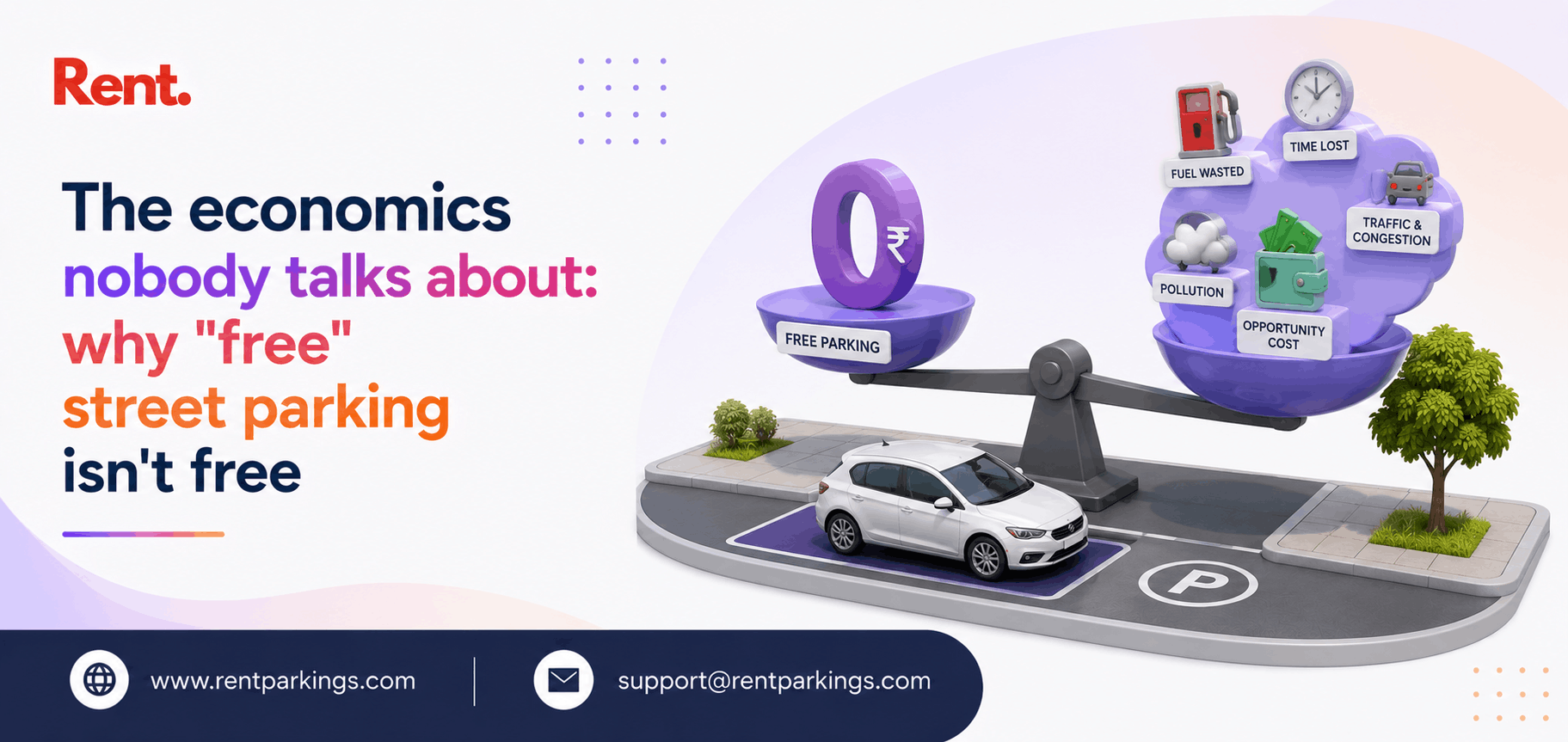
Here is the insight that reframes the whole argument. A single car needs roughly 23 square metres of space to park and manoeuvre, comparable to the floor area of a small bedroom or a modest 1RK. When that space is on a public road and costs the driver nothing, someone is still paying for it: the city, in the form of land that could have been a footpath, a cycle lane, a bus bay, a storm-water drain, or simply a clearer road.
Urban policy researchers in India have argued for years that unpriced street parking is a hidden public subsidy to private car owners, and that the fix is to price it and, where buildings are sold, to unbundle parking from the flat so buyers see what a bay truly costs rather than assuming it is a birthright thrown in with the house. Standards already recommend a certain number of equivalent car spaces per unit of floor area, but demand routinely outstrips sanctioned supply, and the overflow lands, you guessed it, on the public street outside your gate.
Once you see street parking as costly public land rather than free personal turf, the cones look different. They are not one family protecting "their" space; they are one family privatising a slice of the commons that belongs to the whole neighbourhood.
What you can actually do (that is lawful and effective)
If you are tired of the daily scramble outside your gate, here is the honest, lawful toolkit, in rough order of effectiveness.
Protect access, not territory. Keep your gate frontage clear enough to establish that blocking it is obstruction. If someone blocks it, document with a timestamped photo and call the traffic helpline. This is your strongest, most defensible position.
Go through your RWA or residents' association, collectively. A single resident's cones are an encroachment. But a Resident Welfare Association can petition the municipal corporation to formally mark and manage parking on the internal residential streets: designated bays, resident permits, or restricted hours. When the authority sanctions it, it holds; when you improvise it, it does not.
Ask the municipality for a residential parking scheme. Several cities are piloting resident-priority or permit-based on-street parking on congested lanes. Your RWA can formally request inclusion. This converts an informal claim into an official, enforceable arrangement.
Use the establishment's licence as leverage. If a commercial neighbour is the real source of the choke, a complaint to the licensing wing (citing their obligation to provide their own parking) often moves faster than a traffic complaint alone.
Look inward before looking outward. Much street overflow is really a shortage of off-street options. A stack parker in your stilt, a rented long-term bay in a nearby building, or a park-and-ride habit for daily metro commutes, an approach we explore in Why Thousands of Indian Commuters Are Parking Near Metro Stations, can quietly remove the very car that was fighting for the kerb. The most durable fix for "no space outside my gate" is often one fewer vehicle needing that kerb.
Never escalate to force. Deflating tyres, scratching a "wrongly parked" car, or blocking someone in retaliation flips you from complainant to offender instantly, and can invite both criminal and civil liability. The system rewards the resident who documents and reports, not the one who takes matters into their own hands.
Where this is all heading
India's streets are at an inflection point. Vehicle numbers keep climbing, metro networks keep expanding, EV adoption is reshaping who needs to park and charge, and city after city is discovering that the only sustainable answer to parking chaos is management, not more free tar. In that future, the informal economy of cones and chains has no place. On-street space will increasingly be marked, priced, time-bound and app-managed, and the question "whose spot is this?" will have a simple answer: whoever is currently paying or permitted to use it.
That may feel like a loss to the family that has "always" parked outside its gate. But it is also a quiet gain for everyone else on the lane, because a managed street is a fairer street. The neem-tree patch stops being one household's fiefdom and goes back to being what it always was: a shared piece of the city.
Conclusion
The plastic cone outside your gate is a small monument to a big misunderstanding. In India, the road in front of your house is public property, and no resident holds an exclusive or preferential right to park on it. What you do hold is the right to access your own property, the right not to be blocked in or out, and that is real, enforceable and worth defending. Everything beyond it, from the reserved chains to the painted "P" boards, rests on custom and weak enforcement, not on anything solid.
As Indian cities move toward priced, marked, managed on-street parking, the smart resident stops fighting for turf and starts working the system that actually protects them: keep your access clear, document obstructions, act collectively through your RWA, petition the municipality for a formal scheme, and reduce your own street footprint where you can. The road outside your house was never yours to reserve, but a well-managed street can still be one where you, and everyone else on the lane, find room to park in peace. For more practical, India-first parking guides, explore RentParkings.
FAQs
Can I legally reserve the road outside my house for parking in India?
No. The road in front of your house is public property. Courts have held that a resident cannot claim exclusive or preferential right to park there. Placing cones, chains or boards to reserve public road space without municipal authorisation is an encroachment and is illegal.
Can my neighbour park in front of my gate?
Yes, as long as they are not in a marked no-parking zone and are not blocking your ability to enter or exit your property. It is a public road. You can only object if the parked vehicle actually obstructs your access.
What can I do if someone blocks my gate with their car?
Blocking your access is an actionable obstruction. Photograph the vehicle with a timestamp, note the time, and call the traffic police helpline. Persistent offenders can be fined and towed, and repeated blocking can be taken to a civil court for an injunction.
Are the cones and chains people use to hold parking spots legal?
No. Reserving public road space with objects, without permission from the municipal authority, is an encroachment. In several cities, corporation squads confiscate such cones and chains and can fine the residents responsible.
Is on-street parking free everywhere in India?
Increasingly, no. Cities like Delhi and Bengaluru are moving to priced, managed on-street parking through parking management plans and paid bays. On such streets, the space belongs to whoever is paying or permitted to use it at that time, not to the nearest resident.
Does my Resident Welfare Association (RWA) have the power to allot street parking?
An RWA cannot unilaterally privatise a public road, but it can petition the municipal corporation to formally mark, permit or manage parking on residential streets. Once the authority sanctions the scheme, it becomes enforceable, unlike individual cones.
A shop's customers block my residential lane every day. What can I do?
Commercial establishments are usually required to provide their own parking as a condition of their trade licence. Beyond a traffic complaint, you can escalate to the municipal licensing wing citing that obligation, which often carries more weight than a nuisance complaint alone.
Can I deflate the tyres of a car wrongly parked outside my house?
No. Damaging a vehicle or blocking it in retaliation turns you from complainant into offender and can invite criminal and civil liability. The lawful route is to document the obstruction and report it to the police or municipal authority.
Does maintaining the road outside my house give me any parking rights?
No. Sweeping, watering or repainting the kerb outside your home does not privatise public land, just as maintaining a patch of a public park gives you no ownership of it. Maintenance creates no legal parking right.
How much space does a parked car actually take, and why does it matter?
A single car needs roughly 23 square metres to park and manoeuvre, about the size of a small room. Because that space on a public road is scarce and unpriced, cities increasingly treat free street parking as a hidden public subsidy, which is why paid and managed on-street parking is spreading across Indian cities.
Share This post
Search
Recent Post
What Happens When You Need Your Parking...
01 Sep, 2026
How Listing Your Parking Space in India...
31 Aug, 2026
Parking Space vs Gold: The Idle Asset Th...
28 Aug, 2026
Your Garage Hasn't Parked a Car in Month...
26 Aug, 2026
Someone Dents a Car in Your Rented Parki...
25 Aug, 2026
Your Vacant Plot Is Not Free to Own: How...
24 Aug, 2026
Coaching Centre Parking in India: Why Ko...
21 Aug, 2026
India's PG and Co-Living Boom Has a Park...
20 Aug, 2026