

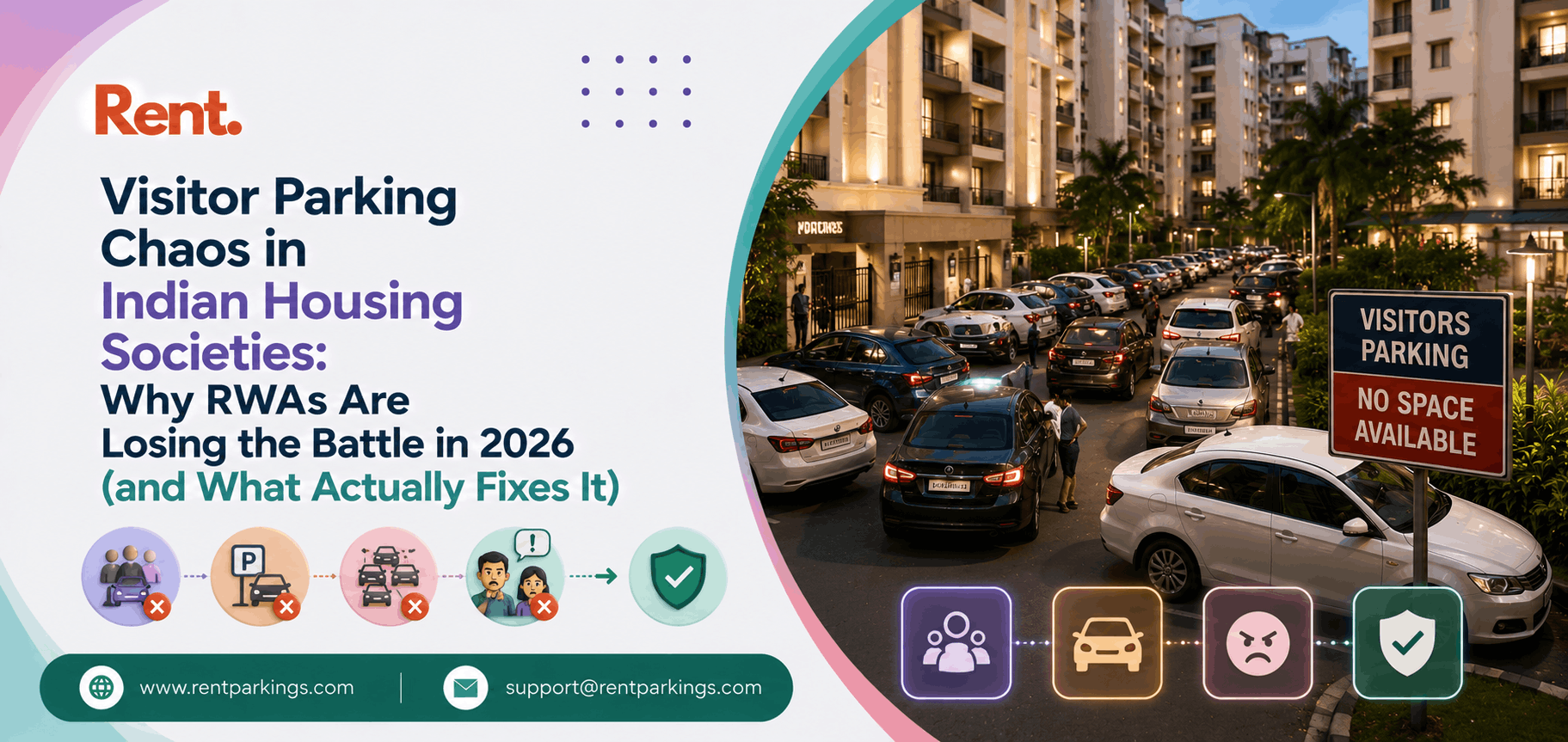
Visitor Parking Chaos in Indian Housing Societies: Why RWAs Are Losing the Battle in 2026 (and What Actually Fixes It)
Most Resident Welfare Associations think their parking problem is a shortage of slots. It usually isn't.
Walk into almost any RWA general body meeting in Bengaluru, Pune, or Noida, and you'll hear the same complaint dressed up in different words: "we need more parking." But pull the actual numbers from a dozen mid-sized societies and a different picture shows up. The allotted resident slots are mostly fine. What's breaking the system is the twenty, thirty, sometimes fifty visitor vehicles that show up on any given evening with nowhere sanctioned to go.
Delivery riders. Cab drivers waiting on a pickup. A relative's car parked for the weekend. A contractor's van left overnight because moving it felt like too much effort. None of these vehicles were planned for when the builder handed over the project ten or fifteen years ago, and none of them show up in the society's original parking allocation. They just accumulate, night after night, until someone's car is blocked in and a WhatsApp group turns into a shouting match.
This is the piece nobody talks about when they discuss RentParkings, India's trusted parking marketplace, or apartment parking more broadly. Ownership rights get debated. Resale value gets debated. Visitor parking (the messiest, most daily source of friction in an Indian housing society) barely gets discussed at all, even though it's the thing security guards, committee members, and residents actually fight about.
What a Visitor Parking Crisis Actually Looks Like on the Ground
It rarely announces itself as a crisis. It shows up as small, recurring irritations that compound over months.
A society in Gurugram with 320 flats and 280 covered resident slots might comfortably house its own cars. But add festival season, a couple of weddings in the community hall, three simultaneous house parties, and the internal road becomes a single-file lane by 9 pm. Security guards, armed with a paper register and a ballpoint pen, are expected to track every entry and exit manually: a job that was already unrealistic at 50 vehicles a day and becomes impossible past 150.
In older societies across Chennai and Kolkata, where the layout predates any real parking planning, the problem is structural. There was never a visitor bay to begin with. Every guest car parks wherever there's a gap, which usually means blocking someone's driveway or eating into the fire lane, which is a genuine safety issue most residents don't think about until an ambulance can't get through.
And then there's the newer breed of visitor that older bylaws never anticipated: food delivery riders on two-wheelers, e-commerce vans making society-wide drop-offs, and app-based cab drivers idling near the gate for ten minutes at a stretch. None of these fit the old mental model of a guest visiting a resident, yet they now make up a meaningful share of daily vehicle movement in urban Indian societies.
Why the Guard-Register System Keeps Failing
Ask any facility manager, and they'll admit the paper register was never built to handle this volume. A few specific failure points show up again and again.
- Entries get logged with illegible handwriting, making disputes over "who let this car in" impossible to resolve later.
- There's no real-time visibility for the committee: nobody knows how many visitor vehicles are inside the campus at 8 pm on a Saturday until someone physically counts.
- Guards face pressure from residents to wave cars through quickly, so verification steps quietly get skipped during busy hours.
- Overstay is nearly impossible to track. A "visitor" car that never leaves can sit in a guest slot for weeks before anyone notices.
- Shift changes lose information. What one guard knew about a flagged vehicle rarely makes it to the guard who takes over at 8 am.
None of this is really the guards' fault. They're being asked to run a logistics operation with a tool designed for a much smaller, slower-moving problem.
The Digital Shift: What Societies Are Actually Adopting in 2026
Over the last two or three years, a wave of Indian societies, particularly larger gated communities in Hyderabad, Bengaluru, and Mumbai's western suburbs, have started moving away from the paper register entirely. The tools aren't exotic. They're mostly variations on a few core ideas.
Pre-approval through resident apps. A flat owner generates a QR code or one-time pass for an expected guest before they arrive, so the guard's job becomes verification rather than judgment.
ANPR cameras at the gate. Automatic number-plate recognition logs every vehicle automatically, creating a searchable record without relying on handwriting.
Time-bound visitor slots. Instead of open-ended parking, guest vehicles get allocated a specific bay for a specific window, after which the system flags an overstay.
UPI-linked payment for paid visitor parking. Some societies now charge a nominal fee, often ₹20 to ₹50 an hour, for non-resident vehicles staying beyond a grace period, collected instantly through UPI rather than cash that's easy to misplace.
Centralised dashboards for the managing committee. Instead of asking a guard for a headcount, committee members can see live occupancy on a phone.
None of these fixes require tearing up the compound and rebuilding it. Most run on existing infrastructure with a modest one-time setup cost, which is part of why adoption has picked up even among societies that are usually slow to spend on anything beyond basic maintenance.
Who Actually Owns That Parking Space, Anyway
A lot of the tension around visitor parking traces back to a question most residents have never had properly answered: who has the legal right to allocate a slot in the first place. Builders, RWAs, and individual flat owners all tend to assume the rules favour them, and in India that assumption is often wrong.
The rights around stilt, covered, and open parking are governed by state-specific apartment ownership laws and the society's own bylaws, and they don't always match what residents believe. Anyone on a managing committee dealing with a visitor parking dispute should first get clear on who actually holds ownership over parking within the society, because half the arguments at RWA meetings dissolve once that's settled properly.
Why Visitors Keep Spilling Onto the Street Outside
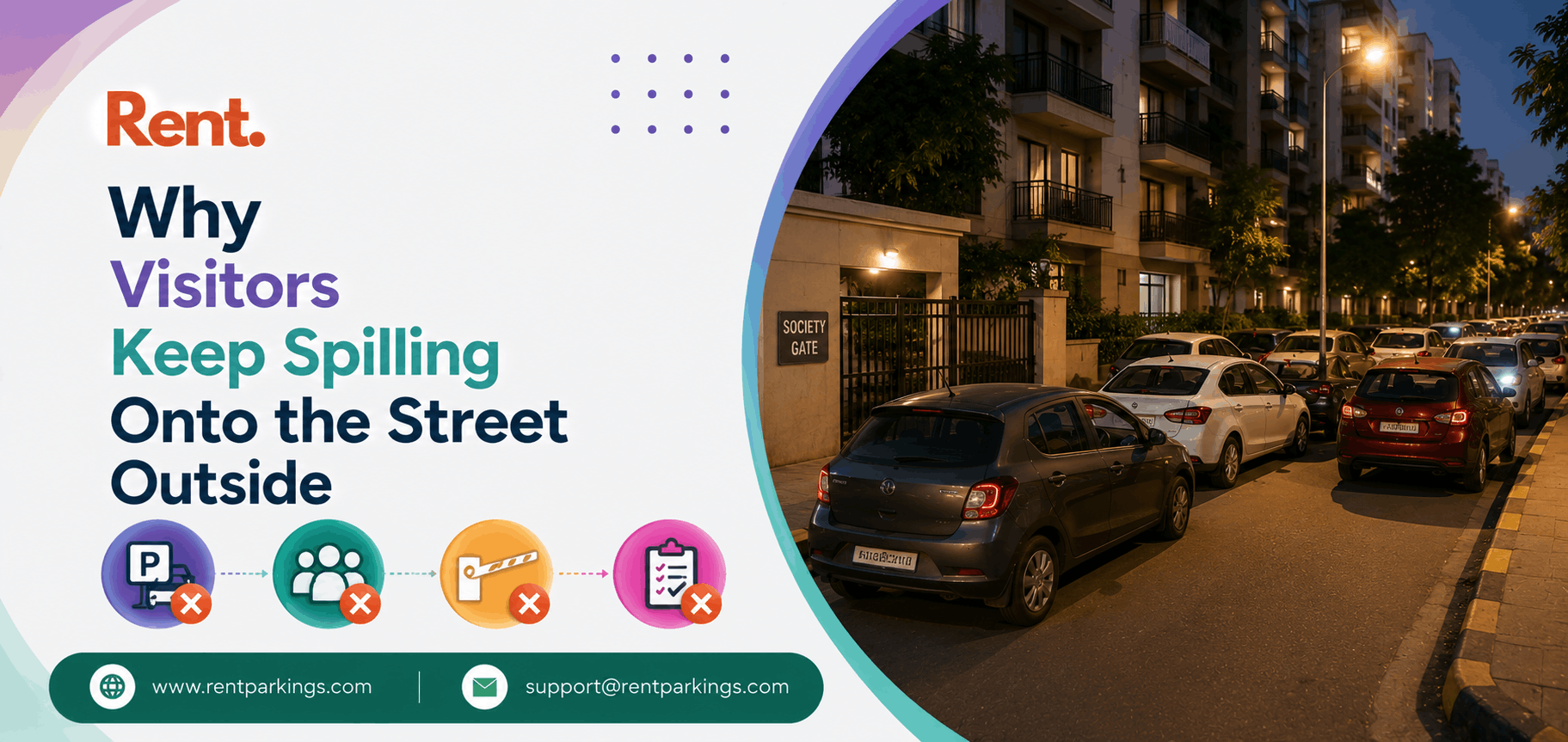
When a society's internal parking fills up, the overflow doesn't disappear; it moves to the road just outside the gate. This creates a second, entirely different set of problems: traffic police challans, blocked resident driveways on the public side, and friction with neighbouring properties who now deal with cars they have no relationship to.
Many residents assume they have some informal right to the stretch of road facing their building, especially in older residential lanes in cities like Lucknow or Jaipur. That assumption rarely holds up. The actual rules around reserving road-facing parking in India are more restrictive than most people expect, and understanding them matters as much for a society's visitor overflow strategy as it does for an individual homeowner.
Getting the Layout Right in the First Place
A surprising number of visitor parking disputes come down to something simple: the bays were never sized correctly to begin with. Older societies, in particular, were often designed around a single standard car dimension without accounting for the mix of hatchbacks, SUVs, and two-wheelers that actually show up today. Committees planning a re-layout of visitor bays, whether they're carving out new space or repainting existing lines, benefit from working off the current standard car and two-wheeler parking dimensions used across India, rather than guessing based on how the original builder laid things out two decades ago.
Multi-Level and Stack Solutions: A Fix for Societies Overlook
Land-starved societies in cities like Mumbai and central Chennai have limited options for expanding footprint. For them, the more realistic answer isn't finding new land; it's using existing land more efficiently, through stack parking systems or compact multi-level structures within the compound.
The tricky part is that India already has a cautionary tale here. Many public multi-level parking towers built over the last decade sit mostly empty because of poor placement or clunky user experience: a pattern worth studying before a society sinks lakhs of rupees into similar infrastructure. A closer look at why so many of India's multi-level parking towers ended up underused is genuinely useful reading for any committee evaluating a stack-parking investment, because the mistakes are avoidable if you know what to look for.
Turning Underused Visitor Slots Into Society Income
Here's the part most RWAs never think through: not every visitor slot is occupied every day. A society with 15 designated guest bays might see peak usage of 12 on a wedding weekend and 3 on an ordinary Tuesday. That gap (empty, paid-for infrastructure sitting idle most weekdays) is money the society is quietly leaving on the table.
Some managing committees have started renting out spare visitor capacity during off-peak hours to nearby office-goers, delivery hubs, or event organisers, generating a modest but steady stream that offsets maintenance costs. The math on this can be surprisingly attractive: a city-wise breakdown of what a well-utilised parking slot in India can actually earn across a month makes the case clearly, especially for societies located near IT corridors or commercial stretches where demand for short-term parking is constant. It's a smaller-scale version of the same logic that makes individual property owners list spare space on marketplaces like RentParkings: idle square footage, priced sensibly, adds up.
A Practical Playbook for RWAs in 2026
For committees looking to actually fix the problem rather than argue about it for another year, a few steps tend to matter more than the rest.
- Audit current usage for two weeks: count visitor vehicles by hour, not just by day, before deciding what to build or buy.
- Separate "guest" traffic from "service" traffic (delivery riders, cab drivers, contractors) and design different rules for each.
- Move to app-based pre-approval before investing in hardware like ANPR cameras; the software fix is cheaper and often solves 70% of the problem alone.
- Set a clear overstay policy with a grace period and a modest hourly charge collected via UPI, rather than an unenforced verbal rule.
- Reassess bay dimensions against current vehicle mix before repainting or restriping any parking area.
- Evaluate whether idle visitor capacity during weekday off-peak hours can be monetised safely, with proper access control.
- Review the society's own bylaws and legal parking rights before making any allocation decision that could later be challenged.
None of this requires a large budget or an outside consultant. It requires someone on the committee willing to treat parking as an operations problem rather than a source of gossip.
Frequently Asked Questions
Why do Indian housing societies struggle with visitor parking specifically, rather than resident parking?
Resident parking is usually allocated once and stays fixed, while visitor traffic changes hour to hour and includes categories (delivery riders, cab drivers, event guests) that older societies never planned for. The unpredictability, not the total volume, is what breaks manual systems.
Is it legal for an RWA to charge visitors for parking inside the society?
Most RWAs can set reasonable visitor parking charges through their bylaws, provided it's approved through the managing committee and communicated transparently to residents. It's worth checking the society's specific bylaws and applicable state cooperative or apartment ownership laws before implementing a fee.
What's the cheapest way for a small society to reduce visitor parking chaos?
A free or low-cost resident app for pre-approving guests, combined with a clear time-bound policy, solves a large share of the problem without any camera hardware or major capital spend.
How do ANPR cameras actually help with visitor parking management?
They automatically log every vehicle's entry and exit time, removing reliance on handwritten registers and giving the committee a searchable record for disputes, overstays, or security concerns.
Can a society legally rent out unused visitor parking slots to outsiders?
Many societies do this successfully, but it depends on the bylaws, the specific approvals in place, and how access control is managed. Committees should confirm this is permitted under their society's rules before setting up any paid arrangement.
What should a society do about delivery riders and cab drivers who aren't traditional "visitors"?
Treat them as a separate category with their own short-stay rules: a designated waiting zone near the gate works better than folding them into the same process used for a resident's personal guests.
How much does a digital visitor parking system typically cost for a mid-sized Indian society?
Costs vary widely by scale and features, but app-based pre-approval systems tend to be the most budget-friendly entry point, while ANPR camera installations represent a larger one-time investment. Societies should get quotes tailored to their specific gate count and vehicle volume rather than assuming a fixed price.
Why do visitor cars end up parked on the street outside the society gate?
This usually happens when internal visitor capacity is full or poorly managed, pushing overflow traffic onto public roads, which can create its own legal and traffic issues for both the society and its neighbours.
Are stack parking or multi-level systems worth it for a land-constrained society?
They can be, but only when usage patterns genuinely justify the investment and the design accounts for real user behaviour: many public multi-level structures in India sit underused because that homework wasn't done first.
How can a housing society start monetising idle parking capacity without disrupting residents?
Start small: offer only clearly idle weekday off-peak slots, keep access controlled and time-bound, and treat it as a pilot before expanding. Listing available capacity on an established parking marketplace makes it easier to reach genuine demand without the society having to manage bookings manually.
Where This Leaves Committees Heading Into the Rest of 2026
Visitor parking will never fully disappear as a source of friction in Indian housing societies; there are simply too many moving parts, too many stakeholders, and too much unpredictable daily traffic for any system to be perfectly smooth. But the gap between societies that manage it well and those stuck relitigating the same argument every quarter usually comes down to a handful of decisions: clear policy, the right amount of digital tooling, and an honest look at whether existing capacity is being used at all.
For committees sitting on visitor bays that go empty most weekdays, there's a straightforward next step worth considering. Property owners and societies across India are already turning spare capacity into steady monthly income by listing it where genuine demand exists: list your unused parking space on RentParkings and start earning from it today, on your own terms, whether that means hourly, daily, or monthly rentals to verified drivers searching for exactly that kind of spot.
Share This post
Search
Recent Post
Parking Space vs. Renting Out a Room to...
05 Oct, 2026
Think Parking Rental Only Pays in Mumbai...
02 Oct, 2026
Your Mumbai Parking Space Is Worth More...
01 Oct, 2026
Hyderabad's Real Estate Boom Left One As...
30 Sep, 2026
What Your Parking Space in Chennai Could...
29 Sep, 2026
Your Plans Changed After Listing Your Pa...
28 Sep, 2026
Parking Space vs SIP: Which Idle Asset A...
25 Sep, 2026
What Your Parking Space in Pune Could Ac...
24 Sep, 2026