

The Hidden Reason Indian Parking Owners Won't List Their Space — And the Tech Quietly Fixing It (2026)
Ramesh, a retired bank officer in Kochi, had a driveway sitting empty for six years before he ever considered renting it out. It wasn't the paperwork that stopped him, and it wasn't the thought of strangers driving past his gate either. It was one nagging question: once someone else had a key to his property, who was actually in control of it?
That single worry, more than pricing or paperwork, is what keeps thousands of unused parking spots across Indian cities sitting idle. People rarely doubt they can find a paying renter. What stalls them is everything that comes after the handshake — the missing accountability once access changes hands.
It's a fair worry to have. Handing over a set of keys to a stranger you met through an app feels like a bigger leap than it should, particularly in a market where "security" has traditionally meant a night watchman jotting entries into a register by torchlight.
That picture has started shifting quietly over the past couple of years. A newer layer of low-cost, India-friendly hardware and software has arrived specifically to answer this worry, and none of it demands technical know-how or a large budget — most solutions cost less than what a single month of rent would bring in.
Why the Timing Matters in 2026
Parking supply has fallen well behind demand across India's major metros, which means owners sitting on an unused patch of land or a spare driveway slot are holding an asset the market genuinely wants. Bengaluru, Chennai, Mumbai, Hyderabad, Pune, and the wider Delhi NCR region are all telling the same story — buyers looking for a reliable monthly spot near a metro corridor, tech park, hospital, or housing complex outnumber the spots on offer.
That imbalance is pulling more owners toward listing spots they'd otherwise leave empty. But it's also raising the stakes on the trust question, since renting to someone found through an app carries a different weight than renting to a familiar face in the neighbourhood. The systems an owner puts in place to manage that relationship end up mattering a great deal.
The encouraging part is that hardware has caught up with the need. Tasks that once demanded a full-time guard and a paper logbook can now run through a device that costs a few thousand rupees and pairs with a phone in minutes.
What's Actually Available to Indian Owners Right Now
Nobody needs to install everything on this list. Most owners renting a single spot will only ever need one or two of these. Here's a rundown of the options and what each one is built to solve.
1. App-Controlled Smart Padlocks
Instead of a chain and a traditional padlock, these locks open through a phone app, a numeric code, or a temporary passcode you can issue and cancel at will. For a gated plot or a covered stilt spot, this means no physical key ever needs to leave your hand, and you can shut a renter out the moment a payment is missed or a term ends.
Expect to pay somewhere between ₹2,500 and ₹8,000 depending on build quality and how long the battery lasts.
2. One-Time-Code Gate Entry
Popular in gated housing complexes and now trickling down to individual owners with automated barriers, this setup texts a temporary code to a renter's phone that unlocks the gate for a set window of time. There's no physical key involved at all, and every single entry gets timestamped automatically.
"It's particularly handy for hourly or daily rentals close to railway stations, airports, or event venues, where one spot might serve three or four separate drivers within a week.
3. Cameras With Off-Site Storage
Older CCTV setups relied on a local recorder that overwrote itself every few days and was often useless by the time you actually needed footage. Newer cloud-linked cameras push recordings to remote storage automatically, so even a stolen or damaged camera doesn't wipe out your evidence.
A basic cloud camera setup for one spot usually runs ₹3,000 to ₹6,000, plus a monthly storage charge that's frequently under ₹150 for a week or two of retained footage.
4. Location Tracking for Multi-Spot Operators
Owners managing several spots at once — say, a small commercial yard near a Gurugram tech corridor, or land used by a logistics fleet — can set up virtual boundaries that trigger an alert whenever a vehicle enters or exits without a matching reservation. This tends to matter far more for someone running multiple bays than for a single homeowner with one driveway to manage.
5. Payments Tied Directly to Access
This last one skips hardware entirely. A growing number of parking apps now link entry directly to UPI payment status, meaning a gate or lock only opens once that period's payment has actually gone through. It quietly removes the job of chasing someone for rent, and it stops a renter from continuing to use a spot on an agreement that's already lapsed.
What Happens When Owners Skip All of This
Talk to owners who've rented out spots the traditional way — a spare key handed over with a verbal promise — and the same complaints keep surfacing. A renter who stops paying but leaves the vehicle parked anyway. A duplicated key nobody authorised. An argument over whose car was actually there on a given night, with nothing to settle it.
None of these problems are dramatic on their own. But together they create exactly the kind of ongoing friction that convinces an owner it's easier to leave a spot empty than to keep dealing with it. None of the tools above make every headache disappear, but they do remove the specific ones caused by having no record and no way to intervene remotely.
Picking the Right Setup for Your Space
- Not every space calls for every gadget. Here's a simple way to think through what fits your situation.
- A covered or stilt spot inside an apartment complex: a smart padlock, or an OTP-linked society gate if one already exists, is usually plenty. Dedicated cameras are often unnecessary here since building-wide CCTV already covers the parking area.
- An open driveway or a standalone plot: this is where cloud-backed cameras pay off fastest, since there's no shared security infrastructure watching the space on your behalf.
- A spot near a hospital, station, or any high-churn location: app-based or code-based entry beats a physical key, given how often a different vehicle might occupy the same spot within one week.
- Several spots run as a small business: combining location alerts with payment-linked access gets you closest to running things without being physically present, while still tracking who's parked where and whether they've paid.
Weighing the Cost Against What It Actually Protects
Compared with the monthly income a well-placed spot can bring in, these setup costs stay modest. A single spot near a busy tech corridor or hospital in a city like Hyderabad or Pune can often pull in a few thousand rupees a month, and a one-time spend of ₹5,000 to ₹10,000 on a lock and a camera typically pays for itself within the first couple of months — after that, it's simply protecting income that's already flowing in.
There's a useful parallel here to how a parking space measures up against a fixed deposit as a way to earn passive income. A fixed deposit never needs a lock or a camera, sure, but it also can't respond to market demand the way a physical asset can, and a properly secured spot in a high-demand area can outpace it by a fair margin.
The Legal Angle Most Owners Overlook
Security hardware isn't only about deterring theft — it's also the strongest card you can hold if a dispute ever lands on your doorstep. When a vehicle gets damaged on your property and both sides disagree on who's at fault, timestamped footage or an access log resolves that argument far faster than two people trading accounts of what happened.
This exact scenario comes up in our earlier piece exploring what liability actually looks like when a parked car gets damaged, where a basic "park at your own risk" sign turns out to offer far less legal cover than most owners assume. A clear record of who came in, when, and in what condition changes that entire conversation — and it builds the renter's confidence in you just as much as it protects your own asset.
If your spot happens to sit within a housing society, it's worth getting familiar with how ownership and access actually work inside apartment complexes, since some societies restrict how outside visitors or renters can use shared gates — something to confirm before installing anything near a common entrance.
Where This Overlaps With EV Charging
If your spot includes, or might one day include, an EV charging point, the security question picks up an added layer, since you're now safeguarding a piece of electrical equipment and not just a slab of concrete. Smart charging plugs that only switch on for a paid, authorised session are becoming a natural fit for exactly this reason.
Owners weighing this combination often begin with the groundwork covered in our piece on installing an EV charger within a housing society's parking arrangement, which walks through approvals and wiring considerations well before access control ever enters the picture.
A Reality Check for Night-Time and High-Turnover Locations
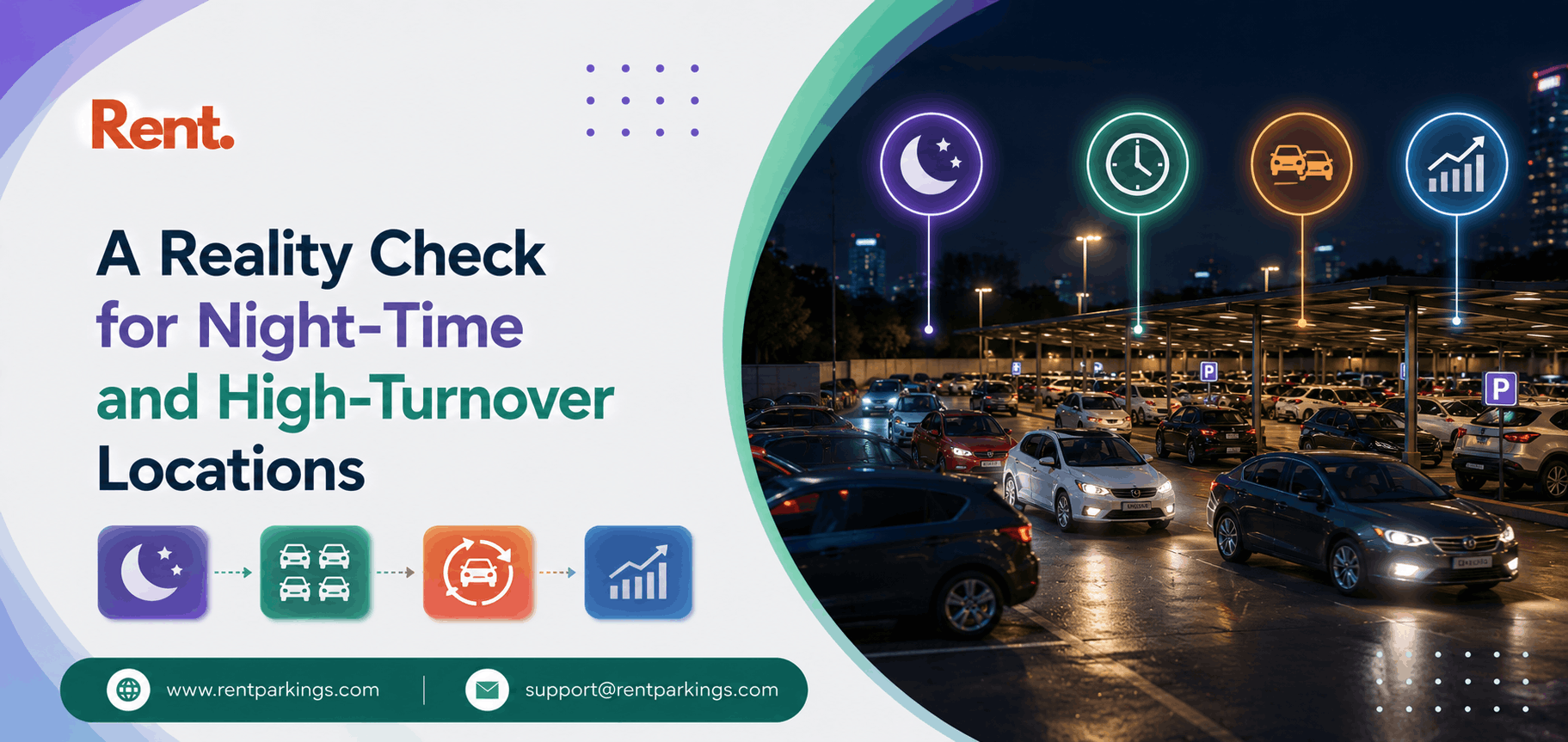
Spots near hospitals tend to see some of the heaviest overnight and off-hour demand of any parking category in Indian cities, since attendants, visiting family, and emergency vehicles show up around the clock. That's precisely where remote-access tools earn back their cost the fastest, given that you can't always be there in person to hand over a key at 2 in the morning.
Our earlier feature on the income potential of parking near hospitals touches on this same pattern of demand, and it's a useful companion read if that describes the kind of location you own.
Where RentParkings Comes Into the Picture
None of this needs to be built from scratch by a single owner acting alone. RentParkings already runs identity checks and keeps booking records for every listing on the platform, so a new renter isn't starting from a completely blank slate of trust. Layering your own smart lock, camera, or coded gate on top of that simply connects two things that used to sit apart: the platform's confirmation of who someone is, and your own physical control over who actually gets in.
Frequently Asked Questions
Do I really need CCTV if I'm only renting out one parking spot?
Not always. If your spot sits inside a building or society that already has shared cameras covering the parking area, a dedicated one may not add much. Standalone driveways and open plots benefit the most, since there's no existing coverage backing them up.
How much does a basic smart parking security setup cost in India?
A smart padlock paired with an entry-level cloud camera generally lands between ₹5,000 and ₹10,000 as a one-time cost, plus an ongoing cloud storage fee that usually stays under ₹150 a month. Most owners recoup that within one or two months of rental income.
Can I use an OTP gate system if my society doesn't already have automated gates?
Yes — standalone OTP-based barriers and smart locks can be fitted independently of whatever infrastructure your building already has, though it's worth checking with your society's management committee before altering anything at a shared entrance.
What happens if a tenant's payment lapses but they haven't moved their vehicle?
This is the exact scenario UPI-linked access is designed to prevent, since the gate or lock stays open only while a payment is current. Without that safeguard, you're stuck chasing the person manually, which is where most disputes in informal parking setups originate.
Is a verbal or handshake agreement enough for renting out a parking spot?
It happens often, but it leaves you with nothing to fall back on if a disagreement surfaces later. A short written agreement paired with an access log from a smart lock or OTP system offers far more protection than a spoken understanding alone.
Are smart locks reliable during power cuts, which are common in many Indian cities?
Most well-made smart padlocks and gate systems run on rechargeable batteries lasting anywhere from a few weeks to a few months, so brief outages rarely affect them. It's still worth checking a device's battery rating before buying if your area sees longer or frequent power cuts.
Does adding security tech affect how much I can charge for my parking spot?
In a roundabout way, yes. Renters — particularly those parking overnight or for long stretches — often gravitate toward spots with visible security, which can justify slightly higher rates or quicker bookings than an unsecured spot nearby.
What's the difference between GPS tracking and geofencing for parking?
GPS tracking follows one specific vehicle wherever it goes, while geofencing draws a virtual line around your property and flags any vehicle that crosses it, no matter which one it is. For most individual owners, a geofence around the parking area itself is the simpler and more practical choice.
Do I need police verification for renters in addition to platform verification?
Some housing societies and local authorities suggest or require basic ID verification for long-term parking tenants, particularly for covered or gated spots. It's a good idea to check your society's or RWA's own guidelines alongside whatever verification a platform already provides.
Can commercial operators managing multiple parking spots use the same tech as individual owners?
The same categories of tools apply, but operators running things at scale typically need centralised dashboards, several linked cameras, and geofencing spanning multiple sites rather than a single lock-and-camera combo. A number of Indian parking management apps now offer multi-site plans built with exactly this in mind.
Where to Start
You don't have to install every device on this list before your very first renter shows up. Pick whichever one addresses your biggest concern — a key changing hands, a payment you can't keep track of, or simply not knowing who was on your property and when — and add the rest later, once the rental income justifies it.
The right security setup turns "I don't know this person" into "I have a clear record of exactly what happened," and that shift alone is often what separates an empty spot from one that's quietly earning every month. If unused parking space has been sitting idle purely because of this worry, it's a reasonable moment to stop waiting. Join RentParkings and publish your parking space for free — set your own hourly, daily, or monthly rates, reach verified drivers, and add whatever security layer helps you sleep easier at night.
Share This post
Search
Recent Post
Parking Space vs. Renting Out a Room to...
05 Oct, 2026
Think Parking Rental Only Pays in Mumbai...
02 Oct, 2026
Your Mumbai Parking Space Is Worth More...
01 Oct, 2026
Hyderabad's Real Estate Boom Left One As...
30 Sep, 2026
What Your Parking Space in Chennai Could...
29 Sep, 2026
Your Plans Changed After Listing Your Pa...
28 Sep, 2026
Parking Space vs SIP: Which Idle Asset A...
25 Sep, 2026
What Your Parking Space in Pune Could Ac...
24 Sep, 2026