

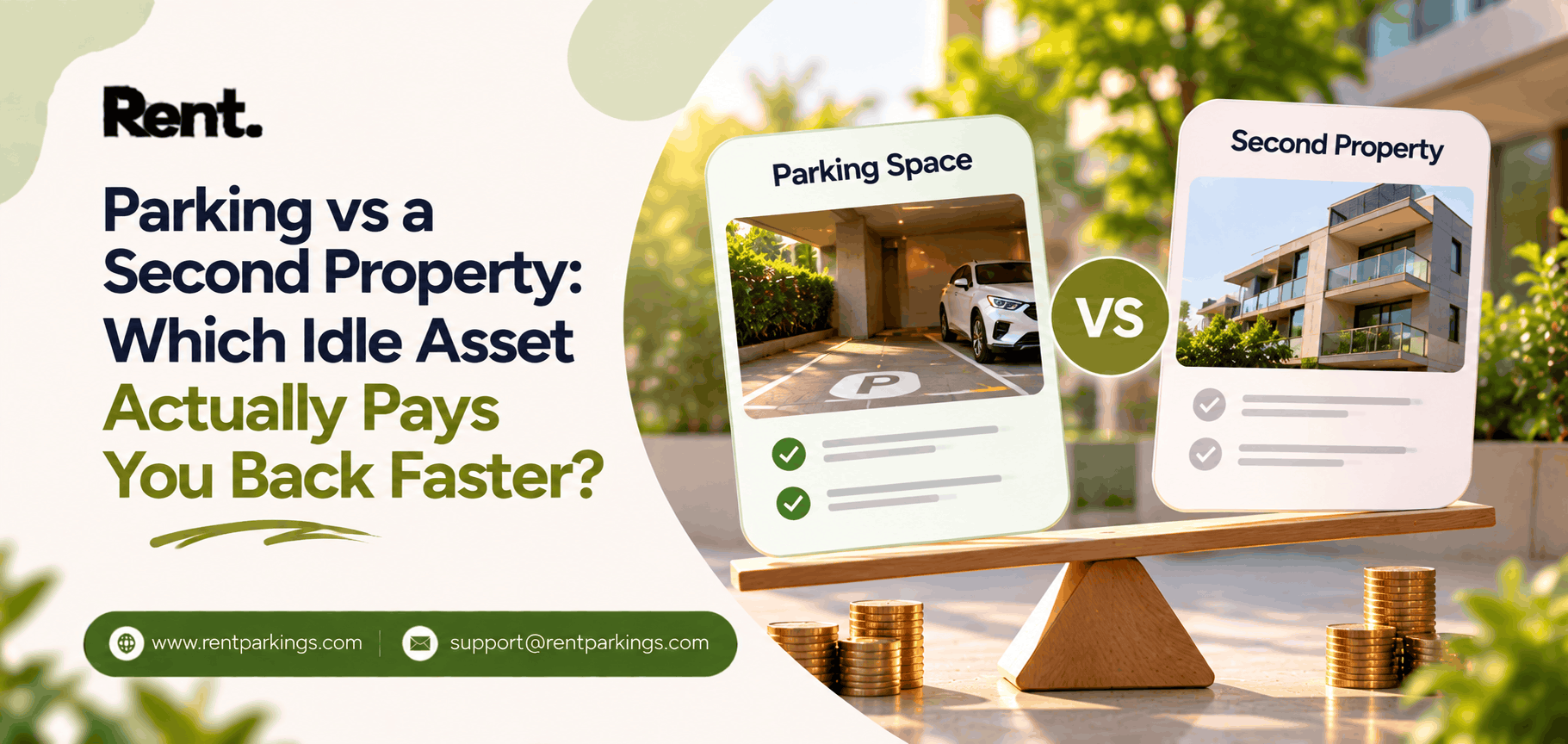
Parking vs a Second Property: Which Idle Asset Actually Pays You Back Faster?
Ask any salaried Indian professional what they'd do with an extra forty lakh rupees, and a surprising number will say the same thing: buy another flat. It feels safe. It feels like what a financially responsible adult is supposed to do.
But here's a question almost nobody asks before signing that second home loan: what is the asset I already own doing for me right now? For most property owners, the honest answer is nothing. The car goes in, the car goes out, and the parking slot sits empty for the other eighteen hours of the day.
This isn't an article telling you real estate is a bad investment. It's an article asking a narrower, more useful question: before you lock up another ten or twenty years of capital in a second property, should you first find out what the parking space sitting right outside your door could be earning, starting this month, at zero extra cost?
That's the comparison worth running the numbers on, and RentParkings exists precisely for the second half of that equation, helping Indian owners turn space they already have into income they're currently leaving on the table.
The Second-Property Instinct, and Why It Keeps Getting More Expensive
There's a reason "buy property" is the default advice handed down in Indian families. Land and flats have historically appreciated, bank lockers feel abstract, and owning a second address still carries a certain social weight.
What's changed is the entry price. In most tier-1 and tier-2 cities, a second property worth buying as an investment now costs significantly more relative to average income than it did a decade ago. The math that used to work at thirty lakhs doesn't work the same way at ninety.
Meanwhile, the asset sitting in your own compound or basement, the one you stopped thinking about because it came "free" with your flat, has quietly become one of the most underpriced things an Indian owner holds.
What Buying a Second Property Really Costs Before It Earns a Rupee
A second property doesn't start earning the day you buy it. It starts costing money immediately, and the bill arrives in several places at once:
- Stamp duty and registration, typically five to seven percent of the property value in most states, paid upfront and never recovered
- Home loan interest, which on a long tenure can add up to more than the principal itself over the life of the loan
- Property tax, society maintenance, and repairs, due whether or not the flat is occupied
- Brokerage for finding a tenant, usually equal to a month's rent, repeated every time a tenant leaves
- Vacancy periods between tenants, where the flat earns nothing but still costs everything
- TDS and compliance obligations once rental income crosses the threshold the Income Tax Department tracks
None of this makes a second property a poor decision on its own. It just means the breakeven point is years away, not months.
What a Second Property Actually Yields, in Plain Numbers
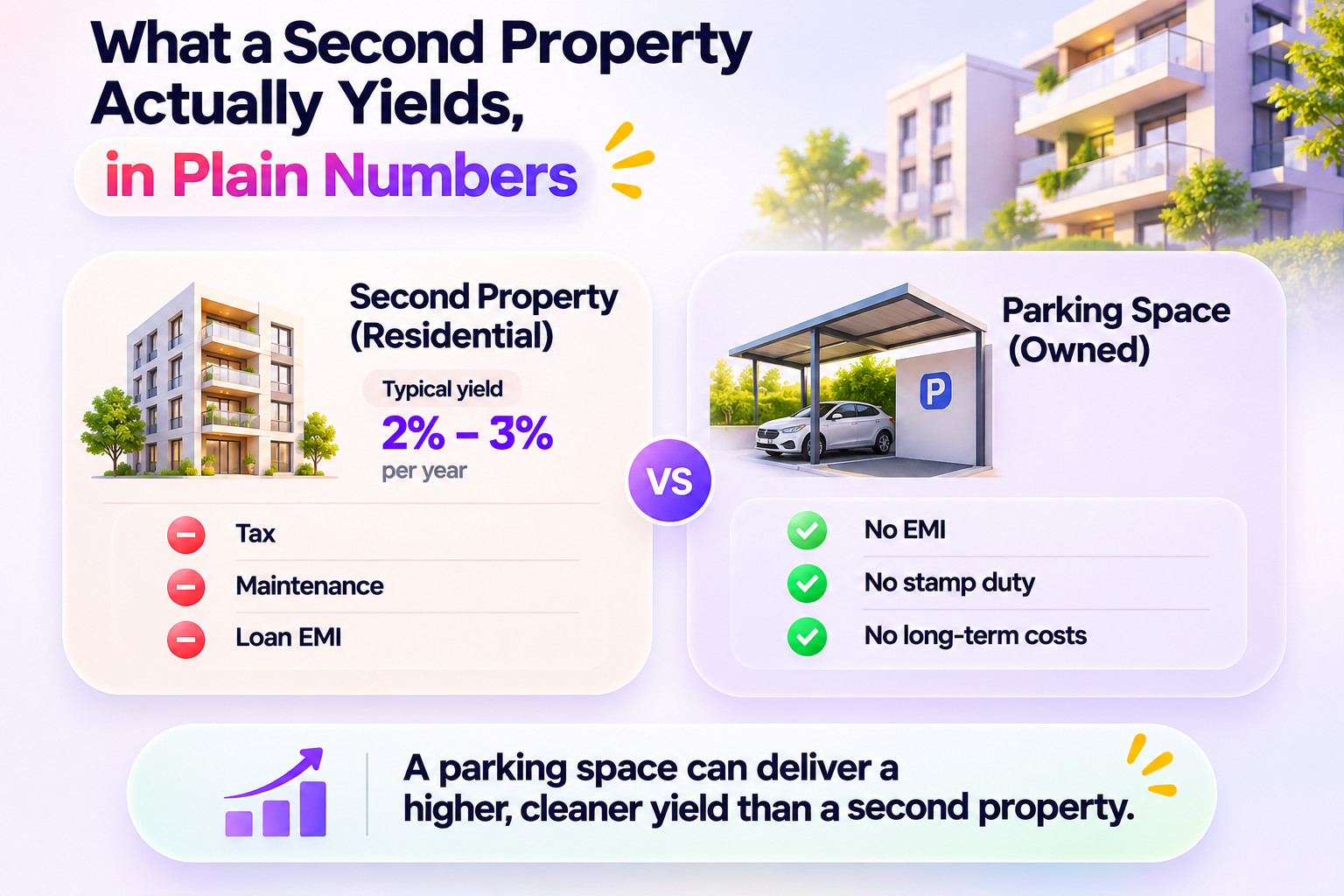
Rental yields on residential property in most Indian cities tend to sit in a narrow band, commonly cited by real estate analysts as somewhere between two and three percent of the property's market value per year. On a property worth seventy lakh rupees, that works out to roughly ₹11,000 to ₹17,000 a month in rent, before tax, maintenance, and the loan EMI are subtracted.
Subtract those, and the number that actually reaches your account most months is far thinner than the headline rent figure suggests.
Compare that to the yield math on an asset you already own outright: a parking space. There's no EMI to subtract, because there's no loan. There's no stamp duty eating into year one, because there's no new purchase. The capital is already spent, years ago, when you bought the flat it came with.
The Space You Already Own Is a Fundamentally Different Kind of Asset
This is the part most financial advice skips entirely. A second property is a new asset you're being asked to fund from scratch. A parking space is an asset you've already paid for, sitting idle, that costs nothing further to activate.
A stilt parking slot in an apartment complex, a basement bay, an open driveway, even a vacant plot earmarked for future construction, all of these fall into the same category: capital you've already committed, sitting unused.
Owners who've thought this through sometimes start with the most obvious space first. If you've ever wondered whether it's even worth the effort to rent out a driveway that mostly sits empty during work hours, the honest answer is that the effort is smaller than most people assume, and the income starts almost immediately.
Running the Comparison: Capital In, Money Out
Line up the two choices side by side and the contrast becomes clearer:
- Second property: capital required often runs into tens of lakhs, plus an ongoing loan commitment
- Parking space: capital required is ₹0, because you already own the space
- Second property: monthly cash flow typically arrives after loan EMI, tax, and maintenance are deducted
- Parking space: monthly cash flow is close to the full listed amount, since there's no financing cost to service
- Second property: a vacant month means a direct loss against the EMI still due
- Parking space: a vacant month simply means the spot earns nothing that month, with no debt ticking in the background
A parking space in a decent location in a metro city can realistically bring in anywhere from ₹2,000 to ₹10,000 or more a month, depending on the city, whether it's covered, and how consistently it's booked. That won't replace a second flat's rent in absolute terms. But measured against the capital an owner actually has at risk, the return profile looks completely different, because the capital at risk on the parking side is close to nothing.
Why This Comparison Matters More in 2026 Than It Did a Few Years Ago
Vehicle ownership in Indian metros hasn't slowed down, even as public parking infrastructure has barely kept pace. More two-wheelers, more electric vehicles that need a place to charge overnight, and more families owning two cars instead of one have all pushed up demand for private parking in exactly the kind of residential and commercial pockets where owners already have spare space.
At the same time, interest rates and construction costs have made a second property a heavier financial commitment than it was in 2015 or 2018. The idle-asset math that used to favour buying land now increasingly favours activating what's already yours.
This is also why owners researching one comparison tend to end up researching several. If you've already looked at how a government savings scheme like PPF stacks up against renting out a parking slot, or weighed it against a fixed deposit sitting at a flat, locked-in interest rate, the second-property question fits the same pattern: an asset that's genuinely useful, sitting next to one that's chronically under-used.
There's Also a Resale Angle Owners Often Miss
A second property is sometimes justified as a long-term appreciation play rather than a monthly income source. Fair enough, but the parking space you already own plays a role here too. Research into India's resale market has consistently found that a dedicated parking slot measurably affects what buyers are willing to pay for a flat, which means the asset isn't just earning you rent today, it's protecting the resale value of the property it belongs to.
Three Things Quietly Keeping Owners From Listing What They Already Have
If the math is this favourable, why do so many parking spaces across Indian cities sit empty? Usually it comes down to one of three assumptions, and none of them hold up well under scrutiny.
"It probably won't earn enough to bother with"
Owners often picture parking income as pocket change, a few hundred rupees here and there. In reality, a well-located spot booked consistently through the month can add up to a meaningful side income, and because it costs nothing to list, there's no downside to testing the actual number for your specific location.
"My society or RWA will never allow it"
Most housing societies have no blanket rule against an owner renting out a slot they already hold rights to, particularly for short stays or daily bookings rather than a long-term tenant. It's worth checking your society's actual bylaws rather than assuming the worst.
"It's too much hassle to manage"
This is the assumption doing the most damage, and it's also the easiest one to disprove. An unused parking space genuinely is quietly costing you money every month it sits idle, in the sense that it's an opportunity you're not capturing, and listing it takes a fraction of the effort owners expect going in.
What Listing Actually Looks Like, in Practice
The mechanics are simpler than the second-property comparison might suggest. Listing a parking space on RentParkings is completely free, with no listing fee, no commission deducted before you see your first booking, and no hidden charge buried in the fine print.
You decide the terms, not a platform algorithm and not a tenant's negotiating leverage. That includes:
- The price per hour, per day, or per month
- Whether you accept short bookings, long-term monthly renters, or both
- When the space is available, and when it's blocked off for your own use
Payments move through UPI or net banking, so there's no cash handling and no awkward collection conversation. Renters go through a verification step before a booking is confirmed, which is the same safeguard owners ask about most often when they're comparing this to the uncertainty of finding a flat tenant through word of mouth.
None of this requires construction, renovation, or a second loan. It requires listing a space you already own and letting it start earning while you decide, separately and on your own timeline, whether a second property still makes sense for you.
Frequently Asked Questions
1. Is listing my parking space on RentParkings actually free, or is there a catch?
It's free to list, full stop. There's no listing fee and no charge deducted before your first payout. The platform makes this intentionally simple because the entire point is removing the usual friction that stops owners from trying it.
2. How does the income from a parking space compare to rent from a second flat, in real terms?
A second flat typically brings in more in absolute rupees, but it also requires far more capital, debt, and ongoing cost to generate that rent. A parking space you already own earns on a far smaller base of risk, since there's no purchase price or loan behind it.
3. Do I need to spend money fixing up my parking space before I list it?
Usually not. Most owners list exactly as the space stands, whether that's an open driveway, a covered stilt slot, or a basement bay. Covered or well-lit spaces can command a bit more, but a basic, usable spot is enough to start.
4. Should I sell a second property I already own and put that money into parking instead?
That's a bigger decision than this article can answer for you, and it depends on your loan terms, tax position, and long-term goals. What's worth doing first is listing the parking space you already own, at zero cost, so you can see the actual numbers before making any decision about property you've already purchased.
5. Can I set my own rent, or does RentParkings decide the price?
You set it. Whether you want to rent by the hour, by the day, or by the month, the pricing and the terms are entirely yours to decide and change whenever you like.
6. Does renting out a parking space involve stamp duty, GST, or complicated registration?
No. There's no property transaction happening, so none of the costs associated with buying or selling real estate apply. Income earned may be subject to ordinary income tax reporting, the same as any other earning, but there's no stamp duty or registration involved.
7. Will my housing society object to me renting out my own parking slot?
Most societies have no rule against it when the slot belongs to your flat, especially for short or occasional bookings. It's sensible to glance at your society's bylaws, but outright bans are uncommon.
8. How do I actually receive the money?
Payments are made digitally through UPI or net banking directly to you, so there's no cash exchange and no delay chasing a tenant for rent.
9. What happens if I need the space back for my own car?
You control the calendar. You can block out dates in advance or pause the listing whenever you need the space, and resume it the moment you're free again.
10. Is this meant to replace real estate as an investment altogether?
Not necessarily. It's meant to be the thing you do first, before committing fresh capital to a new property, since it activates an asset you already own with no additional investment and no risk to anything else you hold.
The Smarter First Move Before You Sign Another Home Loan
Buying a second property isn't a mistake. For many Indian families it's still a reasonable long-term move. But it's a decision that deserves to be made with clear eyes, not as a default reflex because it's what everyone else seems to be doing.
Before that capital leaves your account, there's a simpler, reversible, zero-cost experiment worth running first: list the parking space you already own and see what it actually earns. If the number surprises you, it might change how urgently you need that second flat at all. If it doesn't change your plans, you've lost nothing and gained a bit of income along the way.
Either way, there's no reason that spot should keep sitting empty while you weigh your next big financial move. Start earning from the parking space you already own and find out what it's really worth before you spend a single rupee on a new one.
Share This post
Search
Recent Post
The Post Office Promises a Monthly Chequ...
02 Nov, 2026
Parking Space Listing Checklist India: 1...
30 Oct, 2026
Bengaluru's Draft Parking Rules Could Ma...
29 Oct, 2026

The Real Money Near India's Airports Isn...
28 Oct, 2026
Monsoon Season Quietly Changes What a Co...
27 Oct, 2026
Madurai's Temple Crowds Fill Every Hotel...
26 Oct, 2026
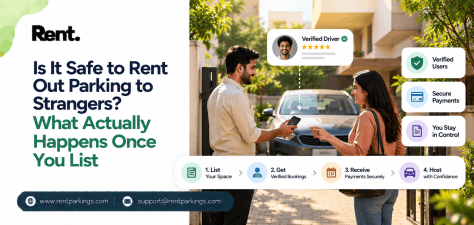
Is It Safe to Rent Out Parking to Strang...
23 Oct, 2026

Coimbatore's Cotton Mills Built the City...
22 Oct, 2026