

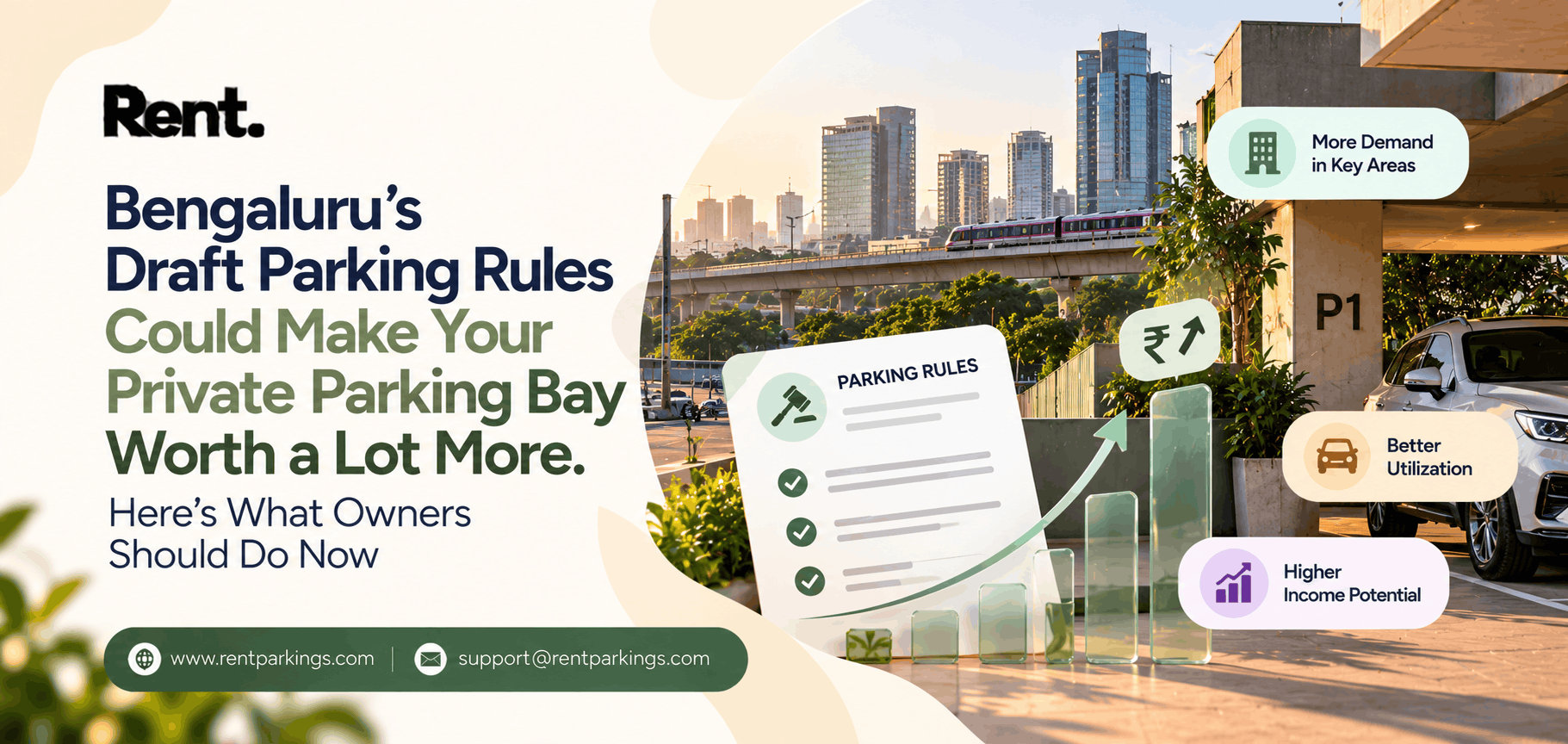
Bengaluru's Draft Parking Rules Could Make Your Private Parking Bay Worth a Lot More. Here's What Owners Should Do Now
Looking for parking, or got a space to rent out?
Search monthly and daily parking near you, or list your empty slot free.
The Lane Outside Your Gate
Walk down a side lane in Indiranagar, Koramangala or HSR Layout around nine at night and look at the kerb. Cars sit nose to tail on both sides, some doubled up, a few half on the footpath. On most residential lanes nobody pays a rupee for that space. It has simply always been free.
Meanwhile, behind a gate a few steps away, a perfectly good parking bay sits empty because its owner is out at work, travelling, or never bought a second car.
That mismatch is the quiet story behind Bengaluru's parking problem. Plenty of private space exists. It just is not connected to the people who need it. And the rules that decide how much free road space drivers get may be about to change, which would make that connection far more valuable.
This post explains what the proposed rules say, what is still undecided, and what an owner with a spare bay, garage or plot can sensibly do about it today. If a spare bay turns out to be worth listing, RentParkings is where that listing actually happens.
What the Draft Rules Actually Propose
In August 2026 the Karnataka government published the draft Greater Bengaluru Authority (Parking) Rules, 2026, meant to give legal force to the city's Parking Policy 2.0. Public comments were invited until the second week of September. Based on news reports and analysis of the draft, the main ideas are:
- Paid parking across the city rather than only on a few commercial roads, with the city split into zones and hourly charges that differ by zone. Reports mention rates in the tens of rupees an hour, and higher figures were mooted for the busiest areas.
- Residential parking permits for people who park on public roads outside their homes, with annual fees reported in the range of ₹15,000 to ₹25,000 depending on the vehicle type.
- Eligibility conditions, including that the permit is meant for residents of buildings that already meet the minimum parking required under building bye-laws.
- Stricter no-parking stretches, including peak-hour restrictions on major roads.
- Incentives for private owners who create or open up off-street parking, including vacant plot owners, with the government reportedly leaving fee-setting for private lots to the owners and drivers.
- Pressure on property owners to provide parking for tenants, with reports that vehicles left outside a property could become the owner's responsibility.
A word of caution that matters. These are proposals. They were open to objections, and the authority's own officials said the draft would go through more rounds of discussion. Some details also differ between news reports. Before you make any financial decision, check whether the final notified rules say the same thing.
Why This Matters Even if the Rules Change
Here is the practical point. Whatever the final version looks like, the direction of travel in Bengaluru is clear: free road space is getting scarcer, paid parking is spreading, and the city wants more parking to move off the street and onto private property.
Pay-and-park was already being rolled out on important roads in areas such as Jayanagar, HSR Layout, Koramangala and around Cubbon Park earlier this year, and central stretches like the Indiranagar 80 feet and 100 feet roads, Ejipura Main Road and Magrath Road have been lined up for paid parking.
When a habit that used to be free starts costing money, drivers do not stop owning cars. They start comparing options. A reliable private bay within walking distance of home or office suddenly looks like a sensible alternative to paying for a roadside patch that may be restricted at peak hours.
That is the opening for you.
Bengaluru also has a feature that makes private bays unusually relevant. The city grew outward in layers, so older neighbourhoods carry narrow lanes and buildings planned for far fewer vehicles than families own today, while newer corridors grew around offices and apartment towers. Bengaluru's Tech Parks Ran Out of Parking. So Companies Started Renting Land From Their Neighbours. looks at exactly this shift around the city's IT corridors, worth a read if your bay sits anywhere near one. The result is a patchwork where one street has spare bays and the next has none. Owners who understand their own lane, and who describe it honestly, are the ones who get the first bookings.
Who Is Most Likely to Look for a Private Bay
Think about the people who feel any change in street parking first:
- Residents of older buildings with fewer bays than vehicles, who have parked on the lane for years.
- Tenants and flatmates with a second car or a bike that the building never planned for.
- Office-goers in busy commercial pockets who currently circle for a free kerb.
- Weekend visitors to restaurant and pub streets, where valet and street space fill up fast.
- Small businesses with delivery vehicles that need a predictable overnight spot.
Neighbourhoods that have long reported packed lanes include Indiranagar, Koramangala, HSR Layout, Jayanagar, Malleshwaram and Kammanahalli. If your bay sits in or near a place like these, demand is likelier to find you.
Three Kinds of Bays, Three Kinds of Customers
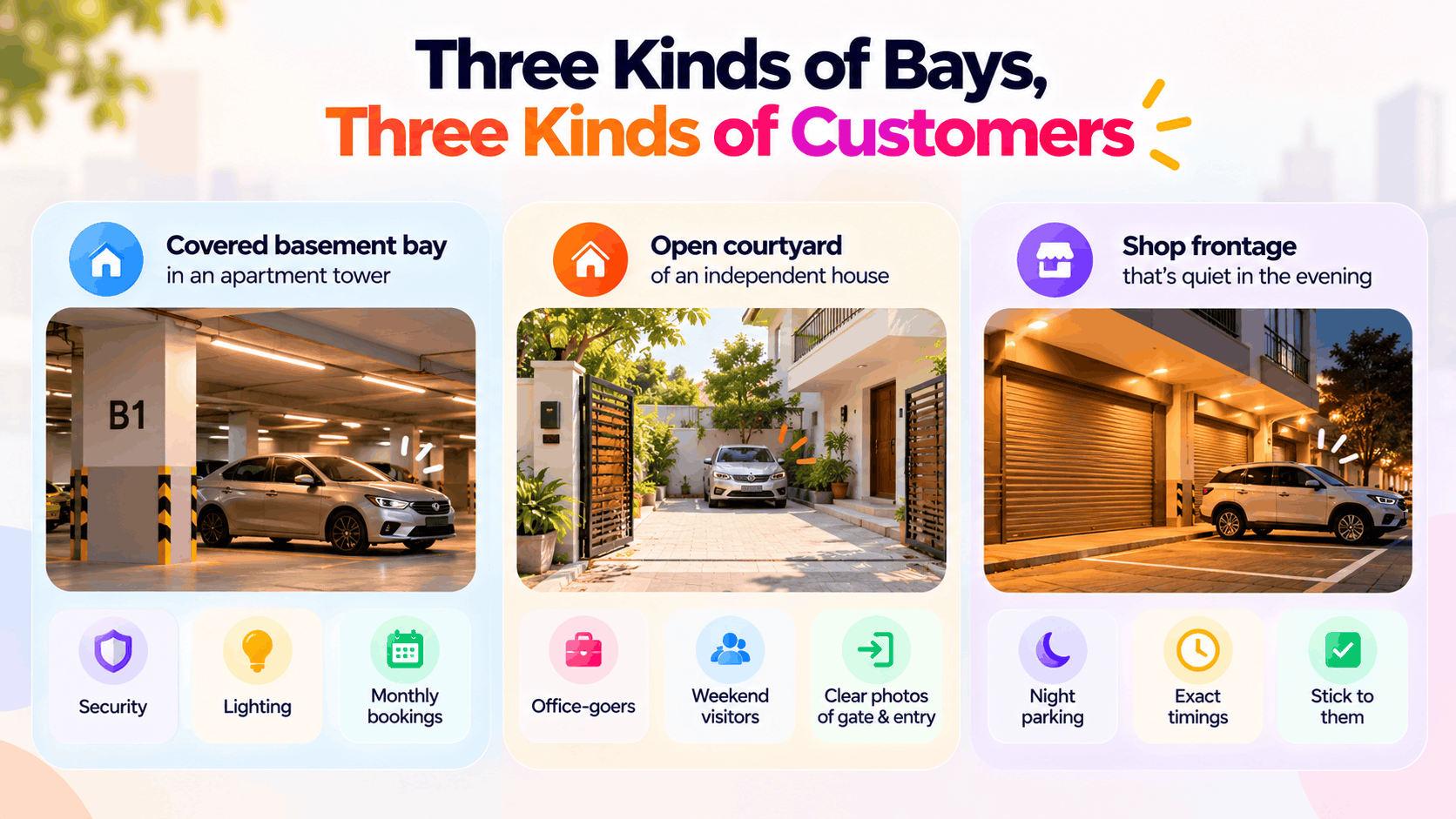
Not every bay attracts the same driver, so describe yours for the person it actually suits. These are illustrations, not promises.
The covered basement bay in an apartment tower. This one suits residents of older buildings nearby who want a roof during the monsoon and a guard overnight. Monthly bookings fit naturally, and your selling points are security and lighting, so mention both.
The open courtyard of an independent house. This one suits office-goers and weekend visitors who need a few hours at a time. Clear photographs of the gate and the approach lane matter most, because a driver has to trust the entry before they book.
The frontage of a small shop that goes quiet in the evening. This one works for night parking. Drivers arrive after the shutters come down and leave before they go up again, so exact timings are everything. Say them plainly and stick to them.
Do You Have Something Worth Listing?
A surprising number of Bengaluru owners do:
- an apartment owner with a second allotted bay that the family does not use
- an independent house owner with a front courtyard, a porch or a side setback
- a ground-floor garage that now stores boxes instead of a car
- a shop or small office whose frontage empties out in the evening
a vacant site that sits idle between construction plans
Be honest with yourself about which of these is truly yours to rent. That brings us to the part owners often skip.
Check Your Own Compliance Before You List
Do not rent out something your building actually needs. If the draft's logic holds, buildings that fail to provide the parking required under their approved plan may face consequences, and some reports mention fines for missing required parking. A bay that counts toward your building's mandatory parking is different from a genuinely surplus one.
So before you list:
- Look at your sanction plan or ask your builder or association which bays are required and which are surplus.
- If you live in an apartment, read your association's bye-laws and speak to the office-bearers about outside vehicles.
- If you are a tenant, ask your landlord in writing. A bay bundled with your rented flat is not automatically yours to sublet.
- For an independent property or a vacant site, ask a local consultant or an architect how the rules apply to commercial use of the space.
None of this is meant to scare you off. It is meant to make sure that the money you earn is not wiped out by a notice from your own association or the authority. Once that part is settled, Tax on Parking Rental Income in India: The 2026 Owner's Compliance Guide is worth a look too, since the rent itself will usually count as taxable income.
Own an empty parking space?
List it free on RentParkings and let drivers nearby find it. There is no listing fee.
Pricing a Bengaluru Bay Without Guessing
Pricing is where most first-time owners go wrong, so use a method rather than a mood. Nobody Taught You How to Price a Parking Space covers the general approach in more depth if you want the fuller version.
Anchor one: the cost of the alternative. If a road permit does end up costing ₹15,000 to ₹25,000 a year, that works out to about ₹1,250 to ₹2,100 a month for a patch of tarmac with no roof, no guard and no guarantee that it will not be restricted at peak hours. A private bay that offers more should be comfortable pricing around or above that ballpark, depending on the area. Treat this only as an anchor until the final numbers are known.
Anchor two: what nearby paid parking charges. Check the pay-and-park rates on the nearest main road and the rates at the closest mall, hospital or office basement. Drivers compare against these.
Anchor three: your own features. A roof, a watchman, CCTV, an easy turning radius, EV charging access and a short walk to the metro all justify a higher rate. A tight entry, a steep ramp or limited hours justify a lower one. There's a Wall Socket Next to Your Parking Spot. In 2026 India, That's Rentable Real Estate. breaks down how much extra an EV-ready bay can fetch, if that happens to be an option where you are.
Start fair, then adjust. Open slightly under the closest comparable option for the first few weeks, collect a few good reviews and raise your rate gradually.
Short stays suit commercial roads where drivers change daily. Monthly bookings suit residential lanes where neighbours need a permanent place. Offering both is fine.
What if the Final Rules Are Softer Than the Draft?
It is entirely possible. Public pushback on paying for kerb space outside your own gate has been loud, and the authority has said the draft will go through more discussion. If the final rules are gentler, street parking stays cheaper and fewer drivers will hunt urgently for a private bay.
Even then, the underlying pressure does not vanish. Dense neighbourhoods still have more vehicles than road, and enforcement against wrong parking keeps getting stricter. A good private bay stays useful in either case. The difference is only how quickly the first enquiry arrives. Since a listing costs little to publish and can be paused whenever you need the space, waiting for certainty is usually the more expensive choice.
Make the Listing Do the Work
Drivers skim. Give them specifics:
- the exact locality and nearest landmark or metro station
- covered or open, and which vehicles fit
- the hours you are free
- security details such as a gate, a guard or a camera
- three or four bright daytime photographs, including the approach and the bay itself
Compare these two descriptions:
"Parking available near Indiranagar, call me."
"Covered car bay on a gated lane, eight minutes on foot from the metro, watchman till 10 PM, fits hatchbacks and sedans, available 8 AM to 8 PM on weekdays."
The second answers a driver's questions before they ask. It also quietly filters out the wrong enquiries, which saves you time.
Keep It Safe and Simple
Letting a stranger park on your property needs a few habits, not a lot of fear. Who's Actually Parking in Your Space? The Question Holding Back Thousands of Indian Owners goes deeper into this if the idea of an unfamiliar car on your property makes you pause:
- note the vehicle number and a working phone number for every booking
- photograph the bay and nearby walls before a new driver starts
- share three or four house rules in advance, such as arrival hours and no vehicle servicing
- tell your watchman or association which vehicle to expect
- keep chats and payments on one platform so there is a clear record
Mistakes to Avoid in the First Month
- Listing a bay your building needs. Confirm it is truly surplus first.
- Copying a price from another city. Bengaluru pockets differ street by street, so price by your own lane.
- Dark, cropped photos. They make drivers assume something is hidden.
- Slow replies. Drivers message several owners at once, and the first helpful reply often wins.
- Forgetting the calendar. Double booking your own bay is the quickest way to lose a regular.
- Treating draft rules as final. Plan around the direction, not around one number.
What to Do This Week
- Confirm that the bay is yours to rent, and surplus to your building's requirement.
- Measure it and note what vehicles fit.
- Walk to the nearest pay-and-park road and write down the rates.
- Take photographs in daylight.
- List the bay, reply quickly, and review your price after a few weeks.
If the final rules turn out to be gentler than the draft, you have still lost nothing, because a listing costs little to publish and can be paused whenever you need the space back.
Frequently Asked Questions
1. Are the Bengaluru parking rules final?
Not as far as published reports show. The draft Greater Bengaluru Authority (Parking) Rules, 2026 were opened for public objections. Check the government notification for the final version before you plan around any specific fee or restriction.
2. Can I rent out the parking bay allotted to my apartment in Bengaluru?
Often yes, if the bay is legally yours and surplus to your building's required parking. Your association's bye-laws and sanction plan decide the details, so confirm with the office-bearers or your builder first.
3. How much can I charge for a parking bay in Bengaluru?
There is no fixed figure. Compare nearby pay-and-park rates, mall and office basement charges, and your own features such as cover and security. Start slightly below the closest option, then raise the price as reviews arrive.
4. Will paid residential parking permits increase demand for private bays?
It may, because drivers who lose free kerb space will compare alternatives. Nothing is guaranteed, and demand depends on your locality and price. A private bay with security and cover tends to appeal more than open roadside space.
5. Do I need to pay tax on parking rent in Bengaluru?
Parking rent can be taxable income, and some situations may involve GST depending on how the space is let and the amounts involved. Speak to a chartered accountant before the first payment so you plan correctly.
6. Can I rent a vacant plot in Bengaluru as parking?
Possibly, and the draft rules reportedly encourage it with incentives. However, land use, permissions and local rules apply, so check with the authority or a qualified consultant before you let anyone park on the site.
7. What if I need my bay back later?
You control the days and hours you offer, and you can block dates or pause the listing. State your availability clearly from the start, and give any regular driver reasonable notice before changing it.
8. Which Bengaluru areas usually have the toughest parking?
Reports frequently mention Indiranagar, Koramangala, HSR Layout, Jayanagar, Malleshwaram and Kammanahalli, along with commercial roads and restaurant streets. If your bay is in or near these areas, demand may be steadier.
Your Empty Bay May Matter More Tomorrow Than It Does Today
You do not need to wait for a final notification to find out whether your bay has takers. You need a photograph, an honest description and ten minutes. List your parking space on RentParkings, where listing is free at the moment, and let Bengaluru's drivers find you.
Share This post
Search
Recent Post
Parking vs a Second Property: Which Idle...
04 Nov, 2026
The Post Office Promises a Monthly Chequ...
02 Nov, 2026
Parking Space Listing Checklist India: 1...
30 Oct, 2026

The Real Money Near India's Airports Isn...
28 Oct, 2026
Monsoon Season Quietly Changes What a Co...
27 Oct, 2026
Madurai's Temple Crowds Fill Every Hotel...
26 Oct, 2026
Is It Safe to Rent Out Parking to Strang...
23 Oct, 2026

Coimbatore's Cotton Mills Built the City...
22 Oct, 2026