

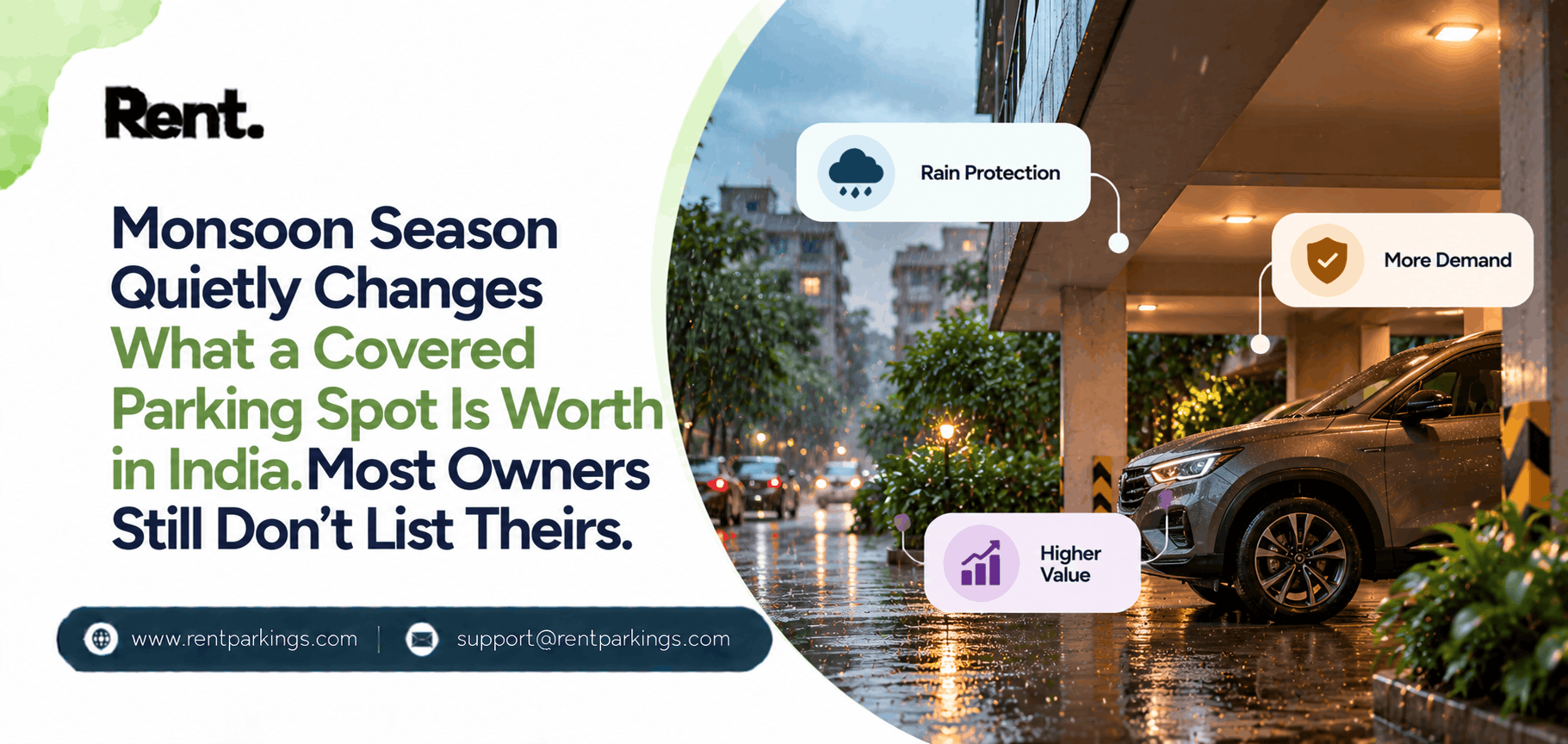
Monsoon Season Quietly Changes What a Covered Parking Spot Is Worth in India. Most Owners Still Don't List Theirs.
Looking for parking, or got a space to rent out?
Search monthly and daily parking near you, or list your empty slot free.
Every June, something shifts in the parking economy of Indian cities, and almost nobody renting out a garage, basement or covered shed seems to notice it happening.
The moment the first heavy spell hits Mumbai, Chennai or Kolkata, an uncovered patch of tar that was perfectly fine in March suddenly isn't good enough for anyone who cares about their car's upholstery, a scooter's electricals, or a delivery van's cargo staying dry. A roof over a parking space stops being a nice-to-have. For three or four months, it becomes the single thing a driver is actively hunting for and willing to pay more to get.
If you own any kind of sheltered parking in India, a basement bay, a stilt-level slot, a tin-shed carport, an underground or multi-level building space, this is the window where that asset is worth noticeably more than it is the rest of the year. Most owners who could be earning from it are still letting it sit empty, mostly because nobody ever told them the rains change the math. RentParkings exists largely to close that gap between owners who have unused covered space and renters who suddenly, urgently, need it.
Why a Roof Suddenly Matters So Much
Open-air parking works fine for eight months of the year in most of India. Then the monsoon arrives and changes the calculation for three separate groups of people at once.
Car owners start worrying about waterlogged wheel wells, rust creeping into the underbody, and the slow damage that comes from a vehicle sitting in standing water overnight. Two-wheeler owners have it worse: a scooter or bike left out in continuous rain for a season can develop electrical faults that cost far more to fix than a season of covered parking would have cost to rent. And anyone running deliveries, moving stock, or storing goods in a vehicle overnight needs the cargo to stay dry, not just the vehicle.
None of this is new information to the people searching for a dry spot. What's new is that, in most neighbourhoods, there's still no organised way for them to find one. They end up negotiating with a building watchman, parking two streets away and walking the rest in the rain, or simply risking it. A listed, covered space solves a problem that's already there every single monsoon, it just hasn't had a proper marketplace until recently.
What Actually Counts as "Covered" Here
Owners tend to assume this only applies to a proper closed garage. It's broader than that. Any of the following qualifies as covered parking that's worth more between June and September:
- A basement or semi-basement bay in an apartment building
- A stilt-level slot under a residential tower
- A corrugated-sheet or tin-roofed carport attached to an independent house
- An underground parking level in a commercial or mixed-use building
- A multi-level parking bay inside an office or retail complex
- Even a deep verandah or porch that keeps direct rain off a vehicle, if it's wide enough
If any of these describe a space you own and aren't using daily, the economics of listing it just got better for roughly a third of the year. A detailed look at what garage and basement space earns through a full calendar year, not just during the rains, is worth reading if you haven't already: Your Garage Hasn't Parked a Car in Months. It Could Be Paying Your EMI Instead.
How Much More Can You Actually Charge
Owners who've listed covered space through a monsoon season tell us the uplift varies by city and by how badly that particular street floods, but a pattern shows up again and again. Hourly and daily rates on covered spots near waterlogging-prone roads, busy markets, hospitals and transit points have reportedly moved up anywhere from a fifth to about half again what the same spot fetched in the dry months, with monthly covered-parking arrangements near flood-prone commercial stretches commanding the steadiest premium of all.
None of this is guaranteed, and nobody should list a space expecting a fixed number. What is fairly consistent is the direction: demand for a dry spot goes up before supply does, and that gap is exactly where an owner sets their own terms rather than accepting whatever a tenant offers. On RentParkings, you decide the hourly, daily or monthly rate yourself, and you can change it the week the rains start without asking anyone's permission.
Who's Actually Looking for a Dry Spot
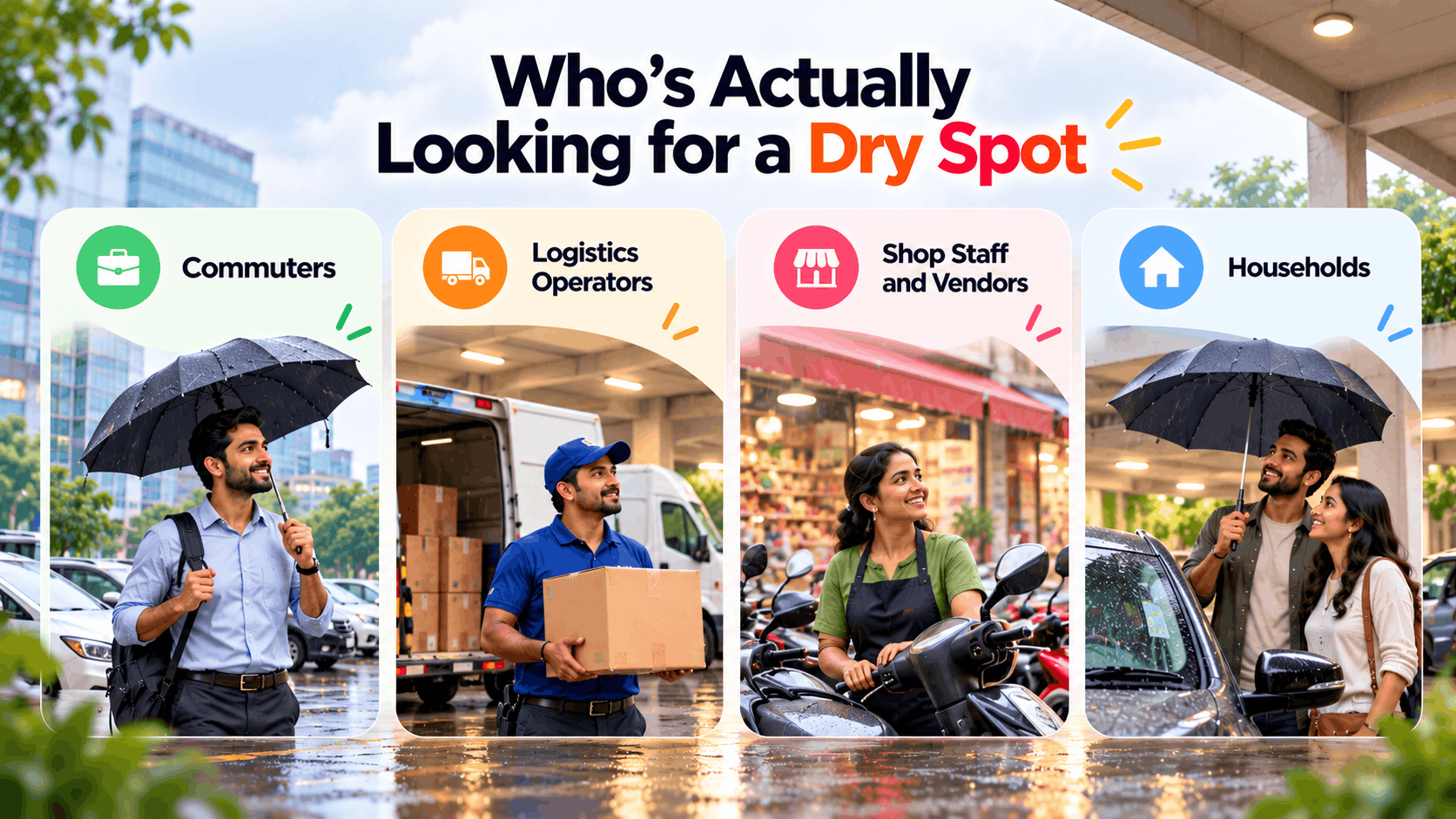
It helps to know who you're pricing for. Four groups show up consistently during a wet season.
Commuters who normally park on the street near their office start hunting for something sheltered the moment the first flooded underpass makes the news. Coworking spaces in particular have packed more vehicles into neighbourhoods that were never built for that density, and monsoon only sharpens a problem that was already brewing, as covered in The Coworking Boom Built India a New Parking Problem Nobody Is Talking About.
Small logistics operators and last-mile delivery fleets are another group that leans hard on covered parking during the rains, since a soaked cardboard shipment is a write-off in a way a soaked car usually isn't. The broader supply gap that trucking and warehouse operations run into across Indian cities, rain or no rain, is laid out in India's E-Commerce Boom Built a Trillion-Rupee Warehouse Industry. Nobody Built Parking For Its Trucks., and monsoon only tightens that squeeze further.
Shop staff and vendors near wholesale and retail markets form a third group, since they're often parking two-wheelers for a full working day in weather that would otherwise ruin them. And ordinary households with an extra vehicle, a parent's car, a second scooter, start looking for covered space the first week it rains hard enough to make the usual spot unusable.
Own an empty parking space?
List it free on RentParkings and let drivers nearby find it. There is no listing fee.
The Streets Where This Shows Up First
Demand for covered parking doesn't rise evenly across a city. It concentrates around the stretches that flood first and the places people can't simply skip visiting because of weather.
Local markets and weekend bazaars are a reliable early indicator. These already run on tight, chaotic parking even in dry weather, and once the lanes start holding water, two-wheeler owners and shoppers alike will pay for a dry spot within walking distance rather than wade in. That underlying squeeze, rain or not, is covered in Local Market and Bazaar Parking in India: The Weekend Chaos Shop Owners Are Quietly Profiting From (2026).
Low-lying residential lanes, areas near drains and culverts, and roads that sit close to a river or lake typically see the sharpest jump in covered-parking demand, simply because the alternative is a vehicle sitting in ankle-deep water by evening. If your covered space happens to sit even slightly uphill from a street that floods every year, you already have an advantage that's worth mentioning in your listing description.
Getting Listed Before the First Heavy Spell
None of this requires planning months in advance. A listing on RentParkings takes a few minutes to put up, costs nothing to create, and can go live the same afternoon you decide to try it.
A few things are worth doing before the rains properly set in:
- Mention explicitly in your listing that the space is covered, and describe what kind of covering it is (concrete roof, tin shed, basement, stilt level)
- Set an hourly or daily rate that reflects the season, and revisit it once or twice through June and July as you see what bookings actually come in
- Add a monthly option if your space is in a flood-prone or market-adjacent lane, since that's where longer-term demand tends to land
- Note your exact location relative to any nearby flooding point, since that detail is often what tips a renter toward your listing over another one
Owners who already run a seasonal listing strategy for other high-demand windows, like the run-up to Diwali and Navratri covered in Festive Season Is Coming: Why Now Is the Best Time to List Your Empty Parking Space in India, will recognise the pattern here. Monsoon is simply a second, longer window where timing the listing matters as much as the space itself.
What Changes Once the Rains Stop
Nothing about this commits you to anything permanent. Once October rolls around and the roads dry out, you're free to lower your rate back to a normal level, switch from hourly to monthly, pause the listing entirely for a while, or simply leave it running at whatever price the market will still bear. The listing is yours to edit, pause or restart whenever your own situation changes, whether that's needing the space back for a visiting relative's car or deciding the income isn't worth the booking traffic anymore.
That flexibility is really the whole point. A covered parking space doesn't ask you to sign away control of it for a season or a year. It asks you to set a price, a schedule, and a few basic terms, then lets you change your mind whenever the weather, or your own plans, do.
Frequently Asked Questions
1. Does listing covered parking on RentParkings cost anything?
No. Creating a listing is completely free, for the monsoon season or any other time of year. There's no sign-up fee, no listing fee, and nothing deducted before you've actually earned something from a booking.
2. How much extra should I charge during the rains?
There's no fixed formula, but owners near flood-prone roads or markets commonly raise hourly and daily rates somewhat above their dry-season price. You set the number, and you're free to adjust it mid-season if bookings tell you the price is too low or too high.
3. My garage isn't fully enclosed, just a tin roof over a slab. Does that still count as covered?
Yes. Anything that keeps direct rainfall off a parked vehicle, a tin shed, a concrete overhang, a deep verandah, qualifies. Just describe the covering honestly in your listing so renters know exactly what they're getting.
4. Do I have to commit to renting it out for the whole monsoon?
No. You can list for a single day, a week, or the full season, and you can pause or remove the listing whenever you want. Nothing locks you into a fixed period.
5. What if I need the space back in the middle of the rains, say a relative is visiting with their car?
You stay in control of the listing at all times. You can pause bookings, block out specific dates, or end an existing rental arrangement according to the terms you set when you listed it.
6. How do I know who's actually going to park there?
RentParkings runs a verification step on renters before a booking is confirmed, so you're not simply handing a stranger your gate code with no information about who they are.
7. Will monsoon bookings affect how I price the space the rest of the year?
Not unless you want them to. Plenty of owners run a higher monsoon rate and then return to their usual pricing once the season ends. The two are entirely separate decisions.
8. Is there a minimum size or type of space RentParkings accepts?
Any genuine parking space works, from a single two-wheeler bay to a multi-car basement. What matters more during monsoon is accurately describing whether and how it's covered.
9. How does payment actually reach me?
Renters pay through the app, and the money is transferred to your bank account or UPI handle on the schedule tied to your booking type, whether that's per hour, per day or per month.
10. Is my covered spot even in demand if I'm not near a flood-prone main road?
Often yes. Even side lanes and residential blocks see a jump in two-wheeler owners and small-vehicle owners looking for shelter once the rain settles in for the season. It's worth listing and watching the response before assuming there's no demand nearby.
The Window Is Short. That's What Makes It Worth Acting On
A covered parking space doesn't suddenly become valuable because of anything you did to it. The value was always sitting there, waiting for three or four wet months to make it obvious. Most owners let that window pass every single year because listing never crossed their mind, or because they assumed renting out parking meant giving up control of the space for good.
It doesn't. You list for free, you set the price and the terms, and you decide how long the arrangement runs. The sooner you get a covered space listed, the sooner it starts earning instead of just sitting there waiting out the rain. List Your Covered Parking Space on RentParkings Before the Rains Peak.
Share This post
Search
Recent Post
Parking vs a Second Property: Which Idle...
04 Nov, 2026
The Post Office Promises a Monthly Chequ...
02 Nov, 2026
Parking Space Listing Checklist India: 1...
30 Oct, 2026

Bengaluru's Draft Parking Rules Could Ma...
29 Oct, 2026

The Real Money Near India's Airports Isn...
28 Oct, 2026

Madurai's Temple Crowds Fill Every Hotel...
26 Oct, 2026

Is It Safe to Rent Out Parking to Strang...
23 Oct, 2026

Coimbatore's Cotton Mills Built the City...
22 Oct, 2026