

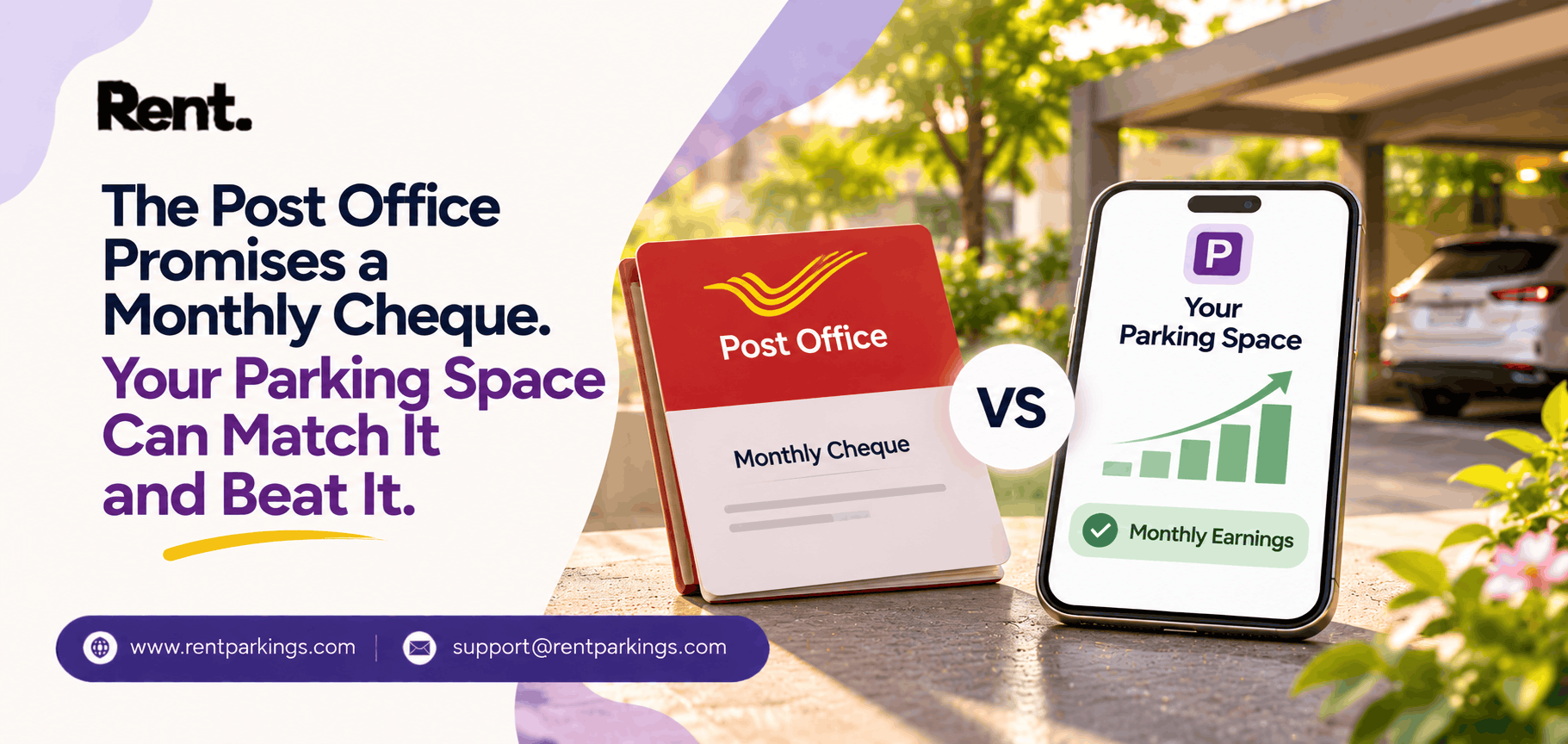
The Post Office Promises a Monthly Cheque. Your Parking Space Can Match It and Beat It.
Ready to Earn a Monthly Income From Your Empty Parking Space?
Skip the post office queue. List your space free on RentParkings and start earning rent every month.
Walk into any post office in a mid-sized Indian town on the first working day of the month and you will see the same crowd. Retired schoolteachers, bank pensioners, widows running a household on a fixed budget, all collecting the interest their Monthly Income Scheme deposit just generated.
It is a comforting ritual. Fixed amount, fixed date, government-backed. No surprises.
But here is a question almost nobody in that queue has ever asked themselves: is the parking space outside their own gate doing anything close to that for them? For most owners, the honest answer is no. It sits there unused, worth exactly nothing until someone backs a car into it.
That is the gap this piece wants to close. Not by telling anyone to abandon a scheme that has served Indian households well for decades, but by placing it next to an asset many owners already have and rarely think of as income: a parking spot that can be listed, at no cost at all, on RentParkings, India's own parking marketplace.
What the Post Office Monthly Income Scheme Actually Pays You
The Post Office Monthly Income Scheme, usually shortened to POMIS, works in a simple way. You deposit a lump sum, up to roughly ₹9 lakh in a single account or ₹15 lakh jointly, and the post office pays a fixed monthly interest amount for five years.
The rate is set by the government and revised every quarter. It has held close to 7.4% for a while now, which on a ₹9 lakh deposit works out to a monthly payout somewhere around ₹5,500, give or take a little depending on when the account was opened.
That is a real number, and for someone who wants zero decisions to make once the account is open, it is genuinely useful. The capital stays locked away for five years. The payout does not move. Expenses can rise and the cheque stays exactly the same size.
Where a Parking Space Starts Pulling Ahead
A parking space runs on a completely different logic, and once the difference is laid out plainly, the comparison stops feeling like a stretch.
Start with the money needed to get in. POMIS asks for a lump sum before it pays anything back. A parking space already sitting on your property asks for nothing new. The driveway, the covered slot, the basement bay, whatever form it takes, the capital was spent long ago when the property itself was bought.
Then there is the rate itself. POMIS fixes a number and holds it there for five years, whatever happens to demand in your neighbourhood. A parking space does not work that way. A new office complex opening two streets over, or a banquet hall booking out most weekends in season, can push the going rate for nearby parking higher, and nothing stops an owner from charging accordingly.
This is the part that tends to surprise people once they actually try it, as a related Empty Parking Space Side Hustle India piece lays out in more detail. The space itself was never the limiting factor. The limiting factor was that nobody had ever listed it anywhere a renter could actually find it.
Three Things POMIS Simply Cannot Offer
The Capital Stays Yours
With POMIS, the deposit is out of reach for five years, returned only at maturity. A parking space has no comparable principal locked away at all. The asset stays fully owned, fully sellable, and instantly reclaimable the moment it is needed for anything else, all while it earns quietly in the background.
You Set the Price. The Scheme Sets Its Own.
Nobody rings up the post office to negotiate a slightly better payout. The rate is the rate, decided elsewhere. A parking listing works the opposite way. The owner decides what a quick stop costs by the hour, what a full day runs to, and what a steady monthly tenant pays for the same bay, and any of it can change whenever conditions do.
There Is No Five-Year Commitment
Withdraw from POMIS early and part of the interest is forfeited as a penalty. Take a parking listing down because a relative is staying over for a fortnight, or because the flat is being sold, and nothing is lost in the process. Pausing or removing a listing is the whole transaction.
"But Parking Income Isn't Guaranteed Like POMIS Is." Fair Enough.
This is the one objection worth taking seriously rather than waving away. POMIS pays out whether or not anyone ever needs a parking spot that month. A parking listing earns only once somebody actually books it.
That much is true, and pretending otherwise would not help anyone. What changes the picture is location. A spot near a hospital, for one, rarely sits quiet for long, which is close to the steady pattern described in RentParkings' own Parking Near Hospitals in India: Why It's a Daily Struggle for Patients — and a Quiet Income Opportunity for Property Owners Nearby piece. A spot near a crowded market, a coaching hub, or a residential lane with no visitor parking behaves in much the same way.
Even a fairly ordinary location, booked on and off through a typical month, tends to settle somewhere between a modest sum and a genuinely useful one, and unlike POMIS, that number has room to grow as regular renters start treating the listing as their default spot.
What This Looks Like Across Different Kinds of Space
Not every owner is sitting on the same kind of asset, so the comparison plays out a little differently depending on what is actually available.
- A driveway or open yard: usually the simplest to list, often priced for quick hourly or daily bookings from visitors and delivery vehicles passing through.
- A covered or stilt bay inside an apartment complex: frequently the most sought after, since covered parking shields a car from sun and monsoon rain in a way an open spot cannot.
- A basement or garage bay: suits a longer monthly arrangement with one regular tenant, closer in feel to the steady, predictable rhythm of a POMIS payout.
- A vacant plot near a construction site or industrial stretch: can earn surprisingly well from trucks and site vehicles that otherwise have nowhere official to stop.
- A commercial building's parking bays after office hours: fills a gap most owners never think to price, since the space sits empty for twelve hours every evening and across weekends.
Plenty of owners hold more than one kind of space, say a flat with a covered bay alongside a family plot with open ground, and list both at once, much the way the Apartment Owners Profiting from India's Parking Crisis piece describes a few owners doing already. There is no rule limiting anyone to a single spot.
Add a power socket near the bay and the same space can pull in a little extra from EV owners too, a detail explored further in There's a Wall Socket Next to Your Parking Spot. In 2026 India, That's Rentable Real Estate.
Listing Costs Nothing. That Changes the Arithmetic Completely.
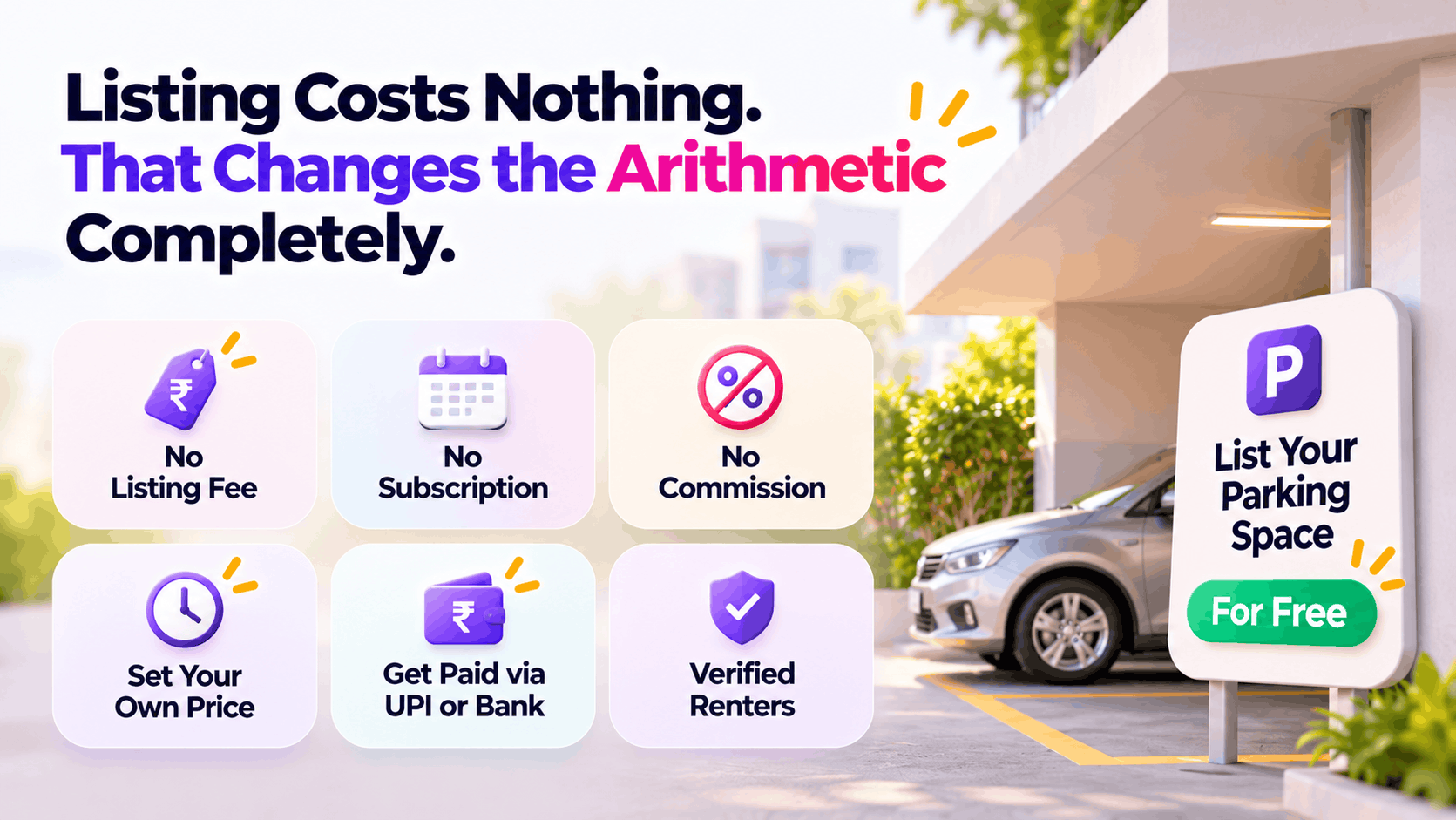
Here is where the comparison stops being close at all. Opening a POMIS account costs the entire deposit upfront before a single rupee of interest shows up. Listing a parking space on RentParkings costs nothing, now or at any later point.
There is no listing fee charged to appear on the platform, no subscription billed every month, and no slice taken out of what an owner earns. A listing goes up, a price gets set for hourly, daily, or monthly bookings, and none of that carries a cost.
Payouts land through UPI or a direct bank transfer once a booking is confirmed, and every renter passes through the platform's own verification step before a booking goes through, so handing over a gate code to a complete unknown is not really what is happening here.
Seasonal Spikes a Fixed Scheme Can Never Offer
A POMIS payout looks the same in a quiet month and a packed one. A listed parking space is not bound by that ceiling.
During weddings, festivals, and local events, demand for parking near the venue climbs sharply, and owners who already have a listing live are the ones who benefit, the exact pattern walked through in a RentParkings piece on Rent your parking on the big days: the quiet way Indians are earning from empty spots. A fixed-income scheme has no mechanism for catching that kind of temporary surge. A listed space catches it automatically, every time one comes around.
Getting Started Takes Less Effort Than Opening the POMIS Account Did
Opening a POMIS account meant a trip to the post office, paperwork, a KYC check, and a lump sum ready to hand over on the spot. Listing a parking space asks for a fraction of that effort.
- Create a free account on RentParkings and add the space, with a few photos and a short description of what is on offer.
- Choose a price for hourly, daily, or monthly bookings, along with the hours the space is actually free to use.
- Review booking requests as they arrive, with each renter's identity confirmed through the platform first.
- Get paid once a booking wraps up, and adjust the price or pause the listing the moment plans change.
None of that calls for construction, fresh investment, or giving up control of the property. It simply puts an asset that was already sitting idle in front of people who are actively searching for exactly what is on offer.
Frequently Asked Questions
1. Is it really free to list a parking space on RentParkings?
Yes, completely. RentParkings does not charge to create a listing, does not take a cut for showing it to renters, and never will. The only figures involved are the ones an owner chooses to charge.
2. How does parking income compare to POMIS if the money might be needed back quickly?
POMIS locks a deposit away for five years, and pulling it out early forfeits part of the interest. A parking listing carries no lock-in whatsoever. It can be paused or removed the moment plans change, since the property behind it was never tied up to begin with.
3. Does a parking space need to be booked every single day to be worth listing?
Not at all. Even a handful of bookings a month on a reasonably located spot adds up meaningfully across a year, and many owners start with occasional weekend or event-day bookings before a steadier monthly tenant comes along.
4. Who actually decides how much to charge?
The owner does, entirely. Unlike a bank or post office scheme with a fixed rate set elsewhere, RentParkings lets owners choose their own hourly, daily, and monthly prices, and change them whenever local demand shifts.
5. Is income from renting out a parking space taxable in India?
Generally yes, rental income of this kind is usually taxable and should be declared under the applicable head, though the exact treatment depends on an owner's overall financial situation. Checking with a tax professional for a specific case is wiser than assuming one blanket rule covers everyone.
6. What happens if nobody books a new listing for a few weeks?
That can happen early on, often before word spreads locally or pricing settles at a level the neighbourhood will actually pay. Tweaking the price slightly or improving the listing's photos and description tends to help far more than simply waiting it out.
7. Is it safe to let strangers park in a driveway or basement?
RentParkings runs every renter through a verification step before a booking is confirmed, which rules out a complete stranger simply turning up unannounced. Most owners also keep the same basic precautions in place that they would for any visitor to the property.
8. Can a parking space be listed if it is not technically owned outright, like one allotted to a flat?
Generally, only whoever holds legal rights to the space, whether as the outright owner or as someone with documented allotment rights, should be the one listing it. Checking the sale deed or the society's own records first helps settle any doubt before going ahead.
9. Will listing a parking space cause a problem with the housing society?
Most societies have no real objection to an owner renting out their own allotted bay, though some simply prefer to be informed as a courtesy. A short conversation with the RWA beforehand is worth having wherever the society tends to be particular about who comes through the gate.
10. How is this different from a private arrangement with a neighbour who needs parking?
A private arrangement works right up until it does not, usually once payment turns inconsistent or nobody is quite sure who is actually meant to be parking there. Listing through RentParkings keeps a clear record of who booked, what was agreed, and when, something a casual verbal deal rarely manages.
The Spot Outside Has Been Waiting Longer Than Five Years
A POMIS deposit is not a poor choice, and nothing here argues that it is. It simply is not the only idle asset sitting in an Indian household, and it is rarely the one asking for the least effort relative to what it could bring in.
The parking space outside the gate, under the building, or on that extra plot nobody quite knows what to do with, has been sitting there far longer than any five-year scheme requires. Start Earning from Your Parking Space on RentParkings today, set a price that makes sense, and let it finally earn its keep instead of just taking up room.
Share This post
Search
Recent Post
Parking vs a Second Property: Which Idle...
04 Nov, 2026

Parking Space Listing Checklist India: 1...
30 Oct, 2026

Bengaluru's Draft Parking Rules Could Ma...
29 Oct, 2026

The Real Money Near India's Airports Isn...
28 Oct, 2026

Monsoon Season Quietly Changes What a Co...
27 Oct, 2026

Madurai's Temple Crowds Fill Every Hotel...
26 Oct, 2026

Is It Safe to Rent Out Parking to Strang...
23 Oct, 2026

Coimbatore's Cotton Mills Built the City...
22 Oct, 2026