

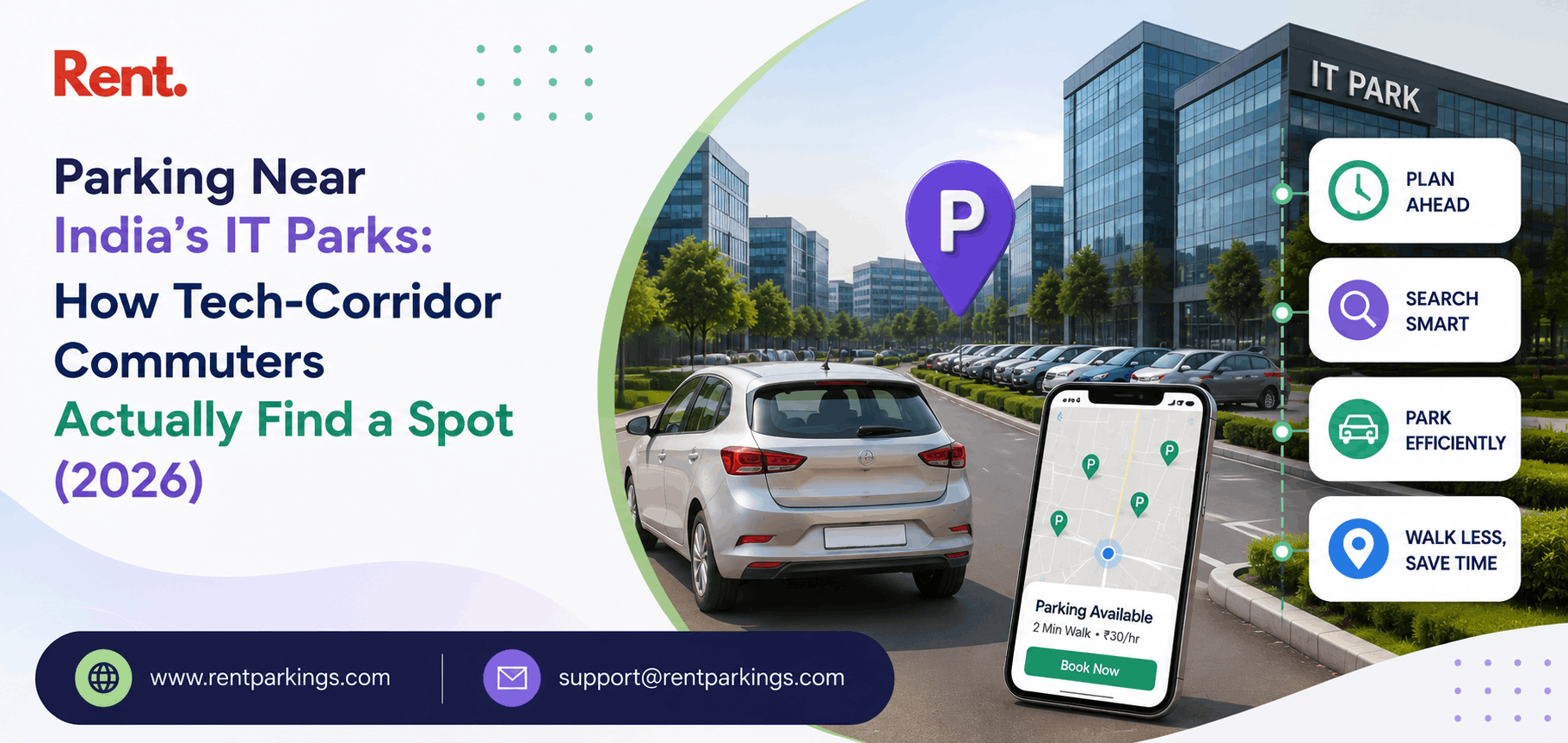
Parking Near India's IT Parks: How Tech-Corridor Commuters Actually Find a Spot (2026)
Ask anyone who works on Bengaluru's Outer Ring Road what the hardest part of their day is, and a good number will not say the code review or the client call. They will say the twenty minutes they spent circling Bellandur at 9:40 a.m. looking for somewhere to leave the car. India built its tech corridors for jobs and glass towers. It did not build them for the two-wheelers and cars those jobs would arrive in.
This is the quiet, daily grind of the Indian IT commute: not the famous traffic jams that make the news, but the last-mile hunt for a parking spot within walking distance of the office gate. It repeats every working morning across the ORR, Chennai's OMR, Gurugram's Cyber City, Hyderabad's HITEC City, Pune's Hinjewadi and a dozen smaller hubs, and it is getting tighter, not easier.
This guide is the practical playbook nobody hands you on day one. It explains why the crunch exists, the real options employees use to solve it, and corridor-by-corridor tips. And if you happen to live or run a shop right next to one of these hubs, your empty daytime spot, listed free on RentParkings, is exactly what a stressed commuter two lanes away is searching for.
Why Parking Near IT Parks Is So Hard in the First Place
The shortage is not bad luck. It is arithmetic.
Office space grew faster than parking ever could
Take the Outer Ring Road as the clearest example. The corridor already carries around 60 million square feet of commercial and IT office space and is projected to head toward 100 million. The firms clustered there, the SAP Labs, Ciscos, Intels and Wipros of Bellandur and beyond, generate close to a third of Bengaluru's entire IT revenue. But the roads, the building setbacks, and the basement levels were designed for a fraction of today's headcount. When a single tower can hold ten thousand employees and offer a few thousand bays, the maths simply does not close.
Not everyone can take the metro, yet
Tech corridors are precisely the places where public transport arrived late. HITEC City finally has good metro connectivity; the ORR's metro line is still filling in; OMR and Hinjewadi commuters have spent years dependent on the road. Until the last-mile network is dense, a large share of employees will keep arriving on two and four wheels, and each of those needs somewhere to sit for nine hours.
The office pass is a lottery
Inside most IT parks, reserved parking is rationed. Senior staff and car-poolers get passes; everyone else is on a waitlist or a first-come scramble that rewards the 8:30 arrival and punishes the 10:00 one. New joiners, contractors, and consultants routinely get no allocation at all.
The policy squeeze is now official
Back in 2025, traffic police in Bengaluru formally pushed ORR tech parks toward a pay-and-park model, explicitly to take private vehicles off the congested corridor. Whatever your view of that, the direction of travel is clear: free, unlimited, take-it-for-granted office parking is ending. Corridors across India are nudging employees toward pooling, public transport and, for those who still must drive, paid or off-site parking.
Put together, these forces mean the reliable solution is rarely "the office lot." It is a plan you build for yourself.
The Real Options Commuters Use
Here is what actually works on the ground, roughly in order of reliability for someone who reports to the same desk every day.
1. A monthly reserved spot within walking distance
The single most dependable answer is a fixed monthly spot you know is yours, a short walk from the gate. These almost never come from the office, they come from the neighbourhood around it. Every tech corridor is ringed by residential layouts, independent houses, and small commercial buildings whose parking sits empty from 9 to 6 while the owners are at work or their driveway is unused. Bellandur, Kaikondrahalli and Marathahalli around the ORR; Thoraipakkam and Perungudi along OMR; the sectors behind Cyber City; the lanes off Madhapur and Gachibowli near HITEC City, all of them have this hidden supply.
A monthly arrangement turns the daily hunt into a non-event. You pay a fixed amount, you have a guaranteed bay, and you stop gambling on arrival time. This is where a platform matters: instead of asking watchmen and hoping, you can search listed monthly spots near your office on RentParkings and lock one in, and listing such a spot is free for the resident on the other side of the deal, which is what keeps supply coming.
2. Park-and-ride at the nearest metro or transit node
Where the metro reaches the corridor, the smartest move is often to not drive the last stretch at all. Park the car or scooter at a station a few stops out, where a spot is cheaper and easier, and ride in. HITEC City and Cyber City commuters increasingly do this; ORR employees do it from whichever line is closest to their home side. It trades a short train ride for the daily parking war, and usually wins.
3. Two-wheeler-first thinking
A scooter or bike needs a fraction of the space of a car and slips into gaps a sedan cannot. In the densest corridors, employees who switch to two wheels for the commute, or keep one specifically for office days, often solve their parking problem outright. Two-wheeler bays fill up too, but the odds are far better, and a monthly two-wheeler spot near the gate costs a fraction of a car bay.
4. Nearby malls, hotels and commercial complexes
Many corridors have a mall or business hotel within walking distance that sells monthly or day parking. It is not glamorous, and it can be pricier, but a covered, secured bay you can rely on beats forty minutes of circling. Worth pricing against a private monthly spot before you commit.
5. Company shuttles and pooling
The option employers keep pushing, and for good reason. If your office runs shuttles from residential clusters or metro stations, using them removes your car from the equation entirely. Pooling with three colleagues turns four parking problems into one, and increasingly earns you priority for whatever office bays remain.
A Corridor-by-Corridor Snapshot
The broad tactics are the same everywhere, but each hub has its own texture.
Bengaluru, Outer Ring Road (Bellandur, Marathahalli, Whitefield)
The toughest of them all, and the one under the most active policy pressure. With office space heading toward 100 million sq ft and pay-and-park now on the table, assume office parking will get scarcer and costlier. The winning play here is a monthly spot in the residential pockets just off the ORR (Kaikondrahalli, Devarabisanahalli, the layouts behind Whitefield's parks), combined with metro or shuttle for the days you can leave the car home.
Chennai, OMR (Thoraipakkam, Perungudi, Sholinganallur)
The IT Expressway is long and linear, which means parking pain is concentrated at the big campus clusters. Residential streets run close to the service road for much of its length, so a monthly spot a lane or two inside is very achievable. Two-wheelers dominate here, and a reserved bike spot near the gate is often the cleanest fix.
Gurugram, Cyber City and Cyber Hub
Dense, premium, and busy well into the evening because of Cyber Hub's restaurants. Office and mall parking exists but fills fast and can be expensive. Commuters lean on the metro and on monthly spots in the surrounding sectors. If you stay for the after-work crowd, a guaranteed bay is worth far more than the hourly saving.
Hyderabad, HITEC City and Gachibowli
Helped by solid metro connectivity, which makes park-and-ride genuinely practical. Even so, the Madhapur-Gachibowli core is packed on weekdays. Monthly spots in the residential lanes off the main roads are the standard workaround for those who still drive.
Pune, Hinjewadi (Phases 1, 2, 3)
Famous for its commute more than its parking, but the two are linked, the longer the jam, the more people want a car, and the more the bays overflow. With limited rail access, Hinjewadi runs on private vehicles, so off-campus monthly spots and company buses do the heavy lifting.
Tier-2 hubs, Coimbatore, Kochi, Indore, Jaipur, Chandigarh
Smaller IT parks with a real advantage: the residential fabric is right next door and far less monetised. A polite arrangement for a neighbour's driveway, or a listed monthly spot, solves the problem cheaply, often before the crunch these cities' growing parks are heading toward arrives in full.
What the Daily Parking Hunt Actually Costs You
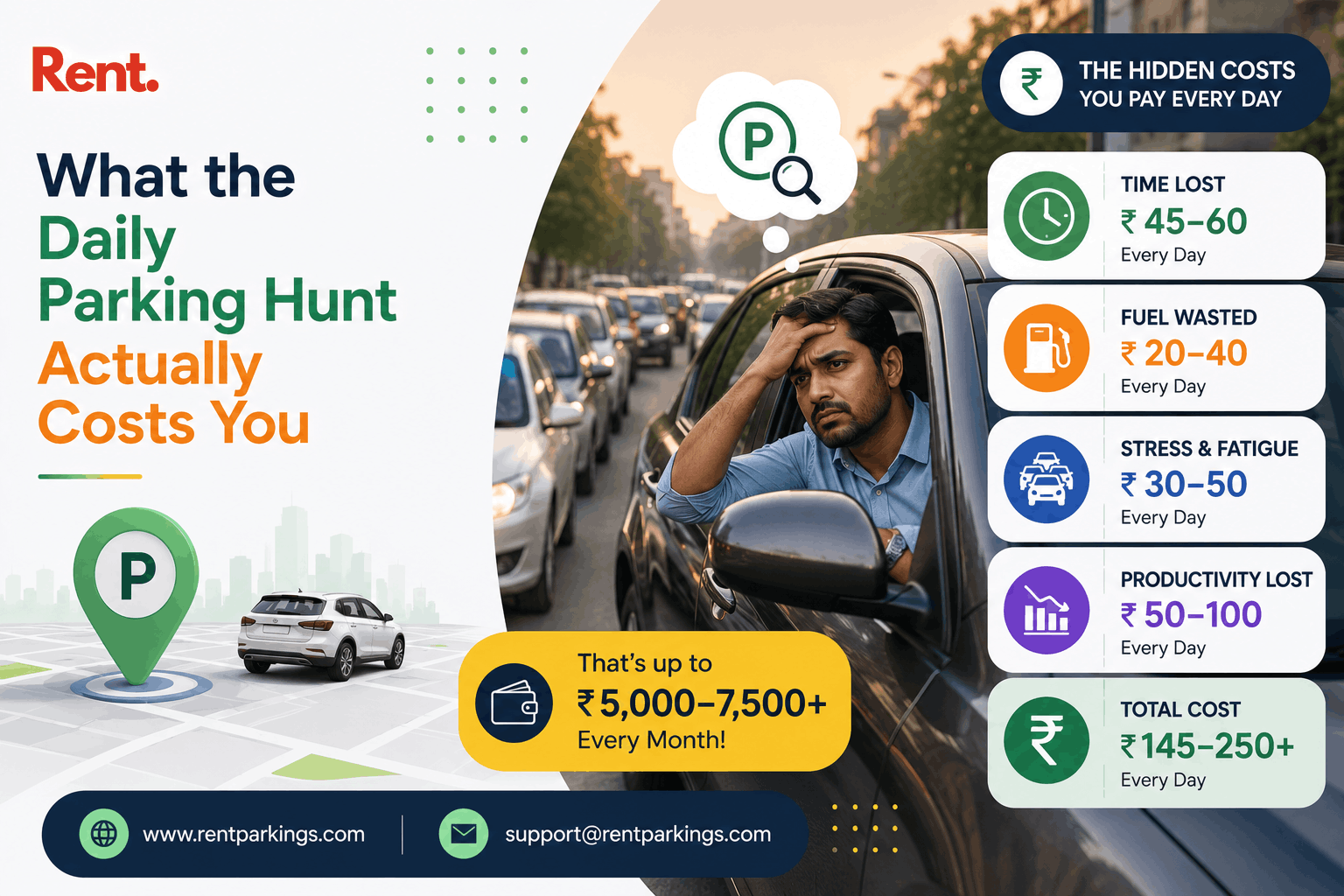
It is easy to shrug off the parking scramble as a minor annoyance. It is not minor, and adding up the real cost is what pushes most people to finally fix it.
Start with time. Fifteen to twenty-five minutes of circling every morning, plus the walk back from wherever you finally squeezed in, is close to an hour a day lost to nothing. Over a working month that is roughly twenty hours, most of a working week, spent looking at other people's bumpers. No promotion, no salary hike, just returned mornings.
Then the money you do not see. Idling and crawling in first gear burns fuel with almost no distance covered, and it is the harshest kind of wear on a clutch and engine. On a corridor where you might do this twice a day, the running cost of "free" office-area parking quietly exceeds what a reserved monthly spot would have cost in the first place.
Add the stress. Starting the day already tense, watching the clock as a stand-up meeting ticks closer while you hunt for a gap, is a bad way to walk into work, and an even worse way to walk out to a car you parked half-legally, wondering if it has been towed or clamped. That low-grade anxiety compounds over months.
And finally the risk. A car left in a hurried, unofficial spot, half on a footpath, in an unlit stretch, blocking a gate, is exposed to towing, fines, scrapes from passing traffic and, occasionally, worse. A known, reserved bay removes that whole category of worry. When you weigh a monthly spot, you are not just buying space; you are buying back time, fuel, calm and a lower chance of an unpleasant surprise at 7 p.m.
Night Shifts, Odd Hours and Weekend Work
The standard parking advice assumes a 9-to-6 day, but a huge share of India's tech and support workforce does not work those hours. Support desks, operations centres and teams serving overseas clients run late evenings, night shifts and rotational weeks, and parking behaves very differently for them.
The good news is that off-peak arrivals face a far emptier corridor. If your shift starts at 2 p.m. or 10 p.m., the morning scramble is simply not your problem, and even office bays may be available. The catch is the other end: security, lighting and safe access matter enormously when you are walking to your vehicle at midnight or 5 a.m. A spot that is fine in daylight can feel very different on an empty, poorly lit lane after a night shift.
For odd-hours workers, two things are worth prioritising. First, a well-lit, secured spot close to the gate is worth paying a premium for, this is not where you economise. Second, confirm access timing explicitly: a private monthly spot or a mall lot that closes its barriers at 11 p.m. is useless to a night-shift employee, so match the spot's available hours to your actual shift before committing. A resident's driveway can be perfect here precisely because it is available around the clock, but agree the terms clearly up front.
Weekend workers get the easiest deal of all, corridors are quiet on Saturdays and Sundays, and the same residential spots that are contested on weekday mornings often sit completely free.
A Practical Checklist for the Commuter
If you are starting a new job on a corridor, or your office just tightened its parking policy, work through this once and you will rarely think about parking again:
- Decide your vehicle honestly. If a two-wheeler covers your commute, it will nearly always solve parking too.
- Map the walk, not the drive. A guaranteed spot eight minutes away beats a maybe-spot at the gate. Measure options by walking time.
- Lock a monthly arrangement before you need it. Search listed spots near your office and reserve one; do not wait for a bad Monday to start looking.
- Check the metro math. If a station is within a stop or two of home, park-and-ride may beat driving the whole way.
- Confirm timing and access. Match the spot's available hours to your shift, especially for late or rotational shifts, and confirm gate or key access.
- Keep a backup. Note one mall or paid lot within walking distance for the days your usual plan falls through.
Living or Working Beside a Tech Corridor? Your Empty Spot Is the Solution
Here is the part most people near these hubs never think about. If you live in a layout off the ORR, own a house on a lane near OMR, or run a shop a short walk from Cyber City, you very likely have a parking spot that sits empty for the exact nine hours a nearby commuter is desperate for one. Your car is out during the day. Your second bay is unused on weekdays. The strip in front of your shutter is idle until evening.
That idle spot is genuinely valuable to someone working two hundred metres away, and matching the two is straightforward. You can list your spot free on RentParkings, describe when it is available and what fits (car or two-wheeler), and let a commuter who needs a reliable daytime bay find it. Free listing is the point: it costs the resident nothing to make the spot visible, which is why corridors slowly build the off-campus supply that official lots never manage to. You solve a stranger's daily headache, your unused space stops being unused, and the corridor gets a little less clogged with circling cars.
It is the same idea from both sides of this article. The commuter's hardest problem and the resident's most overlooked asset are the same few square metres, they just need to find each other.
Conclusion
The parking crunch around India's IT parks is not a temporary glitch that a new flyover will fix. It is structural: office space and headcount have outrun parking supply, public transport is still catching up, and cities like Bengaluru are actively steering employees away from free, unlimited office bays. Waiting for the office lot to sort itself out is the one strategy guaranteed to fail.
The commuters who stop stressing about parking are the ones who take control of it, choosing the right vehicle, measuring options by walking time, using park-and-ride where the metro allows and, above all, locking in a reliable monthly spot in the neighbourhood just off the corridor rather than gambling at the gate each morning. That neighbourhood supply exists precisely because thousands of residents and shopkeepers next to these hubs have spots sitting empty all day. Listing one on RentParkings is free, finding one is quick, and between them they turn the worst part of the tech commute into a solved problem. On a corridor where every minute counts, that is time, and sanity, handed straight back to you.
FAQs
Why is parking so difficult near IT parks in India?
Office space and employee numbers have grown far faster than parking supply. A single tower can hold thousands of workers but only a few hundred bays, public transport reached many corridors late, and cities like Bengaluru are now pushing tech parks toward paid parking to cut congestion. The result is a daily shortage at the gate.
Where can I find monthly parking near my office on the ORR or OMR?
The most reliable spots are in the residential lanes just off the corridor, layouts around Bellandur and Marathahalli near the ORR, or Thoraipakkam and Perungudi along OMR, where driveways and second bays sit empty on weekdays. You can search listed monthly spots near your office on RentParkings and reserve one instead of hunting on foot.
Is park-and-ride a good option for tech corridors?
Yes, wherever the metro reaches the corridor. Parking at a station a few stops from the hub is usually cheaper and easier than driving the last stretch, and it skips the daily parking war entirely. HITEC City and Cyber City commuters use this heavily, and it is expanding on the ORR.
Is it easier to park a two-wheeler than a car near IT parks?
Much easier. A scooter or bike needs a fraction of the space, fits into gaps a car cannot, and a monthly two-wheeler spot near the gate costs far less. For many corridor employees, switching to two wheels for the commute solves the parking problem outright.
Are IT parks in Bengaluru really moving to paid parking?
In 2025 Bengaluru traffic police asked ORR tech parks to adopt a pay-and-park model to reduce private-vehicle congestion. The broader trend across corridors is away from free, unlimited office parking, so it is wise to plan for paid or off-site options.
How much walking distance is reasonable for a reserved parking spot?
A guaranteed spot within roughly a five-to-ten-minute walk is ideal and almost always beats an uncertain bay right at the gate. Measure your options by walking time rather than driving distance, since the last hundred metres of circling is what wastes your morning.
Can I use nearby mall or hotel parking for my office commute?
Often yes. Many corridors have a mall or business hotel within walking distance that sells monthly or daily parking. It can cost more, but a covered, secured, guaranteed bay is frequently worth it compared with circling for a free spot.
I live near an IT park, can I let a commuter use my empty daytime spot?
Yes, and it is one of the most useful things an idle spot can do. If your bay or driveway is empty while you are at work, a nearby commuter needs exactly that. You can list it free on RentParkings, set your available hours, and let someone working close by book it.
Is it free to list my parking spot on RentParkings?
Yes. Listing a parking spot on RentParkings is free, you add the location, availability and what vehicle fits, and commuters searching near that corridor can find and book it. Free listing is what keeps off-campus parking supply growing around busy hubs.
What is the single best way to stop stressing about IT-park parking?
Lock in a reliable monthly spot near your office before you need it, ideally combined with metro or a shuttle for days you can leave the car at home. Turning parking from a daily gamble into a fixed arrangement removes the problem from your morning for good.
Share This post
Search
Recent Post
What Happens When You Need Your Parking...
01 Sep, 2026
How Listing Your Parking Space in India...
31 Aug, 2026
Parking Space vs Gold: The Idle Asset Th...
28 Aug, 2026
Your Garage Hasn't Parked a Car in Month...
26 Aug, 2026
Someone Dents a Car in Your Rented Parki...
25 Aug, 2026
Your Vacant Plot Is Not Free to Own: How...
24 Aug, 2026
Coaching Centre Parking in India: Why Ko...
21 Aug, 2026
India's PG and Co-Living Boom Has a Park...
20 Aug, 2026