

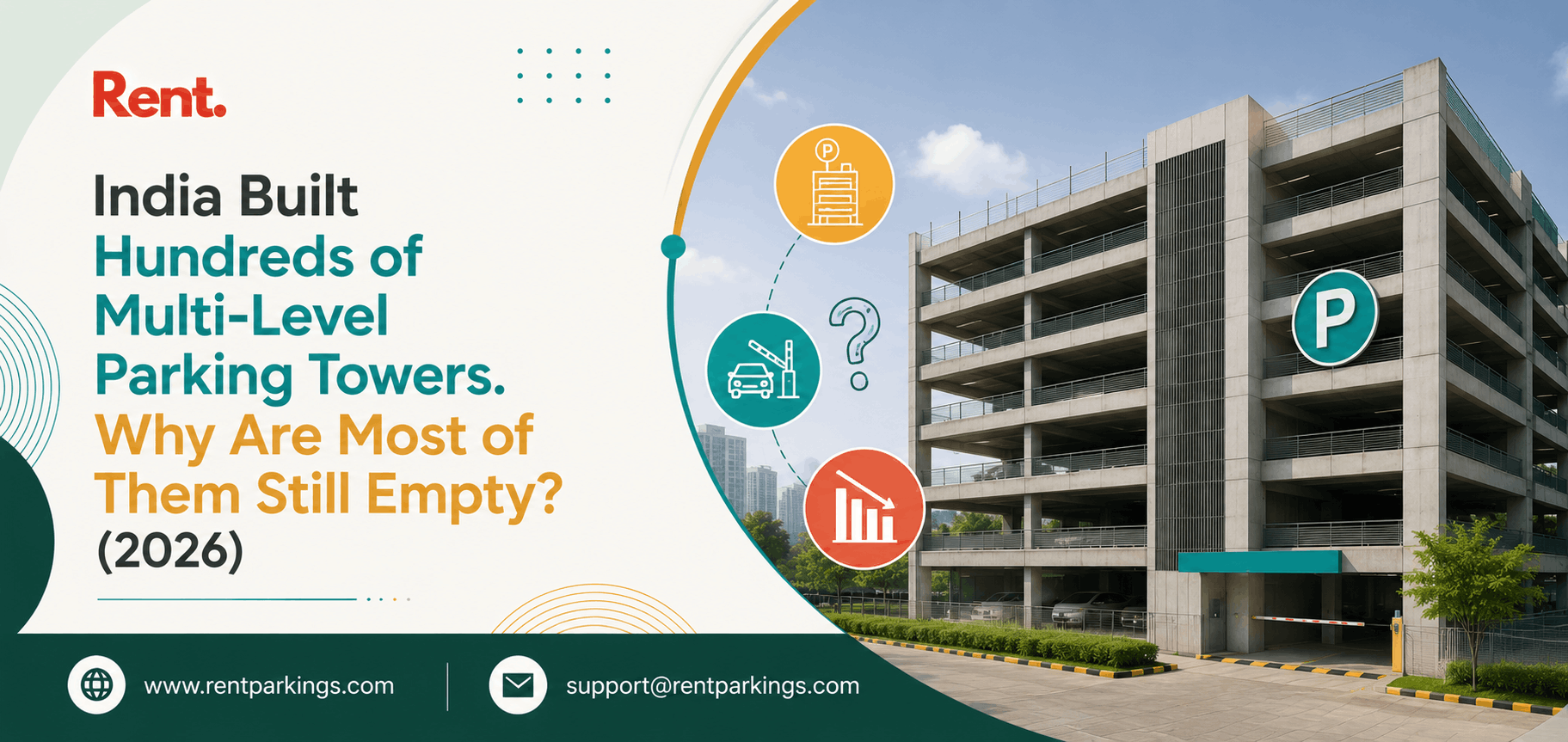
India Built Hundreds of Multi-Level Parking Towers. Why Are Most of Them Still Empty?
Stand outside almost any newly built multi-level parking structure in an Indian city on a weekday afternoon and you'll see two things at once: a gleaming, multi-storey concrete or steel tower designed to hold hundreds of cars, and a street right outside it lined bumper-to-bumper with vehicles parked illegally on the road. The tower has spare floors. The street has none. This isn't a one-off — it's close to the national pattern, and it's one of the more visible, least discussed failures in how Indian cities have tried to solve parking with capital rather than design.
This piece isn't about parking rules or fines — it's about the buildings themselves: how much India has spent on multi-level and automated parking, why so much of that capacity sits unused, and which cities are quietly figuring out how to change that in 2026.
The Big Build-Out: How Much India Has Actually Spent
Multi-level car parking has become one of the default answers Indian municipal corporations reach for when a commercial district or old city core runs out of surface parking. Under the Smart Cities Mission, AMRUT, and direct municipal budgets, well over a hundred of India's Smart Cities have funded projects that include automated or multi-level parking components, and the sums involved are substantial. Delhi's Municipal Corporation alone has proposed nine additional multi-level parking facilities at a combined cost of roughly ₹775 crore, and individual facilities in cities like Ahmedabad, Bhopal, and Chandigarh have each run ₹50–100 crore to build. Nationally, the broader parking systems market in India — spanning automated, semi-automated, and manual multi-level infrastructure — was valued at roughly ₹5,800 crore (about USD 700 million) in 2025, with fully automated systems now accounting for roughly 60% of that market, reflecting how strongly cities have shifted toward mechanised, space-saving designs as urban land has become scarcer and more expensive.
The logic behind the spending is sound on paper. A single hectare of land in a dense Indian commercial district can be worth more than most municipal budgets for an entire ward; stacking parking vertically, six, eight, or twelve levels high, lets a city create hundreds of parking spaces on a footprint that would otherwise hold perhaps thirty cars at surface level. On land-cost economics alone, multi-level parking is often the only mathematically sensible way to add meaningful parking capacity in a city centre.
The Land Economics Behind Going Vertical
To understand why cities keep choosing this expensive, complicated solution despite the occupancy numbers, it helps to look at the raw arithmetic that planners are working with. A surface parking lot in a dense Indian city centre typically needs around 23–25 square metres per car once driving aisles and turning space are accounted for. In a commercial district where land itself might be valued at several lakh rupees per square metre, that surface footprint represents an enormous amount of locked-up real estate value for a single parked car. A multi-level structure on the same footprint, by contrast, can hold six, eight, or more cars per level across multiple floors, meaning the effective land cost per parking space drops sharply even after accounting for the extra construction cost of the structure itself.
This is precisely why municipal corporations keep approving these projects even in cities where existing facilities are underused: the per-space land economics of vertical parking are genuinely better than surface parking almost everywhere land is scarce, which is most Indian city centres. The problem was never the underlying math. It's that land economics on a planner's spreadsheet and a driver's five-minute decision about where to park are two completely different calculations, and cities have consistently solved for the first while underestimating the second.
The Occupancy Paradox: Empty Towers, Jammed Streets
The gap between that logic and what actually happens is stark. A recent study on India's urban parking infrastructure found that costly, purpose-built parking buildings sit largely empty while the surrounding streets remain jammed with parked vehicles — a pattern documented across multiple cities rather than being an isolated local failure. In Delhi, occupancy across several municipal multi-level facilities hovers around 30–40%. Bengaluru's multi-level parking structures average close to 30% utilisation. Similar underuse has been reported in Pune, Chennai, and Ahmedabad, even in areas where street-level parking is visibly overflowing just metres away.
Why people skip the tower and park on the street anyway
A handful of practical, unglamorous reasons keep repeating across cities:
Distance from the actual destination. Many multi-level facilities were sited on whatever municipal land was available and cheap, rather than directly adjacent to the shopping street, market, or office cluster people are actually visiting. A five-to-ten-minute walk from a parking tower to a destination sounds minor on a map, but against a "park directly outside the shop" habit built over decades, it's often enough to tip the decision toward the street.
Entry, exit, and turning geometry. Several older multi-level facilities were designed around compact hatchbacks and sedans that dominated Indian roads a decade ago. As SUVs and larger MPVs have become a much bigger share of new car sales, many existing ramps, turning radii, and automated lift-and-pallet bays simply can't accommodate the height, wheelbase, or turning circle of newer vehicles, quietly locking out a growing share of the vehicle fleet.
Pricing that doesn't compete with "free." Even modest per-hour or per-visit charges struggle to compete with roadside parking that is technically illegal but functionally free and unenforced in many areas. Without either meaningfully priced street parking or genuinely low-friction tower pricing, drivers default to whichever option costs nothing and takes less effort, regardless of legality.
Poor visibility and way-finding. Many facilities simply aren't obvious from the street they serve — signage is inconsistent, and unlike an open surface lot, a driver can't tell from the road whether an eight-storey tower has three empty floors or is completely full, so many don't bother checking.
Habit and awareness. In neighbourhoods where a multi-level facility is relatively new, a large share of regular visitors simply formed their parking habits before it existed and never revisited the decision, especially if their first experience finding the entrance or navigating the ramps was confusing.
When the Technology Itself Undermines Trust
Occupancy isn't only a design and behaviour problem — in a few high-profile cases, it's been a reliability problem that made the news and dented public confidence in automated parking as a category.
Coimbatore's RS Puram multi-level parking facility, commissioned in 2022 at a cost of over ₹40 crore with capacity for 380 cars, remained effectively non-operational for nearly three years because of repeated hydraulic lift failures, with only two of its floors made partially usable again after major repairs completed in December 2025. For most of its existence, a ₹40-crore facility built specifically to relieve parking pressure in a busy commercial neighbourhood simply couldn't be used.
Delhi's Green Park facility, unveiled in November 2020 as one of the city's first fully automated parking towers at a cost of roughly ₹18.2 crore, suffered a mechanical failure in November 2021 when several parking platforms in one of its towers collapsed, damaging vehicles and leaving others trapped inside the structure. Incidents like this don't need to repeat often to leave a lasting impression — a single widely reported failure of an automated system is often enough to make nearby residents default back to manual, surface-level, or roadside parking out of simple caution, even after a facility is repaired and back in service.
The lesson from both cases isn't that automated parking technology doesn't work — robotic and mechanised systems operate reliably at scale in plenty of Indian facilities. It's that maintenance budgets, quality control during construction, and ongoing technical servicing matter just as much as the initial capital spend, and cities that treat automated parking as a one-time construction project rather than a long-term mechanical asset are the ones most likely to end up with an expensive, idle structure.
Which Cities Are Getting It Right
A few cities offer a genuinely useful counter-example. In January 2026, the Chandigarh Municipal Corporation launched "MC One Pass," a unified digital monthly pass valid across every civic-body-managed parking site in the city, covering both surface lots and multi-level facilities under one system. Rather than treating each parking structure as an isolated facility a driver has to separately discover, register for, and pay at, Chandigarh's model removes the friction of navigating multiple systems and makes any of the city's parking assets, tower or surface, equally easy to use. That kind of unification directly addresses two of the biggest reasons towers sit empty: awareness and friction.
Pune has taken a different but complementary route on the technology side. Locally developed automated systems from Pune-based manufacturers, including tower and robotic parking equipment built for roughly a 20-year operating life with comparatively low maintenance requirements, have helped the city and neighbouring Bhopal add parking capacity for several hundred thousand vehicles through smart parking projects, suggesting that domestically engineered systems built for Indian conditions — dust, power fluctuations, heat — can outperform imported designs not built with those stresses in mind.
Bengaluru, Hyderabad, Chennai, and Coimbatore, despite the RS Puram setback, remain the country's most active zone for new parking-system deployment, with IoT-enabled sensors and app-based real-time availability checks increasingly bundled into new projects, letting a driver see from their phone whether a nearby tower actually has space before committing to the detour.
How Automated Parking Systems Actually Work
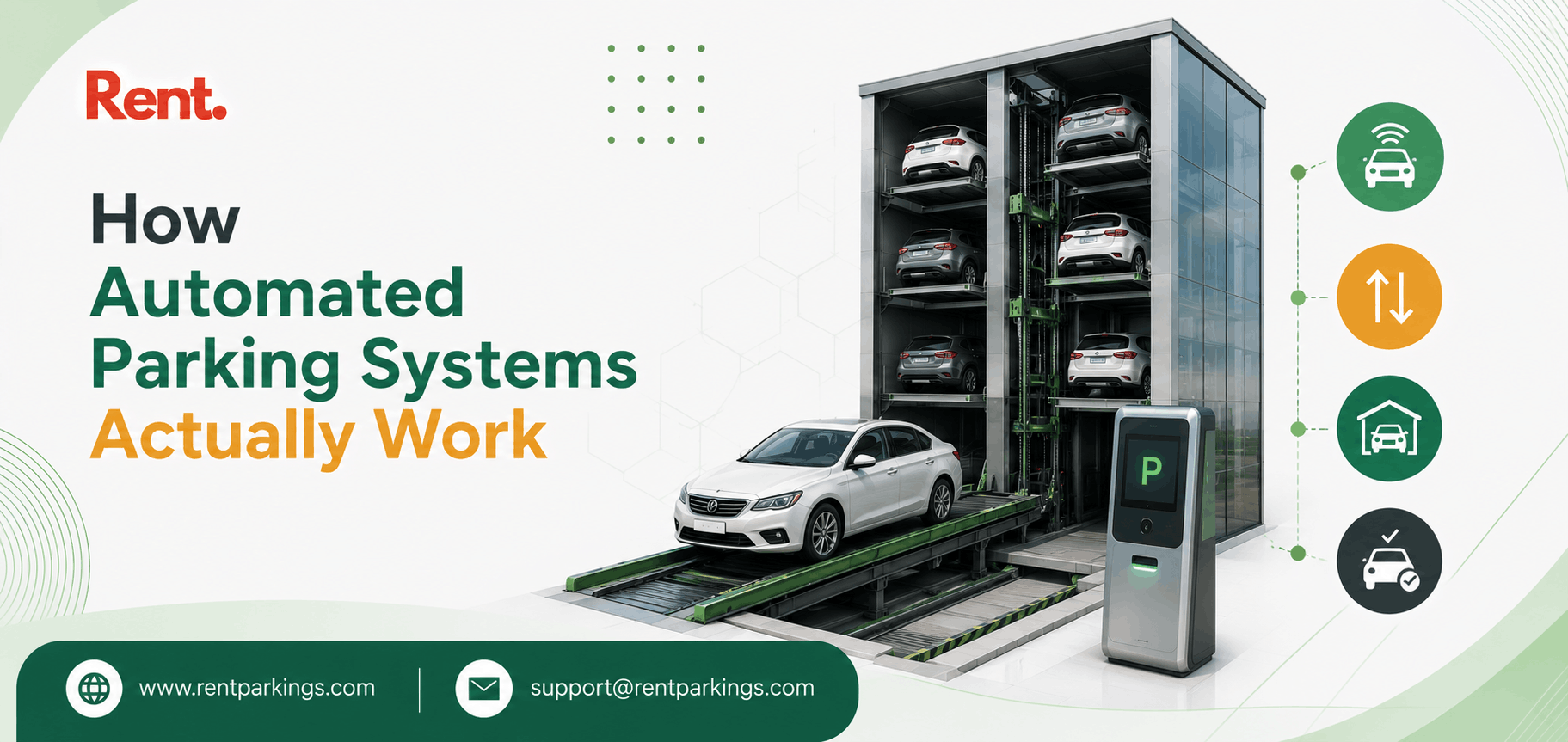
For anyone encountering one of these facilities for the first time, the underlying technology falls into a few broad categories, and understanding the difference explains a lot about why some facilities handle larger vehicles better than others.
Puzzle parking systems move cars horizontally and vertically on a grid of steel pallets, shuffling vehicles out of the way to retrieve a specific car, similar to a sliding puzzle. These are common in apartment basements and mid-sized commercial buildings because they're relatively compact and cost-effective, though retrieval can take a few minutes during peak hours if several cars need to be shuffled first.
Tower or robotic parking systems use a central lift-and-shuttle mechanism to place each car into an individual slot within a vertical steel structure, with no ramps or driving required inside the tower itself — the driver leaves the car at a ground-level bay and the system handles the rest. These tend to have the highest space efficiency per square metre of land but also the highest construction and maintenance cost, which is part of why breakdowns, like Green Park's, are more consequential when they happen.
Semi-automated stack and pallet systems sit between the two, typically used where full automation isn't cost-justified but simple vertical stacking (two or three cars, one above another) can meaningfully increase capacity on a small footprint, common in retrofit projects for older buildings that weren't originally designed with basement parking.
What Would Actually Fill These Structures
Taken together, the Delhi, Coimbatore, and Chandigarh examples point toward a fairly consistent list of what separates a well-used multi-level facility from an empty one: siting it close enough to the actual destination that walking distance isn't a deterrent, designing entry and lift bays around the SUVs and larger vehicles that now make up a growing share of India's car fleet rather than a decade-old vehicle mix, pricing it to genuinely compete with the real (not nominal) cost of nearby street parking, making real-time availability visible from the street or a phone app rather than requiring a driver to guess, and budgeting seriously for ongoing mechanical maintenance rather than treating the facility as finished once construction ends.
None of this requires reinventing the technology — puzzle, tower, and robotic parking systems are mature and proven at scale elsewhere in the country. What separates a 30% -occupied tower from a genuinely useful piece of city infrastructure is almost entirely in the details of siting, pricing, communication, and upkeep that get decided after the ribbon-cutting, not during it.
What the Next Generation of Facilities Is Adding
As cities plan their next wave of multi-level parking, the design brief is visibly shifting beyond simply stacking more cars. EV charging points are increasingly built into new facilities from day one, rather than retrofitted later, positioning multi-level structures as combined parking-and-charging hubs as electric car ownership grows in cities like Bengaluru, Delhi, and Pune. Rooftop solar installations on the top level of open-air towers are becoming more common, offsetting some of the facility's own power draw, which matters more than it sounds given how power-hungry hydraulic lifts and pallet shuttles can be. And several newer projects are being planned with ground-floor retail or F&B space built into the facility itself, turning what used to be a purely functional structure into something that generates its own foot traffic and revenue independent of parking fees, which also makes the building feel less isolated and more part of the street it sits on.
Vehicle ownership in India continues to climb steadily, and every percentage point of growth adds pressure on already-scarce urban parking supply. That growth curve is exactly why the occupancy problem matters: the demand for parking capacity is real and rising, even in facilities that currently sit half-empty. The gap isn't between supply and demand at a city level, it's between where the supply sits and where the demand actually needs it to be, which is a solvable, if unglamorous, planning problem rather than a fundamental limit on how much parking a city can use.
The Bigger Lesson for Indian Urban Planning
The multi-level parking story is a useful, concrete illustration of a broader pattern in Indian urban infrastructure: building capacity is not the same as solving the underlying demand problem. A city can pour hundreds of crores into vertical parking towers and still have jammed streets outside them if the tower doesn't fit into how people actually move through that neighbourhood, what they're willing to pay, and what kind of vehicle they drive. As land in Indian city centres keeps getting more expensive and vehicle ownership keeps climbing, multi-level and automated parking will almost certainly keep expanding — the market data points firmly in that direction. The open question for the next wave of these projects is whether cities design them around how people actually park, or keep building impressive, underused towers next to permanently jammed streets.
Conclusion
India's multi-level parking boom is a genuinely interesting infrastructure story hiding in plain sight in almost every major city — expensive, technologically ambitious buildings that, in many cases, aren't doing the job they were built for. The fix isn't more concrete or taller towers; it's closer siting, vehicle-compatible design, honest pricing against the real alternative, visible real-time availability, and a maintenance budget that takes automated machinery as seriously as the construction budget did. Chandigarh's unified digital pass and Pune's homegrown, low-maintenance robotic systems both show that the fix is achievable without reinventing the technology. Until more cities apply those lessons, the pattern outside most Indian parking towers is likely to stay the same: a half-empty structure, and a fully jammed street right next to it.
FAQs
What is a multi-level car parking (MLCP) system?
An MLCP is a purpose-built structure, manual, semi-automated, or fully automated, that stacks parking spaces vertically across multiple floors or levels to fit more vehicles onto a smaller land footprint than a surface lot would allow.
Why are India's multi-level parking buildings often empty despite traffic congestion outside?
Occupancy in many Indian multi-level facilities runs around 30–40% because they're often sited too far from the actual destination, priced without real competition from free roadside parking, poorly signposted, and in some cases unable to accommodate larger modern vehicles like SUVs.
How much has India invested in multi-level and automated parking infrastructure?
Individual facilities in cities like Ahmedabad, Bhopal, and Chandigarh have cost ₹50–100 crore each, Delhi has proposed nine new facilities worth roughly ₹775 crore, and India's overall parking systems market was valued at around ₹5,800 crore (USD 700 million) in 2025.
What are the different types of automated parking systems used in India?
The main categories are puzzle parking (pallets shuffle horizontally and vertically), tower or robotic parking (a central lift-shuttle places cars into individual slots with no internal driving), and semi-automated stack/pallet systems for smaller-scale vertical stacking.
Why did Delhi's Green Park automated parking tower have platforms collapse in 2021?
Several parking platforms in one tower of the Green Park facility, one of Delhi's first fully automated parking towers, failed mechanically in November 2021, damaging vehicles and trapping others inside, an incident that significantly dented public confidence in automated parking in the area.
What happened to Coimbatore's RS Puram multi-level parking facility?
Commissioned in 2022 with capacity for 380 cars at a cost of over ₹40 crore, RS Puram was largely non-operational for nearly three years due to repeated hydraulic lift failures, with partial repairs restoring two floors to use only in December 2025.
Which Indian city has the most advanced smart parking system in 2026?
Chandigarh's "MC One Pass," launched in January 2026, unifies every civic-body-managed parking site, surface and multi-level, under a single digital monthly pass, making it one of the more integrated smart parking systems in the country as of 2026.
Can SUVs and larger vehicles use automated multi-level parking systems in India?
It depends on the facility. Many older automated and puzzle parking systems were designed around the compact hatchbacks and sedans common a decade ago, and their ramps, turning radii, or pallet dimensions may not accommodate the height or wheelbase of newer SUVs and MPVs.
How does sensor-based or smart parking guidance work?
IoT-enabled sensors installed at individual parking bays or entry points detect real-time occupancy and feed that data to an app or digital display, letting drivers check available space in a specific facility before deciding to drive there.
What would increase usage of India's underused multi-level parking structures?
Siting facilities closer to actual destinations, redesigning bays for larger modern vehicles, pricing that genuinely competes with roadside parking, visible real-time availability information, and dedicated ongoing maintenance budgets for the mechanical systems are the factors most consistently linked to higher occupancy.
Share This post
Search
Recent Post
What Happens When You Need Your Parking...
01 Sep, 2026
How Listing Your Parking Space in India...
31 Aug, 2026
Parking Space vs Gold: The Idle Asset Th...
28 Aug, 2026
Your Garage Hasn't Parked a Car in Month...
26 Aug, 2026
Someone Dents a Car in Your Rented Parki...
25 Aug, 2026
Your Vacant Plot Is Not Free to Own: How...
24 Aug, 2026
Coaching Centre Parking in India: Why Ko...
21 Aug, 2026
India's PG and Co-Living Boom Has a Park...
20 Aug, 2026