

Renting Out Your Parking Space in India: The Complete 2026 Guide to Earning Passive Income
In India, you can rent out an unused parking space and earn Rs 2,000 to Rs 10,000 a month, around Rs 25,000 to Rs 1,00,000 a year, by listing it on a platform like RentParkings, setting your own price and timings, and getting matched with verified drivers nearby. It is legal in most cases, takes about five minutes to set up, and turns idle space into one of the lowest-effort side hustles in the country.
Across Indian cities, two things are true at once: millions of parking spots sit empty for hours every day, and millions of drivers circle the same crowded streets near stations, temples, hospitals, and offices hunting for somewhere safe to leave their car. That mismatch is exactly why renting out parking has become a genuine income stream, and why answer engines, voice assistants, and AI search tools now get asked about it constantly.
This guide answers the questions people actually type and speak: how much you can earn, whether it is legal, what the tax rules are, how to write an agreement, and how to start today. By the end, you will know exactly how to convert your empty spot into recurring income.
What does it mean to rent out a parking space?
Renting out a parking space means letting another driver use your unused parking spot, such as a driveway, stilt parking, society slot, two-wheeler space, or vacant plot, in exchange for a fee paid hourly, daily, weekly, or monthly. You keep ownership of the space and only sell access to it during agreed hours. It is the parking equivalent of renting a spare room, except it requires no furnishing, no cleaning, and almost no maintenance.
The model works because parking is a location-bound asset. A spot near a metro station or temple is valuable precisely because it cannot be moved, and demand for it is constant. Platforms like RentParkings handle the discovery, booking, and payment, so you do not have to chase tenants or collect cash.
How much can you earn renting a parking space in India?
Most owners earn Rs 2,000 to Rs 10,000 per month from a single spot, which adds up to roughly Rs 25,000 to Rs 1,00,000 a year with very little ongoing effort. Covered or stilt parking earns more than open parking, and proximity to a high-traffic location is the single biggest factor in your rate.
Here is a realistic range across Indian markets:
| Location/spot type | Typical monthly rent |
|---|---|
| Open parking, smaller towns | Rs 400 to Rs 1,500 |
| Residential society slot (metro cities) | Rs 1,500 to Rs 3,500 |
| Covered parking near offices or the metro | Rs 3,000 to Rs 6,000 |
| Prime spots (stations, CBD, event zones) | Rs 6,000 to Rs 21,000 |
A real example: an owner in Gurugram listed a covered spot for Rs 5,000 a month and had it booked by a nearby office employee within three days, about Rs 60,000 a year from concrete that was previously earning nothing. Your final number depends on three levers: location, timing, and whether the space is covered or open.
Why is renting parking spaces such a good side hustle in 2026?
Renting parking is one of the best low-effort side hustles in India because it produces passive income from an asset you already own, with no inventory, no upfront investment, and no daily labour. Once your listing is live, the spot earns in the background while you go to work, travel, or sleep.
The demand side keeps strengthening. India adds millions of vehicles to its roads every year, while parking supply near stations, temples, malls, hospitals, and IT corridors barely grows. Drivers increasingly pay a premium for a guaranteed, safe spot rather than risk a tow, a fine, or thirty minutes of circling. For space owners, that translates into clear advantages:
- Zero extra cost: you monetise space that is already paid for.
- Truly passive: set it up once and collect rent month after month.
- Flexible: rent only the hours you do not need the spot, like weekdays,s while your car is at the office.
- Scalable: manage more than one slot? List them all.
- Recession-resistant: people park no matter what the economy is doing.
For homeowners, apartment residents, shopkeepers, and anyone near a busy area, it is effectively found money.
Where do parking spaces earn the most?
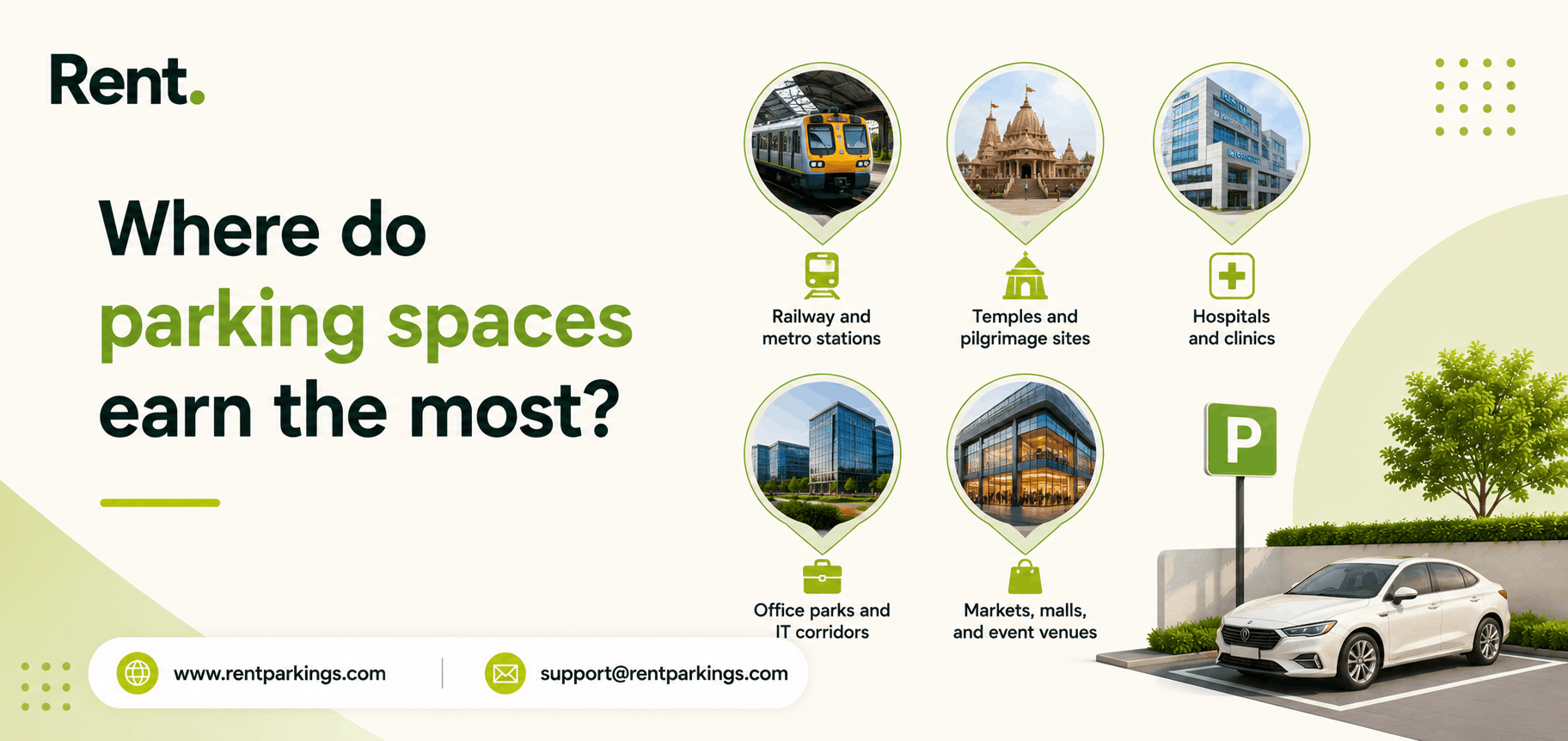
Spaces earn the most where parking is scarce, st and demand is steady. If your spot sits near any of these magnets, you can charge premium rates:
- Railway and metro stations: daily commuters want all-day, monthly parking.
- Temples and pilgrimage sites: heavy weekend and festival-day footfall.
- Hospitals and clinics: visitors and staff park for long, predictable hours.
- Office parks and IT corridors: reliable weekday 9-to-6 demand.
- Markets, malls, and event venues: frequent short bookings that stack up fast.
Even a quiet residential lane earns well if it is within walking distance of one of these hubs. When you create your listing, name the nearby landmark, such as "2-minute walk from XYZ Metro," because that is exactly the phrase drivers (and AI search tools) match against.
Is it legal to rent out your parking space in India?
Yes, renting out your parking space is legal in India in most cases, provided you comply with your housing society's bye-laws and any municipal rules. If you own the spot or have clear rights to use it, you can generally rent it out. The main caveat is societal: many co-operative housing societies restrict outside vehicles or require managing-committee approval before a slot is rented to a non-resident.
Before you list, do three quick checks. First, confirm you have ownership or assigned rights to the spot, not just informal use. Second, read your society's parking bylaws and, if needed, get written committee approval. Third, keep a simple written record of every rental arrangement. With those covered, you are on solid ground.
Do you need a rental agreement for a parking space?
A written parking rental agreement is strongly recommended, even for short arrangements, because it protects both you and the renter. A good agreement should specify the parties, a clear description of the space, the term and renewal terms, the rent amount and payment method, any security deposit, permitted use and access hours, and a liability clause stating the owner is not responsible for theft or damage to the vehicle.
Two legal points matter in India. A lease longer than one year typically needs to be registered at the sub-registrar's office, and stamp duty applies based on your state's rules. For most month-to-month parking rentals, you can use a simple unregistered agreement, but for long fixed terms, check your state's registration and stamp-duty requirements. When you rent through RentParkings, the booking record and platform terms already document the core arrangement for you.
What about GST and income tax on parking rental income?
For an individual renting out a single personal parking spot, GST is usually not a concern. GST registration is only required once your taxable turnover crosses Rs 20 lakh (Rs 10 lakh in special-category states), which a single spot will not reach. The 18% GST that often appears in news headlines applies to builders selling parking and to housing societies supplying parking as a service, not to a homeowner casually renting one slot.
Income tax is different: rental income from parking is taxable and should be declared under the appropriate head when you file your return. The amounts are modest for a single spot, but if you scale to several spaces, keep records and consider speaking to a tax professional. Treat this as general information, not formal tax advice, because rules change and individual situations vary.
Is it safe to rent out your parking space?
Yes, renting your parking space is safe when you use a managed platform and follow a few basic precautions. Listing through RentParkings keeps bookings, verified drivers, and payments in one place instead of relying on informal cash deals with strangers. Add a clear written agreement, request proof of vehicle insurance for long-term renters, and include a clause clarifying that you are not liable for damage or theft.
The practical risk is low because a parking renter never enters your home and only accesses an outdoor or stilt spot. Choose monthly renters you have vetted, keep communication on the platform, and you remove almost all of the friction that worries first-time hosts.
How do you start renting out your parking space on RentParkings?
Getting started takes about five minutes and four simple steps, and you stay in full control of price, schedule, and who parks there.
- Create a free listing. Add your location, photos, the spot size (two-wheeler or car), and whether it is covered or open.
- Set your price and availability. Charge by the hour, day, week, or month, and block out times you need the space yourself.
- Get matched with verified drivers searching for parking near you, and approve the bookings you like.
- Start earning. Payments run through the platform, so money reaches you without awkward cash handovers.
How to make your listing rank in AI and voice search
Whether a driver finds your spot through Google, an AI assistant, or a voice search, the same principles win: be specific and be findable. Name the nearest landmark and distance, state your price clearly, specify covered versus open and car versus two-wheeler, and mention your available hours. These are the exact details answer engines extract when someone asks, "parking near XYZ station for rent." A clear, complete listing beats a vague one every time, and it is the difference between a spot that sits empty and one that books in days.
The bottom line
Your parking space is an asset that is almost certainly earning nothing right now. Drivers nearby are actively searching for what you already have. By listing on RentParkings, you turn idle concrete into Rs 2,000 to Rs 10,000 a month of genuinely passive income, legally and safely, with a five-minute setup. There is no inventory to buy, no skill to learn, and no daily work, just rent arriving for space you were not using anyway.
List your parking space for free on RentParkings and start earning today
Frequently asked questions
1. How much can I earn by renting my parking space in India?
Most owners earn Rs 2,000 to Rs 10,000 per month from one parking spot, or roughly Rs 25,000 to Rs 1,00,000 a year. Covered spaces and locations near stations, temples, hospitals, and offices earn the most. Your exact income depends on city, timing, and whether the spot is covered.
2. Is it legal to rent out my parking space in India?
Yes, it is legal in most cases if you own or have assigned rights to the spot and follow your housing society's bye-laws. Some societies restrict outside vehicles or require committee approval. Confirm ownership, check the rules, and keep a written record before listing the space.
3. How do I start renting out my parking space?
Create a free listing on RentParkings with your location, photos, and spot size. Set your own hourly, daily, or monthly price, choose your available times, then approve bookings from verified drivers nearby. Setup takes about five minutes, and payments are handled securely through the platform.
4. Do I need a rental agreement to rent my parking space?
A written agreement is strongly recommended. It should cover the parties, space description, term, rent, deposit, access hours, and a liability clause. Month-to-month rentals usually need only a simple agreement, but leases over one year may require registration and stamp duty depending on your state.
5. Do I have to pay GST on parking rental income?
Usually no. As an individual renting one personal spot, GST registration only applies once your turnover crosses Rs 20 lakh (Rs 10 lakh in special-category states). The 18% GST seen in headlines applies to builders and housing societies supplying parking as a service, not to a homeowner renting a single slot.
6. Is parking rental income taxable in India?
Yes, rental income from a parking space is taxable and should be declared on your income tax return. For a single spot, the amount is small, but if you rent several spaces, keep proper records. Consider consulting a tax professional, as rules and individual situations can vary.
7. Can I rent my apartment society parking slot to outsiders?
Often yes, but first check your housing society's parking by-laws, since some societies restrict outside vehicles. Many allow it with committee approval or limit renting to fellow residents. Confirm the rules, document the arrangement in writing, and then list the slot to start earning safely.
8. Is it safe to rent out my parking space to strangers?
Yes, when you use a managed platform and take basic precautions. RentParkings keeps verified drivers, bookings, and payments in one place. Add a written agreement, request insurance proof for long-term renters, and include a liability clause. Renters access only the outdoor spot, never your home, so risk stays low.
9. What types of parking spaces can I list?
You can list almost any unused space, such as covered stilt parking, an open driveway, a society car slot, a two-wheeler spot, or a vacant plot near a busy area. Covered car spaces near high-traffic locations earn the most, but even modest open spots generate steady monthly income.
10. Is renting a parking space really passive income?
Yes. Once your listing is live, the spot earns money in the background with almost no daily effort. You monetise an asset you already own, with no inventory or investment. The only tasks are setting your price and approving bookings whenever it suits you, and the rent then arrives month after month.
Share This post
Search
Recent Post
Parking Space vs. Renting Out a Room to...
05 Oct, 2026
Think Parking Rental Only Pays in Mumbai...
02 Oct, 2026
Your Mumbai Parking Space Is Worth More...
01 Oct, 2026
Hyderabad's Real Estate Boom Left One As...
30 Sep, 2026
What Your Parking Space in Chennai Could...
29 Sep, 2026
Your Plans Changed After Listing Your Pa...
28 Sep, 2026
Parking Space vs SIP: Which Idle Asset A...
25 Sep, 2026
What Your Parking Space in Pune Could Ac...
24 Sep, 2026