

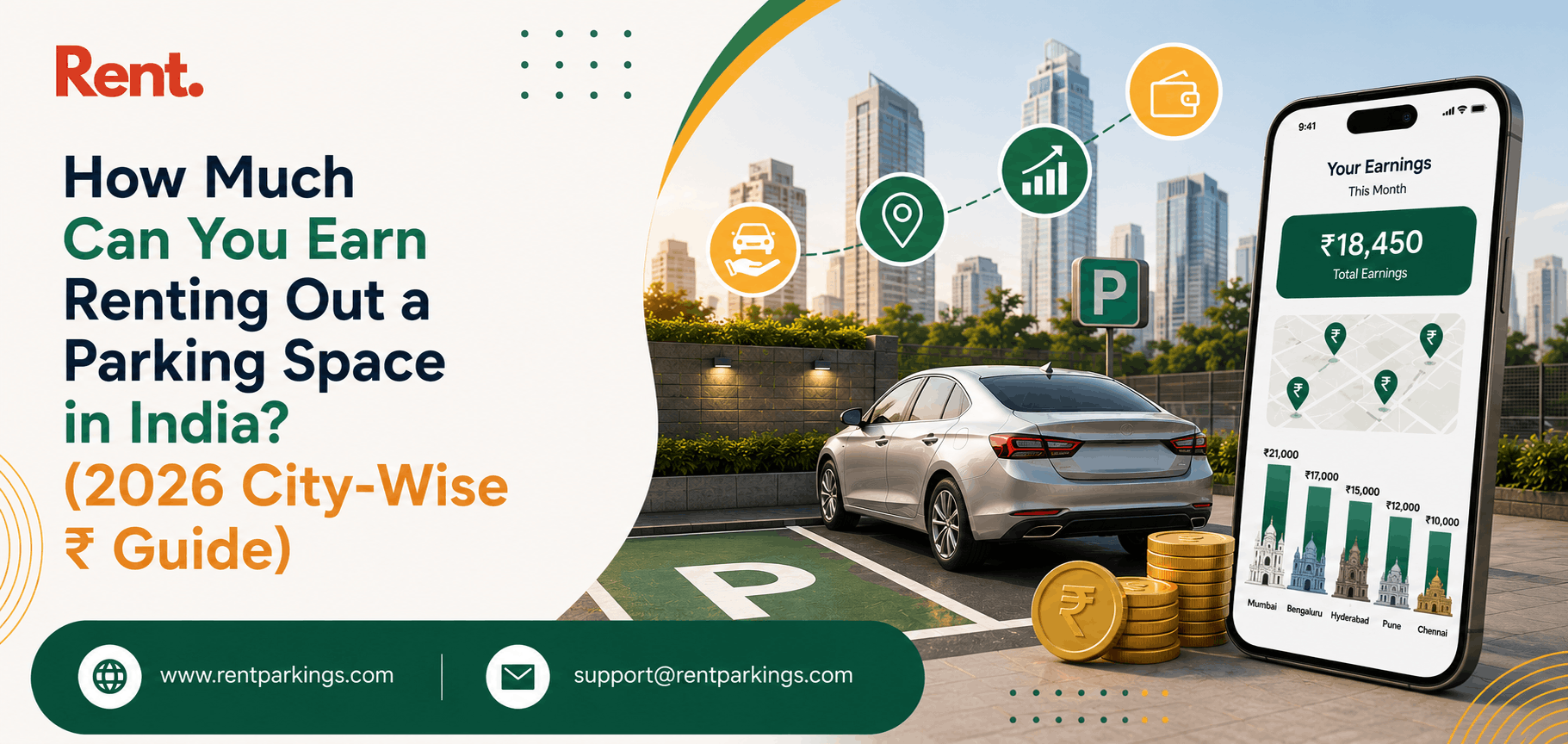
How Much Can You Earn Renting Out a Parking Space in India? (2026 City-Wise ₹ Guide)
A friend of mine in Bengaluru bought a two-bedroom flat off Outer Ring Road a few years ago. It came with two parking slots. He owns one car. For nearly four years, that second slot sat empty, a rectangle of painted concrete quietly doing nothing while cars circled the neighbouring tech park every morning looking for somewhere, anywhere, to stop. When he finally rented it out to a colleague for a fixed monthly amount, his reaction said everything: “I've been sitting on a salary top-up this whole time and didn't even know it.”
That story repeats itself in every Indian city with a parking problem, which is to say every Indian city. Our cars have multiplied faster than our parking has, and the maths is unforgiving: land is finite, registrations keep climbing, and nobody is building new slots in old neighbourhoods. Meanwhile, millions of homeowners, shop owners, and plot owners are sitting on an asset they've never once thought to monetise. If you've ever wondered what your unused slot could actually fetch, this guide walks through the real numbers, the factors that move them, who's looking to rent, and how platforms like India's parking marketplace turn a dead square of concrete into predictable monthly income.
So, what's a parking space actually worth in India?
There's no single answer, and anyone who gives you one flat figure is guessing. What a space earns depends on where it sits, how you rent it, and who needs it. That said, after looking at how listings and local rental markets behave across the country, some fairly consistent monthly ranges emerge for a standard covered or open car slot in 2026. Treat these as typical bands, not promises; your micro-location can push you above or below them.
- Mumbai: ₹4,000 to ₹10,000+ a month, with South Mumbai, BKC, and Andheri pockets commanding the top of that range and often beyond.
- Delhi NCR: ₹3,000 to ₹8,000, climbing sharply near Gurugram's Cyber City, Connaught Place, and the busier Noida sectors.
- Bengaluru: ₹2,500 to ₹7,000, with Koramangala, Indiranagar, Whitefield, and the ORR IT corridor pulling the strongest rents.
- Hyderabad: ₹2,000 to ₹6,000, led by HITEC City, Gachibowli, and Banjara Hills.
- Pune: ₹2,000 to ₹5,500, strongest around Hinjewadi, Kharadi, and Baner.
- Chennai: ₹1,800 to ₹5,000, with T. Nagar, Anna Nagar, and the OMR stretch in demand.
- Kolkata: ₹1,500 to ₹4,500, concentrated around Park Street and Salt Lake's IT belt.
- Tier-2 cities like Ahmedabad, Jaipur, Kochi, Coimbatore, Lucknow, and Madurai: ₹1,000 to ₹3,500, and rising faster than most people expect.
Where demand quietly outruns supply
The pattern behind those numbers is simple. Wherever a lot of people need to be in a small area at the same time, whether that's a tech park at 9:30 a.m., a hospital's visitor gate, a temple on a festival morning, or a metro station where commuters leave cars for the day, the value of a guaranteed spot jumps. A slot 300 metres from a metro entrance in Chennai or Hyderabad can out-earn a bigger, fancier space two kilometres away that no commuter ever passes. Proximity to a genuine, daily source of demand is worth more than square footage, and it's worth more than how new or how large your slot happens to be.
The tier-2 story is changing fast
It's tempting to assume this only works in the metros, but the tier-2 shift is real. As Ahmedabad, Jaipur, Kochi, and Coimbatore add IT campuses, hospitals, and retail high streets, their older neighbourhoods, never designed for today's car density, feel the squeeze. A lane in central Jaipur or near a Kochi hospital that never had a parking problem a decade ago now has cars double-parked down both sides. Owners in these cities are often the last to realise their slot has become valuable, which means less competition and pleasantly surprised first-time listers.
Who's actually looking to rent your space?
It helps to picture the person on the other side of the transaction, because it tells you how to price and position your slot. In practice, four kinds of renters show up again and again across Indian cities.
The first is the daily office commuter, someone who drives to an IT park or business district and needs a guaranteed spot from nine to six, five days a week. They value predictability above everything and are the ideal monthly tenant. The second is the nearby resident whose building fell short: plenty of older flats and newer compact projects simply don't have enough slots, so a neighbour two lanes away becomes a lifeline, usually on a long, stable monthly arrangement. The third is the visitor or patient near a hospital, court, market, or temple, who needs a few hours and will happily pay an hourly rate for the relief of not circling the block. And the fourth is the event-goer (the cricket match, the wedding hall, the festival crowd) who turns a single evening into your highest-earning slot of the month. Knowing which of these lives near you is half the pricing decision already made.
The five things that actually decide your rent
Two slots on the same street can earn very different amounts. Here's what moves the needle, roughly in order of impact.
Location and daily demand. This is the big one. A space near a station, IT park, hospital, market, or event venue rents itself. A space on a quiet residential lane with plenty of street parking nearby is a harder sell. Be honest about which one you have, and remember that “walkable to a demand magnet” beats “technically in a good area” every time.
Covered versus open. In a country that alternates between brutal summer heat and monsoon flooding, a covered or stilt slot protects paint, electronics, and peace of mind, and drivers pay a premium for it. Basement and podium parking usually sits at the top of the range, and a shaded spot can be the deciding factor for someone parking a new car all day.
Security and access. A gated society slot with a guard, CCTV, and a boom barrier is worth noticeably more than an unmonitored patch. Renters, especially those leaving a car all day, are paying as much for safety as for the space itself. If your society has these features, say so clearly in your listing; it's often the single biggest trust signal you can offer.
Ease of getting in and out. A slot a driver can pull into without a three-point struggle is genuinely more rentable. It sounds minor, but anyone who has wrestled a car into a tight corner spot knows why. The everyday reality of manoeuvring in Indian parking is exactly what our guide on Reverse & Parallel Parking in India: 5 Real Situations Solved gets into. An easy, low-stress spot commands loyalty and repeat renters.
How you price and package it. The same space can earn wildly different amounts depending on whether you rent it hourly, daily, or monthly, which brings us to the next question.
Hourly, daily, or monthly: which model earns more?
Each model suits a different kind of owner, and the “best” one depends entirely on your location and how much involvement you want.
Monthly rentals are the calm, hands-off choice. You lock in a working professional or a nearby resident, agree on a figure, collect a predictable amount every month via UPI or net banking, and rarely think about it again. Lower ceiling, but steady and almost effortless, and ideal for a residential slot near offices where the same person will use it for months on end.
Daily rentals shine near stations, airports, and business districts where people leave a car for eight to ten hours and head to work or catch a train. Priced at roughly ₹100 to ₹300 a day depending on the city, a well-placed slot booked consistently can quietly out-earn a monthly arrangement, with a bit more coordination on your end.
Hourly rentals are the high-yield, high-churn option, and they belong near hospitals, markets, temples, malls, and event venues. On a festival morning near a busy temple, or a match night near a stadium, an hourly spot at ₹20 to ₹50 an hour can earn more in a single day than it would in a slow week. The trade-off is that it needs a platform to handle the constant turnover for you rather than you fielding calls all day.
The smart move for many owners is a blend: a steady monthly base, with the flexibility to switch to daily or hourly during peak seasons and local events. covers how to think about this in more detail.
Can you legally rent out your apartment parking space?
This is the question that stops most apartment owners before they start, and it deserves a straight answer. Whether you can rent your slot depends on how it was allotted, what your society's bye-laws say, and whether the space is genuinely yours to license or merely assigned for your use. Open stilt areas, covered basements, and “sold” versus “allotted” slots all carry different rights, and the rules aren't always what residents assume. Before you list, it's worth understanding exactly where you stand. Our detailed breakdown, Apartment Parking Rights in India: Who Owns Stilt & Covered Parking?, unpacks the ownership question so you can rent with confidence rather than a nagging doubt.
As a rule of thumb: if the slot is legally yours or clearly allotted to your flat, and your society permits sub-arrangements, you're on solid ground. Many societies are perfectly happy for an owner to rent a slot to a resident of the same complex, and slightly more cautious about outside vehicles, so it's worth reading the room and the rulebook. When in doubt, a quick word with your RWA or a look at your allotment paperwork saves a lot of friction later. [INTERNAL LINK, insert a relevant existing RentParkings post on society parking rules, RWA guidelines, or tenant parking] is a useful companion read here.
How to turn an empty slot into monthly income
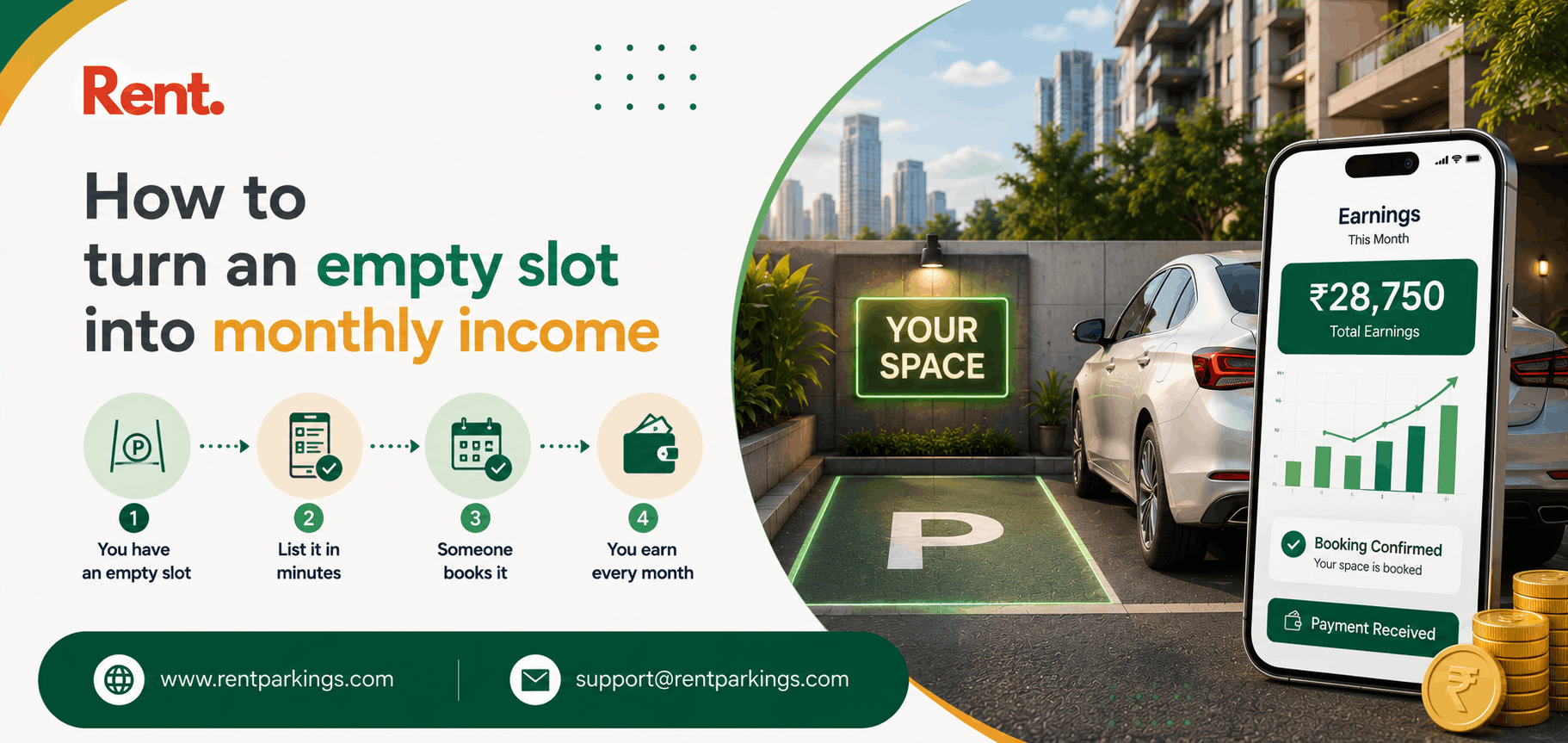
The actual mechanics are far simpler than most owners expect. You don't need to print flyers, field random phone calls, or chase payments. On a marketplace built for this, the flow looks like this.
You create a free listing describing your slot: location, whether it's covered, security features, and a couple of clear photos. You set your own price and choose whether to offer it hourly, daily, or monthly. Verified drivers in your area find and book it. Payments arrive digitally, no awkward cash handoffs at the gate. And because listings are verified on both sides, you're renting to real, accountable people rather than a stranger who answered a classified ad.
That verification piece matters more in India than we often admit. Renting a physical space to someone means trusting them near your home or building, and a platform that checks identities on both ends turns a slightly nerve-racking idea into a routine transaction. explains how that trust layer is built.
Five mistakes first-time listers make
Once owners decide to rent, a handful of avoidable slip-ups tend to cost them money or tenants. Skip these and you're ahead of most.
Underpricing out of nervousness. Plenty of first-timers pick a low number just to get a booking, then discover their slot was worth far more. Check what comparable spaces nearby are charging before you set a figure. Vague listings. “Parking available” converts poorly; “covered stilt slot in a gated society with CCTV, 200 m from the metro” converts well. Ignoring the two-wheeler market. In dense areas, bike and scooter parking rents quickly and steadily, and a small space you'd dismissed can still earn. Skipping a simple written understanding. Even a short message confirming price, timing, and access keeps things clean. And treating it as all-or-nothing: you can rent a slot only on weekdays, only during office hours, or only in festival season, and keep it for yourself the rest of the time.
Is it really “passive” income? An honest take
Let's not oversell it. Monthly rentals are close to genuinely passive: set it up once, and it hums along with little more than a monthly UPI notification. Hourly and daily models involve more moving parts, which is exactly why a platform that automates bookings and payments earns its keep. Nobody is quitting their job on a single parking slot. But as a top-up on income from an asset you've already paid for, one that quietly covers a phone bill, a SIP instalment, or a chunk of your society maintenance every month? That's a rare kind of easy money in 2026: no extra investment, no new skill, just switching on a space that was already yours.
Frequently asked questions
How much can I realistically earn from one parking space in India?
For a standard car slot, monthly rents commonly run from around ₹1,000 in smaller cities to ₹10,000 or more in prime metro locations. Spaces near metro stations, IT parks, hospitals, and commercial hubs sit at the higher end, and switching to daily or hourly rentals in high-footfall areas can push earnings further.
Do I need to own the parking space, or can I rent an allotted one?
It depends on how the slot was allotted and what your society's rules permit. Legally owned or clearly allotted slots are usually fine to rent when your RWA allows it; unclear or shared spaces need checking first. Confirm your ownership status before listing.
How do renters pay me?
Through digital methods you already use, such as UPI and net banking, rather than cash. On a marketplace, payments are handled through the platform, so you're not chasing anyone at the gate.
Is it safe to rent my space to a stranger?
Renting through a marketplace that verifies both owners and drivers removes most of the risk of a random classified listing. You keep control over your pricing, your availability, and who books your slot.
Can I rent out a two-wheeler or bike parking space too?
Yes. In dense residential and commercial areas, two-wheeler parking is in constant demand and rents quickly, even if the per-slot amount is smaller than for a car.
Which rental model earns the most?
Monthly is steadiest and most hands-off; hourly earns the most per hour near temples, hospitals, malls, and event venues but needs more turnover management. Many owners keep a monthly base and switch to daily or hourly during peak seasons.
Your empty slot is a monthly paycheck waiting to start
Here's the simple truth: across Chennai, Bengaluru, Hyderabad, Mumbai, Delhi NCR, Pune, and dozens of fast-growing cities, drivers are hunting for exactly the kind of space you may be leaving empty right now. You've already paid for it. The only thing standing between that concrete rectangle and a monthly deposit in your account is a listing.
If you own an unused parking space, this is your sign to put it to work. Set your own price, choose hourly, daily, or monthly rentals, reach verified drivers in your neighbourhood, and start earning passive income from an asset you already have. List Your Parking Space on RentParkings. It's free to publish, takes only a few minutes, and could turn the most overlooked corner of your property into steady monthly income.
Share This post
Search
Recent Post
Parking Space vs. Renting Out a Room to...
05 Oct, 2026
Think Parking Rental Only Pays in Mumbai...
02 Oct, 2026
Your Mumbai Parking Space Is Worth More...
01 Oct, 2026
Hyderabad's Real Estate Boom Left One As...
30 Sep, 2026
What Your Parking Space in Chennai Could...
29 Sep, 2026
Your Plans Changed After Listing Your Pa...
28 Sep, 2026
Parking Space vs SIP: Which Idle Asset A...
25 Sep, 2026
What Your Parking Space in Pune Could Ac...
24 Sep, 2026