

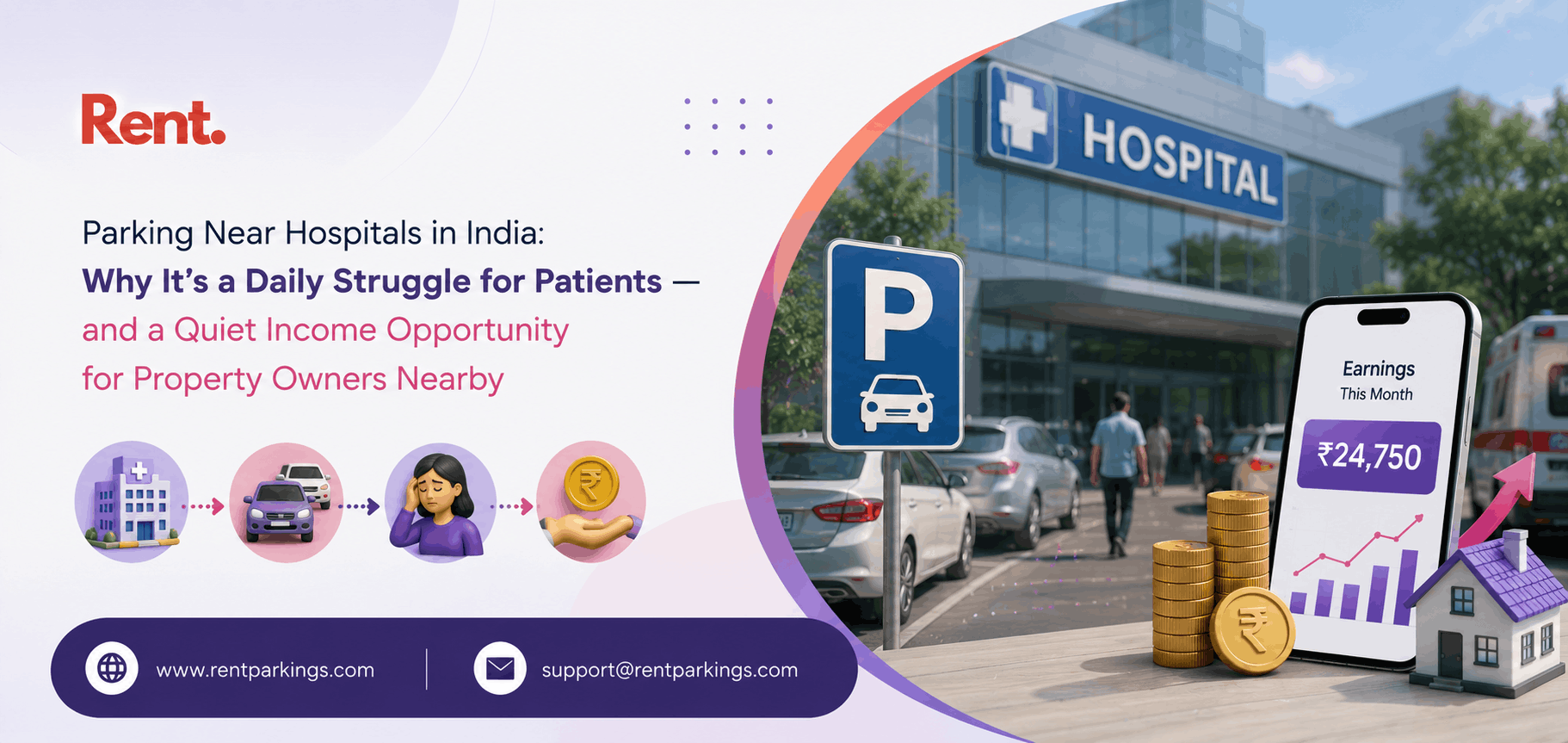
Parking Near Hospitals in India: Why It's a Daily Struggle for Patients — and a Quiet Income Opportunity for Property Owners Nearby
Anyone who has driven a family member to a hospital in India at seven in the morning knows the feeling. You're not thinking about the appointment anymore — you're thinking about where on earth you're going to leave the car. The basement is full. The security guard is waving you toward a "no parking" stretch that will get you towed by lunchtime. Somewhere behind you, an ambulance is trying to get through, and you are the reason it can't.
This is not a one-off bad morning. In city after city — Chennai, Bengaluru, Hyderabad, Mumbai, Delhi NCR, Pune, Kolkata — the parking lot outside a busy multi-specialty hospital is one of the most reliably stressful pieces of real estate in the whole city. And yet, on the same street, there are driveways, empty plots, and basement slots sitting unused all day, owned by people who have simply never thought to rent them out. That gap between desperate demand and idle supply is exactly the kind of problem RentParkings, India's trusted parking marketplace, exists to close.
The Hospital Parking Problem Nobody Talks About
Most conversations about India's parking crisis focus on offices, malls, and metro stations. Hospitals rarely come up, which is strange, because the pressure on hospital parking is arguably worse than at almost any other place. Malls have flexible opening hours and can turn people away when full. Offices have staggered timings. A hospital cannot do either of those things. Patients keep arriving whether or not there is anywhere to put their car, and unlike a shopping trip, a hospital visit is rarely something you can postpone or reschedule to avoid the rush.
Add to this the layout problem. Many older hospitals in Indian cities were built decades before anyone anticipated today's vehicle ownership levels, so their parking basements were designed for a fraction of the cars that now show up. Newer private hospitals often do better, but they are frequently located on narrow arterial roads where there simply isn't space to expand parking even if the hospital wanted to.
Why Hospital Parking Behaves Differently From Every Other Kind of Demand
If you've read about renting parking near offices or metro stations, you might assume hospital parking works the same way. It doesn't, and the differences matter if you're a property owner thinking about listing a space nearby.
Attendants stay for days, not hours
A family member accompanying a patient for a surgery or a multi-day admission isn't parking for two hours — they're parking for two days, sometimes two weeks. That changes the entire pricing conversation. Instead of competing purely on an hourly rate, hosts near hospitals can offer daily and weekly packages that patients' families are often relieved to find, because it removes one more thing to worry about during an already difficult time.
No-parking zones near hospital gates are strictly enforced
Because ambulances and emergency vehicles need a clear approach, most hospitals have "no parking" or "no stopping" zones right outside their gates, and traffic police tend to enforce these more aggressively than an ordinary residential street. Drivers who don't know the area well often learn this the expensive way. This is one more reason genuine, verified parking a short walk away — rather than a risky spot right at the gate — is worth paying for. If you want to understand how these fines and towing rules actually play out city by city, this 2026 city-by-city survival guide to no-parking fines and towing is a useful read for any driver, hospital visit or not.
The visitors are anxious, not leisurely
Someone parking to catch a movie is patient. Someone parking to reach an emergency ward is not. That urgency means proximity and reliability matter more than almost anything else — a host who can guarantee a spot, confirm it the moment it's booked, and describe exactly how to reach it from the hospital's main gate has a real edge over one who can't.
The Opportunity Hiding in Plain Sight
Property owners already understand this dynamic when it comes to metro stations — a driveway that sits five minutes from a station entrance has a very different earning potential than one three kilometres away. The same logic is now playing out around hospitals, quietly and mostly unnoticed. If you own a home, shop, or vacant plot within a few hundred metres of a large hospital in a city like Coimbatore, Madurai, Jaipur, Lucknow, Noida, or Gurugram, you are sitting on the same kind of location advantage that RentParkings has already written about for commuters who live near metro stations — except your customer base is patients' families instead of office-goers, and they tend to need the space for longer, which usually means better per-visit earnings.
It's a pattern that also shows up around India's IT corridors, where thousands of employees hunt daily for a legitimate place to leave their two-wheeler or car near the office gate. The RentParkings piece on how tech-corridor commuters actually find a parking spot makes the same underlying point that applies just as strongly near hospitals: wherever a large number of people are forced to be in one place every single day, nearby property owners have a genuine, recurring income opportunity if they're willing to list what they already have.
How Much Can Property Owners Near Hospitals Actually Earn?
Pricing near hospitals tends to work a little differently from pricing near offices or malls, mostly because of that longer average stay. A basement slot near a busy hospital in a metro city can often be offered as an hourly option for quick outpatient visits, a daily rate for admissions, and a discounted weekly or monthly rate for attendants managing a longer treatment course — think chemotherapy cycles, dialysis, or post-operative recovery, all of which bring the same family back to the same hospital, and often the same parking spot, again and again.
What a specific space earns depends heavily on the city, the hospital's reputation and footfall, and how close the spot is to the main entrance — a two-minute walk commands a real premium over a fifteen-minute one. Rather than guessing at numbers, it's worth looking at the RentParkings city-wise breakdown of how much you can realistically earn renting out a parking space in India, which walks through how location, city tier, and demand type change the maths, and gives a far more honest picture than any single flat "you'll earn ₹X" claim ever could.
Getting It Right: Legal, Safety, and Pricing Basics
Before listing a space near a hospital — or anywhere else — it helps to get the basics right so there are no surprises later. That means being clear about ownership or authorisation to rent the space, understanding whether any income tax obligations apply once earnings cross a certain threshold, and thinking through simple safety measures like adequate lighting, a lockable gate, or basic CCTV, especially since many visitors will be leaving a vehicle unattended overnight while a family member is admitted. RentParkings has already put together a thorough legal, tax, and safety guide for renting out a parking space in India that's worth reading in full before you publish your first listing, hospital-adjacent or otherwise.
It's also worth being upfront in your listing description about exactly how a visitor should reach your space from the hospital — which gate, which landmark, whether there's a security guard to check in with. Families dealing with a medical emergency have no patience for vague directions, and a precise, reassuring listing consistently books faster than a generic one.
City Snapshots: Where the Demand Is Building
This pressure isn't limited to India's biggest metros. In Chennai, the stretch of road around several of the city's large private hospitals routinely sees cars circling for a spot during morning OPD hours. In Bengaluru and Hyderabad, hospitals along busy arterial roads face the same squeeze as the IT crowd competing for the same stretch of tarmac. Mumbai's space constraints make basement and building-society parking near hospitals especially valuable, while in Delhi NCR — including Noida and Gurugram — the sheer scale of daily hospital footfall across sprawling healthcare campuses creates demand that no single hospital's own parking structure can fully absorb. Pune, Ahmedabad, Kochi, Jaipur, Lucknow, and Kolkata all show smaller but steadily growing versions of the same story, particularly around hospitals that also attract patients travelling in from smaller towns nearby, who are often the least familiar with local parking rules and the most willing to pay for a dependable, pre-booked spot.
Frequently Asked Questions
Is it legal to rent out my parking space near a hospital in India?
Yes, as long as you own the space or have clear authorisation to rent it out (for example, from your housing society or landlord where applicable), and the space itself isn't in a designated no-parking or emergency-access zone.
How is pricing different for hospital parking compared to office or mall parking?
Hospital parking sees a much wider mix of durations — a two-hour outpatient visit alongside a two-week admission — so successful hosts near hospitals typically offer hourly, daily, and weekly or monthly rates side by side, rather than a single flat hourly price.
What should I include in my listing to attract hospital visitors?
Clear, specific directions from the hospital's main gate, the exact walking distance, security details, and whether the space is covered or open. Anxious visitors book faster when there's no ambiguity.
Are there safety concerns unique to hospital-adjacent parking?
The main one is longer unattended durations — a car may sit overnight or across several days while the owner is inside with a patient. Basic lighting, a secure gate, and CCTV where possible go a long way toward making a listing feel trustworthy.
Do UPI and digital payments work for these bookings?
Yes. Most bookings on marketplaces like RentParkings are settled through UPI or net banking, which suits hospital visitors who are often juggling other urgent payments and appreciate a quick, contactless transaction.
The Bottom Line
India's hospital parking problem isn't going away on its own — new hospital wings are being added faster than new parking structures, and that gap is exactly where individual property owners have room to step in. If you own a driveway, basement slot, or vacant plot within walking distance of a busy hospital, you're closer to a steady, recurring income stream than you might think, serving families who genuinely need what you already have sitting idle.
Ready to put that space to work? List Your Parking Space on RentParkings today, set your own hourly, daily, or monthly pricing, and start reaching verified drivers and families who are actively searching for exactly what you have to offer.
Share This post
Search
Recent Post
Parking Space vs. Renting Out a Room to...
05 Oct, 2026
Think Parking Rental Only Pays in Mumbai...
02 Oct, 2026
Your Mumbai Parking Space Is Worth More...
01 Oct, 2026
Hyderabad's Real Estate Boom Left One As...
30 Sep, 2026
What Your Parking Space in Chennai Could...
29 Sep, 2026
Your Plans Changed After Listing Your Pa...
28 Sep, 2026
Parking Space vs SIP: Which Idle Asset A...
25 Sep, 2026
What Your Parking Space in Pune Could Ac...
24 Sep, 2026