

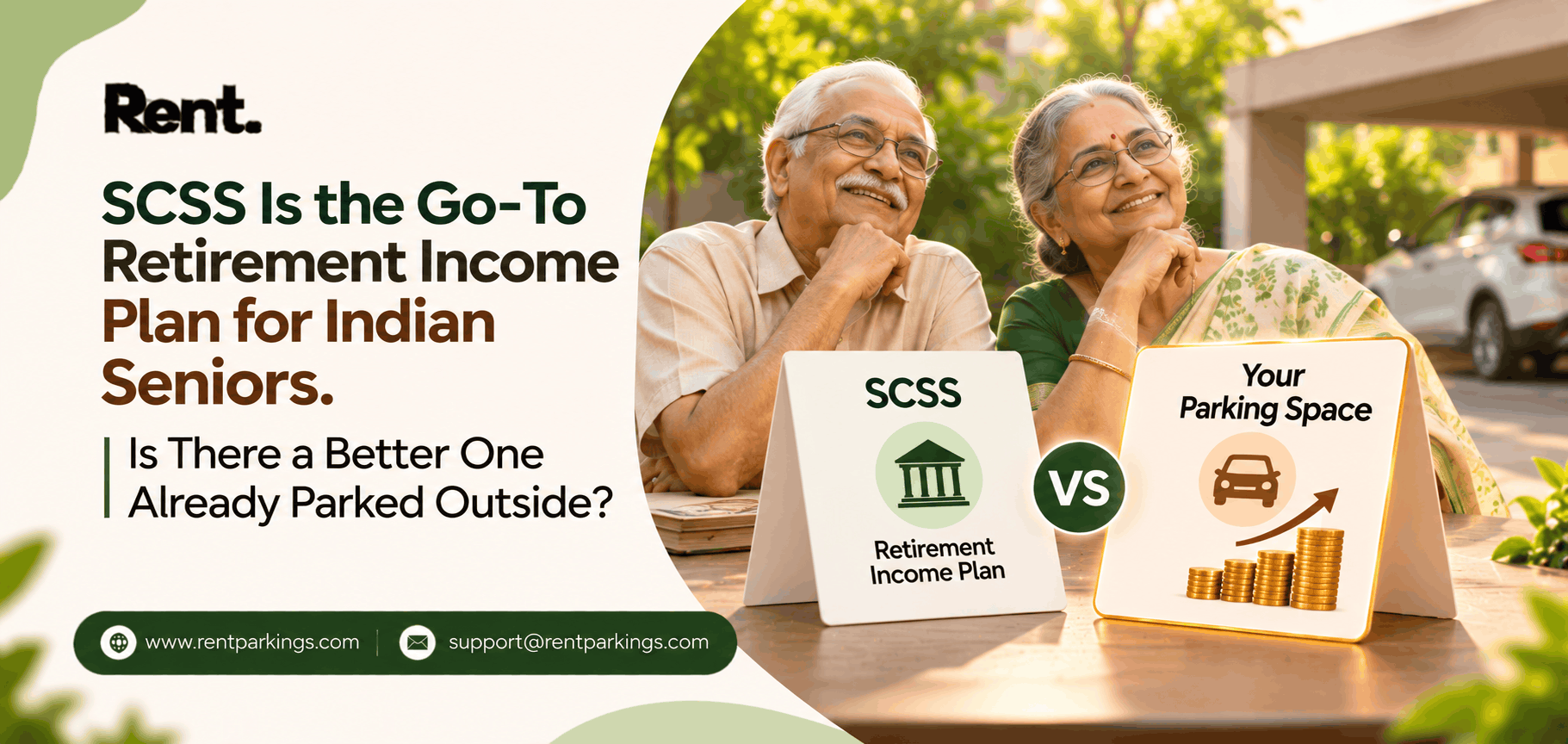
SCSS Is the Go-To Retirement Income Plan for Indian Seniors. Is There a Better One Already Parked Outside?
Every bank relationship manager in India seems to have the same pitch ready the moment a customer turns sixty. Open an SCSS account, lock in a chunk of the retirement corpus, and let the government pay a fixed return every quarter. It is safe, it is simple, and for a lot of retirees, it is the only product anyone ever brings up.
What almost nobody mentions in that conversation is the parking space sitting right outside the gate, or the second covered slot in the basement that the family's extra car stopped using years ago. On RentParkings India, property owners are listing exactly that kind of space for free and turning it into a second, far more flexible income stream, on top of whatever they have already put into schemes like SCSS.
This isn't an argument against SCSS. It is a look at what the scheme actually gives you, what it quietly costs you in flexibility, and why a parking space might be the easiest asset you own to put to work without touching a single rupee of your savings.
What the Senior Citizens Savings Scheme Actually Gives You
SCSS is a government-backed savings scheme built for Indian residents above 60 (55 in some retirement cases), available through post offices and a handful of banks. The appeal is straightforward: the principal carries a government guarantee, the interest rate is fixed for each quarter you hold the deposit, and the payout arrives on a set schedule instead of requiring any ongoing effort from you.
The scheme currently caps deposits at ₹30 lakh per person, runs for five years with an option to extend, and pays interest that is reviewed and reset by the government every quarter, generally sitting somewhere in the high single digits. For someone who wants to park a lump sum and stop thinking about it, that is a reasonable deal.
The Part of the Pitch That Usually Gets Skipped
Three details rarely come up when SCSS is presented as the obvious retirement choice.
- Interest is paid quarterly rather than monthly, so cash flow arrives in four instalments a year instead of a steady monthly rhythm.
- Breaking the deposit early carries a penalty, and the five-year lock-in means that money isn't available if an emergency turns up in year two.
- The interest earned is fully taxable, and TDS applies once a certain threshold is crossed, which quietly reduces the return many retirees assume they are getting in full.
None of this makes SCSS a poor choice. It makes it a product with real trade-offs, the same way every fixed-income instrument has trade-offs. The issue is that those trade-offs are rarely weighed against anything else already sitting in the same household, including an asset most owners stopped thinking about long ago: the parking space.
The Parking Space Doesn't Ask You to Lock Anything Away
Say there is one covered slot that the second car gave up using two years back, or a small basement garage attached to a flat that was inherited. That space has been doing nothing since the day it stopped being used, and unlike an SCSS deposit, it was never meant to sit idle in the first place.
Listing it on RentParkings does not touch the SCSS account, the fixed deposits, or anything else already set up. The lump sum keeps earning whatever it earns, and the parking space becomes a second, separate line of income running alongside it. Adding it costs nothing, and the lock-in on existing savings never has to change.
How Little Effort This Actually Takes
The How Listing Your Parking Space in India Actually Works: A 2026 Owner's Walkthrough on RentParkings breaks the whole process down in detail, but the short version is this: the owner decides the price, the owner decides whether it's rented by the hour, the day or the month, and the listing can be paused whenever plans change. There is no agent fee, no commission on what gets earned, and no obligation to keep anything listed a day longer than wanted.
That is a meaningfully different kind of control than anything SCSS offers. Nobody can call the post office and ask for a different payout schedule or a shorter lock-in period. A parking listing, on the other hand, can have its price changed, its hours adjusted, or be taken down entirely for a month while relatives are visiting.
What This Actually Looks Like in Rupees
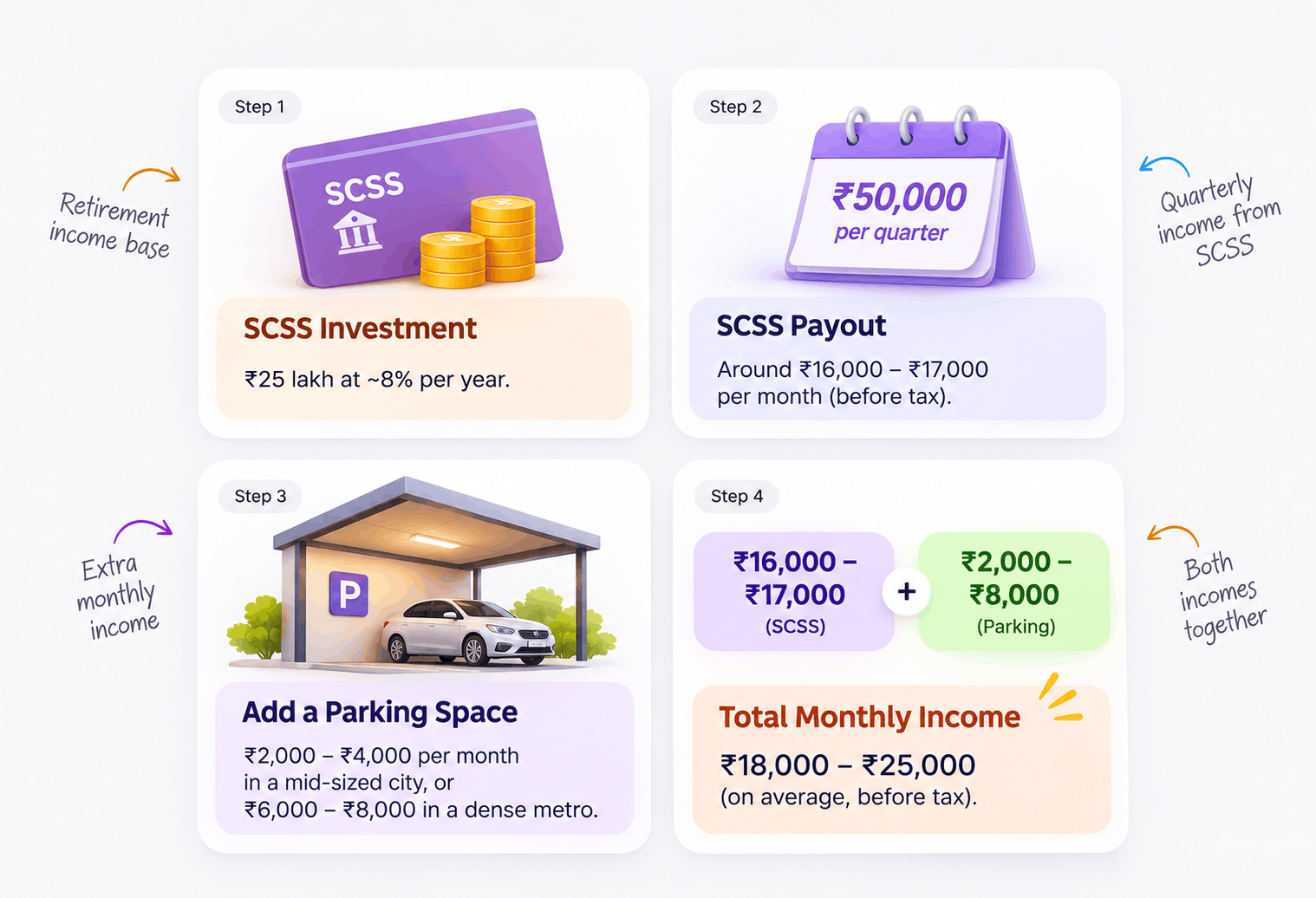
Take a simple, realistic example. A retiree with ₹25 lakh in an SCSS account earning close to 8% a year is looking at roughly ₹50,000 every quarter, which works out to somewhere around ₹16,000 to ₹17,000 a month on average, before tax.
Now add a parking space on top of that. Owners we have spoken with who list a single covered slot in a mid-sized city report monthly numbers anywhere from ₹2,000 to ₹4,000 for a basic spot, and closer to ₹6,000 to ₹8,000 in a dense metro pocket where parking is genuinely scarce. Even a stilt or covered apartment slot tends to earn more than an open one, simply because it keeps the renter's vehicle out of the sun and rain.
That number does not replace SCSS. It sits on top of it, arriving every month instead of every quarter, from an asset that was earning precisely nothing before it got listed.
"But What If Something Goes Wrong?"
This is usually where the conversation stalls, and it is a fair question for anyone handing over access to their property. Renter details are verified before a booking is confirmed, and Someone Dents a Car in Your Rented Parking Space: An Owner's Liability Guide for India walks through exactly what happens if a vehicle is damaged while parked, including what falls on the owner and what doesn't.
Most owners who hesitate here are picturing a worst case that almost never plays out in practice. The far more common outcome is a renter who shows up, pays on time through UPI or net banking, and leaves the space exactly as they found it.
Nobody Is Asking You to Give Up the Space Forever
Plenty of senior owners worry that listing a parking space means losing it the moment a grandchild visits or a family car needs the slot back. That isn't how it works. What Happens When You Need Your Parking Space Back After Renting It Out? covers this directly: the owner sets the terms, notice can be given, and short-term bookings end on schedule without any negotiation required.
Think of it less like a tenancy and more like a tap that can be turned on and off as needed. SCSS doesn't offer that choice. Once the money goes in, it stays in for five years unless the owner is willing to pay a penalty to pull it out early.
Why This Isn't Really an Either-Or Decision
Nobody needs to choose between SCSS and a parking listing, and framing it that way misses the point entirely. SCSS does exactly what it was designed to do: protect a lump sum and pay it out on a fixed schedule with government backing behind it. The parking space was never part of that plan to begin with. It was simply sitting there, unused.
How Much Can You Earn Renting Out a Parking Space in India? is worth a read for anyone who wants a broader sense of what different kinds of spaces bring in across the country, from a single open slot to a full driveway. For most retirees, the real shift isn't picking one income source over another. It's realizing there's a second one available, and it costs nothing to try.
Frequently Asked Questions
1. Is it really free to list my parking space on RentParkings?
Yes. There is no fee to create a listing, no commission taken from what is earned, and no hidden charge for staying listed. The owner decides if and when to rent the space out, and the platform never takes a cut of the monthly income.
2. Do I have to choose between SCSS and renting out my parking space?
No, and that is really the point. The SCSS deposit stays exactly as it is, earning its fixed quarterly interest. Listing a parking space that is already owned does not touch that account or require any early withdrawal.
3. How much more could I earn by listing a parking space alongside SCSS?
It depends heavily on the city and the type of space, but owners typically see anywhere from ₹2,000 to ₹8,000 a month from a single covered or open slot. That arrives on top of whatever SCSS or other investments are already paying.
4. Will I lose access to my parking space if I need it back for family?
No. The rental terms are set by the owner, including how long a booking runs, and the listing can be paused or stopped at any time. Both short-term and monthly listings allow the space to be reclaimed with notice.
5. Is income from renting out a parking space taxed like SCSS interest?
Rental income is taxed differently from SCSS interest and is generally reported under income from other sources or house property, depending on the situation. It is worth checking with a tax advisor for specifics, though it does not affect how SCSS interest itself is taxed.
6. Do I need to be comfortable with technology to list my space?
Not really. Creating a listing takes a few minutes with some photos and basic details about the space, and the process is built to be usable without any special technical skill. Anyone who can use a smartphone for basic messaging can manage a listing.
7. What happens if a renter's car gets damaged while parked in my space?
Liability generally depends on the specific circumstances and the terms agreed for that listing. Verified renter details and clear terms set upfront reduce the chances of a dispute considerably, and the full guide on RentParkings walks through common scenarios.
8. Can I rent my space out by the hour instead of committing to a full month?
Yes. Hourly, daily and monthly rentals can all be offered, individually or together. Many owners start with a monthly listing for steady income and add short-term slots during busier periods.
9. What if my parking space is my only income-generating asset besides SCSS?
That is a fairly common situation, and it is exactly where listing a parking space helps the most. It turns an asset that was earning nothing into a second income stream, without requiring any new investment or risk to the existing SCSS deposit.
10. How do I actually receive the money once someone books my space?
Payments come through UPI or net banking directly, and payouts follow a simple, trackable schedule, so there is always a clear sense of when money is due. No cash handling is involved, and there is no need to chase anyone for payment.
The Retirement Plan Doesn't Need an Either-Or
SCSS will keep doing exactly what it was built to do: protect a lump sum and pay it out safely every quarter. That part of a retirement plan doesn't need to change. What can change is the parking space outside the door that has been earning nothing since the day it stopped being used.
Listing it costs nothing, locks nothing away, and takes considerably less time than opening an SCSS account did in the first place. Start Earning from Your Parking Space on RentParkings today, and let two income streams work for retirement instead of just one.
Own an empty parking space?
List it free on RentParkings and let drivers nearby find it. There is no listing fee.
List my space freeShare This post
Search
Recent Post
The Phone Calls Start Within an Hour of...
05 Nov, 2026
Parking vs a Second Property: Which Idle...
04 Nov, 2026
The Post Office Promises a Monthly Chequ...
02 Nov, 2026
Parking Space Listing Checklist India: 1...
30 Oct, 2026
Bengaluru's Draft Parking Rules Could Ma...
29 Oct, 2026

The Real Money Near India's Airports Isn...
28 Oct, 2026

Monsoon Season Quietly Changes What a Co...
27 Oct, 2026
Madurai's Temple Crowds Fill Every Hotel...
26 Oct, 2026