

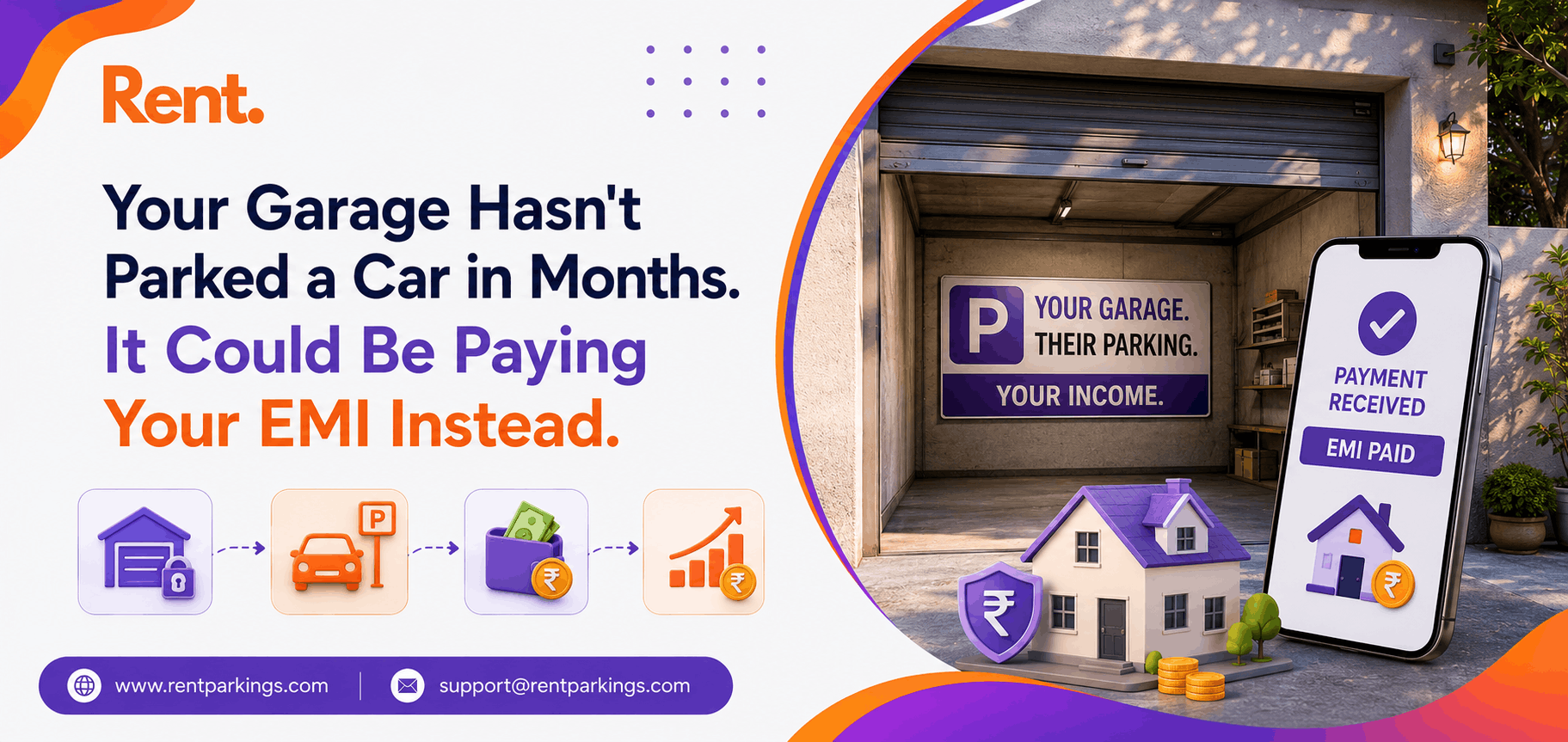
Your Garage Hasn't Parked a Car in Months. It Could Be Paying Your EMI Instead.
Walk into most Indian homes with a garage or a covered basement slot, and you'll find the same thing: a stack of old furniture, a bicycle nobody rides, maybe a carton of Diwali lights, and a car-shaped patch of empty floor. The car that space was built for either sits in the open driveway now, got sold two years ago, or never existed in the first place. Meanwhile, someone two streets away is circling the block at 8 PM, hunting for a spot to leave their scooter or hatchback overnight.
That mismatch is quietly worth money. Across RentParkings, India's parking marketplace, thousands of property owners have started treating their garage or basement bay the same way they'd treat a spare room: as an asset that can be rented out instead of a place to store boxes. If you've got covered parking sitting unused, this guide walks through what it can realistically earn, what owning that decision actually involves, and why more homeowners are choosing to list it this year than ever before.
The Garage Nobody Uses Is Still Costing You Something
It's easy to think of an empty garage as a neutral, zero-cost asset. It isn't. Property tax gets calculated on the full built-up area, including that covered slot. Maintenance charges in gated communities often factor in parking allocation too. You're paying to hold onto space that generates nothing back.
Compare that to a spare room or an unused floor, and owners rarely hesitate to rent those out. Parking gets treated differently mostly out of habit, not because there's less demand for it. In dense residential pockets of Chennai, Pune, or Hyderabad, a dry, secure, covered spot is often harder to find than a room.
Covered Parking Has an Advantage Open Plots Don't
A garage or basement bay isn't just another parking spot. It's covered, usually gated, and often has a lockable shutter or grille. For a renter, that means protection from monsoon rain, bird droppings, dust, and the casual theft risk that comes with leaving a two-wheeler out on an open street overnight.
That extra layer of security lets owners charge a premium over open or stilt parking in the same neighbourhood. It also draws a specific kind of renter: someone parking an expensive bike, a company vehicle, or a car they don't want exposed to weather for weeks at a stretch. Questions about who actually holds the right to rent out a stilt or covered slot come up often here, and the ownership rules are worth understanding before you list, as covered in this breakdown of apartment parking ownership rights in India.
What a Garage or Basement Spot Can Realistically Earn
Numbers vary a lot by city and neighbourhood, so treat these as working ranges rather than promises. Owners who've listed covered parking on RentParkings have reported figures in these bands:
- Tier-1 metro suburbs (parts of Bengaluru, Mumbai, Delhi NCR): roughly ₹3,000 to ₹7,000 a month for a single covered bay, higher near IT corridors or transit hubs.
- Tier-1 city cores with heavy congestion (South Mumbai, central Chennai): sometimes ₹8,000 or more where street parking is nearly impossible.
- Tier-2 cities (Coimbatore, Lucknow, Jaipur, Kochi): typically ₹1,500 to ₹4,000, depending on proximity to markets, hospitals, or coaching hubs.
- Short-term or hourly rentals near event venues, wedding halls, or exam centres: often higher per-day rates during peak season, even in smaller towns.
A full sense of how these figures shift city to city is laid out in this city-by-city guide to parking rental rates across India. The honest takeaway is that a garage rarely turns into a full-time income stream, but it consistently covers a real monthly expense, whether that's a portion of the EMI, the society maintenance bill, or a child's tuition fee.
Listing Costs Nothing, and the Terms Stay Yours
Here's the part that surprises most first-time hosts: putting your garage or basement parking on RentParkings doesn't cost anything. There's no listing fee, no subscription, and no charge to keep your spot live on the platform.
You also stay fully in control of how the arrangement works. That includes:
- Setting your own price, whether that's an hourly rate for occasional visitors or a flat monthly rent for a regular tenant.
- Choosing the rental format: hourly, daily, or monthly, depending on what suits your building and your schedule.
- Deciding who you accept, since verified renter details are visible before you confirm a booking.
- Editing, pausing, or removing the listing whenever your own plans change.
No broker sits in the middle taking a cut of your monthly rent. The decision to rent, to whom, and at what price rests entirely with you.
Verifying Who's Actually Parking There
A common hesitation is not knowing who will be using the space day to day. RentParkings shows renter profiles and verification details before a booking is confirmed, so owners aren't handing over access to a stranger with no track record. Security-conscious hosts have also started pairing this with basic smart parking tools, from simple CCTV to shared-gate access apps, a trend covered in this look at why parking owners in India are turning to security tech before listing their space.
Common Worries Before Listing (and What Actually Happens)
Three concerns come up in almost every conversation with a first-time host.
"What if my society objects?" Most housing societies focus on visitor parking and common areas, not what a resident does with their own allotted covered slot. It's worth checking your society bylaws once, but outright bans on renting your own designated parking are far less common than owners assume.
"What if the renter overstays or doesn't pay on time?" Clear terms set upfront, ideally in writing even if it's a simple message thread, make this easier to handle than it sounds. Monthly arrangements typically include a notice period both sides agree to before the tenancy starts.
"Is the income even worth the hassle?" For a spot that's currently earning zero rupees, almost any monthly figure is a net gain. The bigger tax and compliance picture, including what to keep track of once payments start coming in, is worth a look at in this guide to the legal, tax, and safety side of renting out parking space in India.
How the Process Actually Works
Getting a garage or basement spot listed doesn't take long. In practice, it looks like this:
- Add basic details: location, dimensions, whether it's covered or gated, and any access restrictions.
- Upload a couple of photos and set your price and preferred rental duration.
- Review renter requests as they come in and pick who you'd like to rent to.
- Confirm the booking and receive payments through UPI or net banking.
- Adjust the listing anytime your availability or pricing changes.
Most owners spend under fifteen minutes setting up their first listing. There's no paperwork to courier, no office visit, and no upfront cost at any stage.
Getting Your Space Back When You Need It
A frequent question from owners considering a monthly arrangement is what happens if they suddenly need the garage back, say a new car arrives, or a family member moves in. Building a defined notice period into the agreement from day one, even a simple 15 or 30-day window, keeps this from becoming a dispute later. Short-term and hourly listings avoid the issue almost entirely, since there's no ongoing tenancy to unwind. First-time hosts exploring how a listing actually gets set up from scratch often find it useful to walk through this guide to listing a parking space in India for the first time.
Frequently Asked Questions
1. Is it really free to list my garage or basement parking on RentParkings?
Yes. There's no listing fee, no commission on your first booking, and no subscription cost to keep your spot visible on the platform. You can list, edit, or remove it at no charge at any point.
2. Who decides the rent I charge?
You do. RentParkings doesn't set or cap your pricing. You choose the amount and whether to rent hourly, daily, or monthly based on what works for your property and neighbourhood.
3. Do I need a written agreement with the renter?
It isn't mandatory, but a short written note covering rent, duration, and notice period protects both sides and prevents misunderstandings, especially for monthly arrangements.
4. Can I rent out my garage if I only want short-term bookings?
Yes, hourly and daily listings work well for owners who want flexibility, such as renting out space only on weekends or during local events.
5. What if my apartment society has rules about parking allotment?
Check your society's bylaws for your specific allotted slot, since rules mainly target shared visitor parking rather than a resident's own designated bay. Most societies have no blanket restriction on this.
6. How do I get paid?
Payments typically move through UPI or net banking directly between you and the renter, keeping the process simple and traceable.
7. What if the renter's vehicle gets damaged while parked?
Clarifying upfront that the space is offered on an as-is basis, without owner liability for damage, is standard practice and worth stating clearly before a booking begins.
8. Can I see who's booking my space before I accept?
Yes. Renter profiles and verification details are visible before you confirm any booking, so you're not accepting requests blind.
9. How much can a single covered parking spot actually earn?
It depends heavily on city and location, ranging from around ₹1,500 a month in smaller cities to ₹7,000 or more in high-demand metro pockets, with hourly and event-day rentals sometimes earning more per booking.
10. What happens if I need my garage back for personal use?
Setting a clear notice period at the start of any monthly arrangement, typically 15 to 30 days, lets you reclaim the space smoothly whenever your own needs change.
Turning an Empty Garage Into a Habit, Not a One-Time Decision
None of this requires construction, investment, or giving up control of your property. It just requires listing a space that's already sitting there, unused, while bills keep arriving regardless. Whether it's a few thousand rupees a month or a steady stream of weekend bookings during festival season, the income adds up precisely because the space was earning nothing before.
If there's a garage, basement bay, or covered slot in your home that hasn't seen a car in months, List Your Parking Space on RentParkings and start putting it to work today.
Share This post
Search
Recent Post
What Happens When You Need Your Parking...
01 Sep, 2026
How Listing Your Parking Space in India...
31 Aug, 2026
Parking Space vs Gold: The Idle Asset Th...
28 Aug, 2026
Someone Dents a Car in Your Rented Parki...
25 Aug, 2026
Your Vacant Plot Is Not Free to Own: How...
24 Aug, 2026
Coaching Centre Parking in India: Why Ko...
21 Aug, 2026
India's PG and Co-Living Boom Has a Park...
20 Aug, 2026
Amusement and Water Park Parking in Indi...
19 Aug, 2026