

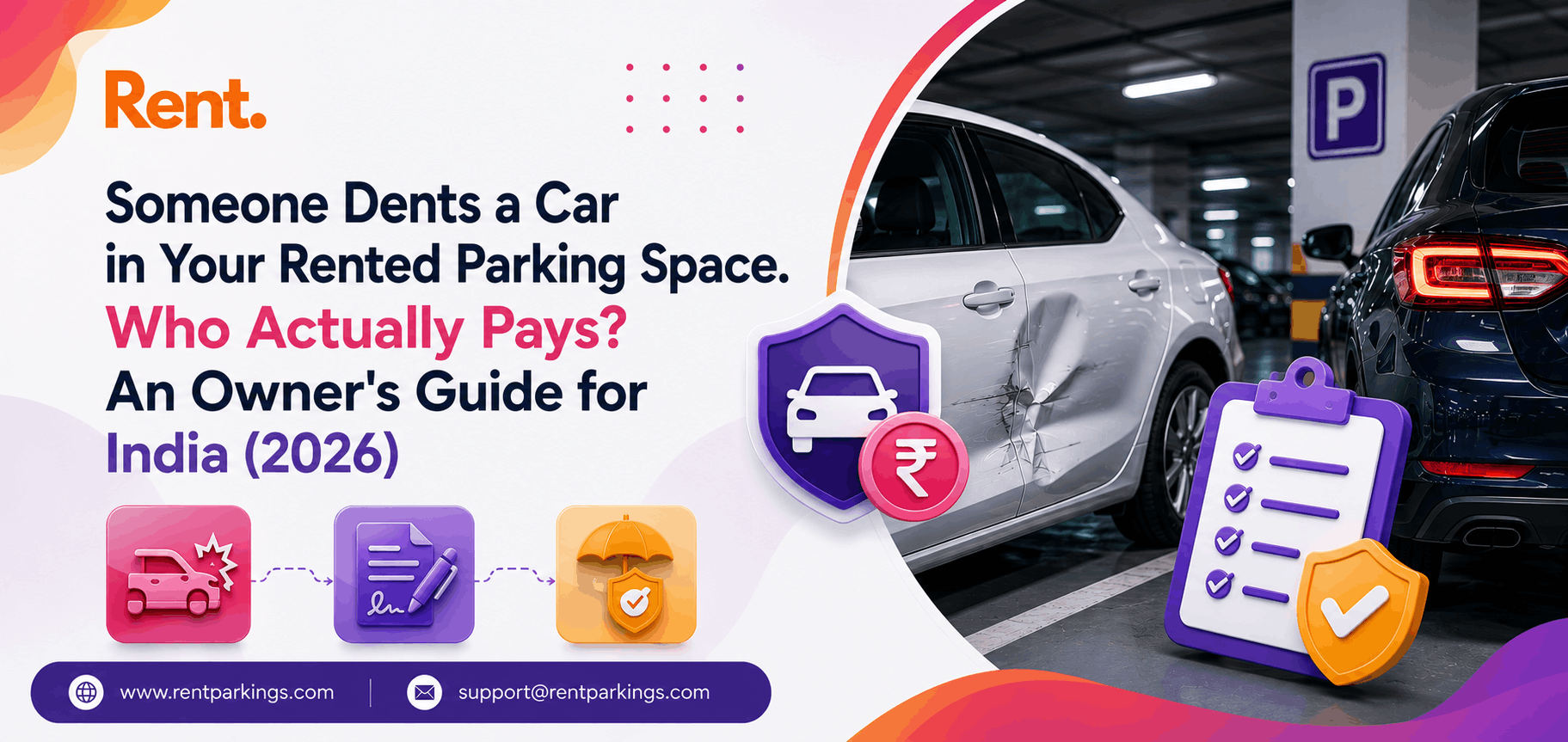
Someone Dents a Car in Your Rented Parking Space. Who Actually Pays? An Owner's Guide for India (2026)
A homeowner in Whitefield, Bengaluru, has a driveway that sits empty for close to ten hours every weekday while she's at the office. Renting it out sounds like easy money. Then one thought stops her every single time: what if someone's bumper gets scratched, or worse, the car goes missing, and she's the one left explaining herself to an angry stranger.
That one worry, more than pricing, more than paperwork, is what keeps thousands of good parking spots sitting empty across Indian cities right now. It's a fair concern to have. It's also, in most cases, based on a picture of parking rental that doesn't match how it actually works on a platform like RentParkings, India's parking marketplace.
This guide walks through what you're realistically on the hook for, what you're not, and how a few simple habits protect you before your first booking ever comes in.
Why This Fear Feels Bigger Than It Is
Most owners picture the worst version of a stranger using their property: a hit-and-run scrape, a missing side mirror, a car that never gets picked up. None of that is impossible. But it's also rare, and it's rare for a simple reason: people booking a parking spot online, paying for it upfront, and leaving their own vehicle behind aren't the ones you need to worry about causing trouble.
Owners we've spoken with who eventually did list their space usually say the same thing in hindsight: the anxiety before the first booking was worse than anything that actually happened afterward.
What Renting Out a Space Actually Looks Like
On a marketplace listing, a renter sees your space, your rate, and your rules before they ever show up. They book a specific window, usually hourly, daily, or monthly, and they pay through UPI or net banking before or right at arrival. You're not standing at the gate playing security guard, and you're not handing your property over to someone who wandered in off the street with no record of who they are.
India's broader parking shortage is exactly what makes this arrangement work in the owner's favour. Millions of vehicle owners are actively hunting for a legitimate place to park, and that gap between demand and available space is the whole argument behind turning an idle spot into a paid listing rather than letting it sit unused.
So Who Is Actually Liable If a Car Gets Damaged?
This is the part most owners never look into before deciding not to list, which is a shame, because the answer is usually more reassuring than they expect.
A few legal commentators describe an unattended, paid parking arrangement as closer to a licence to use space than a full bailment, since you never take physical custody of the vehicle the way a valet service would. That distinction matters in practice: liability for damage typically follows whoever actually caused it, whether that's the renter reversing carelessly or a third vehicle clipping a wing mirror while entering the lane.
As the property owner offering the space "as is," you're generally not on the hook for damage another driver causes, provided your listing is honest about the condition of the space and you haven't promised something you didn't deliver, like guaranteed CCTV coverage that doesn't actually exist.
None of this replaces proper legal advice. If you're listing a large commercial lot with multiple daily users, a short conversation with a local advocate about your specific terms is a sensible extra step, not a requirement most individual home or plot owners will ever need.
The Everyday Situations Worth Planning For
Three scenarios come up more often than outright theft or serious damage, and each has a straightforward answer.
Minor scratches or dings: Normal parking wear, like a light door ding from a tight space, is treated as an ordinary risk of any parking arrangement, rented or not, and rarely becomes the property owner's problem to resolve.
A car that overstays its booked slot: Set a clear overstay rate in your listing terms upfront, so there's no argument later about what happens if someone runs fifteen minutes past their booking.
A vehicle that never gets collected: This is uncommon, but having a simple written note in your terms about how long you'll hold an uncollected vehicle before contacting the renter or local authorities saves confusion if it ever comes up.
How Verified Renters Change the Picture
A stranger parking on your land with no trace of who they are is genuinely a risk. A renter who booked through a platform, paid digitally, and left a phone number and vehicle registration behind is a very different situation.
Rather than approaching this as a demand problem to be solved by more concrete and steel, India's parking shortage is increasingly being met by owners simply putting existing space to work, and the verification layer that comes with booking through a marketplace is a large part of what makes that shift feel safe enough to try.
Even something as small as photographing the space before a renter's first arrival, and asking them to note any existing marks on the surface, sets an honest baseline that protects both sides if a disagreement ever comes up.
Does This Change What Your Property Is Worth?
A reasonable next question is whether opening your parking space to renters affects the property itself, its resale value, or how buyers view it later. This ties into a broader point worth understanding about how a parking space affects flat prices and resale: in most cases, a documented history of legitimate rental income is treated as a point in the property's favour rather than a liability, since it demonstrates the space has genuine, provable earning potential rather than sitting as dead weight on a balance sheet.
Setting Ground Rules Before Your First Booking
A handful of decisions made upfront, before you ever publish a listing, prevent almost every awkward conversation later.
Describe the surface honestly: gravel, concrete, covered, open, uneven, whatever it actually is.
State clearly that the space is offered "as is," with no attendant or valet service, unless you're genuinely providing one.
Decide your hours: daytime only, overnight, or both, and stick to it consistently.
Set an overstay charge and mention it plainly in your listing notes.
Keep a simple record, even a phone photo, of the space's condition before each new renter's first booking.
None of this takes more than a few minutes, and it turns a vague worry into a short, manageable checklist.
What Owners Actually Earn Once the Fear Is Out of the Way
Once the liability question stops being a mental roadblock, the numbers tend to do the convincing. A good starting point is looking at what an empty parking space can genuinely earn across different Indian cities, since the range depends heavily on location and hours available rather than any fixed formula.
Some owners with genuinely idle plots have found that a modest, no-investment listing can realistically add several thousand rupees a month, which lines up with what other hosts describe when they convert an unused spot into steady monthly income without spending anything to get started. Others near high-footfall areas, including locations close to hospitals where visiting families are often searching for somewhere reliable to leave a car for a few hours, a demand pattern also visible in the quiet income opportunity near hospitals, have found bookings show up almost as soon as the listing goes live.
The honest answer to "how much can I actually make" depends heavily on your specific location and hours, but for most owners the real story isn't a dramatic number, it's a small, steady stream of income from space that was earning exactly nothing before.
Frequently Asked Questions
1. If a renter's car gets scratched or dented while parked in my space, am I responsible for the repair cost?
Generally no, as long as your listing accurately described the space and you didn't cause the damage yourself. Responsibility typically follows whoever actually caused the damage, not the person who simply provided the parking space.
2. Can I set my own rules about damage and liability before accepting a booking?
Yes. You control the listing description and any notes you add, so stating plainly that the space is offered "as is" and that you're not providing an attendant service is entirely your call to make.
3. What if a car parked in my space gets stolen entirely?
This is rare, and typically becomes a matter between the renter and local police rather than the property owner, since you never took custody of the vehicle the way a paid attendant would. Keeping basic renter details on file, which most bookings already provide, helps if a report ever needs to be filed.
4. How does RentParkings verify who is actually renting my space?
Bookings are made through the platform with the renter's contact details and payment on record, so you're never handing your space to a completely anonymous stranger the way you might with an informal, word-of-mouth arrangement.
5. Is listing my parking space on RentParkings actually free, or are there charges I'll discover later?
Listing is completely free, with no cost to publish, edit, or keep your space live. There's no hidden fee that shows up after the fact.
6. Do I need to buy separate insurance before I list my space?
Most individual owners renting out a single driveway, garage, or plot don't need a separate policy to get started. If you're listing a larger commercial lot with heavy daily traffic, it's worth asking your existing property insurer whether your current policy already covers incidental third-party use.
7. What happens if a renter overstays the time they booked?
You decide this in advance. Setting a clear overstay rate in your listing terms means there's a straightforward answer already in place rather than an argument in the moment.
8. Can I pause or take down my listing if I change my mind later?
Yes. You can edit, pause, or remove your listing whenever you like, and you're never locked into renting the space out indefinitely.
9. Do I need to be present every time someone uses my parking space?
No. Most owners set their availability and let bookings come in without needing to personally supervise every arrival, which is exactly what makes this a realistic source of passive income rather than a part-time job.
10. What if my housing society has rules against outside vehicles parking overnight?
Check your society's specific by-laws before listing overnight slots, since some societies do restrict outside vehicles after certain hours. Daytime-only listings are usually far less likely to run into this kind of restriction and are a safe starting point if you're unsure.
The Real Cost of Waiting
Every month a parking space sits idle out of caution is a month of income that simply doesn't come back. The liability fear that keeps so many Indian owners from listing turns out, in almost every real situation, to be smaller and more manageable than it looks from the outside.
You set the price. You set the hours. You decide whether it's hourly, daily, or a standing monthly arrangement, and you can change any of it whenever you want. List Your Parking Space on RentParkings today and turn a space that's currently earning you nothing into one that quietly pays you every month.
Share This post
Search
Recent Post
What Happens When You Need Your Parking...
01 Sep, 2026
How Listing Your Parking Space in India...
31 Aug, 2026
Parking Space vs Gold: The Idle Asset Th...
28 Aug, 2026
Your Garage Hasn't Parked a Car in Month...
26 Aug, 2026
Your Vacant Plot Is Not Free to Own: How...
24 Aug, 2026
Coaching Centre Parking in India: Why Ko...
21 Aug, 2026
India's PG and Co-Living Boom Has a Park...
20 Aug, 2026
Amusement and Water Park Parking in Indi...
19 Aug, 2026