

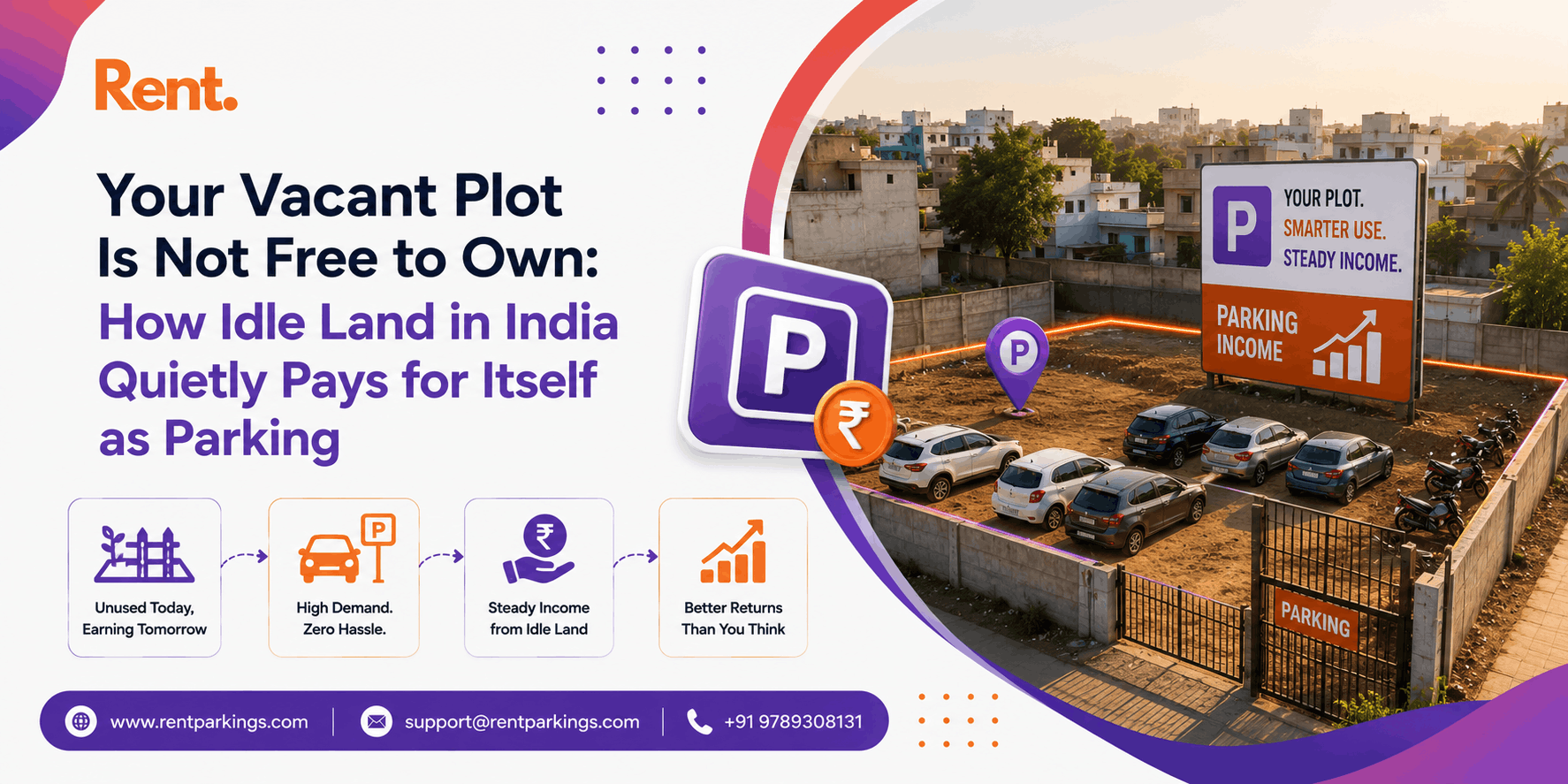
Your Vacant Plot Is Not Free to Own: How Idle Land in India Quietly Pays for Itself as Parking
Most people believe an empty plot costs nothing to hold. It just sits there, quietly appreciating, waiting for the right year to build or sell.
Open the actual ledger and a different picture shows up. Property tax goes out every year. Someone gets paid to clear the weeds before the monsoon turns the place into a mosquito farm. The boundary wall needs patching after a truck clips it. A neighbour calls to say the corner has become an informal garbage dump again, and you make a trip you did not plan for.
None of that is dramatic. Added up over twelve months, though, idle land in an Indian city is one of the few assets that charges you rent for the privilege of owning it.
Parking is the least complicated way to reverse that arithmetic. No construction, no tenancy of a building, no long lock-in. You keep the land, you keep the plans you have for it, and in the meantime the surface earns. Owners across the country are doing exactly this through RentParkings, and listing costs nothing at any stage.
The Running Cost Nobody Adds Up
Ask ten plot owners what their land costs them annually and most will say "nothing much." Ask them to itemise it and the number surprises them.
- Municipal property tax on vacant land, which several corporations now levy at higher slabs precisely to discourage idle holdings.
- Clearing overgrowth twice a year, more often if the plot sits near a market or a bus route.
- Boundary wall or fencing repairs, plus repainting the "Private Property" board after somebody pastes film posters over it.
- A watchman or a caretaker's occasional visit, sometimes shared with a neighbour.
- The slow risk that costs the most: an unattended plot invites encroachment, dumping, and unauthorised overnight parking you never agreed to.
That last point deserves attention. A plot with nobody watching it attracts exactly the activity you do not want. A plot with organised, paid, tracked vehicles on it is watched all day by people who have a reason to be there.
Why Parking Fits Idle Land Better Than Almost Anything Else
Every other use of a vacant plot demands capital or commitment. A godown needs a structure. A shop needs approvals and a tenant with a business plan. Selling means giving up the appreciation you were holding out for.
Parking asks for none of that. The surface is already the product.
What makes it work in Indian cities specifically is the shape of the demand. Vehicles have multiplied far faster than planned parking, and the shortfall does not sit politely in one place. It spills onto whichever open patch is closest, which is often somebody's unused plot, used for free, with nobody paying the owner a rupee.
Formalising that is the entire idea. The same cars park, except now they book, they pay, and you set the terms.
Who Actually Wants to Park on Your Land
Plot owners often assume parking demand means shoppers looking for an hour. That is the smallest slice of it. The steadier money sits with people who need a spot for months at a time.
Office and Corridor Commuters
If your plot sits within a comfortable walk of an office cluster, a metro station, or a hospital, you are looking at monthly renters rather than casual ones. Companies themselves have started solving their overflow by taking space from neighbouring landholders, a pattern documented in Bengaluru's Tech Parks Ran Out of Parking. So Companies Started Renting Land From Their Neighbours., where the land nobody had built on turned out to be the most useful asset on the street.
Small Fleet and Delivery Operators
Grocery, courier, and e-commerce operations run vehicles that have to sleep somewhere. Warehouse compounds were rarely designed with room for the trucks and tempos that feed them, a gap explored in India's E-Commerce Boom Built a Trillion-Rupee Warehouse Industry. Nobody Built Parking For Its Trucks.. If your plot has a wide enough gate and firm ground, a fleet supervisor is a serious prospect, and fleet contracts tend to be the longest running of the lot.
Construction and Project Crews
A large site nearby means engineers, contractors, and material vehicles arriving daily for a year or more. They are the easiest tenants to price because their need has a visible end date, which suits an owner who wants a defined term.
Event and Seasonal Traffic
Banquet halls, exhibition grounds, temples, and examination centres create bursts of demand that dwarf the daily average. The economics of that spike were broken down in Your Empty Plot Near the Temple Is Worth More on Navratri Than It Is All Year: Here's the Math, and the same logic travels to any plot near a venue with a calendar.
Two-Wheeler Clusters
Near colleges, markets, and railway stations, scooters and bikes fill a plot faster than cars do. Per vehicle the rate is lower; per square foot it is often higher, because you fit far more of them.
What Kind of Plot Works
Not every piece of land is ready on day one, but most need less than owners fear. A workable plot usually has:
- Direct access from a road wide enough for a car to turn in without a three-point struggle.
- Ground that holds up in the rain. Compacted gravel or paver blocks over the entry strip is often enough; full concreting is rarely necessary.
- A boundary of some kind, whether a wall, fencing, or even sturdy mesh, so vehicles stay inside a defined area.
- A gate or a barrier you can close, which matters more for pricing than most owners expect.
- Clear title and no ongoing dispute, since you are granting temporary use, not any right in the property.
Lighting and a camera at the gate are optional, and they pay for themselves quickly. Renters consistently choose a lit, watched plot over a cheaper dark one, which lets you price at the upper end of your locality band.
What a Plot Realistically Earns
Rates move street by street, so treat the figures below as the broad monthly bands owners report for a single car slot, not as a quotation. What a spot near a metro gate commands is nothing like what the same city pays three kilometres inland.
- Mumbai: roughly ₹3,000 to ₹6,000 per car slot per month
- Delhi NCR, Gurugram, and Noida: roughly ₹2,500 to ₹5,000
- Bengaluru: roughly ₹2,500 to ₹4,500
- Hyderabad: roughly ₹2,000 to ₹4,000
- Pune, Chennai, and Kolkata: roughly ₹1,500 to ₹3,500
- Ahmedabad and Jaipur: roughly ₹1,500 to ₹3,000
- Kochi, Lucknow, and Coimbatore: roughly ₹1,000 to ₹2,500
- Madurai and similar tier-two centres: roughly ₹800 to ₹1,800
Now do the multiplication that makes plots different from a single flat's parking bay. A modest plot that accommodates eight cars in a Hyderabad corridor at the middle of its band is earning in the region of ₹20,000 a month from land that was previously generating invoices rather than income.
Two-wheelers change the maths again. Where scooters dominate, twenty-five to thirty bikes on the same footprint at a few hundred rupees each can land in similar territory, with far less manoeuvring space wasted.
If the idea of an asset silently draining money is familiar, Your Parking Space Is Silently Burning Money. Here's How to Stop That makes the same case for covered spaces, and the reasoning scales up cleanly to open land.
You Decide the Price and the Terms
This is the part owners are most relieved to hear. Nobody assigns you a rate, and nobody dictates how you rent.
You choose the number. You choose whether the plot is available by the hour for event overflow, by the day for visiting crews, by the month for commuters and fleets, or in some combination across different corners of the land. You choose how many vehicles you are comfortable hosting, which is often fewer than the plot could technically hold, and that is entirely your call.
You also choose the calendar. If the plot must be free for three weeks in November because a family function is happening on it, you block those dates. If you decide to start construction next year, you stop accepting new monthly bookings and wind down. There is no clause anywhere that keeps your land tied up against your wishes.
Listing Costs Nothing. It Never Has.
There is no signup fee, no listing charge, no subscription, and no upfront payment of any kind to publish your plot. A vacant plot that earns nothing should not have to spend anything to start earning.
The listing itself is a short evening's work:
- Photograph the plot in daylight: the entrance, the full surface, the boundary, and the road outside.
- Add the location and describe the access honestly, including gate width and surface type.
- State how many vehicles you will accept and of what kind, whether cars, two-wheelers, tempos, or a mix.
- Set your rate and your rental terms, hourly, daily, monthly, or all three.
- Publish, and respond to enquiries as they arrive.
After that, the effort is genuinely small. A monthly renter who parks and leaves is not a tenant who calls you about a leaking tap. Most plot owners describe their involvement as a few messages at the start of a booking and nothing much afterwards, which is what passive income is supposed to look like.
The Worries Owners Raise Before They List
"Will someone claim rights over my land?"
A paid, time-bound parking arrangement is permissive use, recorded and priced, with an owner who is visibly in control of the space. That is the opposite of the abandoned, unmonitored plot that actually creates trouble. Keep your bookings documented, keep a written monthly arrangement for long-term renters, and the record shows exactly who allowed what and until when.
"What if a vehicle gets damaged on my plot?"
Set expectations at the start. Most open-plot owners rent the space, not custody of the vehicle, and say so plainly in the listing and in any monthly agreement. Lighting, a closed gate, and a camera reduce incidents to begin with, and they also make the plot easier to price.
"What if I need the land back?"
Keep monthly arrangements on a rolling basis with reasonable notice on both sides. Short cycles give you flexibility that a building tenant never would.
"How does the money reach me?"
Digital payouts, straightforwardly. UPI and bank transfers mean each booking leaves a trail, which helps you and helps your accountant at the end of the year.
"What about tax?"
Parking income is income, and treating it properly from the first month is simpler than reconstructing a year of it later. Tax on Parking Rental Income in India: The 2026 Owner's Compliance Guide lays out how owners typically report it and where GST thresholds start to matter.
What the First Month Usually Looks Like
Picture a plot near a hospital road in Coimbatore, roughly enough room for seven cars, held for a decade with no plans yet. The owner lists it on a Sunday with six photographs and a monthly rate at the middle of the local band.
Two enquiries arrive within the week, both from staff at the hospital who have been circling for parking every morning. A third comes from a courier operator wanting overnight space for two vans. By the end of the month, five of the seven slots are taken.
The owner spends perhaps an hour in total across those conversations. The weeds still need clearing before the rains, but now there is income covering it, and the plot is no longer the kind of place that gets treated as a dumping ground.
Nothing about that scenario requires luck. It requires the plot to be visible to the people already searching for space near it.
Frequently Asked Questions
1. Can I rent out a completely empty plot with no shed or structure on it?
Yes. Open land is one of the most in-demand parking formats in Indian cities because it takes larger vehicles and more of them. You need road access, a defined boundary, and ground that stays usable in the rain. A structure adds nothing to the basic arrangement.
2. Does listing my plot on RentParkings cost anything?
No. Creating your listing is free, and it stays free. There is no signup charge, no monthly fee, and nothing to pay before your plot goes live. Land that has been sitting idle should not need an investment to start producing.
3. Who decides the rent for my plot?
You do, entirely. You set the figure and revise it whenever you want. Look at what similar spaces near you are charging, then price where you are comfortable, and adjust once you see how quickly enquiries come in.
4. Can I offer only monthly rentals and skip hourly bookings?
Yes. Hourly, daily, and monthly are options, not obligations. Many plot owners prefer monthly renters for the predictability and simply do not enable shorter durations. The rental terms are yours to shape.
5. How many vehicles should I allow on my plot?
Fewer than the maximum it could physically hold. Leave turning room and a clear path to the gate, because a plot that is painful to exit gets poor reviews and loses renters. Comfortable spacing usually earns more over time than a tightly packed surface.
6. Do I need to level or concrete the whole plot first?
Rarely. Most owners firm up the entry strip and any soft patches with gravel or paver blocks and leave the rest as it is. Full concreting is a choice for the long term, not a requirement for listing.
7. What happens if a renter stays past the agreed period?
Agree the end date in writing at the start and keep monthly terms rolling with clear notice. Overstays are uncommon when the arrangement is documented, and where they happen, a written record and a dated payment trail settle the matter quickly.
8. Is this really passive, or will I be at the plot every day?
For most owners it is close to passive. The active part is the listing and the first few messages with a new renter. Monthly parkers arrive and leave on their own schedule, and they need nothing from you in between.
9. Can I pause my listing if I decide to build on the land?
Yes. Stop accepting new bookings, let the existing ones run out their notice period, and take the listing down. Parking is a temporary use of the surface and was never designed to stand between you and your plans.
10. Will parking income affect how my land is treated for tax?
The income needs to be reported like any other income, and keeping digital records from day one makes that simple. GST becomes relevant only past turnover thresholds, which most single-plot owners never approach. A short conversation with your accountant in the first month settles it for good.
Land That Waits Can Also Earn
Holding a plot for the future is a reasonable decision. Letting it cost you money every year while it waits is not.
Parking asks nothing of the land except that it stay flat and accessible. You name your price, you pick between hourly, daily, and monthly terms, you decide how many vehicles come in, and you stop whenever your plans change. Publishing the listing costs nothing, and the vehicles looking for space near your plot are already circling the block.
If the surface is going to sit there regardless, it may as well pay for its own upkeep. Start Earning from Your Parking Space today, set your own rate, and let a verified renter turn your idle plot into income that arrives every month without you doing much at all.
Share This post
Search
Recent Post
What Happens When You Need Your Parking...
01 Sep, 2026
How Listing Your Parking Space in India...
31 Aug, 2026
Parking Space vs Gold: The Idle Asset Th...
28 Aug, 2026
Your Garage Hasn't Parked a Car in Month...
26 Aug, 2026
Someone Dents a Car in Your Rented Parki...
25 Aug, 2026
Coaching Centre Parking in India: Why Ko...
21 Aug, 2026
India's PG and Co-Living Boom Has a Park...
20 Aug, 2026
Amusement and Water Park Parking in Indi...
19 Aug, 2026