

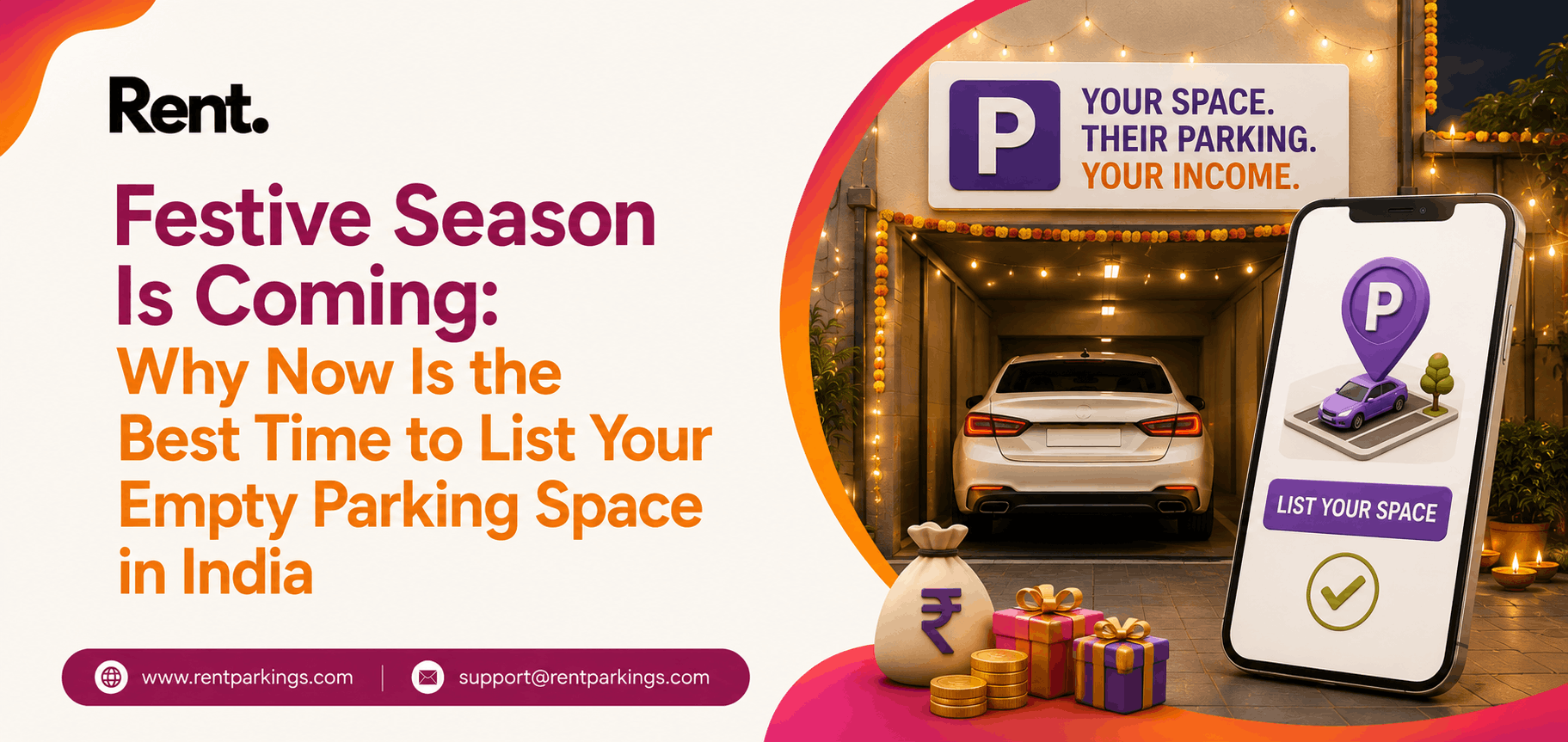
Festive Season Is Coming: Why Now Is the Best Time to List Your Empty Parking Space in India
Take a walk through any market street in Chennai, Pune or Lucknow two or three weeks before Diwali, and you'll notice the parking problem before you even find a place to stand. Cars parked three deep. A scooter wedged sideways between a lamppost and a shuttered shop. Someone reversing out slowly while four people wave directions from four different angles.
This scene repeats itself in dozens of Indian cities every festive season, and every year, thousands of driveways, basements and vacant plots sit within a five-minute walk of all that chaos, doing absolutely nothing.
That gap between demand and supply isn't a traffic problem you're responsible for solving. It's an income opportunity sitting right outside your gate. If you own a parking spot, a garage, or even a patch of unused land near a market, temple, mall or busy residential pocket, RentParkings exists specifically to connect owners like you with people actively searching for somewhere to park, on your terms, with no long-term commitment required.
This is written for property owners in India who have unused space and want a straightforward answer to one question: is the next couple of months actually a good window to list it, and what would that involve?
Why Festive Season Quietly Rewrites the Parking Math
Parking demand in most Indian cities isn't spread evenly across the calendar. It spikes hard around specific windows: Navratri and Dussehra pandals, Diwali shopping weekends, wedding season overlapping the same months, and year-end holiday travel. During these weeks, formal parking near markets, temples, and event venues runs out fast, sometimes hours before the actual rush begins.
Owners we've spoken with who list space near these zones describe the difference as noticeable enough to plan around. A driveway that attracts zero interest in July can become, for six to eight weeks starting in October, one of the more useful pieces of real estate on that stretch of road, simply because a temple lane two hundred metres away is suddenly overwhelmed.
None of this requires spending money on your property. You don't need to build a shed, pour concrete, or hire a guard. You need to make the space you already have visible to people looking for exactly that, which is what listing on RentParkings actually does.
Which Kinds of Space Suddenly Become Valuable
More property types qualify for festive-season demand than most owners assume. A few examples:
- A driveway or open yard within walking distance of a market, mandir, gurdwara or church that pulls bigger-than-usual crowds during Navratri, Diwali or a local festival.
- A vacant plot near a temporary pandal, exhibition ground or fairground that only gets set up for a few weeks a year.
- A basement or stilt parking bay in a residential building close to a shopping street, especially useful if your own vehicle usage drops while you're travelling for the holidays.
- A shop's forecourt or commercial frontage that sits empty after closing hours, right when evening festive crowds are hunting for somewhere to leave their car.
- Farmhouse or weekend-home parking along highway routes that see heavier weekend traffic as families head out of the city during the season.
Owners with a driveway sitting idle most days have an especially easy starting point here, and a good number of them have already worked through the basics in Rent Out Your Driveway, which walks through what a driveway listing typically looks like once it's live.
What This Actually Means for Your Bank Balance
It's worth being honest about the numbers instead of throwing around one big headline figure. What an owner earns from festive-season parking depends heavily on location, how close the spot is to the actual crowd-pulling event, and how many hours a day it's genuinely available.
That said, several owners near festival zones and market streets have reported earning meaningfully more during a six-to-eight-week festive stretch than they would in an ordinary month of routine commuter parking, sometimes two to three times as much, because demand is concentrated and people are willing to pay for a guaranteed spot when they're already short on time and patience.
The part that tends to surprise first-time hosts is how much control they keep throughout. You decide whether to rent by the hour for a shopper making a quick temple visit, by the day for a wedding guest, or by the month if you'd rather lock in a season-long arrangement. Nobody assigns you a rate. You set it, you can change it, and you can pause the listing the moment the rush ends and you want the space back.
This pattern, sharp spikes around specific big days rather than a flat daily trickle, is something a number of owners have quietly been earning from long before festive season became an obvious hook. It's the same logic behind Rent your parking on the big days: the quiet way Indians are earning from empty spots, which looks at exactly this kind of event-driven income beyond just the festive calendar.
"Is It Even Worth the Hassle for a Few Weeks?"
This is usually the first objection that comes up, and it's a fair one. Nobody wants paperwork, phone calls and unfamiliar people showing up at their gate for a seasonal side income that might not amount to much.
Here's the more accurate picture. Listing your space costs nothing, and it stays live for as long as you want it to. There's no fee to publish a listing, no commission just for being visible, and no obligation to accept a booking you're not comfortable with. If nobody books it, you've lost nothing. If someone does, the platform handles the discovery and payment while you decide who gets access and for how long.
The owners who describe it as "not worth the hassle" are usually the ones who never actually switched a listing on to find out. The ones who did, even for a single festive stretch, generally describe it as far less effort than expected: a few photos, a price they picked themselves, and mostly just approving bookings from a phone afterwards.
How Listing Works Before the Season Starts
If this is your first time doing it, the process is shorter than most owners expect.
- Create a free account and add basic details about your space, its location, and roughly when it's available.
- Upload a couple of clear photos so renters know exactly what they're booking.
- Set your own price and choose hourly, daily or monthly bookings, or a mix depending on the day.
- Turn the listing on and leave it there. You're never obligated to accept every request that comes in.
- When a booking request arrives, review the renter's details, approve or decline, and receive payment directly, typically through UPI or net banking.
You can edit the price, pause the listing on days you need the space for family visiting over the festival, and switch it back on the moment you're free again. If you're curious what a realistic range actually looks like once you factor in your city and locality, How Much Can You Earn Renting Out a Parking Space in India? (2026 City-Wise ₹ Guide) breaks that down city by city.
A Rough City-by-City Sense of What's Realistic
Rates vary a lot by locality, even within the same city, so treat the following as a general sense rather than a fixed number. These are approximate patterns reported by owners near festive-demand zones, not fixed platform pricing.
- Chennai: driveways near Mylapore, T Nagar and other temple-adjacent markets tend to see the sharpest short-term spikes during Navratri and temple festival days.
- Bengaluru: basement and stilt spots near commercial stretches like Indiranagar or Jayanagar pick up extra weekend and evening demand through the season.
- Hyderabad: plots near Old City and market areas around Diwali shopping weekends see some of the steadiest short-term bookings.
- Mumbai and Pune: driveways near pandal locations and busy market streets during Navratri routinely run out of formal parking within a few hours of opening.
- Delhi NCR, Noida and Gurugram: farmhouse and weekend-home parking along highway routes sees a bump as families travel out of the city on festival weekends.
- Ahmedabad: garba and Navratri pandal zones create some of the most concentrated short-window demand anywhere in the country, a pattern explored in depth in Your Empty Plot Near the Temple Is Worth More on Navratri Than It Is All Year: Here's the Math.
- Kochi and Coimbatore: temple festival routes and market lanes see a similar pattern on a smaller, more localised scale.
- Jaipur and Lucknow: old-city market lanes near festival shopping areas fill up fast once the season starts.
- Kolkata: neighbourhoods along pandal-heavy pujo routes see a version of the same crunch during Durga Puja.
- Madurai: temple-town traffic during major festival days creates a similar squeeze around the core market area.
What Owners Usually Worry About Before Saying Yes
Two concerns come up more often than any other. First, who exactly is going to be parking there. Second, what happens if something goes wrong while a car is on your property.
On the first point, renters go through verification steps on the platform before a booking is confirmed, so you're not handing over gate access to someone who simply walked in off the street. On the second, most owners keep it simple: a clear description of the space, sensible terms about hours and access, and a written agreement through the platform rather than a verbal understanding that's hard to point back to later.
None of this needs to be complicated, and owners who've been through even one booking cycle almost always describe it as a smaller lift than they expected going in.
Why the Next Couple of Months Matter More Than the Rest of the Year
Festive season doesn't just bring more demand, it brings demand that's willing to pay for certainty. Someone driving two hours to a family wedding, or trying to reach a crowded pandal with kids in tow, isn't in the mood to circle the block for twenty minutes hunting for a spot. They'll pay for a guaranteed space booked in advance, and that's exactly the kind of renter a listing on RentParkings tends to attract this time of year.
If your space has sat empty for months or years, trying this out costs you close to nothing. The real cost is watching the same opportunity go to a driveway one street over that took ten minutes to list, an idea covered from a different angle in How to Turn Your Empty Parking Space Into ₹6,000/Month — No Investment Needed.
Frequently Asked Questions
1. Is it really free to list my parking space on RentParkings?
Yes. Listing your space costs nothing, and there's no fee just for keeping the listing live. You only deal with money once an actual booking comes through, at the price you set.
2. Do I have to commit my space for the entire festive season?
No. You can list it for a single day, a specific week, or the whole season, and you can pause or switch off the listing whenever you want the space back for personal use.
3. Can I set different prices for hourly, daily and monthly bookings?
Yes, you decide the pricing structure entirely. Many owners charge higher hourly rates on peak festival days and switch to a flat monthly rate the rest of the year.
4. How do I actually receive the payment?
Payments are typically settled through UPI or net banking, tied directly to the booking you approved, so you're not chasing anyone for cash afterwards.
5. What if my housing society or RWA has rules about parking?
Most society rules target long-term structural changes or disputes between residents, not short-term, owner-approved parking on your own allotted space. It's worth a quick check if you're unsure, but this rarely blocks a straightforward arrangement.
6. Will strangers just show up without any verification?
No. Renters go through verification steps on the platform before a booking is confirmed, so you have visibility into who's requesting access before you approve anything.
7. What if something gets damaged while parked on my property?
Setting out clear terms about hours of access and any specific instructions before you approve a booking reduces most disputes before they ever start. A written agreement through the platform helps more than a verbal understanding would.
8. Do I need to be home every time someone uses my parking space?
Not necessarily. Many owners with driveways or basement parking manage bookings entirely through their phone without being physically present for every handover.
9. Is festive season the only good time to list my space?
No. Festive season is simply when demand spikes hardest in most areas, but plenty of owners keep listings active year-round for daily commuters, exam-season crowds and local events.
10. How much ongoing effort does managing a listing actually take?
Once your listing is live, most of the work is just approving or declining booking requests as they arrive. There's no daily maintenance required beyond that.
Conclusion
Festive season in India has a way of turning ordinary streets into a scramble for parking, and that scramble isn't going to sort itself out. What can change is whether your unused driveway, plot or basement spot becomes part of the solution, or just stays another empty patch nobody knows about.
Listing costs you nothing, the price is entirely yours to decide, and you can switch it off the moment the season winds down or you need the space back for yourself. Start Earning from Your Parking Space on RentParkings and find out what your spot near this year's festival crowd could actually be worth.
Share This post
Search
Recent Post
What Happens When You Need Your Parking...
01 Sep, 2026
How Listing Your Parking Space in India...
31 Aug, 2026
Parking Space vs Gold: The Idle Asset Th...
28 Aug, 2026
Your Garage Hasn't Parked a Car in Month...
26 Aug, 2026

Someone Dents a Car in Your Rented Parki...
25 Aug, 2026
Your Vacant Plot Is Not Free to Own: How...
24 Aug, 2026
Coaching Centre Parking in India: Why Ko...
21 Aug, 2026
India's PG and Co-Living Boom Has a Park...
20 Aug, 2026