


Your NPS Account Looks Impressive on Paper. Most of That Money Still Isn't Yours to Spend.
A 44-year-old deputy manager at a PSU bank in Coimbatore checks his NPS statement once a year, usually around tax-filing season. The number on screen keeps climbing. It looks like progress, and in a narrow sense it is.
But ask him when he can actually touch that money and the mood shifts. Not now. Not at 50. Not even fully at 60, when the scheme finally lets him in, because a chunk of it has to be converted into an annuity whether he wants the annuity or not. For a man who built that corpus one disciplined deduction at a time, it is a strange kind of ownership: his name is on the account, but the terms are written by someone else.
Downstairs, in the same building, there is a covered parking bay that came with his flat. His wife drives, he doesn't own a second car, and the bay has sat empty for three years. Unlike the NPS corpus, that space could start paying him this month, in money he can spend the same week it arrives, with no sixty-year waiting period attached. Owners across RentParkings, India's parking marketplace, are already doing exactly that with spaces just like his.
This isn't an argument against NPS. It's a government-backed scheme with real tax advantages and a genuine place in a retirement plan. The argument is simpler: if you're already relying on a product that locks your money away for decades, it's worth knowing that a different kind of asset, one you already own, doesn't have to work the same way.
Listing Costs You Nothing. The Space Just Sitting There Can Start Paying You Every Month.
Before going further into NPS and its rules, here's the part worth saying plainly, because it's easy to lose under all the retirement-planning detail: putting your parking space up on RentParkings doesn't cost a single rupee. There's no listing fee, no charge just to appear in search, and nothing deducted from your first booking to "activate" anything.
What this really comes down to is simple. A space you're not using, sitting idle month after month, can be turned into a space that earns you money every month instead. A driveway nobody drives into anymore, a covered bay that's been empty since the second car was sold, a plot near your shop that's never once been rented out: each one has the same potential, and none of it needs you to spend anything to get started.
You decide what that income looks like. A few hours for a visiting relative's driver, a daily booking near a business district, or a straightforward month-to-month tenant parked outside your gate: the arrangement, and the price you attach to it, stays entirely in your hands.
That's the real contrast with a scheme like NPS. One asks you to contribute for decades before it pays you back on its own schedule. The other is a space you already own, doing nothing today, that can be free to list and earning a monthly income by next week, on terms you set yourself.
What NPS Actually Promises, and What It Doesn't
The National Pension System asks for discipline in exchange for a long runway. Contributions to the main Tier I account stay locked until you turn 60, with only narrow exceptions along the way: a specified medical emergency, a child's wedding or higher education, or a first home purchase, and even then the withdrawal is capped at a quarter of your own contributions and allowed only a handful of times across the entire tenure.
When 60 finally arrives, the rules still don't hand everything over. At least 40 percent of the accumulated corpus must go into buying an annuity, and whatever monthly pension that annuity pays out afterward is taxed as regular income. The remaining portion can usually be withdrawn as a lump sum, but by then the money has already spent decades doing exactly one thing: waiting.
There's also no fixed, promised return. NPS money is invested across equity, corporate bonds and government securities in proportions the subscriber chooses, so the final corpus depends on how markets behave over that stretch of years. Many subscribers find that out only when they finally sit down and read the fine print, usually well after they've already committed a decade of contributions.
None of this makes NPS a bad product. Its tax deduction under Section 80CCD, on top of the regular 80C limit, is one of the more generous breaks available to salaried Indians. The point is narrower: it is built to be slow, and it is built to be rigid, by design.
What an Idle Parking Space Pays, Starting This Month
A parking spot works on a completely different clock. There's no vesting period, no age threshold, and no government form standing between you and the money. Owners who list a spare slot on RentParkings describe earnings that range quite a bit by location: a basic residential bay in a smaller city might bring in somewhere between ₹2,000 and ₹4,000 across a month, while a covered spot near a business district in Bengaluru, Mumbai or Gurugram can cross ₹10,000 without much difficulty.
The earnings that an empty parking space can realistically generate depend heavily on locality, visibility and whether the bay is covered, but the mechanics behind getting there are the same everywhere. You list the space, you set a price, and the first booking can land within days rather than decades.
That immediacy is the part an NPS statement can never offer. A 22-year-old who starts an NPS account today won't see a rupee of it until 2064 at the earliest. A parking space that's sat empty since last month can be earning by the weekend.
Locked-In Money Versus Liquid Money: What Actually Separates Them
Put the two side by side and the real difference isn't the size of the eventual payout. It's who controls the timeline and the terms.
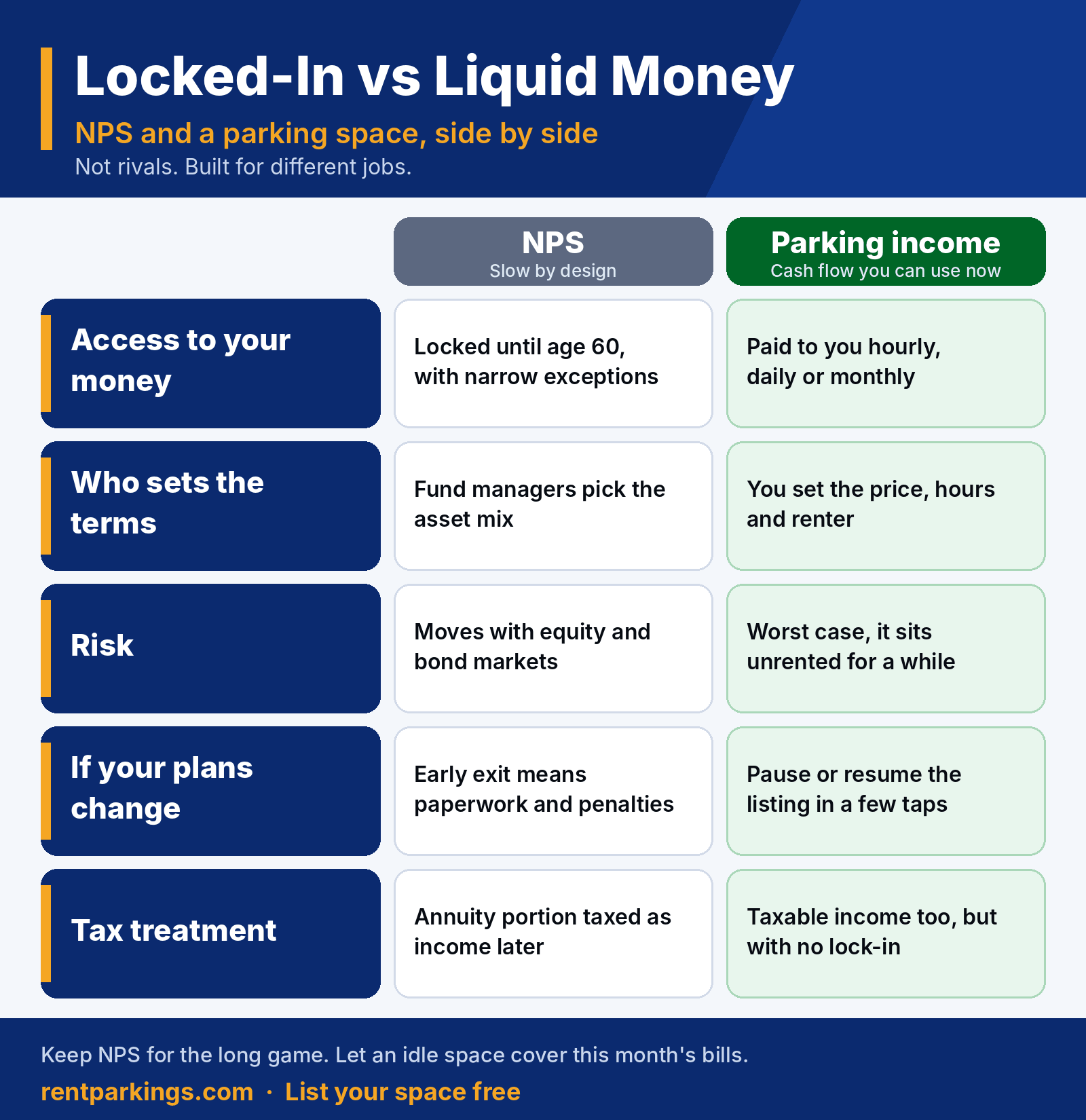
- Access to your own money: NPS keeps your contributions out of reach until 60, with a handful of narrow exceptions. Parking income lands in your account on whatever cycle you choose, hourly, daily or monthly.
- Who sets the terms: NPS fund managers decide the asset allocation within regulatory limits. As the owner of a parking space, you decide the price, the hours it's available, and who can book it.
- Risk of loss: NPS returns move with equity and bond markets and are never guaranteed. A parking space doesn't fall in value overnight the way a mutual fund can; at worst, it simply sits unrented for a while.
- What happens if your plans change: Exiting NPS early or altering your contribution pattern involves paperwork and penalties. Pausing a parking listing takes a few taps, and resuming it takes just as few.
- Tax treatment: NPS contributions get a dedicated deduction, but the annuity portion is taxed later as income. Parking rental income is also taxable, but it isn't tied to any lock-in, so you keep both the flexibility and the obligation to declare it honestly.
Seen this way, the two aren't really competitors. One is built for forced, long-horizon saving. The other is built for cash flow you can use right now, this quarter, this festival season, this college-fee deadline.
A Rough Side-by-Side, in Plain Numbers
Say a mid-career professional contributes roughly ₹5,000 a month to NPS. Across 18 years, with market-linked growth that nobody can promise in advance, that discipline builds toward a retirement corpus, most of which still won't be spendable the moment it's needed for something urgent today.
Compare that with a parking bay rented out for somewhere between ₹1,500 and ₹8,000 a month, depending on the city and the spot's visibility. Over the same 18 years, assuming nothing more ambitious than steady occupancy, that income has already been spent, saved, reinvested or used to pay down a loan, in real time, as it arrived. The parking slot itself typically keeps or gains value as a property asset on top of whatever it earned along the way, which is a combination NPS simply isn't structured to offer.
"But NPS Has Better Tax Benefits." Fair Point. Here's the Honest Answer.
This objection deserves a straight response rather than a dismissal. NPS's Section 80CCD(1B) deduction is genuinely useful, and nothing about renting out a parking space replaces that benefit or should be expected to.
The two aren't mutually exclusive, and treating them as a forced choice is where a lot of retirement planning goes wrong. Keep contributing to NPS for the long-term, tax-advantaged portion of your plan. Use the parking income for the things NPS structurally can't help with: this month's school fees, an unplanned repair, a down payment you don't want to wait fifteen years to assemble.
Owners who lean into this combination often end up diversifying further than just the car bay itself. A single plot can earn from more than one type of vehicle or occasion, splitting hours between a two-wheeler commuter on weekdays and an event booking on weekends, which stacks cash flow on top of whatever the long-term retirement product is quietly doing in the background.
Who Should Actually Use Both, Rather Than Pick One
If you're salaried, already contributing to NPS for the tax break, and sitting on a parking space that hasn't earned a rupee in years, the sensible move usually isn't to abandon NPS. It's to stop treating an idle asset as if it has no role to play simply because it isn't labeled "retirement product."
This matters even more around predictable spikes in demand. A plot near a temple or a popular venue can earn disproportionately more during specific festival weeks than it does the rest of the year, and that seasonal bump is money an NPS account will never generate no matter how long you wait.
Retirees and near-retirees have the most to gain here, simply because they're often the ones asking what else their locked-up savings can be paired with. A parking space doesn't ask for a 60th birthday before it starts contributing.
How Simple Starting Actually Is
The appeal of a parking rental income isn't just that it starts sooner. It's that getting there takes almost no effort compared to the forms, nominee declarations and fund-manager choices that come with opening an NPS account in the first place.
Listing a spare bay on RentParkings is completely free, with no listing fee, no commission taken just to appear in search, and no subscription of any kind. A single afternoon booking, a weekly arrangement with a nearby office-goer, or a straightforward month-to-month tenant are all options you set yourself, and you're free to switch between them whenever your own plans change.
Modern conveniences have made this even less of a hassle than it used to be. An owner who's added an EV charging point near their allotted bay can price that differently from a plain parking slot, since electric-vehicle owners are often willing to pay a premium for guaranteed charging access.
None of this requires the space to be glamorous. It needs to exist, it needs an owner willing to list it, and it needs about ten minutes to get online.
Frequently Asked Questions
1. Does listing my parking space on RentParkings cost anything?
No. Creating a listing is completely free, with no fee charged simply for appearing in search results or for keeping the listing live month after month.
2. Who decides the rental price, me or RentParkings?
You do. RentParkings doesn't set rates on your behalf; you choose the hourly, daily or monthly price based on your locality and how much control or flexibility you want to offer renters.
3. Is NPS income taxed the same way as parking rental income?
No. The NPS annuity portion is taxed as regular income once payouts begin after 60. Parking rental income is typically treated as income from other sources and should be declared in the year it's earned, regardless of your age.
4. Can I really withdraw parking income whenever I want, unlike NPS?
Yes. There's no lock-in period attached to rental income the way there is with NPS contributions. Whatever a renter pays you is yours to use immediately, without waiting for any age threshold or exit rule.
5. Should I stop contributing to NPS and rely on parking income instead?
Not necessarily. NPS still offers a tax deduction that parking income doesn't replicate, so most owners are better off treating the two as complementary rather than choosing one over the other.
6. What if I only have the parking space, not a flat, to rent out?
That's fine. Plenty of listings on RentParkings come from owners of standalone plots, commercial bays or farmhouse driveways who never lived on the property, not just flat owners with a spare slot downstairs.
7. How much paperwork does listing a space actually involve?
Very little. You typically need basic ownership or occupancy proof and a few photos of the space; there's no lengthy application process comparable to opening a long-term investment account.
8. Will my housing society object to me renting out my own allotted bay?
Society rules vary, and it's worth checking your RWA's specific bylaws, but renting out a bay you already hold rights to is generally a matter between you and the renter rather than something that needs blanket society approval.
9. What happens if I need the parking space back for my own use later?
You can pause or end a listing whenever your circumstances change. Most bookings are structured in a way that lets you resume personal use without needing to give up the listing permanently.
10. Is renting out a parking space actually a meaningful amount of money, or just pocket change?
It depends on the locality, but owners in high-demand areas near IT corridors, metro stations or business districts often report monthly income that comfortably covers a maintenance bill or a loan EMI, which is far from pocket change for an asset that was otherwise earning nothing.
The Spot Downstairs Doesn't Need a Retirement Age
NPS will keep doing what it was designed to do: build a long-term, tax-advantaged corpus that becomes available on its own schedule, not yours. That's a legitimate role in anyone's financial plan, and nothing here argues otherwise.
But an empty parking bay was never meant to sit idle for the next twenty years waiting for a government-defined exit window. It can start earning in the time it takes to list it, set a price, and let someone book it. List your parking space for free on RentParkings and let it start paying you back while your other investments are still busy waiting.
Own an empty parking space?
List it free on RentParkings and let drivers nearby find it. There is no listing fee.
List my space freeShare This post
Search
Recent Post

A Whitefield Techie and a Jayanagar Reti...
12 Nov, 2026

The Renter Never Showed Up. Here's What...
11 Nov, 2026

Noida's Parking Market Has Five Differen...
10 Nov, 2026

Gurugram's Glass Towers Charge ₹120 a Sq...
09 Nov, 2026

SCSS Is the Go-To Retirement Income Plan...
06 Nov, 2026

The Phone Calls Start Within an Hour of...
05 Nov, 2026
Parking vs a Second Property: Which Idle...
04 Nov, 2026
The Post Office Promises a Monthly Chequ...
02 Nov, 2026