

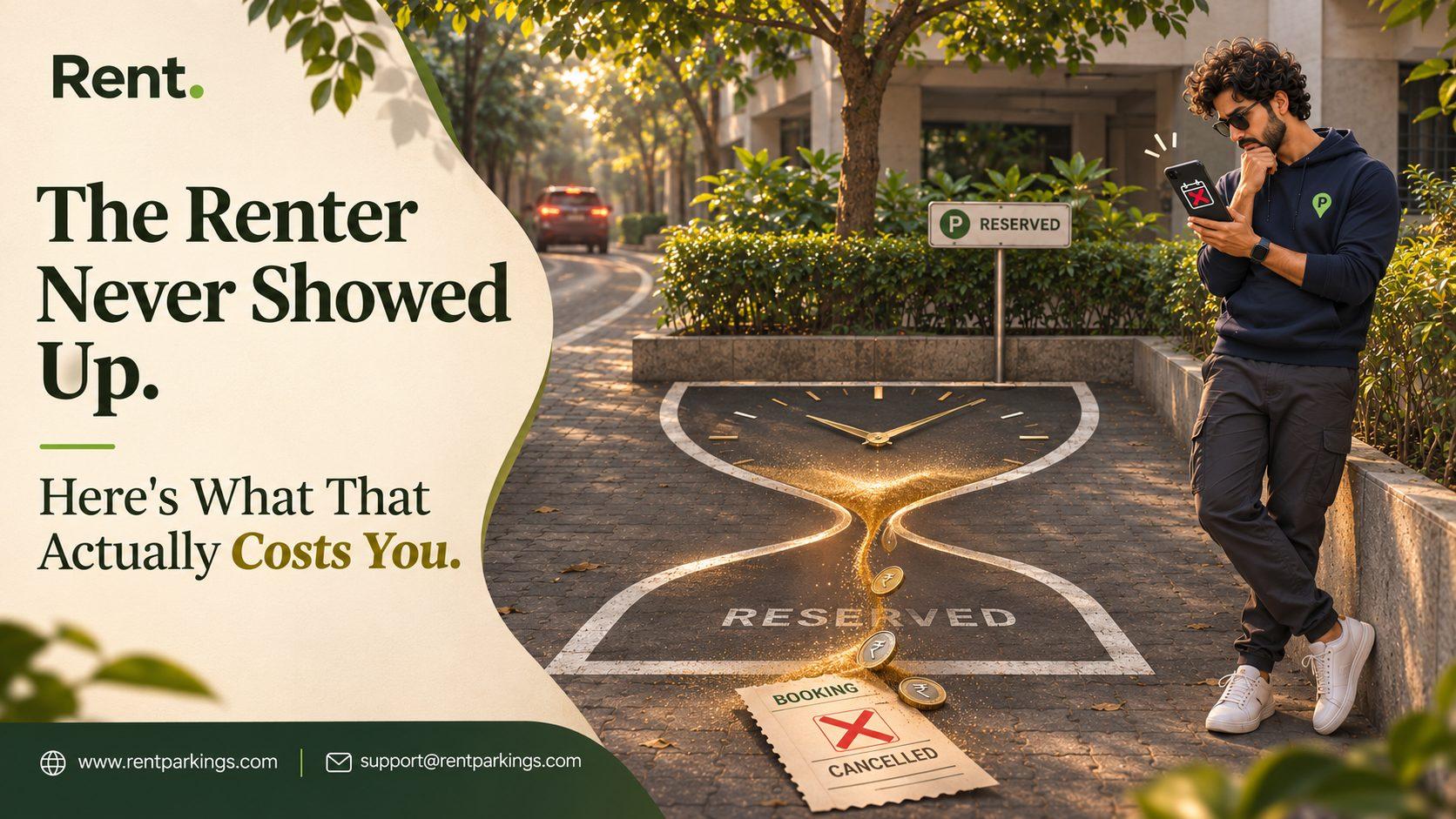
The Renter Never Showed Up. Here's What That Actually Costs You.
Picture a second-floor apartment owner in Chennai checking their phone at twenty past six. A renter confirmed a booking for their spare covered bay starting at six. Nobody has pulled in yet.
The owner isn't thinking about the two hundred rupees they might lose tonight. They're thinking about whether they made a mistake by listing the space at all.
That single worry, more than pricing or paperwork, is what keeps thousands of Indian property owners from ever publishing their first listing on RentParkings. Not fear of a damaged car. Not fear of a difficult neighbour. Just the quiet suspicion that a stranger will book a slot, vanish, and leave the owner holding nothing.
It's a reasonable thing to wonder about before you've ever rented anything out. It's also, once you look closely at how a booking actually works, a much smaller problem than it feels like from the outside.
Why This Question Shows Up Before Almost Any Other
Ask ten first-time hosts what stopped them from listing for six months, and most will mention the no-show scenario before they mention anything about money. That's not irrational. Humans are generally more alert to a loss they can picture than a gain they haven't experienced yet, and an empty parking spot with a confirmed booking that falls through is easy to picture.
What's harder to picture, until you've actually hosted for a while, is how rarely it happens and how little it matters when it does. A spot that sits unused because the owner never listed it loses far more money, every single day, than a spot that occasionally gets booked by someone who changes plans.
What a Confirmed Booking Actually Guarantees
A booking on a marketplace like RentParkings isn't a stranger walking up to your gate and asking to park. There's a sequence before that ever happens: the renter creates a profile, picks a time window, and the booking only locks in once both sides have agreed on the price and duration.
That sequence does two useful things for an owner. First, it means you're never guessing who's coming. The renter's details are visible to you before the car arrives, which is a very different situation from handing your gate code to someone you met through a classified ad. The The Hidden Reason Indian Parking Owners Won't List Their Space — And the Tech Quietly Fixing It piece goes deeper into how that verification layer works if you want the mechanics.
Second, it means a no-show isn't an anonymous event. It's tied to an account, a booking record, and a payment method. That accountability is a big part of why it stays rare.
So What Actually Happens If They Don't Turn Up?
In practice, a missed booking plays out in one of three ways, and only one of them actually costs an owner anything.
- The renter cancels ahead of time. Plans change. A meeting gets moved, a trip gets cancelled, a car gets sold. Most cancellations happen hours before the window starts, which gives the listing time to reopen for someone else nearby.
- The renter is late, not absent. Traffic in an Indian city is its own weather system. A booking for 6 PM that turns into a car rolling in at 6:40 is the most common version of a "no-show," and it resolves itself without the owner doing anything at all.
- The renter genuinely never comes and never explains why. This is the scenario owners fear most, and it's also the least frequent of the three. When it happens, the booking terms you agreed to when you set up the listing decide what, if anything, gets paid.
That third case is the one worth planning for, and it's also the one owners have more control over than they realise.
Why a Vacant Hour Costs Less Than a Vacant Year
Here's the comparison that tends to flip the thinking for a hesitant host: a spot that doesn't earn for one booking window because a renter skipped out has lost whatever that window was worth, maybe a few hundred rupees for a short hourly slot. A spot that was never listed at all has lost every single day's worth of income since the owner decided it wasn't worth the risk.
Put differently, treating an occasional no-show as a reason to avoid listing is a bit like refusing to open a shop because a customer might walk out without buying anything. The shop that stays shut loses every sale, guaranteed, forever. The shop that opens loses the occasional browser and keeps the rest.
This is the same math that makes a parking space a genuinely useful idle-asset play. The Parking Space vs Fixed Deposit: The Idle Asset You Keep Forgetting comparison walks through why a spot sitting empty behaves less like a savings instrument and more like a cost, since it earns nothing no matter how carefully it's protected from risk.
Setting Terms That Fit How Cautious You Want to Be
One detail that surprises new hosts: RentParkings doesn't set your cancellation policy for you. You decide whether you'll rent by the hour, the day, or on a running monthly basis, and you decide how much notice you want before a booking is considered confirmed enough to count on.
An owner who wants zero exposure can start with longer booking windows and ask for payment to clear before the renter's car ever reaches the gate. An owner who's more relaxed about it can accept shorter, looser bookings and simply accept that a small fraction won't convert into an actual parked car. Neither approach is wrong. The point is that the choice sits with you, not with a platform algorithm deciding it on your behalf.
That control extends to pricing too. If you're listing a bay in a neighbourhood where demand swings by time of day, you can price accordingly rather than locking into one flat rate. The Parking Rental Rates Across India: A City-by-City Guide is a useful starting point if you're not sure what your own slot is worth before you set your first price.
How First-Time Hosts Keep This From Becoming a Headache
Owners who've hosted for a few months tend to arrive at a short list of habits without anyone telling them to:
- They write a clear, specific listing description. A vague entry attracts vague bookings; a precise one (covered or open, exact dimensions, nearest landmark) attracts renters who actually intend to use it.
- They start with shorter booking windows before opening up to monthly tenants, so a mismatch shows up quickly and cheaply rather than locking in for weeks.
- They require the booking to go through the platform rather than agreeing informally over a phone call, because that's where the accountability and the payment protection actually live.
- They don't take it personally. A cancelled booking is closer to a cancelled restaurant reservation than a broken promise. It happens, it gets logged, and the listing moves on.
If you've never listed before and want the full walkthrough of what that first listing actually involves, from photos to pricing to publishing, the How to List Your Empty Parking Space for Rent: A First-Timer Walkthrough guide covers the steps in order.
A Quick Look at What This Looks Like in Practice
Take a composite example that mirrors what owners near busy medical corridors often report: a driveway owner near a large hospital lists a daily slot aimed at patients' families who need a place for a car during a long admission. Most bookings run three to five days. Across a typical month, a handful of bookings get cancelled early (a patient gets discharged sooner than expected) and one or two bookings simply never convert into a parked car. The owner doesn't notice much difference in their monthly total, because the slot was booked again within hours each time it reopened.
That pattern shows up often enough near high-footfall locations that it's worth reading about on its own. The Parking Near Hospitals in India: Why It's a Daily Struggle for Patients — and a Quiet Income Opportunity for Property Owners Nearby piece breaks down why hospital-adjacent spots tend to refill quickly even after a cancellation, simply because demand never really lets up.
What Changes Once You've Hosted for a While
The owners who worried most about no-shows before listing are usually, a few months in, the ones who've stopped thinking about it entirely. Reputation does a lot of the work here. A renter with a thin booking history and no reviews gets a little more scrutiny than one who's completed a dozen bookings elsewhere on the platform without incident. Over time, most hosts end up with a pool of repeat renters, students, nurses on rotating shifts, delivery riders working a fixed beat, who book the same slot week after week and never need to be screened twice.
None of this requires the owner to do anything clever. It's simply what happens when a listing stays up long enough to build a track record, which is the part that only starts once you actually publish it.
Frequently Asked Questions
1. Does it cost anything to list my parking space on RentParkings?
No. Creating a listing, publishing it, and keeping it live costs nothing. The platform doesn't charge owners a fee to put their space up for rent.
2. What happens if a renter cancels before their booking starts?
The slot simply reopens for someone else. Most cancellations happen well ahead of the booking window, giving the listing time to be rebooked before the original slot would even have started.
3. What if someone books but their car never actually arrives?
This is the least common of the three outcomes owners worry about. Whether anything is owed to you depends on the cancellation and payment terms you set when you created the listing, since you control those terms yourself.
4. Can I require payment upfront to avoid this risk entirely?
Yes. You can set terms that require payment to clear before the booking is treated as confirmed, which removes most of the uncertainty for owners who want zero exposure.
5. Do I have to accept every booking request that comes in?
No. You review who's requesting your space and decide whether to confirm it. Nothing locks in automatically without your say.
6. How do I actually get paid once a booking completes?
Payment comes through to your linked bank account, not handed over in cash at the gate. Most owners find this removes a layer of awkwardness that comes with informal, cash-based arrangements.
7. Is it better to rent by the hour or set a longer monthly term?
Both work, and you can run either or both at once. Hourly bookings suit high-footfall spots near hospitals, stations or markets, while a monthly arrangement suits owners who'd rather have one steady tenant than several short ones.
8. Will my housing society have a problem with occasional renter turnover?
Most societies care more about who's entering the gate than how often. A verified renter with a confirmed booking is generally easier to explain to a security guard or a managing committee than an unregistered visitor.
9. What if I need to pause my listing because a booking pattern isn't working for me?
You can edit or pause a listing at any point. Nothing about this commits you to a fixed arrangement you can't change once you see how it's actually going.
10. Is the no-show risk different for a covered spot versus an open one?
Not meaningfully. The booking and verification process works the same way regardless of whether you're listing a stilt bay, a driveway, or an open plot. What changes is pricing, not the chance of a mismatch.
Listing Doesn't Get Safer by Waiting
The owner checking their phone at twenty past six eventually stops worrying, not because the worry was wrong, but because it was outsized. A missed booking costs an evening. An unlisted space costs every evening, for as long as it stays unlisted, and that's the comparison that actually matters.
Your price, your terms, your pace of onboarding renters: all of it stays in your hands the entire time. There's no fee for putting the space up, no obligation to accept a booking that feels off, and no reason the occasional cancelled plan should be the thing holding back a slot that could otherwise be earning every month. Start Earning from Your Parking Space whenever you're ready to see what yours is actually worth.
Own an empty parking space?
List it free on RentParkings and let drivers nearby find it. There is no listing fee.
List my space freeShare This post
Search
Recent Post

Your NPS Account Looks Impressive on Pap...
13 Nov, 2026

A Whitefield Techie and a Jayanagar Reti...
12 Nov, 2026

Noida's Parking Market Has Five Differen...
10 Nov, 2026

Gurugram's Glass Towers Charge ₹120 a Sq...
09 Nov, 2026

SCSS Is the Go-To Retirement Income Plan...
06 Nov, 2026
The Phone Calls Start Within an Hour of...
05 Nov, 2026
Parking vs a Second Property: Which Idle...
04 Nov, 2026
The Post Office Promises a Monthly Chequ...
02 Nov, 2026