

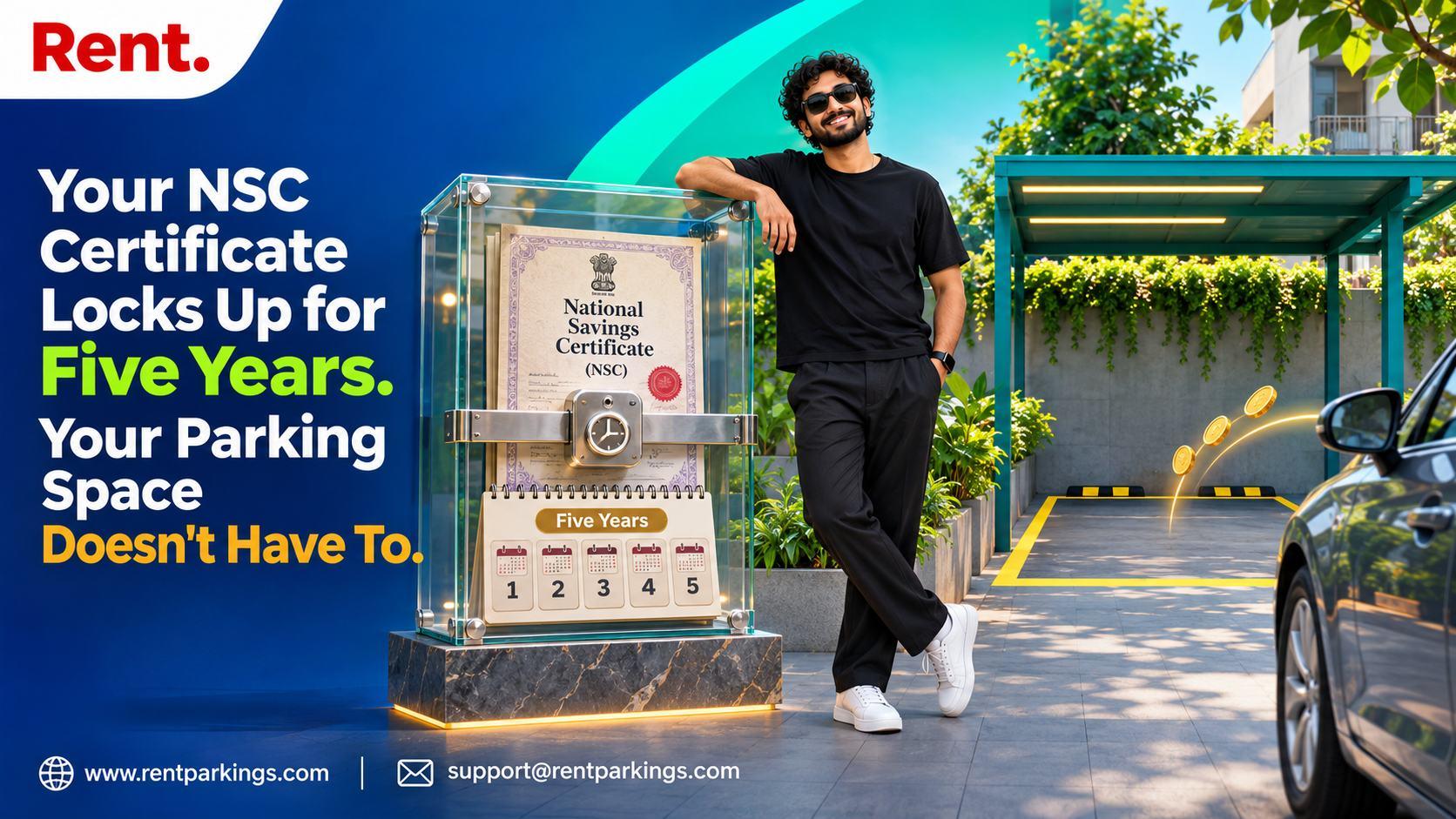
Your NSC Certificate Locks Up for Five Years. Your Parking Space Doesn't Have To.
A reader wrote in last month describing a familiar scene: standing at the post office counter in Coimbatore, renewing an NSC certificate because that is what his father always did with spare money, and what his father's father did before that. The clerk mentioned the five-year lock-in almost as an afterthought, the way people mention things they've said a thousand times. He signed anyway. Outside, in the lane behind his house, his covered parking bay sat exactly where it always sits: empty, silent, earning him precisely nothing.
That contrast is the whole point of this piece. The National Savings Certificate is not a bad product. It is backed by the government, the interest rate is fixed for the full term, and millions of Indian households have used it to build a disciplined savings habit.
But it asks for something most people don't think hard enough about before they sign: five years where that money simply cannot be touched. A parking space an owner already has sitting idle asks for nothing like that. It can start generating a monthly return in the time it takes to create a free listing on RentParkings, India's parking marketplace built specifically for owners who want to turn unused space into income without giving up control of it.
What an NSC Actually Promises, and What It Quietly Takes Away
An NSC certificate is a fixed-income instrument issued through post offices and select banks. The government revises the interest rate every quarter, and once you buy a certificate, that rate is locked for the full five-year term, currently sitting somewhere in the 7 to 8 percent range depending on when you bought in.
Here is what owners often gloss over when they buy one:
- Your principal is locked for five years, with premature withdrawal allowed only in narrow situations such as the death of the holder or a court order.
- Interest is compounded annually but paid out only at maturity, not as a running monthly income.
- The interest you earn each year is treated as taxable income at your slab rate, even though you don't actually receive the cash until the certificate matures.
- There's no flexibility to adjust the amount, pause contributions, or redirect the money if your situation changes midway.
None of that makes NSC a poor choice for long-term, hands-off savings. It simply means the money goes quiet for half a decade. Nothing about it works on your schedule.
What Your Parking Space Can Start Doing This Month
A parking space works on a completely different clock. There's no certificate to buy, no five-year commitment, and no government form to fill out before the income starts.
Listing a driveway, a stilt slot, a basement bay, or a vacant plot on RentParkings costs the owner nothing. There has never been a listing fee, and there isn't one hiding somewhere in the fine print either. The owner decides the price, whether to rent it by the hour, by the day, or by the month, and whether to allow one steady renter or several shorter bookings across the week.
That last part matters more than it sounds like it should. With NSC, the rules are fixed the day you sign. With a parking listing, an owner in Pune can start at a monthly rate for a nearby IT employee, switch to hourly slots during a wedding season rush nearby, and go back to monthly whenever it suits them, all without renegotiating anything with anyone except the next renter.
The Real Difference Is Liquidity, Not Just Returns
It's tempting to reduce this comparison to a single number: which one pays more per year. That framing misses what actually separates the two.
NSC is a sealed box. The money goes in, and for five years, it stays exactly where it is, regardless of whether your roof starts leaking, a child's school fee comes due, or a better opportunity shows up. Parking income is the opposite of a sealed box. It arrives every month, in cash or through UPI and net banking, and an owner can use it, save it, or reinvest it the same week it lands.
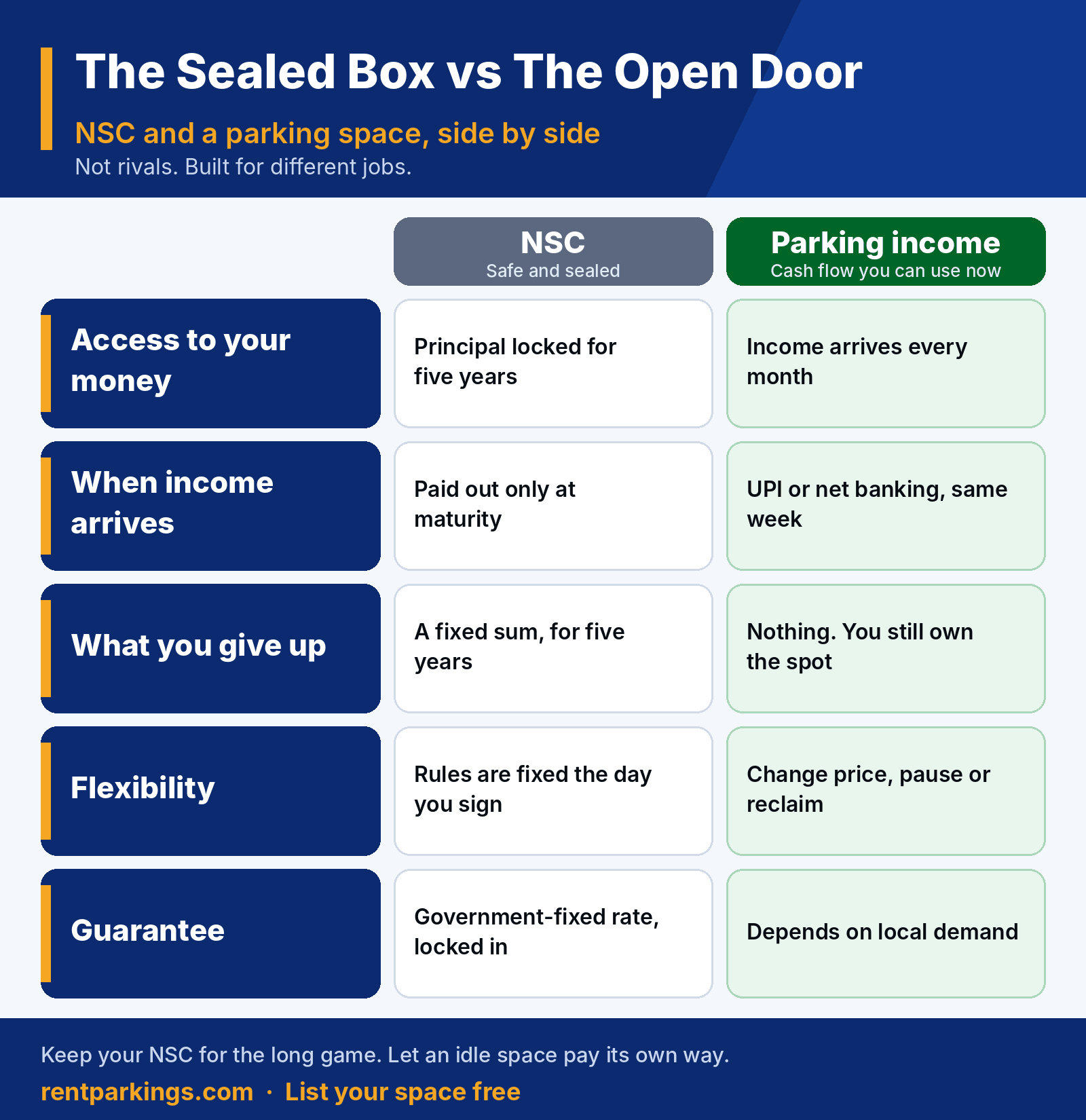
There's also a structural difference worth sitting with: NSC asks you to give up a fixed sum of money for five years. Renting out a parking space asks you to give up nothing. The owner still owns the spot. They're renting out its use, not selling the asset, which means the exact same space that generated income this month is still there, still theirs, still available to rent again next month, or to reclaim entirely if their own needs change.
A Rough Sense of the Numbers
Owners who've listed with RentParkings report a fairly wide range depending on the city and the type of space, and it's only fair to give that range honestly rather than quoting one tidy figure. A covered bay in a high-demand pocket of Chennai or Hyderabad can pull in meaningfully more than an open driveway in a quieter part of a tier-2 city.
Hourly and event-day bookings near stadiums, wedding venues, or exam centres can spike well above the usual monthly rate for a few days at a stretch.
What stays constant across almost every case we've heard about is this: the income starts the same month the listing goes live, not five years later, and there is no ceiling fixed by a government notification. If demand in the owner's locality rises, they can simply revise the price themselves.
Where NSC and Parking Income Actually Differ on Tax
This is one place the two products actually resemble each other, and it deserves a clear answer rather than a hand-wave. NSC interest is taxable every year as it accrues, at the holder's income tax slab rate, even though the cash itself only arrives at maturity. Most people forget this until their CA points it out during filing season.
Income from renting out a parking space is also taxable, generally under income from other sources, and the specifics of how GST and reporting apply depend on the scale and nature of the rental activity. Our detailed breakdown of tax and GST rules for parking rental income walks through this properly rather than skimming it, and makes for a smarter read before an owner assumes either option is somehow tax-free.
Why So Many Owners Still Default to NSC Anyway
If parking income is this flexible, why does NSC still sell certificates by the million every year? Mostly habit, and partly trust. It's a product parents recommend to their children, bank staff push because it's simple to explain, and post offices have sold for decades without a single scandal attached to the name.
None of this is a reason to avoid NSC entirely. For a chunk of long-term savings an owner genuinely won't need for five years, it still does its job quietly and reliably. The mistake is assuming it's the only sensible place for spare capacity, while an actual physical asset like a parking space sits unused purely because nobody got around to listing it.
Fixed deposits get the same blind trust for the same reasons, and we've gone through how a parking space measures up against a fixed deposit in a separate piece, if that's the comparison that applies to an owner's own situation. The underlying lesson doesn't change much from one fixed-income product to the next.
What Actually Happens Once You List
Getting a parking space in front of renters doesn't require technical skill or a long form. An owner photographs the space, sets a price and the hours or days it's available, and the listing goes live on RentParkings at no cost.
Renters who book are verified before any booking is confirmed, payments move through UPI or net banking rather than loose cash handed over at the gate, and the owner can edit the price, pause the listing, or take the space back whenever their own plans change. Our step-by-step walkthrough of how listing actually works covers the full process for anyone listing for the first time, right down to what a typical listing page looks like once it's live.
This isn't the only comparison worth making before deciding where idle money or idle space should sit. We've already looked at how a parking space stacks up against a Public Provident Fund account and its own long lock-in period, and separately against gold as a traditionally favoured idle asset. The pattern repeats across almost every comparison: the fixed-income product wins on guaranteed returns and government backing, while the parking space wins on speed, flexibility, and the fact that the owner never loses access to the underlying asset.
"But NSC Is Guaranteed. Parking Income Isn't." Fair Point.
This objection deserves a straight answer rather than a dismissal. NSC's return is fixed by the government and doesn't depend on a renter showing up. Parking income depends on actual demand in the owner's locality, the condition and accessibility of the space, and how competitively it's priced.
What narrows that gap in practice is that most owners aren't choosing between NSC and parking income as mutually exclusive bets. An owner can keep whatever NSC or fixed deposits they already hold untouched, and simply add parking income on top of that, from a space that was generating zero rupees before they listed it. There's genuinely nothing to compare against on the downside, because the alternative to listing isn't a guaranteed return elsewhere. It's an empty parking spot doing nothing at all, which is the one outcome we'd compare that actually loses every single time.
Frequently Asked Questions
1. Is listing a parking space on RentParkings really free?
Yes. There's no listing fee, no subscription, and no hidden charge deducted before an owner sees their payout. The platform makes this clear upfront rather than burying it in terms nobody reads.
2. Who decides how much to charge for a parking space?
The owner does, from the first listing onward. RentParkings doesn't set a fixed rate card; owners choose hourly, daily, or monthly pricing based on what their own locality and space type can reasonably command, and they can revise it whenever demand shifts.
3. How does parking income compare to NSC if I only have five years of patience either way?
With NSC, that five years is spent waiting for a single lump sum at maturity. With a parking listing, the same five years can generate income every single month along the way, and the owner still has the space itself at the end of it, available to keep renting or to use however they like.
4. Do I lose access to my parking space once I list it?
No. Renting out the use of a space is not the same as selling it. An owner can pause a listing, change its terms, or take the space back entirely whenever their own plans require it.
5. Is the income from renting out parking guaranteed like NSC?
No, and it would be dishonest to claim otherwise. Parking income depends on local demand, so it can vary month to month. What it offers instead of a guarantee is flexibility, immediate access to earnings, and zero cost to try it out.
6. What kind of monthly income can an average owner expect?
It varies widely by city, locality, and the type of space being listed, so there's no single honest number to quote. Covered spaces in high-demand pockets of major cities tend to earn more than open driveways in quieter areas, and hourly or event-day bookings can add meaningfully on top of a steady monthly rate.
7. How do I actually get paid?
Payments move through standard digital channels like UPI and net banking rather than informal cash handovers, which also makes it easier to keep a clean record for tax purposes.
8. Do I have to commit to renting my space for a long period, the way NSC locks in my money?
No. An owner can list for a single month, a handful of weekends, or an open-ended monthly arrangement, and change that commitment whenever they choose. There's no five-year clock running in the background.
9. Is parking rental income taxable, like NSC interest is?
Yes, parking rental income is taxable, just through a different route than NSC's annually accrued interest. Our dedicated guide on tax and GST treatment for parking rental income in India covers exactly how this works and what an owner should keep track of.
10. Should I cancel my NSC and only rely on parking income instead?
That's not really the right question to ask. NSC still has a place for long-term, government-backed savings an owner won't need for years. The point here isn't to replace it, it's to stop leaving a separate, already-owned asset earning nothing while that NSC certificate quietly does its own job elsewhere.
The Five Years Will Pass Either Way
An NSC certificate bought today matures sometime in 2031, whether or not the owner does anything else in the meantime. A parking space sitting idle today will still be sitting idle in 2031 too, unless something changes between now and then.
The honest case here isn't that parking income beats NSC on every measure, because it doesn't try to. It's that an owner doesn't have to choose between the two. The NSC certificate can keep doing its slow, steady, locked-away job exactly as planned, while the parking space that's been sitting empty starts paying its own way starting this month, with the owner setting every term of the arrangement. List your parking space for free on RentParkings and find out what it could actually be worth before another five-year cycle goes by with that space earning nothing at all.
Own an empty parking space?
List it free on RentParkings and let drivers nearby find it. There is no listing fee.
List my space freeShare This post
Search
Recent Post

Fort Kochi's New Year Crowd Triples Ever...
24 Nov, 2026

Why Does the Same Parking Spot Earn ₹3,0...
23 Nov, 2026

Parking Space vs Kisan Vikas Patra: Whic...
20 Nov, 2026

Chennai Is Buying Gold in ₹10 Bits. Nobo...
19 Nov, 2026

Every April, Kondapur Parents Top Up The...
18 Nov, 2026

Delhi Parking Prices Don't Follow the Ci...
16 Nov, 2026

Your NPS Account Looks Impressive on Pap...
13 Nov, 2026

A Whitefield Techie and a Jayanagar Reti...
12 Nov, 2026