

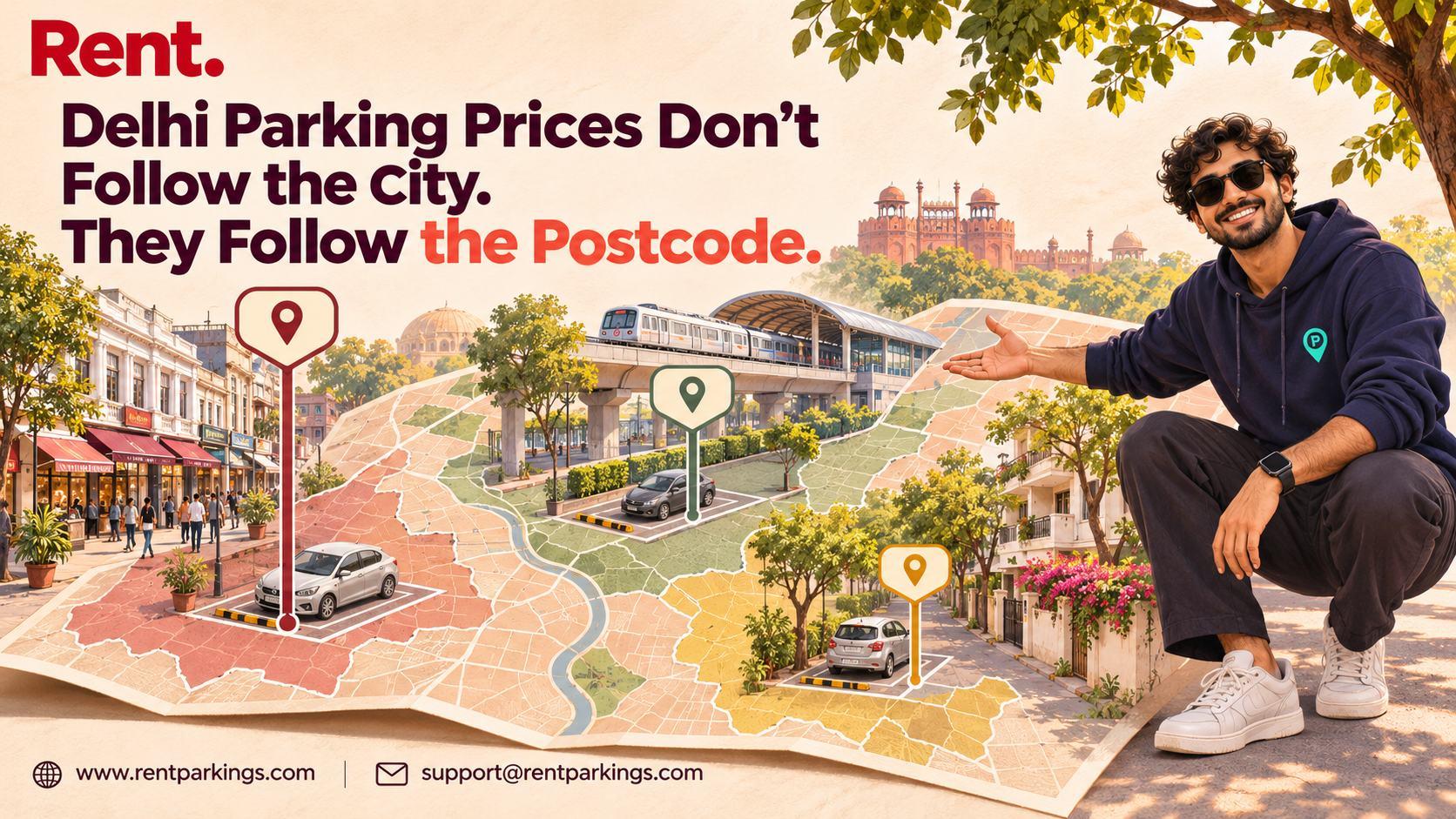
Delhi Parking Prices Don't Follow the City. They Follow the Postcode.
Ask someone in Dwarka what a parking spot is worth and you will get one number. Ask someone in Khan Market the same question and you will get a completely different answer, usually before you've finished asking it.
Delhi does this to almost every topic that touches real estate, and parking rental income is no exception. The capital is less a single market than five or six markets stitched together by the Ring Road, each running on its own clock, its own crowd, and its own idea of what a parking bay should realistically fetch, whether someone needs it for an afternoon or the whole month.
An owner who prices their space the way a cousin in a different part of the city priced theirs is usually leaving money on the table, sometimes a lot of it. The flip side is that once you know which Delhi your property actually sits in, pricing stops being a guess. If you own unused parking space anywhere in the capital, from a basement near Chandni Chowk to a covered bay in Vasant Kunj, RentParkings gives you a direct way to turn that space into monthly income instead of a guess.
Delhi's Parking Map Looks Nothing Like a Single City
Most Indian metros have a downtown and a set of suburbs radiating out from it. Delhi has pockets instead: a wholesale belt that runs on trucks before sunrise, a government quarter built around embassies and ministries, a university and coaching corridor that fills and empties with exam seasons, a medical district where an appointment can mean an entire morning spent circling for a spot, and a ring of newer residential neighbourhoods built around metro lines that didn't exist twenty years ago.
Each of those pockets prices parking differently because each one is solving a different problem. Knowing which one your property falls into is most of the work of figuring out what to charge for it.
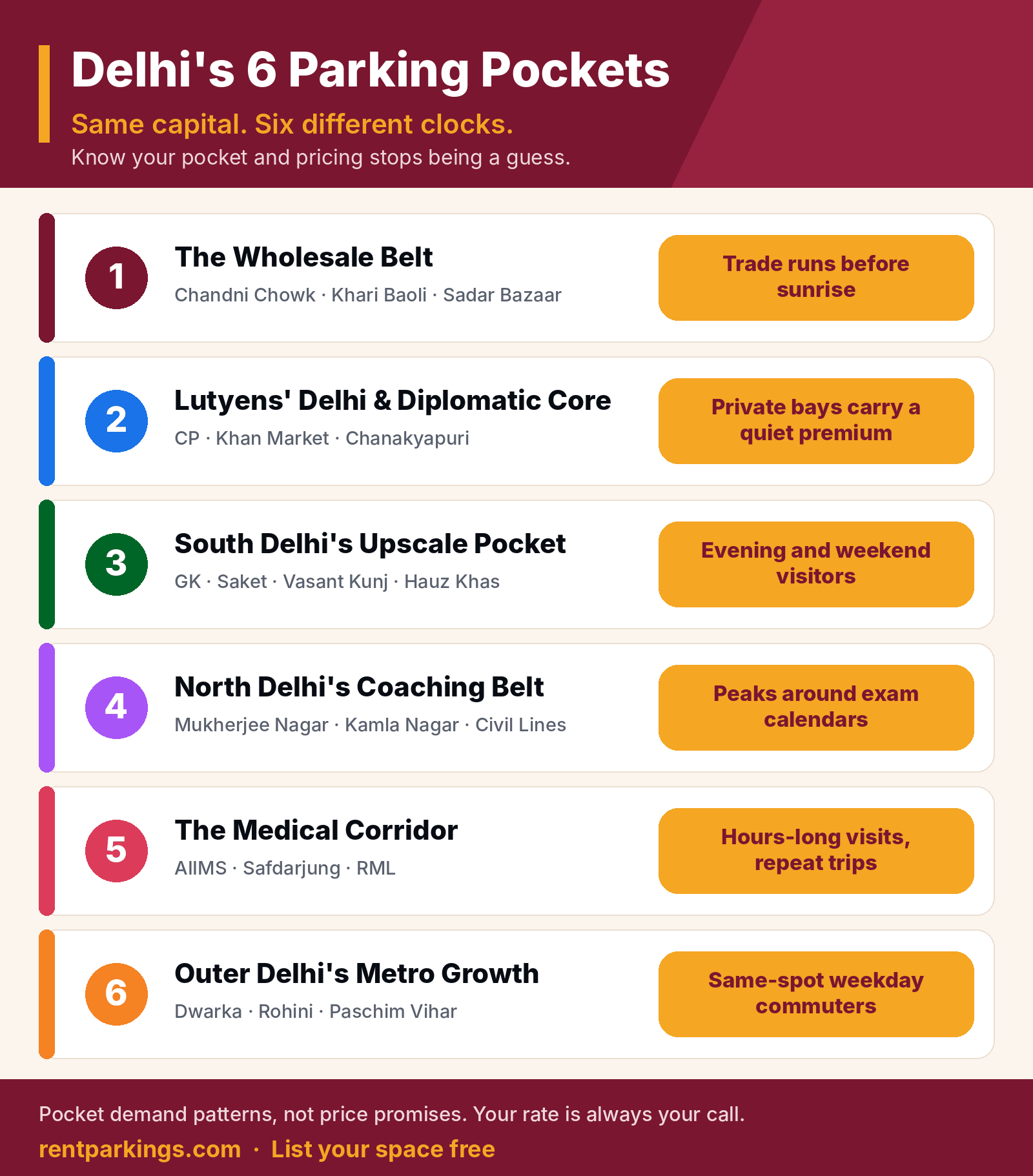
The Wholesale Belt: Chandni Chowk, Khari Baoli and Sadar Bazaar
Old Delhi runs on inventory, not footfall. Trucks and loaders queue before dawn outside Khari Baoli's spice wholesalers and Sadar Bazaar's general merchandise lanes, and by mid-morning the lanes are too narrow for a cycle-rickshaw to pass, let alone a car hunting for somewhere to sit for twenty minutes.
Any open bay, rooftop slot or adjoining plot near this belt is competing for space with a goods economy that effectively never stops. Traders, delivery agents and out-of-town buyers all need somewhere to leave a vehicle for an hour or two while they finish business, and most have already given up on finding free street parking anywhere close. Why India's Wholesale Markets Run Out of Parking Before the Sun Comes Up goes into exactly how that daily crunch builds, and it's a useful reminder that a congested commercial district doesn't need a new multi-level structure to solve its parking gap. It just needs owners nearby who are willing to rent out what they already have sitting idle.
Lutyens' Delhi and the Diplomatic Core: CP, Khan Market, Chanakyapuri
Move a few kilometres south and the economics flip entirely. Connaught Place, Khan Market and the embassy belt around Chanakyapuri see constant vehicle traffic from government staff, diplomatic visits, upscale retail and some of the highest commercial rents in the country, but almost none of that translates into easy parking.
Security protocols around the diplomatic enclave, VIP movement that shuts roads with little warning, and strict heritage-zone construction rules all keep new multi-level parking structures from being built here. What exists instead is a quiet premium for any private bay, basement slot or courtyard space that an owner is willing to open up, verified and on their own terms, in a part of the city where "just park on the road" stopped being realistic years ago.
South Delhi's Upscale Pocket: Greater Kailash, Saket, Vasant Kunj, Hauz Khas
South Delhi runs on evenings and weekends more than mornings. Restaurants, malls, boutique shopping lanes and dense upper-middle-class residential blocks mean visitor parking demand spikes after office hours and stays high through the weekend, while many residential plots in the same stretch have covered or stilt parking that sits empty all day during the week.
This is also where a lot of Delhi's mid-rise apartment blocks sit, the kind of building where every flat comes with one allotted stilt or basement slot that sits untouched for most of the week. You Own a Parking Slot in Your Apartment. Here's What It Could Be Earning You in 2026 looks at exactly this kind of space, and it's a close match for South Delhi's apartment belt, where the allotted slot often turns out to be worth more attention than the flat above it ever gets.
North Delhi's Student and Coaching Belt: Mukherjee Nagar, Kamla Nagar, Civil Lines
North Delhi runs on exam calendars. Mukherjee Nagar alone houses tens of thousands of students preparing for competitive exams at any given time, and Kamla Nagar's proximity to Delhi University adds another layer of daily foot and vehicle traffic that the area's lanes were never built to absorb.
For an owner here, demand doesn't look like one steady stream, it looks like sharp peaks around batch timings, test dates and admission seasons. Coaching Centre Parking in India: Why Kota, Sikar and Every Big-City Tuition Hub Run Out of Space Twice a Day walks through why hubs like this run out of space twice daily rather than once, which is exactly the kind of pattern that rewards an owner who can list a spot for specific hours rather than locking it into a single flat monthly rate.
The Medical Corridor: AIIMS, Safdarjung and RML
A single appointment at AIIMS, Safdarjung Hospital or RML can easily eat an entire morning once you add in the time spent circling nearby lanes for somewhere to park. Patients travel from across North India for treatment here, often with elderly family members or someone who needs a short, close walk rather than a ten-minute hike from a far-off lot.
Parking Near Hospitals in India: Why It's a Daily Struggle for Patients — and a Quiet Income Opportunity for Property Owners Nearby breaks down why this particular kind of demand is both constant and genuinely income-friendly for owners nearby, since patients and attendants tend to book for a few hours at a time, pay without haggling, and come back on follow-up visits.
Outer Delhi's Metro-Linked Growth: Dwarka, Rohini, Paschim Vihar
The newest Delhi is built around metro stations that didn't exist a generation ago. Dwarka, Rohini and Paschim Vihar have grown into dense residential pockets where a large share of residents drive a short distance to the nearest metro station and then take the train the rest of the way into the city, rather than driving the whole route themselves.
That habit creates a very specific, very repeatable kind of parking demand: commuters who want the same spot every weekday, ideally within walking distance of the station entrance. Live Near a Metro Station? You're Sitting on the Most Wanted Parking Space in the City covers how owners near these corridors are turning that daily commuter pattern into a dependable monthly booking rather than a one-off.
What a Postcode Actually Changes About Your Earnings
Once you know which Delhi your property sits in, a few factors decide what it's realistically worth:
- How close you are to a transit point, a hospital gate, a coaching hub or a commercial lane where street parking has effectively disappeared.
- Whether demand peaks during the day, in the evening, or across specific exam and shopping seasons.
- Whether the space is covered, open, stilt or basement, since covered bays command a premium almost everywhere in the city.
- How comfortable renters feel about the verification and identity checks around who's actually using the space.
- Whether you're better off renting by the hour, by the day or on a flat monthly basis, which depends almost entirely on the pattern above.
Real Numbers Are Local, But the Range Is Wide
Owners we've spoken with across the city report a wide spread depending on all of the above. A quiet residential bay in an outer Delhi colony with no particular landmark nearby might bring in somewhere around ₹2,000 to ₹4,000 a month from a single regular commuter. A covered slot close to a metro entrance, a coaching hub or a hospital gate tends to do meaningfully better, often landing in the ₹5,000 to ₹9,000 range, and an open plot near a wholesale market during peak trading hours can sometimes out-earn both on a per-hour basis, simply because turnover there is so high.
None of these numbers are fixed, and that's actually the point. On RentParkings, you decide the rate, the hours and the rental terms for your own space, whether that means a flat monthly fee for a commuter, a daily rate for a shop's forecourt, or an hourly slot timed around a coaching batch.
Listing in Delhi Takes Minutes, Not Weeks
None of this requires construction, a broker, or a long-term commitment. Listing a parking space in Delhi on RentParkings is free, start to finish, and the whole process usually takes less time than one failed attempt at finding street parking near CP.
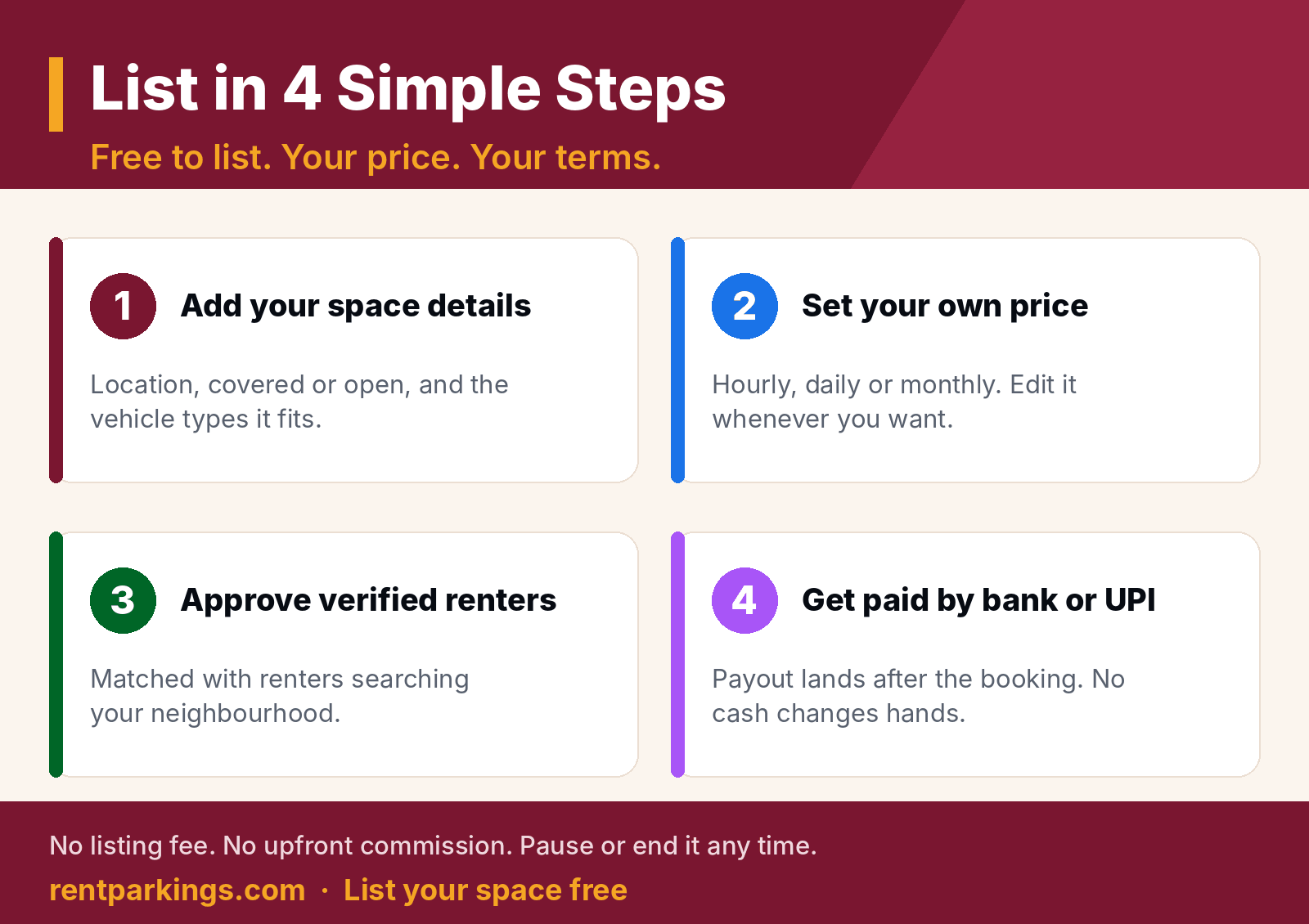
- Add basic details about your space: location, whether it's covered or open, and the vehicle types it fits.
- Set your own price and rental terms, whether that's hourly, daily or monthly, and edit either whenever you want.
- Get matched with verified renters searching that specific neighbourhood, and approve who you're comfortable with.
- Receive the payout straight to your bank account or UPI app once a booking wraps up, with no cash changing hands.
There's no listing fee, no commission locked in upfront, and no obligation to keep the space listed longer than you want to. You stay in control of pricing and availability the entire time.
Frequently Asked Questions
1. Does it cost anything to list my parking space on RentParkings?
No. Creating a listing is completely free, whether your space is in Chandni Chowk, Dwarka or anywhere in between. You only deal in money once a renter actually books your space, and even then, you're the one who set the rate.
2. I don't live near my second property in Delhi. Can I still list its parking space?
Yes. Many owners list a spot attached to a flat, shop or plot they rarely visit themselves. You manage the listing, pricing and bookings remotely, and payments reach you the same way regardless of where you are.
3. How do I decide what to charge for parking in a specific Delhi neighbourhood?
Start by looking at what's nearby: a metro station, a hospital, a coaching hub or a commercial lane all pull different crowds. A spot near constant foot traffic can usually support a higher rate than a quiet residential lane with no particular draw, and you can always adjust the price later based on how quickly bookings come in.
4. Will my Delhi housing society or RWA block me from renting out my allotted parking spot?
Most RWA bye-laws deal with visitor behaviour and internal allotment, not with whether you can earn from a bay that's legally registered to you. It's worth a quick read of your society's rules before listing, but outright bans on renting out your own allotted space are rare.
5. What if I only want to rent my parking space during specific hours, like market hours or coaching batch timings?
That's exactly how a lot of owners near wholesale markets, coaching hubs and exam centres use RentParkings. You can list a space for a few fixed hours a day rather than around the clock, which suits areas where demand comes in predictable bursts instead of a steady stream.
6. How do I know who is actually parking in my space?
Every renter's identity gets verified before their booking goes through, so you're never handing your space to a complete stranger with no record attached. You also see who's asking and can turn down a request that doesn't sit right with you.
7. What happens if I need the parking space back for my own car?
You can pause or end a listing whenever you need to, whether that's for a day, a festival weekend, or permanently. Existing bookings are respected until they end, but nothing locks your space away from you long-term.
8. Is renting out parking near a wholesale market or coaching hub riskier than a quiet residential bay?
Not in any meaningful way. The verification process is the same regardless of location, and busier areas often mean more consistent demand, which can make the income more predictable, not less.
9. How do I actually get paid once someone books my parking space?
Every payment settles electronically straight to your bank account or UPI, so there's no cash exchange and nobody to chase down for money. You get a clear record of what each booking paid out.
10. Can I rent out just a driveway or open plot, or does it need to be a proper covered bay?
A driveway, an open plot, a stilt bay, a basement slot or a shop forecourt can all be listed. Covered spaces tend to earn a bit more in most parts of Delhi, but open spaces near the right kind of demand, like a wholesale lane or a metro corridor, still earn steadily.
Your Postcode Already Decided What Your Space Is Worth. You Just Haven't Checked.
Delhi's parking math was never going to be one number for the whole city, and trying to price your space by what a friend in a different neighbourhood charges will usually leave money on the table either way. What actually matters is the specific pocket of Delhi your property sits in, and whether you're doing anything with that information yet.
The space itself isn't the hard part. Most owners already have it, sitting unused for most of the day regardless of which part of the city they're in. What's missing is usually just the decision to turn that idle slot into quiet, low-effort passive income instead of letting it sit there doing nothing. List Your Parking Space on RentParkings and find out what your particular postcode is actually worth, for free, with the price and the terms staying entirely yours to set.
Looking for parking in Delhi NCR?
Browse monthly and daily parking by area and vehicle type.
Search parkingOwn an empty parking space?
List it free on RentParkings and let drivers nearby find it. There is no listing fee.
List my space freeShare This post
Search
Recent Post

Fort Kochi's New Year Crowd Triples Ever...
24 Nov, 2026

Why Does the Same Parking Spot Earn ₹3,0...
23 Nov, 2026
Parking Space vs Kisan Vikas Patra: Whic...
20 Nov, 2026
Chennai Is Buying Gold in ₹10 Bits. Nobo...
19 Nov, 2026

Every April, Kondapur Parents Top Up The...
18 Nov, 2026
Your NSC Certificate Locks Up for Five Y...
17 Nov, 2026

Your NPS Account Looks Impressive on Pap...
13 Nov, 2026

A Whitefield Techie and a Jayanagar Reti...
12 Nov, 2026