

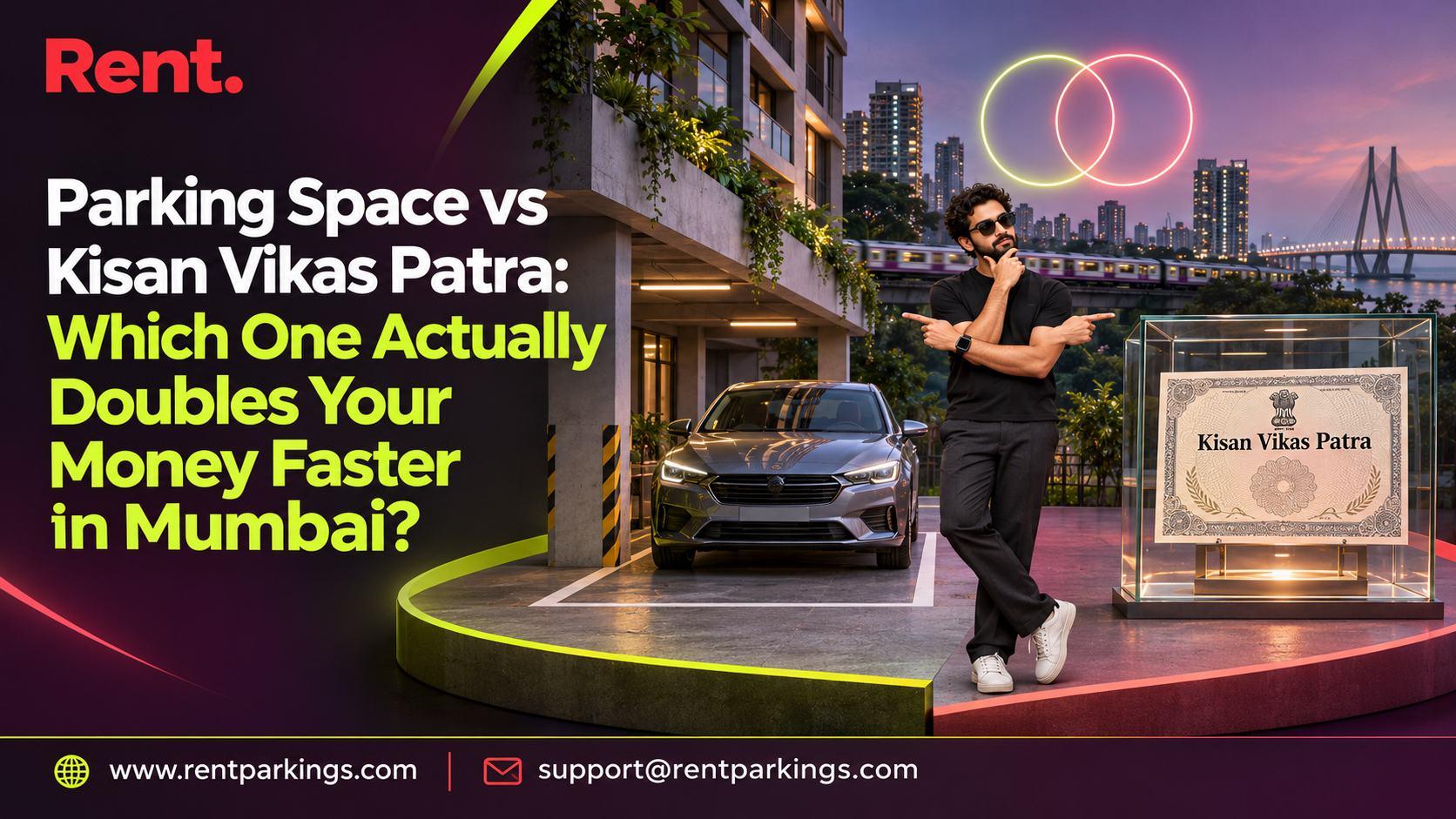
Parking Space vs Kisan Vikas Patra: Which One Actually Doubles Your Money Faster in Mumbai?
Ask anyone at a Mumbai post office counter why they bought a Kisan Vikas Patra certificate, and you will get the same answer every time: because it doubles your money. That part is true. What usually gets left out is how long you wait for the second half of it.
A parking spot sitting unused outside your flat in Andheri, Powai, Thane or Borivali does not ask you to wait nine and a half years for anything. It can start putting money into your account within days of being listed on RentParkings, India's parking marketplace. No government notification deciding your return. No certificate locked in a drawer. Just a spot that was already yours, finally earning something.
What Kisan Vikas Patra Actually Promises You
KVP is a small-savings scheme sold through post offices and a handful of public sector banks, and it has earned its reputation as one of the safest instruments in the country. Safety, though, comes with trade-offs that rarely make it into the sales pitch.
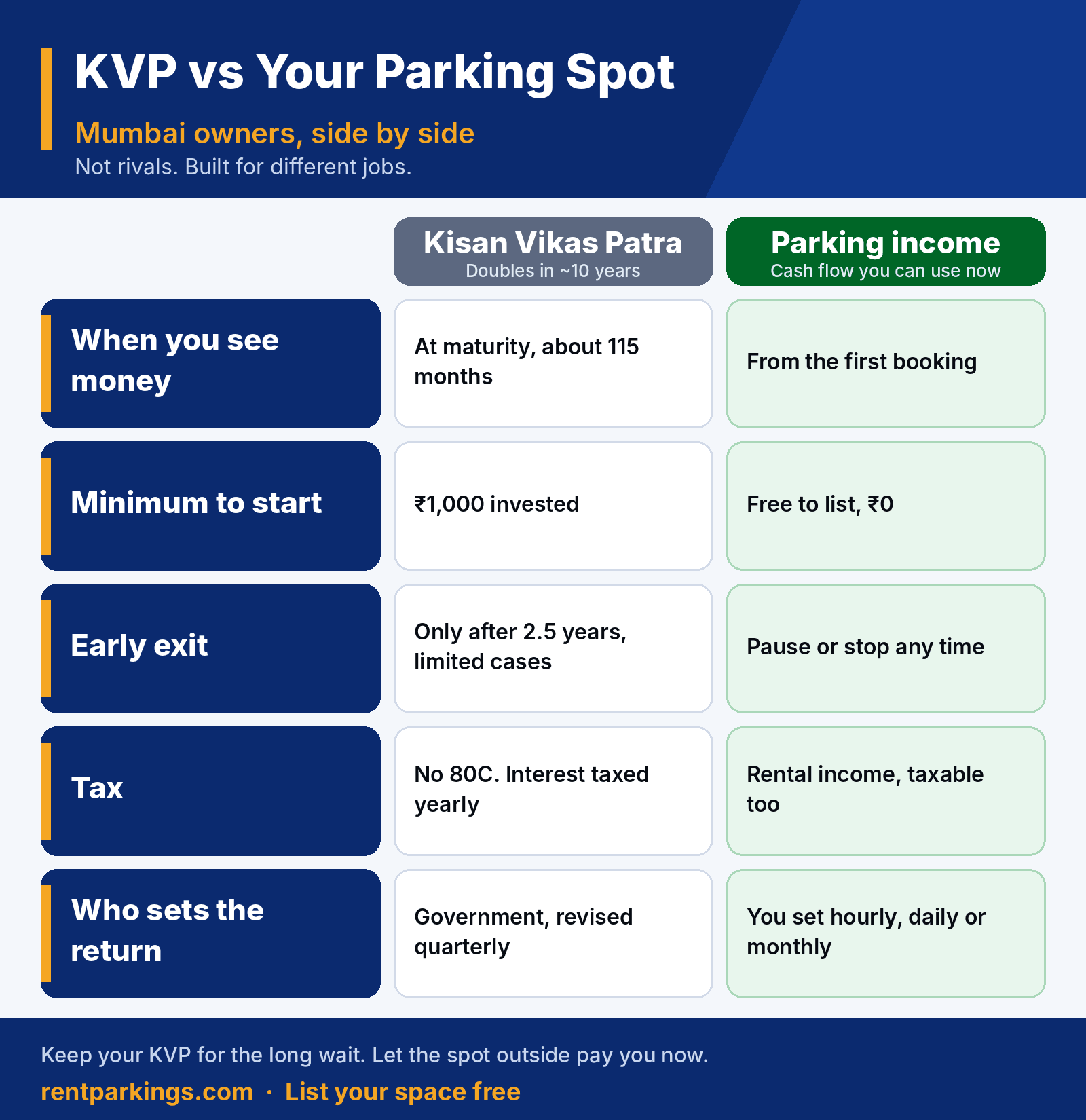
- Minimum investment: ₹1,000, with no upper limit, so it suits everyone from a small saver to someone parking a large lump sum.
- Doubling period: currently works out to roughly 115 months (a little under ten years), based on the interest rate the government revises every quarter.
- Tax treatment: no deduction under Section 80C, and the interest it earns is added to your taxable income every year even though you don't actually receive that interest until maturity.
- Exit rules: premature encashment is only allowed after two and a half years, and even then mainly in specific situations like the death of the certificate holder or a court order.
- Liquidity workaround: you can pledge it as collateral for a loan, which is useful, but that still isn't the same as having cash in hand.
None of this makes KVP a bad place to park money you genuinely won't touch for a decade. It just means calling it "passive income" is a stretch. You don't see a rupee of return until the certificate matures.
Mumbai's Idle Parking Problem Doesn't Look Like a Savings Certificate at All
Walk through almost any residential society in Powai or Andheri West and you'll find at least one allotted parking slot that hasn't held a car in months. The owner moved, sold their second vehicle, or simply never needed the space to begin with.
In a city where a covered slot near BKC or Lower Parel can be worth lakhs on paper, letting it sit empty is its own kind of loss. Property owners we've spoken with describe rental ranges that vary sharply by pocket: a covered spot near a commercial cluster like BKC or Lower Parel has reportedly fetched somewhere between ₹8,000 and ₹18,000 a month, depending on demand and how it's rented out. A mid-demand suburb like Andheri or Powai tends to land closer to ₹4,000 to ₹10,000 a month. Further out, in parts of Thane, Borivali or Navi Mumbai, owners have reported figures in the ₹2,500 to ₹7,000 range, still real money for a spot that was otherwise doing nothing.
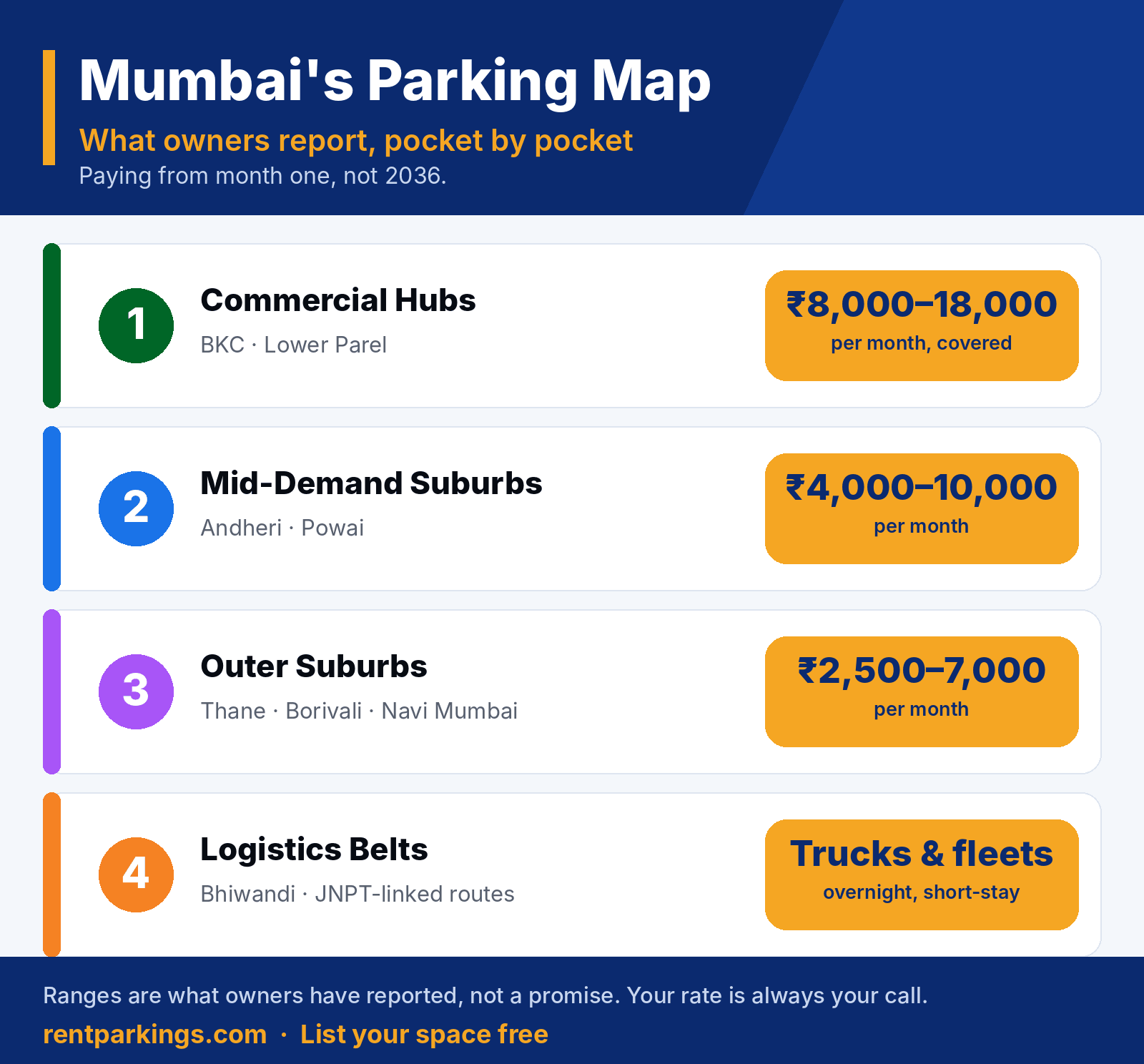
These are estimates, not promises, and every society and street has its own quirks. But even the lower end of that range beats watching the same spot sit empty for another month.
The Real Gap Isn't the Return. It's When You Actually See It.
A KVP certificate and a parking spot can both, in theory, end up doubling a sum of money. The difference is timing. One makes you wait until the final day of a multi-year term. The other can start paying you in week one.
Listing a parking space on RentParkings costs nothing, now or at any point later. You set the price. You decide whether it's rented out by the hour, by the day, or on a running monthly basis, and you can change any of that whenever your situation does. There's no fixed term, no penalty for stopping, and no form to fill out at a counter to get your money moving again.
That kind of flexibility is exactly what a small-savings certificate can't offer. KVP is built to be rigid on purpose. Your parking space doesn't have to be.
"But My Society Will Never Allow It" and Other Reasons Owners Hold Back
Most Mumbai owners who haven't listed their space yet aren't doing it out of laziness. They're stuck on a handful of specific worries, and most of those worries have straightforward answers.
What if someone damages a car while it's parked there?
This is the question that stops the most people before they even try. The honest answer is that liability depends on how the arrangement is structured, and RentParkings walks owners through exactly that in Someone Dents a Car in Your Rented Parking Space: An Owner's Liability Guide for India, which breaks down what an owner is and isn't on the hook for.
Will my society's rules actually let me do this?
Most RWAs have never had to think through parking-rental rules, which means there usually isn't an outright ban, just untested territory. Reading the fine print of your society's by-laws before listing avoids most friction here.
Won't renting it out devalue my flat somehow?
If anything, the opposite tends to be true. A documented, income-generating parking slot is an asset on paper, not a liability, a point covered in detail in Does a Parking Space Add Value to Your Flat in India? Property Prices, Resale, and the 2026 Buyer's Reality Check.
What Listing Actually Takes
The mechanics are shorter than most owners expect:
- Create a free listing with your spot's location, type, and availability.
- Set your own hourly, daily, or monthly rate, with no obligation to accept every booking request.
- Get matched with a verified renter rather than a stranger off the street.
- Receive payouts through UPI or net banking, with RentParkings handling the payment flow.
- Pause or edit the listing any time your plans change, whether that's a visiting relative's car or a sale of the flat.
It doesn't take technical skill, a lawyer, or a weekend of effort. Most owners finish setting up a listing in less time than it takes to fill out a post office deposit slip.
What Doing Nothing Actually Costs You Every Month
It's easy to treat an empty parking spot as a non-issue, because nothing visibly goes wrong when it sits unused. But that framing hides the real cost: every month it stays empty is a month of income you didn't collect, on an asset you already own outright.
Run the numbers on even a modest Thane or Borivali spot, and a year of inaction can mean tens of thousands of rupees that never showed up in your account, money that required no new investment, no risk, and no waiting period to access. A KVP certificate asks you to lock money away for a decade in exchange for a guaranteed double. An idle parking spot asks you for nothing and still quietly costs you something every single month you leave it unlisted.
It's Not Just About Cars, Either
Mumbai's commercial corridors add another layer most owners overlook. Property near logistics hubs in Bhiwandi or close to JNPT-linked traffic routes can earn steadily from trucks and fleet vehicles that need overnight or short-stay parking, a demand pattern explored in India's E-Commerce Boom Built a Trillion-Rupee Warehouse Industry. Nobody Built Parking For Its Trucks.
Even a vacant plot near a construction site in the outer suburbs isn't dead weight. As covered in Your Vacant Plot Is Not Free to Own: How Idle Land in India Quietly Pays for Itself as Parking, raw land that isn't generating anything yet can still be put to work.
And if your society already has an EV charging point near the allotted bays, that's a feature renters increasingly search for, not a sunk cost, something addressed in Charging Where You Park: An Indian Flat Owner's 2026 Playbook for an EV Charger Past the Society Gate.
Frequently Asked Questions
1. Does Kisan Vikas Patra really double my money, and how long does it take?
Yes, the scheme is structured so your invested amount doubles by maturity. As of recent government notifications, that works out to roughly 115 months, just under ten years, though the exact period shifts whenever the interest rate is revised.
2. Is listing a parking space on RentParkings actually free?
Yes, there is no fee to create a listing, and there never has been. You only deal with money when a renter actually books and pays for your space.
3. Who decides how much my parking space rents for?
You do. RentParkings lets owners set their own hourly, daily, or monthly rate based on what they think the spot is worth, and you can adjust it at any time.
4. What if I need my parking space back for my own car?
You can pause or end a listing whenever you want. Most bookings are structured so you aren't locked into renting the space out indefinitely against your wishes.
5. Can I really earn passive income from a parking spot I'm not using?
Within reason, yes. It's not fully hands-off like a matured certificate, but the ongoing effort is minimal once your listing and price are set, and renters book through the platform rather than calling you directly every time.
6. How is renting out parking different from investing in KVP?
KVP locks your capital away and pays out in one lump sum at maturity. A parking space keeps earning repeatedly, month after month, without tying up the asset itself the way a certificate ties up cash.
7. How much could a Mumbai parking space realistically earn?
It depends heavily on the locality. Owners near commercial hubs like BKC or Lower Parel have reported figures in the ₹8,000 to ₹18,000 a month range, while outer suburbs like Thane or Borivali tend to see something closer to ₹2,500 to ₹7,000. These are estimates, not guarantees.
8. Is my parking income taxable, like KVP interest is?
Rental income from a parking space is generally taxable under Indian income tax rules, similar in principle to how KVP interest gets added to your taxable income each year, even though the specific heads and exemptions differ. It's worth checking current rules with a tax professional for your situation.
9. Do I need to verify who is actually parking in my space?
RentParkings matches owners with renters who go through the platform's verification process, rather than leaving owners to vet strangers on their own. That's one of the main differences between listing through a marketplace and just putting up a handwritten sign.
10. What if nobody books my parking space after I list it?
That can happen, especially in the first few days, but it costs you nothing to try since listing is free and there's no commitment attached. Many owners adjust their price or availability once they see what similar spots in their area are getting booked at.
The Spot Outside Your Door Doesn't Need Ten Years to Start Paying You
KVP will keep doing exactly what it's designed to do: sit quietly, compound slowly, and hand you a lump sum roughly a decade from now. That's a fine plan for money you've already decided you won't need soon.
Your parking space was never meant to be that kind of asset. It's sitting right outside your door in Mumbai, costing you nothing to keep, and earning you nothing only because nobody has told it to start. List Your Parking Space on RentParkings and let it begin paying you back this month, not in 2036.
Looking for parking in Mumbai?
Browse monthly and daily parking by area and vehicle type.
Search parkingOwn an empty parking space?
List it free on RentParkings and let drivers nearby find it. There is no listing fee.
List my space freeShare This post
Search
Recent Post

Fort Kochi's New Year Crowd Triples Ever...
24 Nov, 2026

Why Does the Same Parking Spot Earn ₹3,0...
23 Nov, 2026
Chennai Is Buying Gold in ₹10 Bits. Nobo...
19 Nov, 2026

Every April, Kondapur Parents Top Up The...
18 Nov, 2026
Your NSC Certificate Locks Up for Five Y...
17 Nov, 2026

Delhi Parking Prices Don't Follow the Ci...
16 Nov, 2026

Your NPS Account Looks Impressive on Pap...
13 Nov, 2026

A Whitefield Techie and a Jayanagar Reti...
12 Nov, 2026