

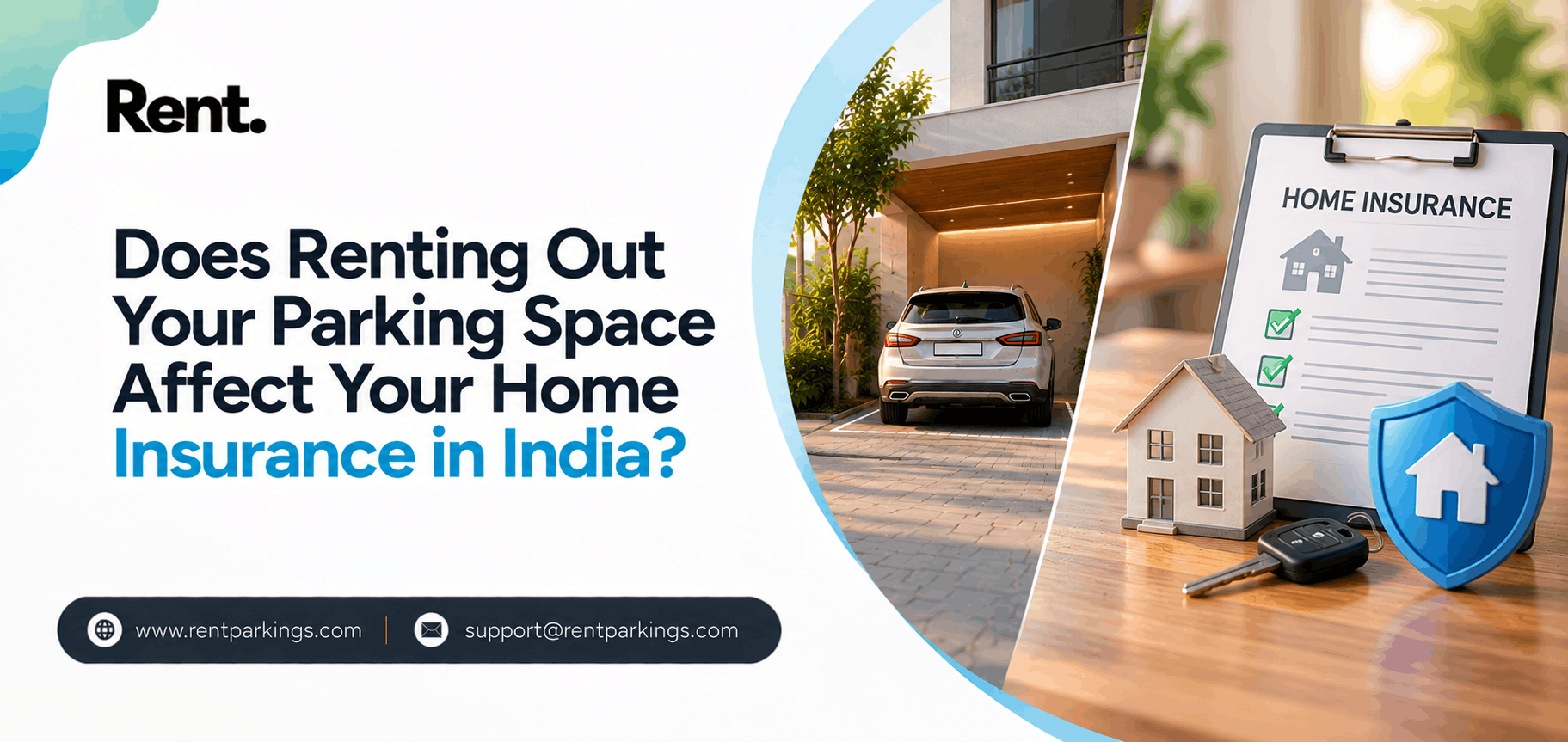
Does Renting Out Your Parking Space Affect Your Home Insurance in India?
A flat owner in Chennai's OMR belt called his insurance agent last month with what he thought was a routine question. He wanted to rent out the covered parking slot under his building, the one his second car hadn't touched in months, to a neighbour who needed a spot for her driver during office hours. The agent's answer wasn't a flat yes or no. It depended on what exactly the policy covered, and how the space was being used, not on the simple fact that money was changing hands for it.
That uncertainty is one of the quieter reasons Indian property owners hesitate before they list unused parking on RentParkings, India's parking marketplace. Nobody wants to accidentally void a policy they've been paying premiums on for years just to earn a few thousand rupees a month. The good news is that the actual risk is far smaller, and far more manageable, than most owners assume.
What Your Home Insurance Actually Covers
Most residential policies in India are built around three things: the structure of the building, the contents inside it, and sometimes a personal liability add-on. None of these are typically written around who is allowed to use a parking bay attached to your flat.
A standard householder's policy protects against fire, burglary, flooding and structural damage. It doesn't usually ask questions about whether a driveway, stilt slot or basement bay is used by your own car, your tenant's car, or a stranger's car parked for four hours through an app.
Where things get slightly more specific is commercial-use exclusions. Some policies word this narrowly enough that renting out a single parking spot for personal income, occasionally or regularly, doesn't count as running a business out of your home. Others are vaguer, and that's exactly where an owner should ask a direct question rather than assume.
When It Actually Could Matter
Enclosed Garages Physically Attached to the House
An open society parking bay and a garage that shares a wall with your living room are treated differently by some insurers. If your garage is structurally part of the insured building and you're letting someone park a vehicle inside it regularly, it's worth a two-minute call to confirm nothing changes.
Frequent Commercial-Scale Use
Renting one slot to one neighbour is not the same, in an insurer's eyes, as running a paid parking lot for ten vehicles a day out of your compound. Scale is what triggers commercial clauses, not the act of renting itself.
Undisclosed Structural Changes
If you've built a shed, added a shutter, or converted part of a plot specifically to rent it as parking, that's a structural change worth mentioning to your insurer regardless of whether you rent it out. This has nothing to do with parking specifically; any unreported construction can affect a claim.
The Real Risk Isn't Insurance. It's an Undocumented Arrangement.
Here's what actually causes problems for Indian parking hosts, and it's rarely the insurance policy itself. It's renting out a space with no written record of who was parked there, when, and under what terms.
If a car gets scratched, a gate gets damaged, or a dispute comes up about how long a vehicle was left behind, the owner who has a booking record, a name, and a phone number on file is in a completely different position than the owner who agreed to something over a WhatsApp voice note. We've walked through exactly what liability looks like in practice in our guide on what happens if a parked car gets damaged in your space, and the short version is that clear terms protect you far more than any insurance clause does.
This is also why the actual mechanics of listing matter more than owners initially think. A platform that timestamps bookings, records who paid and how much, and keeps a simple agreement in place does most of the documentation work for you automatically.
Five Steps That Remove Almost All the Guesswork
- Ask your insurer one direct question. Call or email and ask whether letting a covered parking bay to another person for a fee changes anything about your existing policy.Get it confirmed by your insurer in an email or letter if possible.
- Keep a written record of the arrangement. Even a simple agreement stating the rate, the hours, and the vehicle details is enough to settle most disputes before they start.
- Take photos before handing over the space. A quick photo of the empty bay and its condition costs nothing and answers most "who caused this damage" arguments instantly.
- Know who's actually parking there. Verified renter details matter more for peace of mind than any insurance clause; our guide on how listing actually works on RentParkings walks through how this verification happens during setup.
- Choose a platform, not an informal WhatsApp group. Digital records of bookings and payments give you something concrete to point to if a question ever comes up, which an informal cash arrangement simply can't offer.
What Happens If Something Actually Goes Wrong
Most owners who hesitate over insurance are really asking a bigger question: what if this arrangement turns out to be a mistake and I need to undo it? The reassuring answer is that renting out a parking space isn't a long-term commitment you're locked into.
You decide the rental period, whether it's a single day, a month, or an open-ended hourly arrangement, and you can end it on your own terms whenever your own plans change. We've covered exactly how owners take their space back when they need it in our piece on getting your parking space back after renting it out, and the process is far simpler than owners expect going in.
Different Property Types Carry Slightly Different Considerations
Vacant Plots and Open Land
An empty plot with no structure on it usually falls outside home insurance conversations entirely, since there's no building policy attached to it in the first place. If you're sitting on land near a construction site, a wedding venue, or a busy junction, we've broken down exactly how that income adds up in our guide to renting out a vacant plot for parking income.
Garages and Basement Bays
Covered parking that's structurally part of your home is where the insurer conversation is most relevant, simply because it's the one scenario tied to your building policy. If your garage has sat empty for months while your EMI keeps getting deducted, our article on turning an unused garage into rental income covers the practical side of getting started.
Free Listing, Your Price, Your Terms
None of this insurance conversation should overshadow the simpler point underneath it: listing your parking space on RentParkings costs nothing, ever. There's no listing fee, no commission taken just to appear on the platform, and no hidden charge buried in the fine print. You decide the price. Whether it's ₹50 an hour near a metro corridor in Bengaluru, ₹2,500 a month in a Pune society, or a custom daily rate during a festival week in Ahmedabad, the rate and the terms stay entirely in your hands. You can rent it out hourly, daily, or monthly, and change your mind whenever your own circumstances shift.
For a space that's currently earning you nothing, that combination- zero cost to list, full control over pricing, and a realistic monthly amount landing in your account- is worth a serious look, even if the insurance question was the only thing holding you back until now.
Frequently Asked Questions
1. Does renting out my parking space cancel my home insurance policy?
For the vast majority of standard householder policies in India, no. Renting a single parking bay for personal income isn't the same as running a commercial operation, and most policies don't treat it that way. When in doubt, a two-minute call to your insurer settles it for good.
2. Do I need a separate insurance policy just to list my parking space?
Not typically. Most owners don't take out any additional cover specifically for parking rental. A written agreement, verified renter details, and clear terms usually cover the practical risk far better than an added policy would.
3. What if the person renting my space damages my property or someone else's car?
This is exactly why a written agreement and photos of the space's condition matter before handover. Our detailed guide on parking damage and liability walks through how owners in India have handled this in practice.
4. Is it actually free to list my parking space on RentParkings?
Yes, completely. There's no fee to create a listing, no charge to keep it live, and no hidden commission just to appear searchable on the platform.
5. Will my housing society have a problem with this if insurance comes up?
Most RWAs are concerned with visitor management and security, not insurance technicalities. As long as you're renting an assigned or common bay you already have rights to, this rarely becomes a society issue at all.
6. My flat has a home loan attached. Do I need to inform my bank?
Renting out a parking space you already own doesn't typically require lender notification, since ownership and usage rights aren't changing. If your loan agreement has unusual clauses, a quick read-through or a call to your bank removes any doubt.
7. How does RentParkings verify who is actually parking in my space?
Renters create a profile with contact and identity details before booking, giving you visibility into who you're dealing with rather than a stranger showing up with cash in hand.
8. Can I really set my own price and choose hourly, daily or monthly terms?
Yes. You decide the rate and the rental structure that suits you, and you can adjust either one at any time as demand or your own plans change.
9. What if I want to stop renting my space out after a few months?
You're free to pause or end a listing whenever you choose. There's no lock-in period forcing you to keep a space listed longer than you want to.
10. Should I bother with a written agreement for something as small as hourly parking?
Yes, even a simple one. A short written record of the rate, hours,s and vehicle details takes a few minutes to put together and prevents almost every dispute that owners worry about before they list.
Bringing an Idle Space Into Use
The insurance question that stopped that Chennai flat owner from listing his covered slot turned out to have a simple answer once he actually asked it. His policy wasn't affected at all, and the only thing that changed was an extra few thousand rupees landing in his account every month for space that had been sitting empty regardless.
If a similar worry has been holding your own driveway, garage,ge or vacant plot back from earning anything, the fastest way to get a real answer is to check with your insurer directly, and then list your parking space for free on RentParkings while you're at it. The space isn't getting any more use sitting idle either way.
Share This post
Search
Recent Post
Parking Space vs. Renting Out a Room to...
05 Oct, 2026

Think Parking Rental Only Pays in Mumbai...
02 Oct, 2026
Your Mumbai Parking Space Is Worth More...
01 Oct, 2026

Hyderabad's Real Estate Boom Left One As...
30 Sep, 2026
What Your Parking Space in Chennai Could...
29 Sep, 2026
Your Plans Changed After Listing Your Pa...
28 Sep, 2026
Parking Space vs SIP: Which Idle Asset A...
25 Sep, 2026
What Your Parking Space in Pune Could Ac...
24 Sep, 2026