

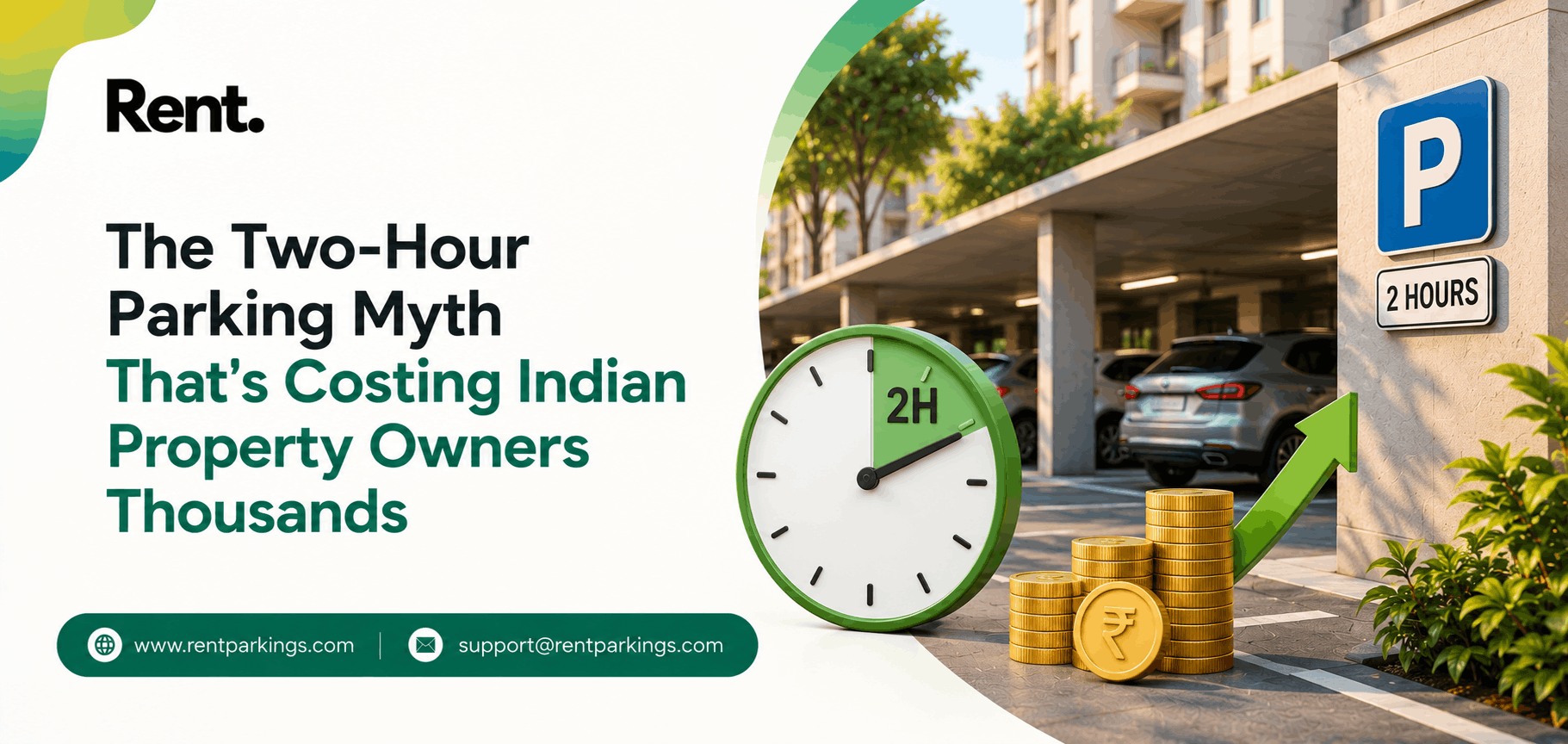
The Two-Hour Parking Myth That's Costing Indian Property Owners Thousands
Picture a small paved patch outside a shop in a busy Coimbatore lane, right across from a diagnostic centre. The owner had assumed for years that nobody would bother paying to park there for an hour or two while waiting for a blood test. So the patch sat empty, collecting dust and the occasional stray cow, while patients circled the block looking for somewhere, anywhere, to leave their scooter.
That assumption is more common than it should be. Ask ten property owners in India whether their unused parking spot could earn money, and at least half will say some version of the same thing: nobody wants a spot for just two or three hours, so why bother listing it. It sounds reasonable. It's also wrong, and the gap between that belief and reality is quietly worth a lot of money to the owners who never test it.
This piece is about that gap, and about how RentParkings, India's parking marketplace, lets owners test it without spending a rupee or signing up for anything permanent.
Where the Two-Hour Myth Actually Comes From
Most people who own a parking space think about renting it the way they'd think about renting out a room: a tenant moves in, pays monthly, and stays for a while. That mental model makes sense for a flat. It makes far less sense for parking.
Parking demand in India isn't shaped by tenancy cycles. It's shaped by errands, appointments, hearings, exams and short visits that happen every single day across every city. A two-hour parking need isn't a lesser version of a monthly one. It's a completely different kind of demand, and it happens to be everywhere once you start noticing it.
The mistake most owners make is measuring their spot only against the monthly rental they imagine they could get, decide it's not worth the paperwork for that amount, and stop there. They never price out what the same spot could earn from four or five short bookings a day instead of one long one.
The Places Where Short-Duration Parking Quietly Adds Up
Some locations make the case for hourly parking almost by themselves. Property near a hospital is one of the clearest examples: patients and their families rarely stay for a set number of hours, but they need somewhere close by, and they need it right now. We've written before about how the stretch of road near a hospital gate turns into an income source for whoever happens to own it, in our piece on Parking Near Hospitals in India.
Court complexes follow a similar pattern. A hearing might last fifteen minutes or it might get adjourned within the hour, but the person attending still has to park somewhere for that unpredictable stretch of time. That's exactly the situation we looked at in the piece about a court date at 10 AM and a parking search that outlasts the hearing itself.
Exam centres show the same idea on a much bigger scale, just twice a year instead of daily. Thousands of candidates and their parents descend on one street for exactly the two or three hours an exam takes, then vanish just as quickly. That surge, and what it's worth to the properties around it, is the subject of our Exam Day Parking Chaos in India piece.
Coaching hubs push this even further because the pattern repeats every single day, not just on exam dates. Cities built around tuition, coaching and test-prep culture run through the same cycle morning and evening, which we covered in more depth in Coaching Centre Parking in India.
None of these are one-off events. They're recurring, predictable windows of demand that a nearby owner can plan around, once they stop assuming short-duration parking isn't worth listing.
The Math Owners Usually Skip
Here's the exercise most people never sit down and do. Say a spot near a busy clinic or coaching centre can realistically pull in two or three short bookings on an average day, somewhere in the range of ₹30 to ₹60 per hour depending on the city and the demand around it. Even on a modest day, that's a few hundred rupees for space that was otherwise doing nothing except collecting monsoon puddles.
Stack that across a month and it starts looking less like pocket change and more like a real number, often comparable to what owners assume they'd only get from a long-term monthly tenant, minus the awkward conversation about giving someone a key to your gate for thirty days straight. Hourly and daily listings let an owner keep the spot flexible while still capturing income from the hours that would otherwise go to waste.
The honest caveat here: this isn't guaranteed income, and it depends heavily on location, footfall and how consistently the listing is kept updated. But owners who dismiss the idea outright are doing so without ever running the numbers for their own street.
Why the Hesitation Persists Even When the Math Works
If the math is often favourable, why do so many owners still sit on empty space instead of listing it? Part of the answer is simply that starting feels complicated, even when it isn't. Part of it is a trust problem: owners worry about handing over their gate, however briefly, to a stranger they've never met.
That second concern is legitimate, and it's worth addressing directly instead of waving away. A fair amount of that hesitation traces back to a basic question: who exactly is going to be parking there, and can it be verified? We dug into how marketplaces are solving that trust gap in The Hidden Reason Indian Parking Owners Won't List Their Space, and the short version is that verified renter profiles and booking records have changed what used to be a leap of faith into something closer to a routine transaction.
How Listing an Hourly Spot Actually Works
Getting a spot in front of the people who need it for two or three hours doesn't require a contractor, a broker, or any upfront spending. Listing on RentParkings costs nothing, whether the spot is meant for hourly, daily, or full monthly rental. There's no subscription, no commission taken just to appear in search results, and no catch buried in fine print.
Once the listing is live, the owner decides everything that matters:
- What the hourly, daily, and monthly rates should be, adjusted whenever demand shifts
- Whether the space is available all day or only during certain windows
- Which bookings to accept, based on the renter's profile and history
- When to pause the listing entirely, for a family function, renovation, or personal use
Payments move through UPI or net banking, landing directly with the owner rather than sitting with a middleman. There's no cash handoff to manage and no need to be physically present every time someone books the spot, which matters a great deal for owners who work full-time jobs elsewhere in the city.
What Hourly Rates Actually Look Like Across Indian Cities
Rates for short-duration parking vary a fair bit depending on the city, the neighbourhood, and what's nearby. These are rough starting points reported by owners we've spoken with, not fixed numbers, and they shift with local demand:
- Mumbai and Delhi NCR: dense commercial pockets and hospital zones often support the highest hourly rates in the country
- Bengaluru and Hyderabad: tech-corridor traffic and large hospital campuses keep demand steady through the week
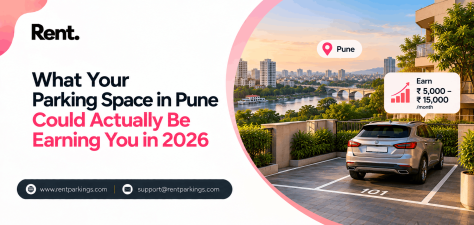
- Chennai and Pune: mixed residential-commercial streets near coaching hubs and clinics see reliable short bookings
- Ahmedabad, Jaipur, and Lucknow: slightly lower average rates, but strong demand around courts, exam centres, and markets
- Kochi, Coimbatore, Madurai, Noida, Gurugram, and Kolkata: growing demand, especially around newer commercial developments and coaching institutes
The point isn't to chase an exact figure quoted somewhere online. It's to recognise that a spot which looks unremarkable on a normal day can still generate a steady trickle of income once it's actually visible to the people looking for it.
Frequently Asked Questions
1. Is listing my parking space on RentParkings actually free, or are there hidden charges later?
It's genuinely free to list, with no signup fee, no monthly subscription, and no charge just for appearing in search results. Owners keep full control of pricing without any surprise deductions.
2. Can I set different rates for hourly, daily, and monthly bookings on the same spot?
Yes, you decide the pricing structure entirely. Many owners run hourly rates during the day for short visits and switch to a flat daily or monthly rate when it suits them better.
3. Is hourly parking really worth the effort for such small amounts per booking?
Individually, one two-hour booking looks small, but a spot near a hospital, court, or coaching centre can pick up multiple bookings a day. Over a month, that adds up to a meaningful number for space that was previously earning nothing.
4. What happens if someone overstays their booked slot?
Overstay situations do come up occasionally, and the platform's booking records make it easy to flag and resolve them. Owners can also build a small buffer into their pricing or availability windows to reduce friction around this.
5. How do I actually receive payment for hourly bookings?
Payments come through UPI or net banking directly, without needing to collect cash on the spot. This also means there's a digital record of every transaction, which most owners find reassuring.
6. Will my housing society object to short-term parking on my own allotted spot?
Every society has its own rules, so it's worth a quick check with your managing committee first. In most cases, an owner renting out their own allotted or private space, especially for short durations, causes far less friction than a long-term tenant moving in.
7. How do I know who's actually parking in my space?
Renter profiles and booking history are visible before you accept a booking, which gives you a basic level of verification. This is very different from handing your gate key to a complete stranger with no digital trail at all.
8. Do I need to be present every time someone parks?
No. Once the listing is set up with clear access instructions, most owners manage bookings remotely through the app, checking in only when it's convenient for them.
9. Can I pause or remove my listing whenever I want?
Yes, the listing can be paused or edited at any time, whether that's for a family event, a renovation, or simply because you need the space back for your own vehicle for a while.
10. Is there a minimum commitment period once I list my space?
No. There's no lock-in period at all. You can list today, take bookings for a week, and stop entirely next month if it doesn't suit you, with no penalty for changing your mind.
The Spot You're Ignoring Is Already Being Searched For
Somewhere within a few hundred metres of that hospital, court, coaching centre, or busy market street, someone is circling the block right now, looking for a place to leave their vehicle for an hour or two. The two-hour myth survives mostly because owners never test it against their own address, their own footfall, and their own street.
Testing it costs nothing and takes a few minutes. List Your Parking Space on RentParkings and let the spot that's been sitting idle start earning on your own terms, whether that's by the hour, the day, or the month.
Share This post
Search
Recent Post
Parking Space vs. Renting Out a Room to...
05 Oct, 2026
Think Parking Rental Only Pays in Mumbai...
02 Oct, 2026
Your Mumbai Parking Space Is Worth More...
01 Oct, 2026
Hyderabad's Real Estate Boom Left One As...
30 Sep, 2026
What Your Parking Space in Chennai Could...
29 Sep, 2026
Your Plans Changed After Listing Your Pa...
28 Sep, 2026
Parking Space vs SIP: Which Idle Asset A...
25 Sep, 2026
What Your Parking Space in Pune Could Ac...
24 Sep, 2026