

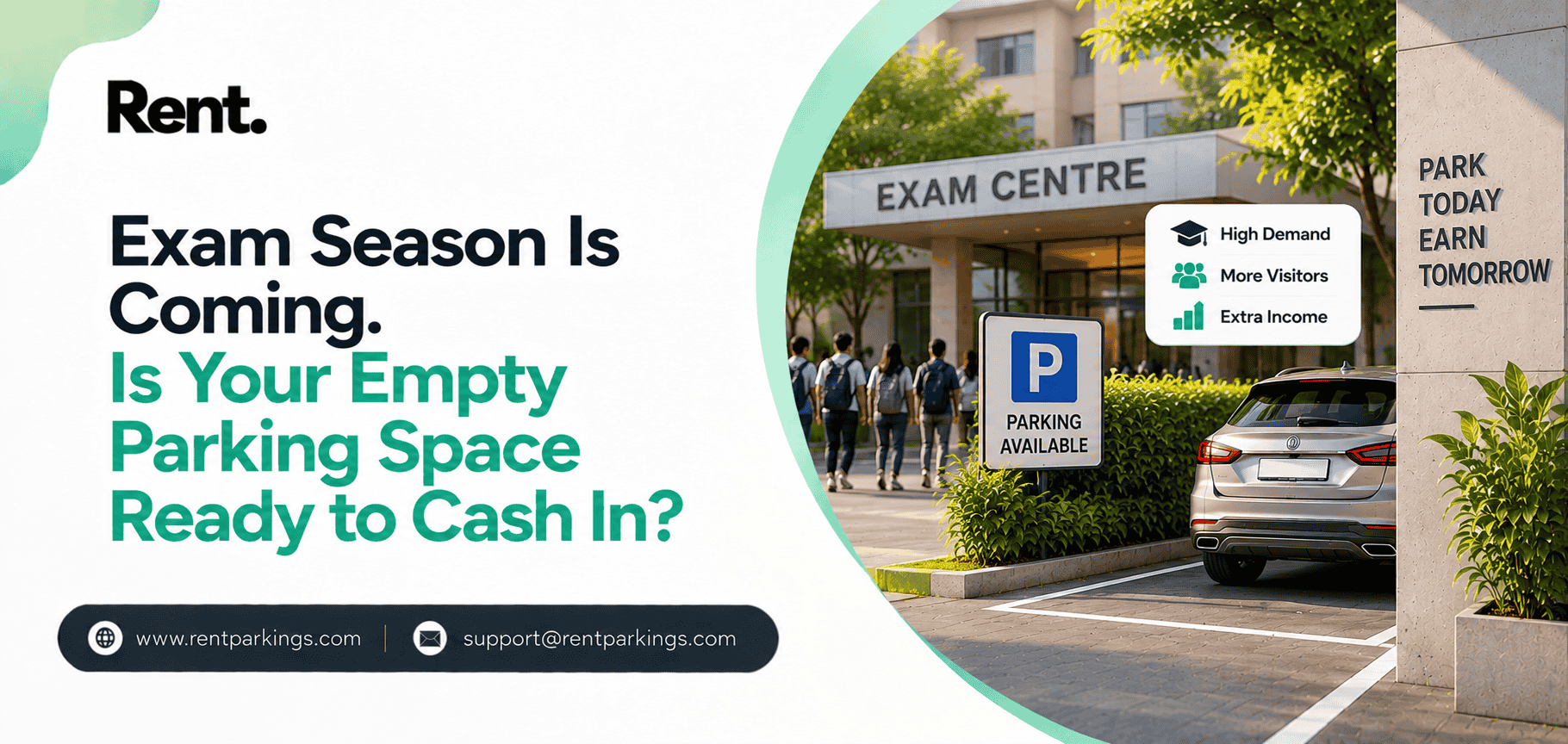
Exam Season Is Coming. Is Your Empty Parking Space Ready to Cash In?
Picture a lane outside a coaching institute in late April. A mother circles the block for the third time, hazard lights blinking, while her son checks the clock every few seconds because the mock test starts in six minutes. Two streets away, a property owner's driveway sits exactly as it has for years: empty, swept, and worth nothing to anyone.
That gap between the two of them is the whole story of exam season in India. Millions of students sit for entrance exams, board exams, and competitive tests every year, and a huge share of them arrive by car or with a parent driving them. Most of the streets around test centres and coaching institutes were never built to handle that kind of traffic for two hours at a stretch, let alone for weeks in a row.
If you own a driveway, a vacant plot, a basement, or a stilt parking slot anywhere near a school, a coaching centre, or an exam hall, this is one of the more predictable income windows available to an Indian property owner in 2026. You don't need to run a business to take advantage of it. You just need to list your parking for free on RentParkings and let the exam calendar do the work.
Why Exam Season Turns Into a Parking Scramble Every Year
India's exam calendar is dense, and it repeats in fairly predictable windows year after year. Board exams for classes 10 and 12 run through February and March. JEE Main has multiple sessions, usually January and April. NEET falls in May. CAT lands in late November. Banking exams, SSC recruitment tests, state PSC prelims, and countless entrance tests for professional colleges are spread across the rest of the calendar, often clustered on weekends.
Each of these creates a short, sharp spike in local traffic. A test centre that handles a few hundred visitors on an ordinary day suddenly has thousands of people trying to reach it within the same two-hour window, most of them arriving by car because parents don't want to risk their child being late over a missed auto or a delayed bus.
Local roads, school gates, and institute compounds were never designed for that kind of load. The result is the same scene you'll find outside almost any major exam venue in the country: double parking, traffic wardens waving arms uselessly, and drivers circling in slow, frustrated loops looking for anywhere legal to stop.
The Exam and Coaching Calendar Owners Should Actually Track
You don't need to memorise every exam date in India to benefit from this. What matters is knowing roughly when the rush happens near you, so you can plan your pricing and availability around it rather than reacting after the fact.
- January to April: JEE Main sessions, board exam preparation season, and pre-board tests bring steady coaching centre traffic.
- February to March: Class 10 and 12 board exams, often with parents waiting outside for the full duration.
- May to June: NEET, several state entrance exams, and the start of admission counselling season.
- June to September: UPSC prelims and mains, along with a wave of banking and SSC tier exams.
- October to December: CAT, GATE preparation intensifying, and a fresh round of competitive exam registrations.
If you're near a coaching hub rather than an exam hall, the pattern looks different but the logic holds. Coaching centres in cities like Kota, Sikar, Hyderabad, Delhi, Pune, and Bengaluru run batches almost year round, with parent visits, test days, and admission counselling periods creating their own smaller spikes on top of the baseline demand.
Who This Actually Works For
It's tempting to assume this opportunity is only for people who happen to live in a dedicated coaching town. That's not really true. If your property sits within walking distance of any of the following, exam season traffic is probably already passing your gate:
- A school or junior college that serves as a board exam or entrance test centre.
- A coaching institute, tuition hub, or test prep centre, even a modest one.
- A university or professional college running its own entrance exams.
- A banking, railway, or government exam centre set up temporarily in a local school or hall.
Owners in tier-2 and tier-3 cities often underestimate how much this applies to them. A NEET or banking exam centre set up for a single Sunday in a smaller town can pull in thousands of candidates from surrounding districts, all of whom need somewhere to park a two-wheeler or a car for a few hours.
What Kind of Space Actually Earns During This Window
You don't need a commercial-grade parking lot. Almost any dry, reasonably accessible patch of space near the action can work, and different property types tend to suit different exam-day patterns.
A driveway or front yard works well for shorter exam-day windows where a family just needs somewhere to leave the car for two or three hours. We've covered this angle in detail in Your Driveway Is Doing Nothing All Day, which walks through how owners with even a single-car driveway are turning it into a recurring source of income rather than just a place their own vehicle sits overnight.
A vacant plot or an empty patch of land near a busy exam venue can absorb far more vehicles at once, which matters on the handful of peak dates when hundreds of families descend on the same street within an hour. Something similar plays out around construction zones too, where the piece Your Empty Plot Near a Construction Site Could Be Earning Right Now makes a point worth borrowing here: idle land close to any high-footfall activity has value, whether that activity is a building project or a test centre gate.
Basements, stilt parking, and covered bays tend to do better with coaching centre traffic that repeats week after week rather than one-off exam dates, since regular customers value a spot they can rely on returning to.
The Money Question: What Owners Are Actually Reporting
Nobody can promise you an exact figure, and you should be wary of anyone who does. What owners who've listed near exam and coaching hotspots tend to describe is a pattern rather than a number: quiet stretches most of the year, followed by a sharp uptick in bookings during the weeks before and during major exam dates.
A single-car driveway a short walk from a busy exam hall might sit at low, occasional use most months and then get booked out for several hours a day during a two or three week exam window. Owners closer to year-round coaching hubs describe steadier, if less dramatic, demand spread across the whole academic calendar rather than concentrated spikes.
It's worth comparing this against other places your money or your space might otherwise sit idle. The logic isn't so different from the one laid out in Parking Space vs Savings Account: Which Idle Asset Is Actually Working for You in 2026?, which argues that an asset earning nothing simply because it's inconvenient to use is still a cost, even if it never shows up on a bank statement.
You Set the Price, You Set the Terms
This is the part owners tend to appreciate most once they actually try it. Listing on RentParkings costs nothing, and it never has a listing fee attached. You decide what to charge, whether that's an hourly rate for exam-day traffic, a daily rate for parents waiting through a test, or a monthly rate for a regular coaching centre commuter who parks there five days a week.
Nothing about it locks you in. You can charge more during a known exam week and drop the price back down once the rush passes. You can restrict availability to certain hours if you still need the space yourself in the mornings or evenings. You stay in control of who books, when, and at what price, the whole way through.
"My Street Isn't a Coaching Hub." And Other Doubts Worth Addressing
A fair number of owners assume this opportunity is reserved for people in famous coaching towns, or that their particular strip of space is too small or too informal to be worth listing. Neither objection tends to hold up once you look closer.
Location matters, but it's rarely about being in a famous hub. It's about proximity to wherever the actual footfall lands on a given day, which is a point explored well in Why Your Neighbour's Parking Space Earns Double Yours. It Has Nothing to Do With Luck. A school two streets from a metro exit, or a lane behind a large exam hall, can outperform a spot in a more prominent part of town simply because it's the first legal place a driver finds after circling twice.
As for small or informal spaces, exam-day parking is often exactly that: a strip wide enough for one car, a corner of a plot, a stretch of driveway that fits a two-wheeler comfortably and a hatchback if the owner parks it carefully. Perfect symmetry and marked bays aren't the bar here. Usable and accessible for a few hours is.
Getting Ready Before the Rush Starts
The owners who benefit most from exam season aren't scrambling to figure things out the week an exam is announced. They've already got a listing live, with clear photos, a fair price, and availability hours set, well before the calendar turns.
Pricing worth thinking about in advance: a flat hourly rate works well for short exam-day windows, since it matches how most parents and students actually think about the time they'll need. There's a common misconception that short-duration parking isn't worth listing at all, which the piece The Two-Hour Parking Myth That's Costing Indian Property Owners Thousands pushes back on directly. A handful of two-hour bookings on a single exam day can add up faster than owners expect.
Payments run through UPI or net banking, so there's no need to handle cash or chase anyone down after the fact. Every renter who books through the platform goes through a verification step before they show up, which matters more during high-traffic exam periods when strangers are moving through a neighbourhood in unusually large numbers.
Frequently Asked Questions
1. When exactly does "exam season" fall in India, and how long does the parking demand window last?
There's no single exam season, more a series of overlapping ones. Board exams run February through March, JEE Main has sessions in January and April, NEET falls in May, and competitive exams like CAT, UPSC, and various state and banking tests are spread across the rest of the year. Near a coaching hub, elevated demand can stretch across several months rather than a single date.
2. How much extra can I realistically earn from my parking space during exam season?
It varies too much by location and space type for anyone to promise a fixed number. Owners near active exam and coaching hotspots generally describe a noticeable jump in bookings during peak weeks compared to the rest of the year, particularly for short, hourly slots on exam days themselves.
3. Do I need to live near a big coaching hub like Kota to benefit, or does this apply to smaller cities too?
It applies well beyond the famous hubs. Any school, college, or hall that gets used as a board exam, entrance test, or government exam centre, even for a single Sunday, pulls in enough traffic to make nearby parking valuable for that period.
4. Is listing my parking space on RentParkings really free, or are there hidden charges?
Listing is completely free, with no signup fee, no subscription, and no hidden charge for creating or keeping your listing live. You only ever deal with the price you set for renters.
5. Can I set a higher price during exam season and a lower one the rest of the year?
Yes. You control your own pricing at all times, and you can adjust your hourly, daily, or monthly rate whenever demand in your area shifts, including raising it during a known exam week and lowering it once things quiet down.
6. What if I only want to rent my space during exam months and keep it free otherwise?
That's entirely your call. You can set your availability to specific dates, days, or seasons, and pause your listing whenever you'd rather keep the space for personal use.
7. Is my space too small or informal, like a strip of driveway, to be worth listing?
Not necessarily. A lot of exam-day parking demand is for exactly this kind of space, somewhere a two-wheeler or a single car can sit safely for a few hours. It doesn't need to be a marked, commercial-style bay.
8. How do I make sure the person parking is actually a student or parent and not a stranger misusing the spot?
Every booking made through the platform involves a renter who has gone through identity verification before they arrive, so you're not simply handing a stranger off the street the keys to your gate.
9. What happens if I need my space back suddenly during exam season, say for a family event?
You stay in control of your calendar throughout. You can block out dates you need for yourself well in advance, or adjust your availability as your own plans change, without being locked into renting it out continuously.
10. How do I get started before the next exam season begins?
Creating a listing takes a few minutes: add some photos, a short description, your price, and your available hours. It's worth doing this well ahead of the next exam window near you so your space is already visible when the search traffic starts.
Your Empty Spot Has an Expiry Date on Its Usefulness. Exam Season Just Shortens It.
Every year, the same streets fill up around the same test centres and coaching institutes, and plenty of nearby driveways, basements, and vacant plots sit just as empty as the year before. The traffic isn't going anywhere. The only real question is whether your space helps solve it or just becomes another obstacle drivers have to circle.
Listing costs nothing, you decide the price and the terms, and the whole thing runs without turning into a second job. If you've got a driveway, a basement, a stilt slot, or a bit of vacant land near a school, a coaching centre, or an exam hall, this exam season is a reasonable time to find out what it's worth. Start Earning from Your Parking Space before the next exam calendar rolls around.
Share This post
Search
Recent Post
Parking Space vs. Renting Out a Room to...
05 Oct, 2026

Think Parking Rental Only Pays in Mumbai...
02 Oct, 2026
Your Mumbai Parking Space Is Worth More...
01 Oct, 2026

Hyderabad's Real Estate Boom Left One As...
30 Sep, 2026

What Your Parking Space in Chennai Could...
29 Sep, 2026
Your Plans Changed After Listing Your Pa...
28 Sep, 2026
Parking Space vs SIP: Which Idle Asset A...
25 Sep, 2026

What Your Parking Space in Pune Could Ac...
24 Sep, 2026