

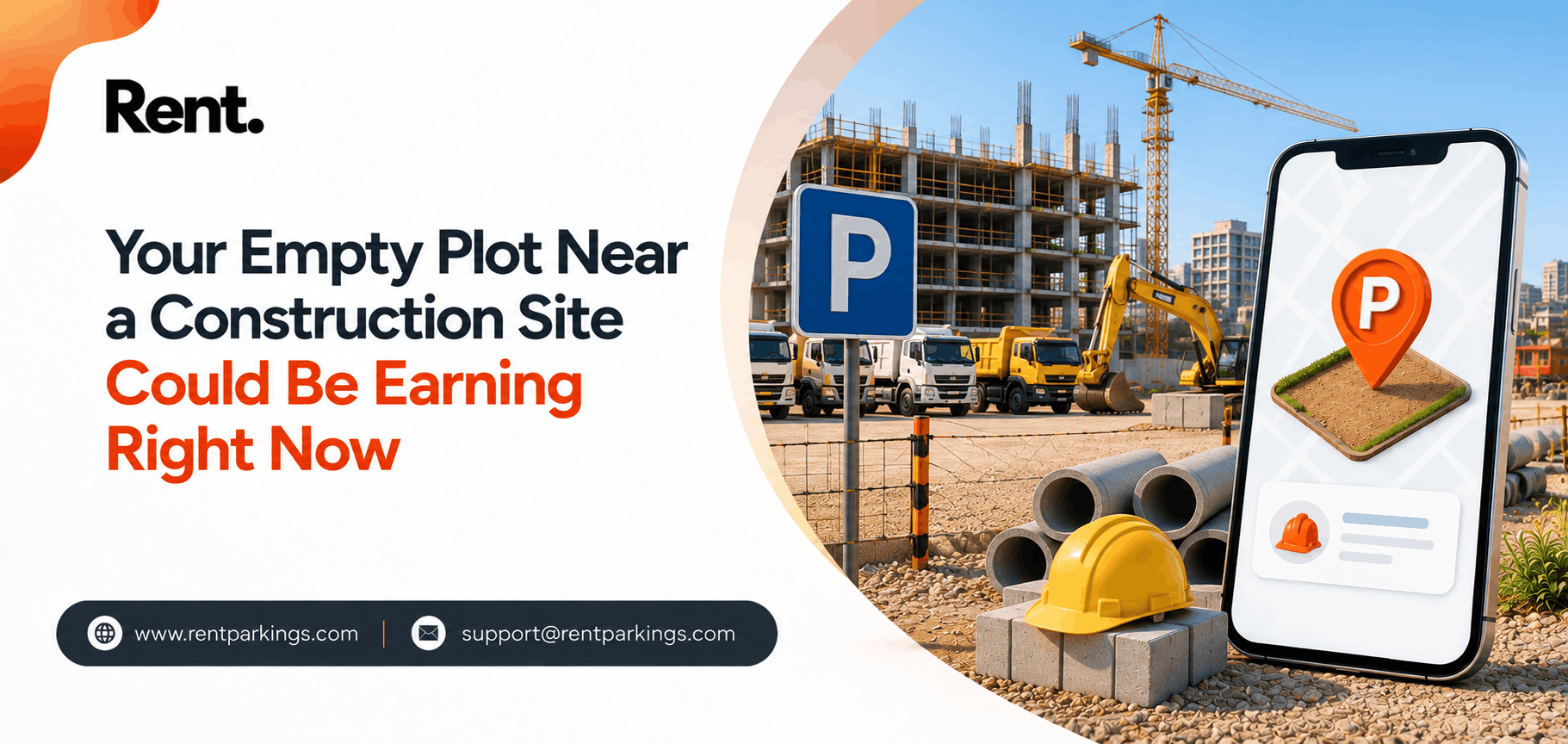
Your Empty Plot Near a Construction Site Could Be Earning Right Now
Drive past almost any active construction project in Pune, Hyderabad, Gurugram or Bengaluru and you'll see the same thing happening along the boundary wall. A row of two-wheelers leaning against whatever fence is closest. A contractor's pickup truck parked half on the road because there's nowhere else to put it. A site engineer's sedan tucked into a gap that clearly wasn't meant for parking.
Most people driving past register this as ordinary city clutter and move on. But if you happen to own a vacant plot, an unused compound corner or a stretch of open land within walking distance of that site, this clutter is actually a fairly reliable income opportunity, sitting there for however long the project takes to finish.
That gap between "empty land" and "land somebody would pay to park on" is exactly what platforms like India's parking marketplace, RentParkings, were built to close. And a construction site nearby might be one of the easiest ways to find out your land already has demand you haven't tapped.
The Parking Problem Every Construction Site Quietly Creates
Construction sites are unusual clients when you think about it. The land itself is being built on, so it can't offer its own parking. Every vehicle connected to the project, and there are more than people expect, has to park somewhere else.
That typically includes several distinct groups, each with a different pattern of use:
- Site engineers, project managers and supervisors who arrive early and stay the full working day, often six days a week
- Contractors and subcontractors making short visits in pickup trucks or SUVs to check progress
- Labour teams arriving on two-wheelers, sometimes forty or fifty bikes for a mid-sized residential or commercial project
- Material suppliers delivering cement, steel, tiles or fittings, whose trucks need a place to idle while unloading
- Inspection officials, architects and the occasional client visit, all needing somewhere temporary to leave a car
None of this is planned for in most project layouts. Site offices and material yards get priority inside the boundary, and the parking pressure spills outward onto whatever land happens to be nearby.
Why This Demand Behaves Differently From a Daily Commuter
Renting to someone who drives to an office every weekday is a fairly familiar picture by now. Construction site demand works a little differently, and honestly, that's part of what makes it attractive.
A single project can generate three separate rental patterns at once:
- Monthly: supervisor cars, security staff bikes and any vehicle that's on site for the whole duration of the build
- Daily: material trucks that show up on a delivery schedule rather than every single day
- Hourly: contractor visits, inspection vehicles and one-off supplier drop-offs
Because large residential or commercial projects in India commonly run anywhere from eighteen months to three or four years, a spot you list near one isn't a random weekend booking. It behaves closer to a fixed tenant, minus any of the paperwork or commitment that comes with actually renting out the land itself.
What Kind of Land Actually Works for This
You don't need a paved commercial lot to make this work. Owners have found reasonable demand from:
- A vacant residential plot bought as an investment and left idle while its long-term plan gets sorted out
- An unused side yard or extra corner of a compound attached to a shop or small commercial building
- Open land along the approach road that contractors already use informally for equipment staging
- Farmland or a plot at the edge of a developing suburb, where new projects are the reason land values are rising in the first place
A few practical things matter more than how the land looks. Distance from the site gate counts for a lot, since nobody wants to walk fifteen minutes carrying tools. A reasonably level, firm surface helps, particularly if trucks will be reversing in. And if labour bikes will sit there overnight, basic lighting or a boundary wall gives renters more confidence, which usually means better occupancy for you.
Not every idle plot near a project will see interest immediately. But if there's an active site within a five or ten minute walk, it's worth listing and finding out rather than assuming nobody would bother.
What This Could Realistically Earn You
It's tempting to want an exact number here, but the honest answer depends heavily on the city, the size of the project, and how close your land actually sits to the gate. What owners near active sites in cities like Pune and Hyderabad have described to us gives a rough sense of the range: two-wheeler parking for labour has landed somewhere between roughly ₹800 and ₹2,500 per bike per month, while a supervisor's car or a contractor's pickup on a monthly arrangement has tended to sit noticeably higher, again varying by location.
Multiply even a modest per-bike rate across thirty or forty labourers and the monthly total starts to look like a genuinely useful passive income stream, not pocket change. And that's before counting the truck and car parking on top of it, all from land that was otherwise sitting there doing nothing.
None of these figures are set by anyone but you. Whether you price by the hour for casual visitors, by the day for delivery trucks, or by the month for staff who'll be there for the life of the project, the rate is entirely your call, and you can adjust it whenever demand shifts.
The Real Worries Indian Landowners Actually Have
Two questions come up almost every time this idea gets raised. What happens if something goes wrong, and does this create a tax headache.
On the liability side, a written monthly or daily agreement, even a simple one, does most of the work. It sets out clearly that the vehicle owner is responsible for their own vehicle while it's parked, which is standard practice and something most contractors and drivers already expect. Our piece on Renting Your Parking Space in India: The Legal, Tax, and Safety Guide goes through exactly what that kind of agreement should cover and where the responsibility genuinely sits if a parked vehicle gets scratched or dented.
On the tax side, most owners renting out a single plot for a year or two won't be dealing with anything complicated, but it's worth understanding the basics before the income adds up to something noticeable. Tax on Parking Rental Income in India: The 2026 Owner's Compliance Guide breaks down when this kind of income actually needs to be declared and when it's genuinely too small to worry about.
Getting It Listed Without the Hassle
Listing is meant to take minutes, not an afternoon, and there's very little ongoing effort once it's live. You add a few photos of the land, set your own rate for hourly, daily or monthly use, mark how much space is available, and specify how long you're willing to rent it for, which can simply match the construction timeline itself.
A few things worth knowing before you start:
- Listing on RentParkings costs nothing, and there's no fee for creating or maintaining a listing
- You decide the price and the rental terms, and you can change either whenever you want
- Renters go through a verification step before booking, so you're not handing over access blind
- Payments come through UPI or net banking rather than cash changing hands on site
- You can pause the listing the moment you need the land back, whether that's for your own construction plans or because the project nearby has wrapped up
If your situation is closer to a home compound than open land, the mechanics are almost identical. Rent Out Your Driveway covers the same setup for a residential driveway sitting idle during work hours.
And before settling on a number, it helps to see what parking is generally going for in your city right now. How Much Can You Earn Renting Out a Parking Space in India? (2026 City-Wise ₹ Guide) is a reasonable starting benchmark, even though construction-site rates often run a bit higher given the volume involved.
This Pattern Is Already Playing Out at a Bigger Scale
Construction sites aren't the only place where a fixed institution outgrows its own parking and pushes demand onto the land next door. Bengaluru's Tech Parks Ran Out of Parking. So Companies Started Renting Land From Their Neighbours. describes almost the same dynamic playing out around IT campuses, just on a longer, more permanent timeline. A construction project is really a faster-moving, shorter-lived version of that same gap, and it closes the moment the building is finished.
Frequently Asked Questions
1. Is it actually free to list my land as parking on RentParkings?
Yes. There's no charge to create a listing, no charge to keep it active, and no fee deducted just for having your space visible on the platform. You only deal with the booking amounts you agree to with whoever rents your space.
2. Should I charge hourly, daily or monthly for parking near a construction site?
Most owners end up using a mix, since a single site generates different kinds of demand. Monthly rates suit supervisor cars and labour bikes staying for the project's duration, while hourly or daily rates work better for delivery trucks and short contractor visits.
3. What if the construction project finishes earlier than expected and I want my land back?
You're free to pause or end the listing whenever you choose. Setting a clear end date or a shorter rental term upfront, tied loosely to the project's expected timeline, also makes this easier to manage from the start.
4. How do I know who is actually parking on my land?
Renters on RentParkings go through a verification step before a booking is confirmed, so you're not simply handing over access to an anonymous vehicle. You can also ask for basic details directly if the arrangement is a longer, monthly one.
5. Who's responsible if a vehicle gets damaged while parked on my property?
A simple written arrangement, even a few lines, should state that each vehicle owner is responsible for their own vehicle while parked. This is standard practice for informal parking arrangements across India and something most drivers already expect to sign.
6. Do I need to declare this income for tax purposes?
If the amount is modest, it may not need special treatment beyond your regular filing, but it's worth checking once the income becomes consistent over several months. Our guide on parking rental income tax explains where that threshold generally sits.
7. Will my housing society or local authority object to me renting out separate open land?
If the land isn't inside a housing society's boundary and isn't an allotted flat parking spot, society rules typically don't apply at all. It's still worth a quick check with local norms if the plot borders a residential layout.
8. How do payments actually reach me?
Payments are handled through UPI or net banking rather than cash handovers, which keeps a digital record of every transaction for your own reference.
9. Can I restrict my listing to only daytime hours, or only certain vehicle types?
Yes. You set the availability window and the terms, so if you'd rather not have labour bikes parked overnight, or you only want to rent to trucks during delivery hours, that's entirely your choice to specify.
10. How long does it usually take to get a first booking after listing?
This varies by location and how close the site is, but demand near an active construction project tends to be more immediate than general parking listings, simply because the need already exists right next door and isn't going away until the project wraps up.
The Land Is Already Sitting There
A construction project two streets away isn't something most landowners think to connect to their own vacant plot. But the vehicles need somewhere to go for as long as that project runs, and an idle piece of land nearby is often the simplest answer available, long before anyone builds proper parking into the site plan itself.
You don't need to invest anything to test whether your land qualifies. Set your own price, choose your own terms, and see what interest looks like. Publish Your Parking Space for Free and find out whether the site down the road is worth more to you than the empty plot has been so far.
Share This post
Search
Recent Post
Parking Space vs. Renting Out a Room to...
05 Oct, 2026

Think Parking Rental Only Pays in Mumbai...
02 Oct, 2026
Your Mumbai Parking Space Is Worth More...
01 Oct, 2026
Hyderabad's Real Estate Boom Left One As...
30 Sep, 2026
What Your Parking Space in Chennai Could...
29 Sep, 2026
Your Plans Changed After Listing Your Pa...
28 Sep, 2026
Parking Space vs SIP: Which Idle Asset A...
25 Sep, 2026
What Your Parking Space in Pune Could Ac...
24 Sep, 2026