

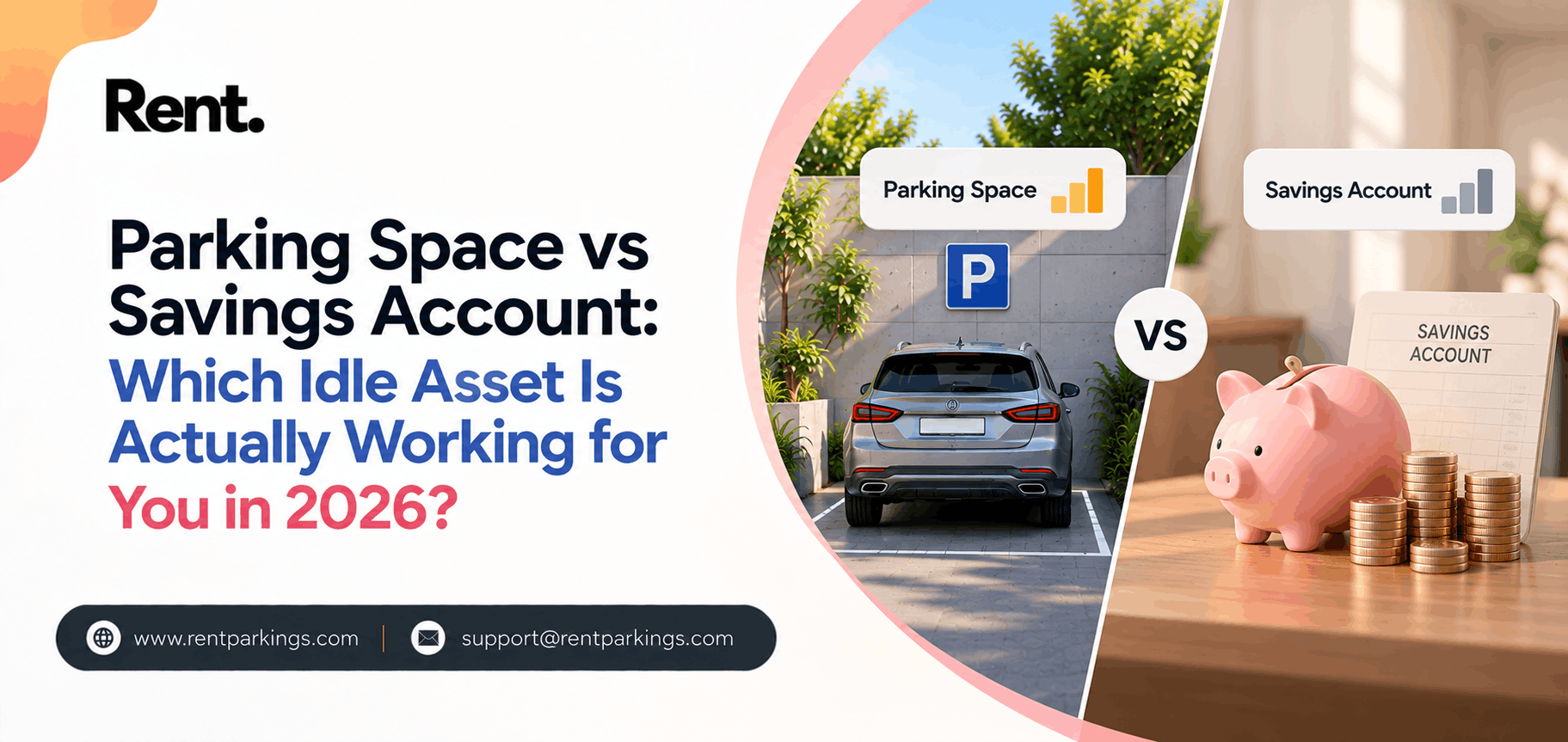
Parking Space vs Savings Account: Which Idle Asset Is Actually Working for You in 2026?
Open your bank's passbook app right now and look at the interest credited last quarter. For most savings accounts in India, it's a number small enough to feel almost like a rounding error against your actual balance.
Now think about the parking space sitting under your building, next to your farmhouse, or in front of your shop. It hasn't earned you a single rupee this year either, but for a very different reason: nobody's using it, and nobody's paying you for it.
Both are idle assets in the loosest sense. Only one of them can be turned into monthly income without you moving a single rupee out of your bank account. That's the comparison this piece is about, and once you see the numbers side by side, the case for listing your space for free on RentParkings becomes hard to argue with.
The Passbook Moment Every Indian Saver Knows
Most Indian savings accounts pay somewhere between 2.5% and 4% annual interest, depending on the bank and the balance slab. A handful of small finance banks push higher, sometimes touching 6-7% on specific balance ranges, but the average saver isn't chasing those accounts around for an extra percentage point.
So if you're keeping, say, ₹5 lakh parked in a regular savings account at 3% interest, you're looking at roughly ₹15,000 a year before tax. Spread across twelve months, that's about ₹1,250 a month. It's not nothing, but it's also not going to move the needle on your household budget in any meaningful way.
Here's the part that usually goes unnoticed. While that money sits there earning next to nothing, a completely different asset in your life is doing the exact same thing, except it isn't even a cash sum you could redirect. It's a fixed, physical space that's been idle since the day you bought or built it.
Meanwhile, Your Parking Space Is Doing Exactly Nothing
If you own a driveway, a basement slot, a stilt-covered bay, or a plot with room for two or three cars, chances are it sits unused for large parts of the day, the week, or the year. Maybe you have one car and two sanctioned spots. Maybe your family shifted to a smaller vehicle and the second bay just collects dust now.
A lot of owners we've spoken with admit they'd never really thought about the parking space as something that could generate income on its own. It felt like a fixed part of the property, not a separate asset with its own earning potential.
Part of the hesitation also comes from genuine, reasonable questions: who's going to park there, is it safe, what if something goes wrong. We've covered how verification and security tools are quietly solving the trust problem for hesitant owners, and it's worth a read if that's what's holding you back. For now, just hold onto this idea: an asset earning nothing because of unanswered questions is still an asset earning nothing.
What a Parking Spot Can Actually Earn, City by City
The honest answer is that it depends heavily on where you are and what kind of space you're offering. A covered slot in a high-demand pocket of Bengaluru or Mumbai will fetch more than an open plot on the outskirts of a smaller city. But even conservative estimates put most owners well ahead of what a savings account would give them on an equivalent value.
Rough ranges reported by owners across different markets look something like this:
Metro cores (parts of Mumbai, Delhi NCR, Bengaluru): roughly ₹4,000 to ₹10,000 a month for a covered or secure spot near offices, transit hubs, or dense residential pockets.
Tier-1 cities (Chennai, Hyderabad, Pune, Ahmedabad, Kolkata): roughly ₹2,500 to ₹6,000 a month depending on locality and demand.
Tier-2 hubs (Kochi, Coimbatore, Jaipur, Lucknow, Madurai): roughly ₹1,500 to ₹4,000 a month, often higher near hospitals, courts, or coaching centres.
Noida and Gurugram specifically: commercial and residential demand has pushed rates toward the higher end of the metro range in several micro-markets.
We've mapped out fuller city-by-city parking rental rates across India if you want to see where your area falls. But even taking the lower end of these ranges, a single spot earning ₹2,000 a month works out to ₹24,000 a year, which already beats the interest on a ₹5 lakh savings deposit at typical rates.
The Difference Nobody Talks About
Here's where the comparison gets interesting instead of just being a numbers exercise. Money in a savings account is a store of value that quietly loses purchasing power to inflation every year, even while it earns a small amount of interest. A parking space doesn't behave that way.
Your parking space doesn't lose value the way a bank balance's real worth can erode over time. You're not spending down a principal to generate the income. The asset stays exactly where it is, in the same condition, ready to be rented out again the next month, and the month after that.
This is also why the comparison to a fixed deposit is worth thinking through separately. We've written about how a parking space can out-earn a fixed deposit in the right location, and the same underlying logic applies here. An FD locks your money away for a fixed term, while your parking space keeps generating income without ever leaving your ownership.
None of this means a parking space should replace genuine savings or investment planning. It simply means an asset that's currently producing nothing has real earning potential sitting untapped, and leaving it that way is its own kind of cost.
"But Isn't This Complicated?" Here's What Listing Actually Involves
This is usually where the hesitation kicks in. Owners imagine paperwork, agents, negotiations, and some vague sense that it's not worth the hassle for a spot that might earn a few thousand rupees a month.
In practice, listing your space on RentParkings costs nothing. There's no listing fee, no commission carved out before you see a rupee, and no obligation to keep your listing up if you change your mind. You create a listing, describe the space, set your own price, and decide whether you want hourly, daily, or monthly rentals.
That last part matters more than it might seem. You're not handing over control to a platform or a tenant. You decide the rate. You decide whether someone can book it for two hours on a Saturday or lock it in for six months. If your plans change and you need the space back, you're not stuck in a long lease you can't get out of.
We've laid out the full mechanics in our guide on how to earn money by renting your unused parking space in India, including how verification and payments work behind the scenes so you're not fielding calls from strangers directly.
What You're Actually Agreeing To
- No upfront cost to create or maintain your listing.
- You set the hourly, daily, or monthly rate, and you can change it whenever you want.
- You choose whether to accept a booking request or decline it.
- Payments happen through the platform, not cash handed over on the street.
- You're not locked into renting the space forever; pause or remove your listing anytime.
Getting Started Without Overthinking It
If the math above has convinced you but the how still feels vague, the process is genuinely simpler than most owners expect. You don't need a lawyer, a broker, or a weekend cleared out for site visits.
Start by noting roughly what you're offering: a car-sized bay, a two-wheeler spot, or a larger plot that could fit several vehicles. Take a few photos in daylight. Note down what's nearby, whether it's a metro station, a hospital, an office complex, or simply a residential lane where people struggle to find parking.
From there, our complete guide to renting out your empty parking space in India walks through the listing process step by step, including how to price competitively for your area and what details renters look for before booking.
Most owners who list a space they'd otherwise ignored tell us the same thing. It wasn't the windfall that changed anything, it was realizing the money had been sitting there unclaimed the whole time.
Frequently Asked Questions
1. Does it cost anything to list my parking space on RentParkings?
No. Creating and maintaining a listing on RentParkings is completely free, with no listing fee and nothing deducted before you receive your earnings. You decide what to charge renters, and the platform doesn't take a cut off the top before that.
2. Can I really set my own price for my parking space?
Yes, you set the hourly, daily, or monthly rate yourself based on what you think your space and location are worth. You can change your pricing later if demand in your area shifts or you want to test a different rate.
3. How much can a parking space realistically earn compared to a savings account?
It varies by city and location, but owners in metro pockets often report ₹4,000 to ₹10,000 a month for a good covered spot, while tier-2 city owners typically see ₹1,500 to ₹4,000. Even the lower end of that range usually outpaces the interest a similar sum would earn sitting in a regular savings account.
4. Is parking rental income taxable in India?
Yes, rental income from a parking space is generally treated as taxable income and should be declared under the applicable head when you file your returns. It's worth speaking with a tax advisor about how it fits into your specific situation, since the exact treatment can depend on your other income sources.
5. What if I need my parking space back for my own car later?
You're not locked into a long-term commitment. You can pause or end a listing when your circumstances change, and monthly rentals in particular give you flexibility to plan ahead for when you'll need the space again.
6. How do I know the person renting my space is trustworthy?
RentParkings verifies renter details before a booking is confirmed, so you're not handing your space over to a stranger with no information attached. You also get to review booking requests and decide whether to accept them.
7. Is my parking space really idle if I sometimes use it myself?
A space you use occasionally can still earn money during the hours or days it's empty, especially if you offer it for shorter hourly or daily bookings instead of a fixed monthly term. Many owners list their space only for the specific windows when they know it won't be needed.
8. Do I need to sign a long contract to list my space?
No long-term contract is required to get started. Monthly rentals are simply a pricing option you choose, not a binding lease, and you remain in control of whether to continue, change, or stop your listing at any time.
9. How is renting out a parking space different from investing in an FD or mutual fund?
A fixed deposit locks your money away for a set term and pays a fixed interest rate, while a parking space keeps earning month after month without you ever depositing or withdrawing capital. The space itself isn't spent or reduced by the income it generates, which isn't true of money drawn from an investment.
10. What if nobody wants to rent my parking space?
Demand depends on your location, but most areas in and around Indian cities have some level of parking shortage, whether it's near offices, transit points, or residential streets with too many vehicles and too few spots. Listing costs nothing, so there's no financial downside to testing whether your specific space finds a renter.
Getting Off Zero
A savings account will keep doing what it's always done: paying you a little, slowly, while inflation nibbles at the rest. Your parking space, on the other hand, has been sitting there this whole time, unlisted and unpaid, waiting for you to decide it's worth something.
You don't need to move your savings, take on risk, or sign away control of the space to start. You just need to list it. List Your Parking Space on RentParkings today and let an asset you already own start paying you back for once.
Share This post
Search
Recent Post
Parking Space vs. Renting Out a Room to...
05 Oct, 2026
Think Parking Rental Only Pays in Mumbai...
02 Oct, 2026
Your Mumbai Parking Space Is Worth More...
01 Oct, 2026
Hyderabad's Real Estate Boom Left One As...
30 Sep, 2026
What Your Parking Space in Chennai Could...
29 Sep, 2026
Your Plans Changed After Listing Your Pa...
28 Sep, 2026
Parking Space vs SIP: Which Idle Asset A...
25 Sep, 2026
What Your Parking Space in Pune Could Ac...
24 Sep, 2026