

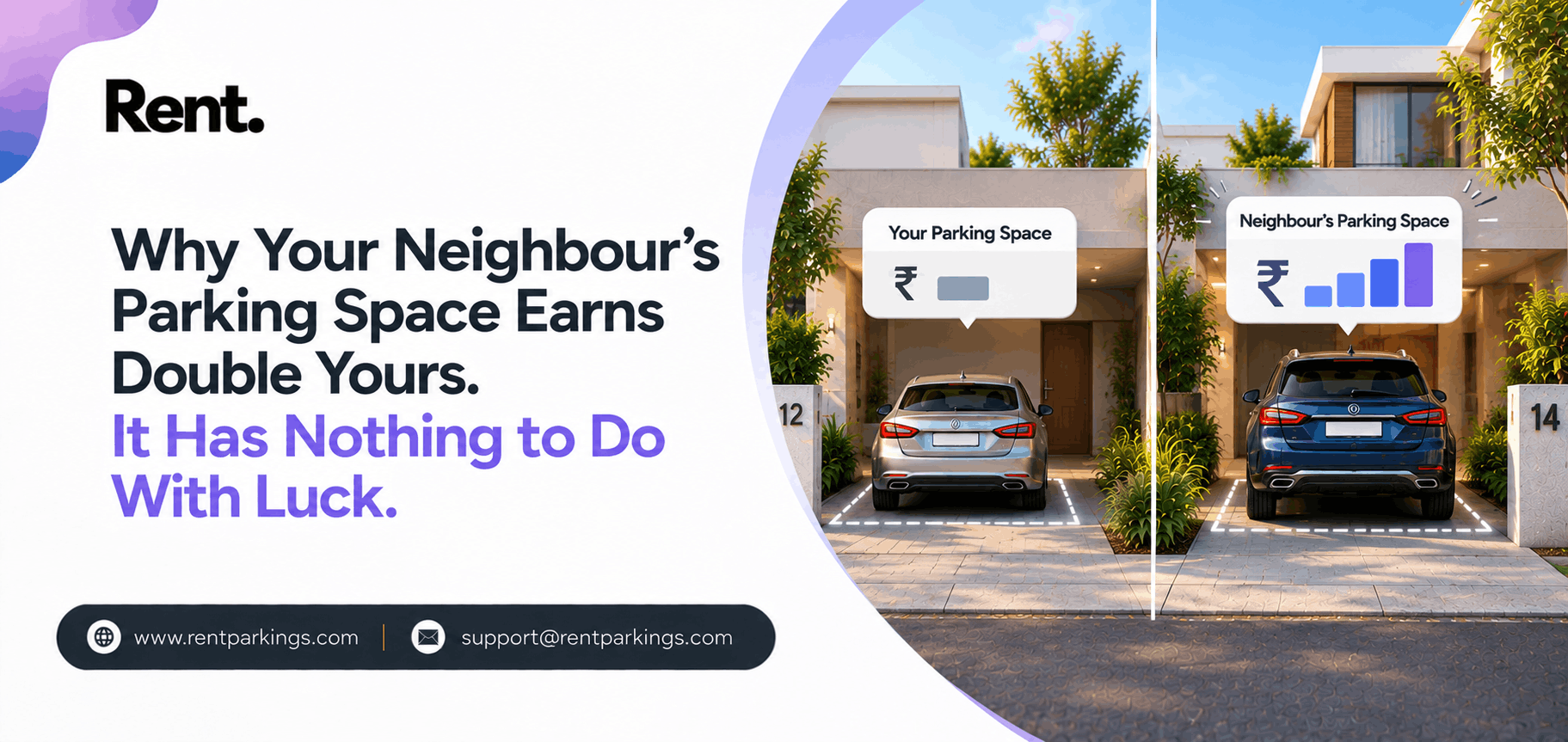
Why Your Neighbour's Parking Space Earns Double Yours. It Has Nothing to Do With Luck.
Two owners in the same Bengaluru layout listed almost identical covered parking spots last year. One now earns close to six thousand rupees a month from it. The other has spent weeks trying to find anyone willing to pay twenty five hundred. The spots sit twenty metres apart, in buildings built the same year, priced within a few hundred rupees of each other at launch.
The gap isn't about who tried harder or who got lucky. It's about what happens to be a five minute walk from each gate, and almost nobody thinks about that before they list.
Most Indian property owners who sit on an unused driveway, garage, stilt slot or vacant corner treat location as a footnote. They post a price close to what a neighbour charges, or what feels "fair," and move on. But a parking space isn't priced like a room or a shop. Its value comes almost entirely from what's within walking or short-drive distance, and that number can swing by three or four times depending on a landmark most owners never bothered to notice on their own street. This piece walks through what actually drives that swing, so you can work out what your own spot is realistically worth before you list it free on RentParkings, India's parking marketplace built for exactly this.
What "Location" Actually Means for a Parking Space
When people talk about a good location for renting out a car, they usually mean a metro-connected suburb or a posh neighbourhood. For parking, the definition is narrower and far more specific. It's about what's generating a daily, weekly or seasonal crunch for four-wheeler space within a short radius of your gate.
A handful of landmark types tend to do the heavy lifting across Indian cities, and most owners have at least one within striking distance without realising it:
- A metro or suburban rail station where commuters currently circle the block looking for a legal spot
- An office cluster, IT park or coworking hub where employee parking runs out well before lunch
- A hospital, diagnostic centre or nursing home where visitors and patients' families need somewhere close and reliable
- A coaching centre, exam hall or college campus with predictable daily or seasonal rushes
- A temple, church, gurdwara or other place of worship with a weekly crunch and sharp seasonal spikes around festivals
- A stadium, convention centre or wedding venue with occasional but intense demand on event days
- A wholesale market, railway station or courthouse where early-morning or all-day parking is chronically short
Owners two streets away from any one of these, and most urban Indian addresses are closer to something on this list than they assume, are sitting on a very different asset than someone in a quiet residential pocket with none of it nearby.
The Real Numbers: What Different Locations Tend to Fetch
Exact pricing varies by city, society rules and what condition the spot is in, so treat the figures below as the kind of range owners on the platform have reported rather than a fixed rate card. What matters more is the pattern: proximity to genuine daily demand roughly doubles or triples what an identical spot earns in a low-demand pocket.
- Quiet residential lane, no landmark nearby: often somewhere around ₹1,500 to ₹2,500 a month for a covered spot, sometimes less for open ground
- Within ten minutes of a metro station or busy office cluster: commonly ₹3,500 to ₹6,000 a month, with hourly and daily bookings adding on top
- Near a hospital or diagnostic centre: a mix of monthly regulars (staff, long-term patient families) and paid hourly visitors, often ₹4,000 to ₹7,000 combined
- Beside a coaching hub or exam centre: heavily seasonal, with single-day rates spiking during exam windows even when the rest of the month is average
- Close to a temple, church or gurdwara with a big festival calendar: modest most weeks, then a real spike around Navratri, Diwali, weekly congregation days or other peak dates
- Near a stadium, wedding venue or convention centre: low or no income on ordinary days, but a single match day or wedding season weekend can sometimes bring in what a quiet spot earns in a month
Nothing about these ranges is fixed by RentParkings. You decide what to charge, whether you want to rent it out by the hour, by the day or as a straight monthly booking, and you can change that pricing whenever you like. The platform simply gives your listing visibility to people already searching nearby.
How Each Kind of Nearby Landmark Actually Changes the Math
Metro and Transit Corridors
Commuters near a metro or suburban rail line have a very specific, very repetitive problem: they need somewhere to leave a car every single working day, ideally within a five to ten minute walk. That repetition is what makes this category so dependable. Owners living close to a station have written before about how a spot that once sat empty for years turned into the single most requested listing on their street, a pattern we broke down in a piece on what a transit-adjacent parking spot is actually worth. If your building sits within that radius, you're not competing with much.
Religious Sites and Festival Windows
This one gets underestimated constantly. A plot near a temple might look unremarkable for forty nine weeks of the year and then turn into the busiest square metre on the block during a nine-day festival window. The seasonal math around this, including how much a single festival stretch can be worth compared to the rest of the year, was covered in an earlier look at income near religious sites during Navratri. Owners who dismiss this as "only a few days a year" tend to be the ones leaving the most money on the table, because those few days often outearn a full ordinary month.
Tourist and Weekend-Destination Towns
If your property sits in or near a hill station, beach town or weekend getaway, the pattern flips again: demand isn't daily, it's weekend and holiday-driven, and it's often severe. Places like Lonavala, Manali and Ooty regularly run out of legal parking within an hour of Saturday morning, a squeeze we've examined in more detail in our coverage of the weekend parking crunch in India's hill towns. Owners in these towns who list a spare plot or driveway aren't competing against dozens of alternatives, because there usually aren't dozens of alternatives.
Stadiums and Event Venues
Event-day parking is the most extreme version of location-driven pricing. A spot near a stadium can sit unused for weeks and then earn several days' worth of ordinary rental in a single afternoon when a match or concert is on. Our guide to what match-day demand looks like around Indian stadiums, the stadium and match-day parking overview for 2026, digs into how sharply that spike moves. It's not a business model on its own, but for owners who already have the spot, it's meaningful upside stacked on top of regular bookings.
EV Charging Infrastructure
This is a newer factor and one that's quietly changing what a spot is worth. If there's a charging point in or near your building, or you'd be willing to add one, that space stops being generic parking and becomes something closer to specialised real estate for the growing number of Indian EV owners hunting for reliable charging access. We wrote about how that shift is playing out for owners in a look at parking spots doubling as charging real estate. Even without a charger installed, being near one raises the profile of the surrounding area.
Why Owners Keep Underselling Their Own Location
The most common reason a good spot sits empty or underpriced isn't a bad location. It's an owner assuming their street has nothing special nearby, without ever actually checking. Most people size up their own neighbourhood from habit rather than from a fresh look at what's genuinely within reach.
A five minute exercise usually changes the picture. Open a map, drop a pin on your gate, and look at what falls inside a fifteen minute walk and a ten minute drive. An owner who assumed they were "just another residential lane" sometimes finds a diagnostic lab, a coaching centre and a mid-sized office building all sitting quietly within that radius, none of which they'd ever connected to their own driveway.
The other reason owners hesitate has nothing to do with location at all. It's the effort question: does listing a parking space mean dealing with strangers, paperwork, and constant back and forth? In practice, it's closer to the opposite. Listing on RentParkings costs nothing, there's no fee to publish your space, and once it's up, the work is mostly answering a booking request and collecting a payment through UPI or net banking. For a lot of owners, this turns into the closest thing to true passive income available from an asset that was doing absolutely nothing before.
How to Work Out What Your Own Spot Could Be Worth
You don't need a professional valuation to get a realistic starting number. A short, honest walk-through usually gets you close enough to list with confidence.
- Map everything within a fifteen minute walk and a ten minute drive: stations, offices, hospitals, coaching centres, religious sites, event venues
- Check how full the streets around those landmarks get during their busy hours, and note whether people are already circling for a spot
- Look at what similar spots nearby are charging, but treat that as a starting point rather than a ceiling, especially if your location genuinely has an edge
- Decide whether hourly, daily or monthly bookings suit your spot best. A spot near an office suits monthly regulars; one near a stadium or temple suits short, high-value bookings
- List at a reasonable opening price, watch how quickly it gets booked, and adjust up or down after the first few weeks based on actual demand
This is the part owners tend to skip, and it's also the part that determines whether a listing earns fifteen hundred rupees a month or five times that. You're always the one setting the number, on your terms, and you can revise it any time your circumstances or the neighbourhood's demand changes.
Frequently Asked Questions
1. Does listing my parking space on RentParkings cost anything?
No. Listing is completely free, with no fee to publish, no commission taken to keep your space visible, and no hidden charge for creating or editing your listing at any point.
2. How do I know what my specific spot is worth without guessing?
Start with what's within a fifteen minute walk of your gate: stations, offices, hospitals, coaching centres, temples or event venues. Compare a few similar nearby listings for a rough starting price, then adjust based on how quickly bookings come in during your first few weeks.
3. My area doesn't have a metro station or big office nearby. Is it still worth listing?
Often, yes. Hospitals, coaching centres, wholesale markets, religious sites and even a nearby residential society with a visitor parking shortage can all generate steady demand, even in areas that don't look obviously "prime" at first glance.
4. Can I set my own price, or does RentParkings decide the rate?
You set your own price and terms. RentParkings doesn't fix your rate; it connects your listing with people searching nearby, and you decide the hourly, daily or monthly figure that works for you.
5. What if demand near me is mostly seasonal, like near a temple or exam centre?
That's fine. You can price and structure the listing around your specific pattern, charging more during festival weeks or exam season and keeping a lower baseline rate the rest of the time.
6. How much ongoing effort does managing a listing actually take?
Very little for most owners. Once your listing is live, it mainly involves reviewing booking requests, confirming availability, and receiving payment through UPI or net banking. Many owners describe it as close to passive income once the first few bookings settle into a rhythm.
7. Will renting out my parking space cause problems with my housing society?
It depends on your society's specific bylaws, so it's worth a quick check with your managing committee before you commit to anything long-term. Many societies have no issue with an owner renting out their own allotted spot, particularly for short-term or occasional use.
8. Is my spot too far from anything to be worth listing?
Even locations without an obvious landmark can attract steady interest, especially in dense residential pockets where visitor and second-car parking is genuinely scarce. Listing costs nothing, so there's little downside to testing demand in your specific area.
9. Can I pause or remove my listing if I need the space back?
Yes. You stay in control of your listing throughout, and you can pause, edit or take it down whenever you need the space for yourself, a guest or a family member.
10. How do payments actually reach me as the owner?
Payments are collected digitally through standard methods like UPI and net banking, so you're not handling cash or chasing renters for payment after the fact.
Your Street Is Worth More Than You've Assumed
Most owners never run the fifteen minute exercise above. They glance at their street, decide nothing special is nearby, and either skip listing altogether or price far below what the location can actually support. Given that listing costs nothing and you control the price, the terms and how long the spot stays available, there's very little reason to leave that assessment unmade.
The spot outside your gate has been sitting there this whole time, doing nothing for anyone. Publish your parking space for free on RentParkings and find out what it's actually worth to the people already searching near you.
Share This post
Search
Recent Post
Parking Space vs. Renting Out a Room to...
05 Oct, 2026
Think Parking Rental Only Pays in Mumbai...
02 Oct, 2026
Your Mumbai Parking Space Is Worth More...
01 Oct, 2026
Hyderabad's Real Estate Boom Left One As...
30 Sep, 2026
What Your Parking Space in Chennai Could...
29 Sep, 2026
Your Plans Changed After Listing Your Pa...
28 Sep, 2026
Parking Space vs SIP: Which Idle Asset A...
25 Sep, 2026
What Your Parking Space in Pune Could Ac...
24 Sep, 2026