

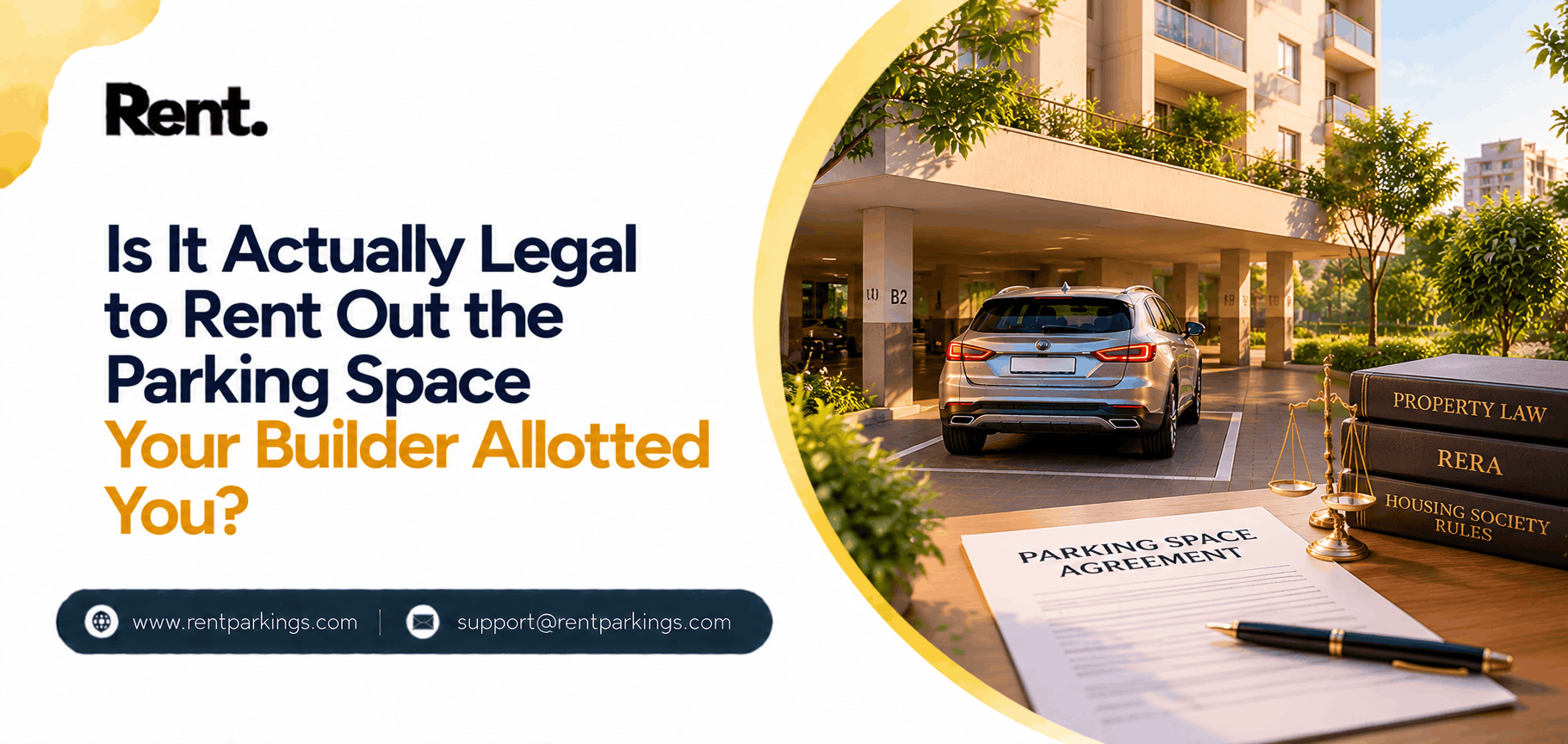
Is It Actually Legal to Rent Out the Parking Space Your Builder Allotted You?
A surprising number of flat owners across Indian cities are convinced that renting out their own parking slot sits somewhere between a legal grey zone and an outright violation. Almost none of them have ever actually checked.
That one unchecked assumption is probably the single biggest reason good parking inventory sits locked up and unused in Indian housing societies right now. Not apathy. Not confusion about pricing. Just a belief that nobody ever tested against the actual paperwork sitting in their own almirah.
Thousands of people have put that fear to the test on RentParkings, India's parking marketplace, and every one of them discovered the same thing: nobody else's permission was ever required. The right was theirs from the start.
Tracing Where the "It's Illegal" Belief Took Root
Nobody wakes up one day and decides parking rental must be against the law. The idea gets picked up somewhere, usually from one of these places.
- A notice pinned to the society board, phrased vaguely enough to sound universal, usually written with commercial vehicles or long-staying paying guests in mind rather than someone renting out their own bay by the hour.
- A builder's brochure or allotment letter that says parking is "for personal use," language buyers took as a hard limit, when the builder was simply describing how the space was being used on the day of sale, not setting a permanent rule.
- A neighbour's second-hand story about someone else's society dispute, retold without the specific clause that actually caused the problem.
- Confusion between a society's power to manage common areas and an owner's right over a space that was individually allotted and paid for.
Every one of those sources is real. None of them actually proves that renting your own allotted parking space is unlawful.
Common Parking vs. Allotted Parking: The Distinction That Decides Everything
Indian apartment law, including the provisions most states have adopted under RERA 2021 and the various state Apartment Ownership Acts, draws a fairly clean line between two kinds of parking.
Common parking belongs to the society as a whole. Nobody owns a specific bay in it, and a resident can't rent out a slot that technically belongs to everyone.
Allotted parking is different. When a buyer pays separately for a stilt, covered, or basement slot, or when the sale deed and allotment letter name a specific space as theirs, that space turns into a right that belongs to the flat on its own, the same way a balcony or a private terrace does. What an owner does with a space they hold an exclusive right to, within reasonable limits, is generally their own call.
This is the distinction that most of the "is this even legal" worry misses entirely. The question isn't whether parking rental is legal in India. It's whether a specific space is common or allotted, and for most flat owners with a documented, named slot, the answer points one way.
What Your Sale Deed and Builder-Buyer Agreement Usually Say
Three documents typically settle the question for any individual owner.
- The sale deed or conveyance deed, which either names a specific parking unit or doesn't.
- The possession-time allotment letter, where a bay number is typically recorded next to the flat it belongs to.
- The builder-buyer agreement, which occasionally adds restrictions, though in most residential projects it's silent on renting rather than actively prohibiting it.
If a space appears in any of these with a specific identifier tied to a flat, that's usually enough to treat it as an exclusive asset rather than shared society property. Reading these three pages once is a five-minute task that settles a worry most owners have carried around for years without checking.
What Your Housing Society Can, and Genuinely Cannot, Stop You From Doing
A Resident Welfare Association can regulate traffic flow, visitor timings, and parking conduct inside the compound. What it generally cannot do is block an owner from exercising a right over a space that is legally and individually allotted to them, the same way it can't stop someone from using their own balcony.
Societies do retain real authority over shared infrastructure, security gates, and common-area access, and that authority deserves respect rather than dismissal. EV chargers made this split visible for a lot of owners recently. An owner wanting one installed at their own allotted bay still has to loop the society in, but only for the wiring load and safety checks that affect the building's shared electrical system, never for permission to use a bay that already belongs to them. Charging Where You Park: An Indian Flat Owner's 2026 Playbook for an EV Charger Past the Society Gate lays out exactly where that boundary sits. The parking right underneath it was never the society's to grant or withhold in the first place.
Three Things Worth Checking Before You List Your Space
None of this is about asking permission. It's about knowing what you actually have, so you list with confidence instead of second-guessing yourself after the fact.
- Confirm the space is named as exclusively yours. Look for a specific bay number or identifier against your flat in the sale deed or allotment letter, not a generic reference to "society parking."
- Check whether it's a separately purchased covered slot or a basic allotted spot. Covered, stilt, and basement bays bought as distinct units tend to have the clearest documentation.
- Skim your society's parking bye-law once. Not to seek approval, but to understand what rules exist around visitor access, timing, or gate passes, since a renter arriving in an auto-rickshaw at midnight is a different operational question than a legal one. If you want the fuller picture on which bay type carries which ownership claim before you list, Who Actually Owns the Parking in Your Apartment? Stilt, Covered & Open Parking Rights in India (2026) is worth the extra five minutes.
The Tax Paperwork Owners Tend to Forget About
Being legally allowed to rent out a parking space doesn't mean the income is invisible to the taxman. Rental earnings from parking, like any other rental income, are expected to be declared, and the compliance side of this is simpler than most owners assume once they see it laid out. Tax on Parking Rental Income in India: The 2026 Owner's Compliance Guide walks through exactly what that looks like, and it's worth bookmarking before your first payout lands.
Listing Costs You Nothing
Here's the part that tends to get buried under all the legal questions: putting your space up on RentParkings doesn't cost you a single rupee, at any point.
There's no listing fee, no subscription, and no commission deducted before the money reaches you. You decide the price, whether that's an hourly rate for a spot near a metro station or a flat monthly figure for a long-term renter, and you decide the terms, including who you're comfortable renting to and for how long.
For a space that was already sitting empty for most of the day, that adds up to realistic, low-effort income from an asset you already own and were never using to its full potential anyway.
What Listing Actually Looks Like Once You Decide To Do It
The process itself is short enough to finish during a tea break. You list the space with a few photos and basic details, set your own hourly, daily, or monthly rate, and RentParkings handles renter verification so you're not handing your bay to a stranger with zero information attached. Payments move through UPI or net banking, so there's no cash changing hands and no awkward follow-up calls chasing payment. How to List Your Empty Parking Space for Rent: A First-Timer Walkthrough walks through the entire sequence, from first listing to first payout.
You can pause or edit the listing whenever your own plans change, which matters if you're buying a second car soon or expecting a guest with their own vehicle for a few weeks.
A Quick, Realistic Example
Picture a flat owner in a mid-sized apartment block in a city like Pune or Coimbatore, sitting on a covered stilt bay that's been empty since their second car was sold off two years ago. For most of that time, the "is this legal" question alone kept the space idle.
Once they actually pulled out the allotment letter, the bay number was right there against their flat number in black and white. No ambiguity, no society clause blocking it, just a space they'd been sitting on without realising it was fully theirs to rent. Owners in comparable spots have reported earning anywhere from a modest side amount to a meaningful dent in their monthly EMI, depending on location and demand, simply by listing what was already theirs.
Numbers obviously vary by city and bay type, so guessing isn't the move. How Much Can You Earn Renting Out a Parking Space in India? (2026 City-Wise ₹ Guide) gives a far more useful starting benchmark.
Frequently Asked Questions
1. Is it legal to rent out my parking space in India?
In most cases, yes, provided the space is individually allotted to your flat rather than classified as shared common parking. The sale deed or allotment letter naming a specific bay number against your flat is usually the deciding factor.
2. How do I find out if my parking space is "allotted" or "common"?
Check your sale deed, allotment letter, and builder-buyer agreement for a specific bay number tied to your flat. If none of these documents name a specific space, it's likely treated as common parking shared across the society.
3. Can my RWA legally stop me from renting out my allotted parking space?
Generally, an RWA can regulate conduct, timing, and access within the society, but it cannot block an owner from exercising a legitimate right over a space that is individually and legally allotted to them.
4. Does listing my parking space on RentParkings cost anything?
No. Listing is completely free, with no sign-up fee, no subscription, and no charge deducted from your earnings before they reach you.
5. Who decides the rental price for my parking space?
You do, entirely. RentParkings doesn't set rates on your behalf. You choose an hourly, daily, or monthly price based on your location and comfort level, and you can adjust it whenever you like.
6. Will I have to deal with strangers showing up with no background check?
No. Renters go through a verification step on the platform before a booking is confirmed, so you're not handing your space over to someone with zero traceable information.
7. Do I need to pay tax on parking rental income?
Yes, parking rental income is treated like other rental income and should be declared. The amounts involved for a single parking space are usually modest, and the compliance process is simpler than owners expect once they've gone through it once.
8. What if I need the space back for my own car later?
You stay in control of your own listing. You can pause, edit, or end it whenever your circumstances change, whether that's buying a second vehicle or hosting a relative with their own car for a while.
9. Is a covered or stilt parking space treated differently from an open one, legally?
Both can be rented out if they're individually allotted to your flat, though covered and stilt bays purchased as separate units tend to have clearer documentation, which makes the ownership question even easier to settle.
10. How do I actually get paid once someone books my space?
Payments move through UPI or net banking directly, with no cash handling and no chasing anyone down for a transfer. You set the terms, the renter pays through the platform, and the money reaches your account.
Conclusion
The legal question that's kept so many Indian parking spaces sitting empty usually resolves itself the moment someone actually reads their own allotment letter. For the vast majority of owners with a specifically named bay, the answer was never a maybe. It was a yes that nobody had bothered to confirm.
If that describes a space you own, the next step isn't a legal consultation. It's five minutes with a document you already have, followed by a free listing that starts earning on your own terms. Start Earning from Your Parking Space on RentParkings and let a slot that's been sitting idle finally pay for itself.
Share This post
Search
Recent Post
Rent Out Parking Without Tech Skills: An...
16 Oct, 2026

Jaipur's Wedding Season Isn't Just Pink...
14 Oct, 2026
Ahmedabad Has Two Very Different Parking...
12 Oct, 2026

Nobody Talks About Kolkata's Parking Mar...
09 Oct, 2026

Nobody Talks About Kolkata's Parking Mar...
08 Oct, 2026

For Three Months a Year, an Empty Drivew...
07 Oct, 2026
Delhi, Noida or Gurugram: Which NCR Park...
06 Oct, 2026
Parking Space vs. Renting Out a Room to...
05 Oct, 2026