

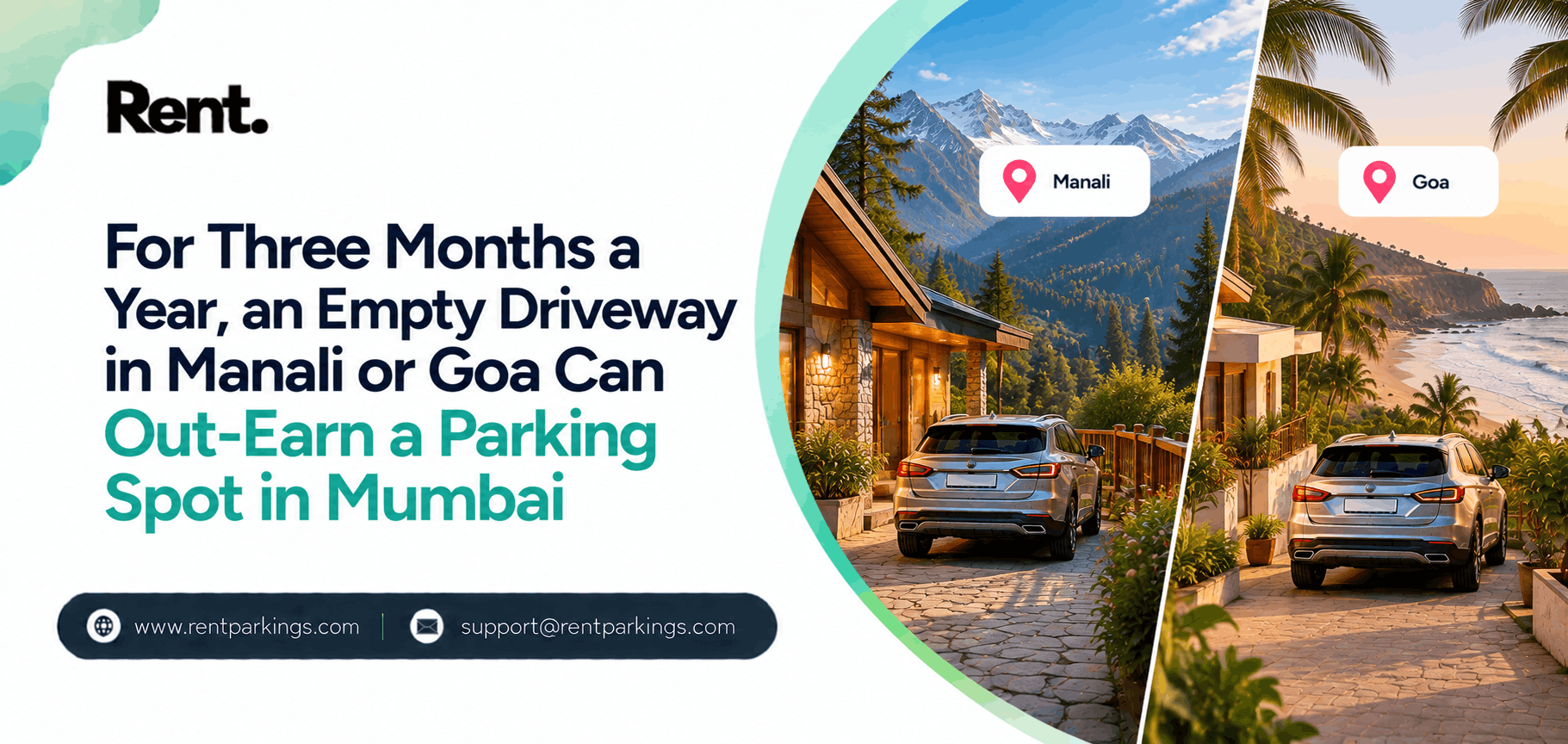
For Three Months a Year, an Empty Driveway in Manali or Goa Can Out-Earn a Parking Spot in Mumbai
For about three months every year, an ordinary driveway in a hill town like Manali can pull in more per hour than a reserved spot outside a Mumbai office tower. Nobody advertises this fact. Most owners in these towns have simply never been asked whether they'd try.
Once you look at why, the pattern is easy to follow. A hill station or a beach town only has so many streets to begin with, and winter pushes far more traffic through them than any of these towns were laid out to handle. Each of those vehicles has to park somewhere, and plenty just keep looping the block until a spot opens up.
That mismatch between demand and space, repeating every winter without fail, is the gap RentParkings exists to close, and putting a space on the platform has never cost an owner a single rupee.
Which Towns This Actually Applies To
This isn't limited to one or two famous names. Shimla, Mussoorie, Darjeeling, Munnar and Coorg all follow the same pattern between October and March: visitor numbers climb, and parking turns into the one thing the town genuinely runs short of.
The coast tells much the same story for a different reason. Goa, Pondicherry, Alibaug and Gokarna fill up with weekenders chasing cooler evenings, and the crowd keeps growing every year while the roads stay exactly as narrow as they were a decade ago.
Wedding bookings stack up through most of this same window, and so does the run of holidays sitting between Diwali and Republic Day. None of these towns widened a single road to match any of it, and none are likely to anytime soon.
Why the Roads Can't Absorb It
Walk through the older part of any hill station and you'll notice the roads are narrow by design, not by neglect. They were laid out for bullock carts and the occasional jeep, not for forty tourist vehicles arriving on a single Saturday.
Municipal lots, on the rare occasion a town even has one, fill up by late morning. What's left is a predictable scene: visitors looping the same three or four streets, shopkeepers irritated by cars blocking their own frontage, and a row of homeowners who have no idea their empty gate is the answer everyone nearby is quietly searching for.
What the Earnings Actually Look Like
Numbers vary a fair bit by exact location, but owners in comparable tourist towns describe a rough pattern worth knowing before you set a price. A driveway close to a market or a well-known viewpoint can bring in somewhere between ₹120 and ₹350 for an hour on a busy weekend, dropping to a flat daily rate closer to ₹150 to ₹300 once the crowds thin out midweek.
A bigger plot near a trekking trailhead or a temple road often works better as a flat monthly rate for the whole season rather than charging by the hour. Either way, that number is entirely the owner's call. RentParkings never sets a price and never takes a cut off whatever rate gets chosen.
A near-identical pattern shows up with weekend homes that stay shut all week and only come alive on Saturdays, something walked through in full detail over at Your Weekend Home's Parking Space Sits Empty Five Days a Week. Here's What Changes When You List It.
Property Types Worth Listing During the Season
The calendar turning to tourist season doesn't automatically make every property useful for parking. A handful of types tend to perform best, and it's worth knowing which category yours falls into before you price it.
- Open land along the main road leading into town, where every car heading in has to pass regardless of where it's eventually parked.
- A driveway or forecourt within a few minutes' walk of a market, a temple, or a well-known viewpoint.
- A covered spot at a weekend home or farmhouse that stands locked up for most of the working week.
Land works a little differently, and it's worth knowing why before you price it. A vacant plot keeps racking up small ongoing costs, fencing, basic upkeep, property tax, whether it earns a rupee or not, and those costs stop feeling like dead weight the moment the land starts paying some of itself back, an idea explored further in Your Vacant Plot Is Not Free to Own: How Idle Land in India Quietly Pays for Itself as Parking.
Getting Listed Doesn't Take a Renovation
Putting a space up on RentParkings doesn't cost anything, not this season and not any season after it. There's no signup charge, no cut taken from each booking, and no catch hiding in the fine print. It stays free to list for as long as you choose to keep it up.
Setting one up means a handful of photos, a short description, and a price of your choosing, charged by the hour, the day, or the month. Every renter goes through a verification step before a booking is confirmed, and payments settle through UPI or net banking directly into the owner's account.
Getting a listing live is a smaller task than it sounds. Most owners finish the whole process, photos, description, price, in under fifteen minutes, a walkthrough of exactly what that looks like is in How Listing Your Parking Space in India Actually Works: A 2026 Owner's Walkthrough.
Why Pricing by Season Beats a Fixed Monthly Rate
A commuter parking a car in a city pays roughly the same amount, month after month, whether it's raining or not. Tourist parking in a hill town or beach village behaves nothing like that. It's quiet for stretches, then suddenly packed for a long weekend, a wedding crowd, or a holiday rush, then quiet again.
That unevenness is exactly why it helps to control your own rate rather than lock into one number for the whole year. A spot that earns ₹150 a day during a slow February week could reasonably triple or quadruple that during the last week of December, and nobody needs to approve the change except the owner.
Winter isn't even the only stretch of the calendar where this happens. Diwali and Navratri travel push a similar short-lived spike through cities all across India, something explored further in Festive Season Is Coming: Why Now Is the Best Time to List Your Empty Parking Space in India.
What Happens Once the Season Passes
Winter eventually ends, and that's usually the second question an owner asks, right after "how much." The listing doesn't have to run all year if you'd rather it didn't. It can be paused for the off-season, edited, or kept open at a reduced rate for the occasional traveller who still passes through.
Two gates a few doors apart can earn very different amounts, and the reason usually has little to do with luck. Visibility from the main road, distance from whatever draws people to the area, and plain footfall all matter more than most owners assume, a difference broken down in Why Your Neighbour's Parking Space Earns Double Yours. It Has Nothing to Do With Luck.
What's Actually Holding Owners Back
Ask around in any of these towns and a pattern emerges fast. Owners aren't against the idea of earning from unused space. They just never heard it was an option, or pictured a mess of forms, some hidden charge, and a complete stranger they'd have no real way to check up on before handing over a gate key.
None of that survives a closer look. There's nothing to pay, identity checks happen before anyone books, and a standalone hill home or beach property usually has no housing society committee to answer to the way a flat inside an apartment block would. The space has been doing nothing for most of a year already. Trying it costs a handful of minutes and not much else.
Frequently Asked Questions
1. Is there any cost at all to listing my space on RentParkings?
None. There's no signup fee, no monthly charge, and no cut taken out of what you earn. Whatever you charge a renter is what lands in your account.
2. Can I really set my own hourly or daily rate, or does RentParkings decide that?
You set it, fully. RentParkings doesn't impose a rate card or a cap, so a price that makes sense during a quiet week and a price that makes sense over New Year's can be two completely different numbers.
3. What if I only want to list during the tourist months and nothing else?
That's a normal way to use the platform. You can list for a defined stretch, pause once the season winds down, and bring the same listing back the following year.
4. How do I know who's actually showing up to park?
Renters complete an identity verification step before a booking can be confirmed, which gives you a basic check on who's arriving before they ever reach your gate.
5. My property is fairly remote. Will booking and payment even work there?
Both are designed to run on an ordinary mobile connection, and most owners manage the whole listing from their phone without needing anything faster than that.
6. How does the money actually reach me?
Payments go through UPI or net banking straight to your account, so there's no cash changing hands and nothing to wait on at a bank counter.
7. Does listing a vacant plot work differently from listing a driveway?
The steps don't change based on what the space is. You add photos, write a short description, and pick a price, no matter if you're listing a concrete driveway, raw unfenced ground, or a sheltered bay at a holiday house.
8. What if a renter doesn't leave when their booking time is up?
You get a notification as a booking nears its end, and the decision on how to handle an overstay, extend it or flag it, sits with you.
9. Will I need any permission from the local municipality before I list?
For a privately owned driveway, plot, or home, there's usually no separate municipal sign-off required to rent out space you already own, though checking your specific town's local rules is always a sensible precaution.
10. Does this only make sense in big-name tourist spots?
Not really. Smaller towns sitting along the route to a bigger destination, or a village near a popular trailhead, often see nearly as much overflow traffic, sometimes with even fewer places nearby for that traffic to park.
Conclusion
Hotels block out their rooms for this rush months ahead of time. Homestays raise their rates and still sell out. Taxi stands bring in extra drivers for the season. The one business that hasn't shown up to the party yet is the ordinary property owner sitting on a gate that's been doing nothing for most of the year.
Trying costs nothing and commits you to nothing beyond the season you choose. Join RentParkings Today and see what your own gate has been worth all along.
Share This post
Search
Recent Post
Delhi, Noida or Gurugram: Which NCR Park...
06 Oct, 2026
Parking Space vs. Renting Out a Room to...
05 Oct, 2026
Think Parking Rental Only Pays in Mumbai...
02 Oct, 2026
Your Mumbai Parking Space Is Worth More...
01 Oct, 2026

Hyderabad's Real Estate Boom Left One As...
30 Sep, 2026
What Your Parking Space in Chennai Could...
29 Sep, 2026
Your Plans Changed After Listing Your Pa...
28 Sep, 2026
Parking Space vs SIP: Which Idle Asset A...
25 Sep, 2026